Sub plan 2
Presentation
•
Science
•
8th Grade
•
Hard
+25
Standards-aligned
Beryl Lopez
Used 4+ times
FREE Resource
34 Slides • 88 Questions
1

Atomic Theory
Timeline of scientists and their findings

2
Multiple Choice
Electrons orbit a certain distance from the nucleus. Either radiate or absorb energy when jumping orbitals.
Dalton
Thomson
Rutherford
Bohr
3
Multiple Choice
The atom is mostly large empty space with a small, dense nucleus at the center
Dalton
Thomson
Rutherford
Bohr
4
Multiple Choice
Atom is a positively charged cloud with embedded negative electrons
Dalton
Thomson
Rutherford
Bohr
5
Multiple Choice
Atoms are indivisible (cannot be broken down)
Dalton
Thomson
Rutherford
Bohr
6
Multiple Choice
What scientist proposed this atomic model?
Dalton
Thomson
Rutherford
Bohr
7
Multiple Choice
What scientist proposed this atomic model?
Dalton
Thomson
Rutherford
Bohr
8
Multiple Choice
What scientist proposed this atomic model?
Dalton
Thomson
Rutherford
Bohr
9
Multiple Choice
What scientist proposed this atomic model?
Dalton
Thomson
Rutherford
Bohr
10
Multiple Choice
In a famous experiment conducted by Ernest Rutherford, positively charged alpha particles were scattered by a thin gold foil. Which of the following is a conclusion that resulted from this experiment?
The nucleus is negatively charged
The atom is a dense solid and is indivisible
The mass is conserved when atoms react chemically
The nucleus is very small and the atom is mostly empty space
11
Multiple Choice
In a famous experiment conducted by Ernest Rutherford, positively charged alpha particles were scattered by a thin gold foil. Which of the following is a conclusion that resulted from this experiment?
The nucleus is negatively charged
The atom is a dense solid and is indivisible
The mass is conserved when atoms react chemically
The nucleus is very small and the atom is mostly empty space
12
Multiple Choice
What subatomic particle was discovered in the cathode ray tube experiment?
Proton
Neutron
Electron
Nucleus
13
Multiple Choice
What subatomic particle was discovered in the cathode ray tube experiment?
Proton
Neutron
Electron
Nucleus
14
Multiple Choice
What evidence led Niels Bohr to believe that electrons occupy specific energy levels in atoms?
Excited electrons emit colored light at every possible wavelength.
Excited electrons emit colored light at only certain wavelengths.
Electrons emit colored light only when in an excited state.
Electrons emit colored light only when in ground state.
15
Multiple Choice
16
Multiple Choice
17
18
19
20
21
Multiple Choice
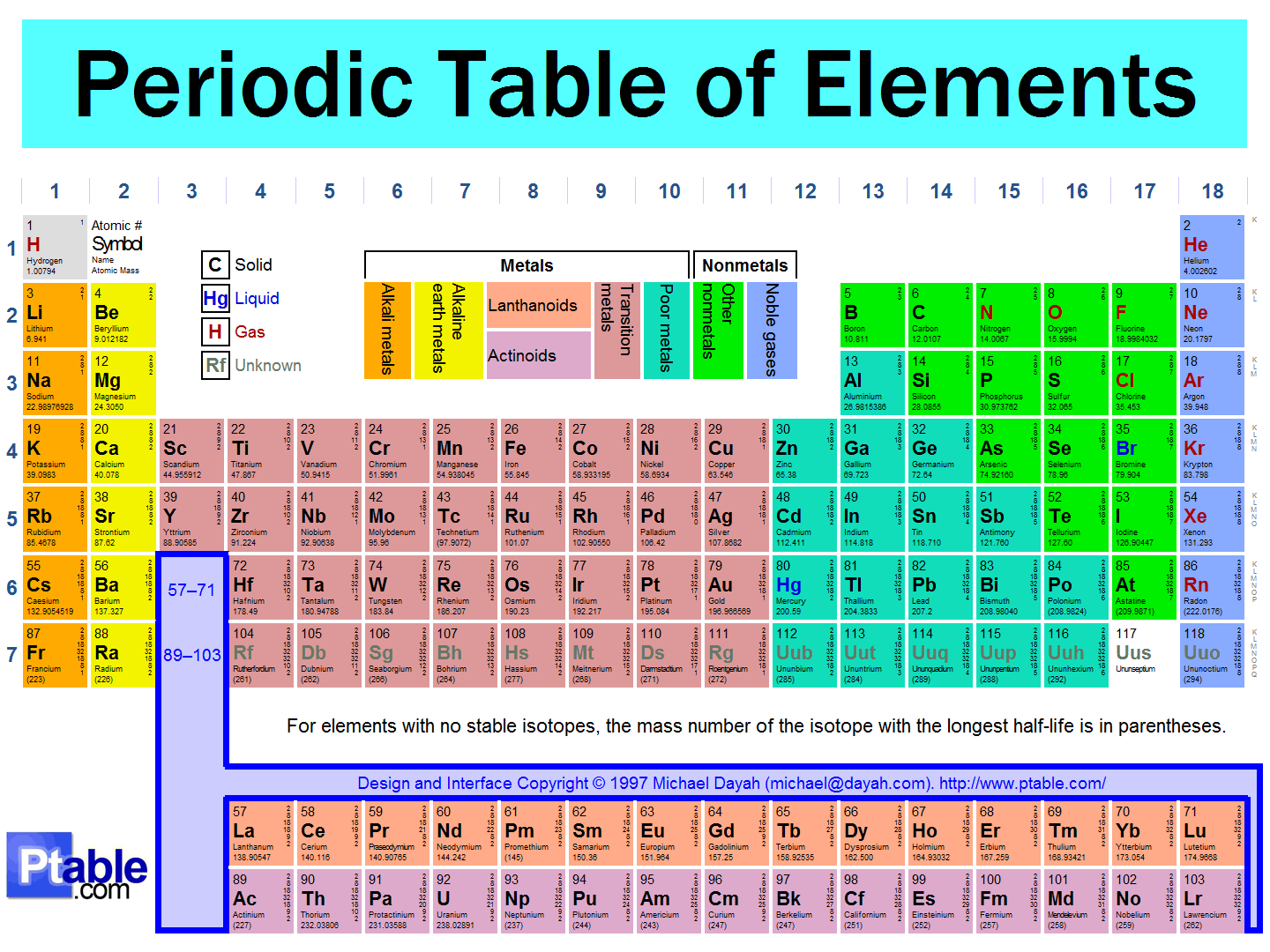
The vertical (up and down) columns in the Periodic Table are called
groups
towers
periods
atomic numbers
22
Multiple Choice
Elements in a .................. have similar chemical properties.
period
group
row
23
24
25
Multiple Choice
Which group of the periodic table is composed of inert (not reactive) gases?
answer choices
alkali metals
alkaline earth metals
halogens
noble gases
26
27
28
29
Multiple Choice
30
Multiple Choice
31
Multiple Choice
Which group of elements are the most reactive nonmetals?
Group 2
Group 1
Group 18
Group 17
32
Multiple Choice
What are the vertical columns on the periodic table called?
Groups
Periods
Elements
Valence electrons
33
Multiple Choice
Which group of elements have one valence electron(s)?
Group 13
Group 2
Group 18
Group 1
34
Multiple Choice
Which group of elements are nonreactive due to already being chemically stable?
Group 17
Group 1
Group 2
Group 18
35
Multiple Choice
Which classification of elements are shiny, silvery solids and good conductors of heat and electricity?
Transition metals
Metalloids
Nonmetals
Metals
36
Multiple Choice
Which classification of elements are gases or dull brittle solids and poor conductors?
Transition metals
Metals
Nonmetals
Metalloids
37
Multiple Choice
Which classification of elements are solids, semi-conductors, and have physical properties like metals and chemical properties like nonmetals?
Transition metals
Metalloids
Nonmetals
Metals
38
Categorize
shiny, silvery solids
good conductors of heat and electricity
malleable and ductile
located ot the left of the metalloids
gases, or dull brittle solids
poor conductors
right of the metalloids
solids
semi-conductors
physcial properties like metals
chemical properties like nonmetals
39
Multiple Choice
What is a Bohr Model
diagrams for funsies
simple diagrams that show the atomic structure of an atom
diagrams that show where it is at on the periodic table
not the answer
40
Multiple Choice
Who discovered the electrons?
Rutherford
Bohr
Thomson
Dalton
41
Pure Substances & Mixtures
Some text here about the topic of discussion
42
Multiple Choice
Both elements and compounds are pure substances.
AGREE
DISAGREE
43
Multiple Choice
Which of these is a compound?
Aluminium (Al)
Carbon Dioxide (CO2)
Nitrogen (N)
Sand
44
Multiple Select
Identify which images are PURE SUBSTANCES! (Check all that apply) : )
45
Homogeneous Mixture is uniform and evenly mixed!
46
Heterogeneous Mixture is NOT uniform and NOT evenly mixed!
47
Multiple Choice
Elements and Subatomic Particles
Protons and Electrons
Atoms and Compounds
Homogenous and Heterogeneous
48
Multiple Choice
In which mixture can you not see all of the parts?
homogeneous
heterogeneous
49
Multiple Choice
In which mixture can you see all of the parts?
homogeneous
heterogeneous
50
51
Drag and Drop
52
Multiple Choice
A solute is usually a ....
Solid
Liquid
Gas
53
Multiple Choice
Water is the universal ____.
solute
solvent
solution
54
Multiple Choice
What is another name for a homogeneous mixture?
Solute
Solution
Heterogeneous mixture
Solvent
55
Multiple Choice
The substance that is doing the dissolving in a solution is called the ---
solute
solvent
concentrated part
diluted part
56
Multiple Choice
If Mohammed dissolves 25g of sugar into 200mL of water that has a mass of 200g, what is the mass of the new solution?
225 g
425 g
175 g
between 200 g and 225 g
57
Multiple Select
Stefanie wants to dissolve a sugar cube into water. Which of the following will speed up the dissolving rate of the sugar cube? (Choose all that are correct!)
Using warm water instead of cold water
Add more than 1 cube at a time
Crushing the cube into small pieces
Adding the cubes to the cup and then pouring on the water
Stirring the water after adding the cubes
58
Multiple Choice
At 60 degrees Celsius, how much NaNO3 can be dissolved in 100g of water?
120 g
105 g
140 g
90 g
59
Multiple Choice
According to the graph, which substance is not much affected in solubility as the temperature rises?
NaNO3
KNO3
NaCl
Na2SO3
60
Multiple Choice
Adam makes coffee by mixing coffee and sugar into hot water. The coffee and sugar have dissolved completely. What type of mixture did Adam make?
Colloid
suspension
solution
compound
61
Multiple Choice
Which of the following groups are ALL mixtures?
soil, water, blood, salt
soil, blood, air, salt water
Oxygen, water, air, salt
salt water, coffee, oxygen, sugar
62
Multiple Choice
Milk is an example of which type of mixture?
solution
suspension
colloid
compound
63
Multiple Select
Which of the following are true statements about the picture? (Choose all that are correct!)
A is the most concentrated
G is the most diluted
C is more diluted than E
D is more diluted than E and more concentrated than C
B is more diluted than A and more concentrated than C
64
Multiple Choice
In the glass of salt water shown, what is the solute in the solution?
water
salt
salt water
this does not have a solute because it is not a solution
65
Multiple Select
Which of the following are homogeneous mixtures? (Choose all that are correct!)
cereal with milk
chocolate chip icecream
salt water
pizza
Soda
66
Multiple Choice
Which picture represents a compound?
A
B
C
67
Multiple Choice
Which of the pictures represents a mixture?
A
B
C
68
Multiple Choice
A substance made of two or more PHYSICALLY combined substances is--
an element
a mixture
a salt
a compound
69
Multiple Choice
A substance made of only 1 type of atom is called --
an element
a salt
a compound
a mixture
70
Multiple Choice
Name the separation technique shown in the diagram.
evaporation
distillation
filtration
71
Multiple Choice
72
Multiple Choice
73
Multiple Choice
74
Multiple Choice
What mixture could you use this tool to best separate that mixture?
Sugar and Salt
Sand and rocks
Apples and grapes
75
Multiple Choice
76
Multiple Choice
If I have a mixture of wooden blocks and metal blocks. What is a fast way to separate them?
relative density (put them in water)
filter
sieve
77
78
Multiple Choice
How do we know a chemical reaction has taken place?
Substances change in appearance
Substances change in size
Substances change in states, like from a liquid into a solid.
New substances are formed
79
80
Multiple Choice
Which of the following is a reactant in the following equation?
O2 + C6H12O6 > CO2 + H2O
CO2
H2O
O2
81
Multiple Choice
Which of the following is a product in the following equation?
O2 + C6H12O6 > CO2 + H2O
CO2
C6H12O6
O2
82
83
84
85
86
Multiple Choice
Lighting a match is an example of
an endothermic reaction
an endergonic reaction
both an endothermic and an endergonic reaction
both an exothermic and an exergonic reaction
87
88
Multiple Choice
In the following equation, which is the catalyst?
H2O2 + Catalase > H2O + O2 + Catalase
H2O2
H2O
O2
Catalase
89
90
91
92
93
94
Multiple Choice
In which of the following has a chemical reaction taken place?
An apple turning brown
Milk developing a sour taste
Smoke being released as a candle burns
All of the previous
95
96
Multiple Choice
Which of the following is an example of a CHEMICAL change?
Shattering a window with a baseball
Ripping paper into 1,000,000,000 tiny pieces
Rusting an iron bar on a humid day
Melting a block of copper metal
97
Multiple Choice
Which of the following is an example of a PHYSICAL change?
Neutralizing vinegar with baking soda
Breaking your iPad with a rock due to school stress
Creating a precipitate by mixing Lead Nitrate and Sodium Iodide
Burning popcorn in the microwave
98
Multiple Choice
What are the products of ALL combustion reactions?
Carbon Dioxide and Water
Smoke and Ash
Fire and Carbon Dioxide
Water and Ash
99
Multiple Choice
What does the symbol (aq) stand for?
Aquatic
Aqueous
Aqua
Aquarium
100
Multiple Choice
Which law states that Matter cannot be created or destroyed?
Law of Conservation of Matter
Law of Gravity
Law of Equivalent Exchange
Law of Matter ad Infinitum
101
Multiple Choice
When a chemical reaction takes in more energy than it gives off it becomes _______________.
colder
hotter
bigger
smaller
102
103
104
Multiple Choice
What does 'atomos' mean?
not to be cut
not to be broken
not very big
not to be seen
105
Open Ended
What did his model of the atom look like?
106
107
Multiple Choice
What is Dalton best known for?
the first modern atomic theory
playing pool
saying that atoms are small
108
109
Fill in the Blanks
Type answer...
110
Multiple Select
Which two desserts look like Thomson's model?
chocolate chip cookie
plum pudding
cake
brownies
111
112
Multiple Choice
What element is most famous in Rutherford's experiment?
gold
silver
platinum
nickel
113
Open Ended
What did Rutherford prove?
114
Multiple Choice
What did Rutherford call his new discovery?
the electron cloud
the nucleus
the orbital
115
116
Multiple Choice
Where is most of the mass of an atom located?
the nucleus
the electron cloud
the space in between particles
117
Open Ended
What did Bohr compare the atom to?
118
Multiple Choice
Bohr is the first to give definite information regarding which subatomic particle?
electron
proton
neutron
119
120
Open Ended
What do we now know about electrons?
121
Multiple Choice
What does an electrons location depend on?
how fast it is moving
how much energy it has
122
Multiple Choice
What do we call the area in which electrons are located?
the electron sky
the electron space
the electron cloud
the electron solar system
Atomic Theory
Timeline of scientists and their findings

Show answer
Auto Play
Slide 1 / 122
SLIDE

Similar Resources on Wayground
116 questions
American Revolution
Presentation
•
7th Grade
115 questions
AutoCad basics
Presentation
•
9th Grade
115 questions
8.3-Electricity-STUDY GUIDE
Presentation
•
9th Grade
115 questions
Evaluating Expressions Order of Operations
Presentation
•
6th - 8th Grade
115 questions
Order of Operations and Expressions
Presentation
•
6th - 8th Grade
110 questions
Exponents - Review Lesson
Presentation
•
8th Grade
116 questions
Civic EOC
Presentation
•
7th - 8th Grade
116 questions
EOC Lesson Civic
Presentation
•
7th - 8th Grade
Popular Resources on Wayground
20 questions
"What is the question asking??" Grades 3-5
Quiz
•
1st - 5th Grade
20 questions
“What is the question asking??” Grades 6-8
Quiz
•
6th - 8th Grade
10 questions
Fire Safety Quiz
Quiz
•
12th Grade
20 questions
Equivalent Fractions
Quiz
•
3rd Grade
34 questions
STAAR Review 6th - 8th grade Reading Part 1
Quiz
•
6th - 8th Grade
20 questions
“What is the question asking??” English I-II
Quiz
•
9th - 12th Grade
20 questions
Main Idea and Details
Quiz
•
5th Grade
47 questions
8th Grade Reading STAAR Ultimate Review!
Quiz
•
8th Grade
Discover more resources for Science
20 questions
8th Grade Science STAAR Review
Quiz
•
8th Grade
8 questions
Amoeba Sister Asexual vs Sexual Reproduction
Interactive video
•
8th Grade
19 questions
Introduction to Properties of Waves
Presentation
•
6th - 8th Grade
16 questions
Interactions within Ecosystems
Presentation
•
6th - 8th Grade
46 questions
8th Science STAAR Review
Quiz
•
8th Grade
15 questions
Symbiotic Relationships
Quiz
•
6th - 8th Grade
10 questions
Food Chain and Food Web
Quiz
•
8th Grade
24 questions
8th grade Science STAAR Review
Quiz
•
8th Grade