

2.15 Culture

Presentation
•
Social Studies
•
6th Grade
•
Practice Problem
•
Easy

Elizabeth Potechko
Used 2+ times
FREE Resource
19 Slides • 8 Questions
1
Lesson 2.15: Culture
2
Objectives, Vocabulary, Essential Question
Objectives:
1. Use maps to identify the common cultural traits of different places.
2. Describe elements of surface culture and deep culture.
3. Explain how people learn culture.
Vocabulary:
deep culture, language family, native speaker, religion, surface culture
Essential Question: What is culture, and how do people learn it?
3
Draw
What do you think of when you hear the phrase "American culture"?
Draw/Write your response... or raise your hand to answer in chat.
4
Draw
What do you think of when you hear the phrase "American Culture"?
Draw or write your response on the space provided,
or answer via chat/raise your hand.
5
"American Culture"


All of these examples are parts of the United States' culture. Not everyone in the United States eats the same foods, enjoys the same entertainment, or holds the same values as others. However, you might find some things in common with the people around you that help you feel like part of a group.

6
Culture and Geography
Human geography includes many topics of study.
Culture is the shared beliefs, customs, and behaviors of a group of people. It includes language, religion, values, and ways of interacting. It also includes food, arts, and celebrations.
Culture helps people feel like they are part of the same group. It can also show how groups are different from each other. As you go through this course, you will learn about different regions of the world. These regions are defined not only by their physical forms, but also by the cultures of the people who live there.
Countries in the region of East Asia share a history of influence from religions and philosophies such as Confucianism, Daoism, and Buddhism. They use writing systems with roots in the Chinese language. Their cultures generally place a high value on respecting older people and tend to focus on group unity.
Countries in the region of Europe are more likely to have a Christian influence in their histories. Many of their writing systems use Latin letters. Their cultures tend to value independence and personal identity.
7
Culture and Geography
This does not mean that every country in a region has the same culture. It does not mean every person or family has the same religious beliefs, behaviors, or values. However, grouping countries into regions helps geographers think about general similarities and differences in culture.
Physical geography can influence culture.
For example, in some places with warm climates, it is common for people to take a short break from work in the afternoon. This break called a siesta, keeps them out of the sun during the hottest part of the day. Siestas are less common in cooler climates.
Culture influences what people do and how they interact.
8
Multiple Select
Which statements are true about culture?
Select all that apply
Physical geography influences culture.
Culture involves the ways people interact with others.
Culture can help people feel that they are part of a group.
All people in a culture have the same values.
9
Surface Culture and Deep Culture
Aspects of culture can be grouped into two categories:
Surface culture- culture that is easy to observe
Deep culture- a culture's rules, behaviors, and ways of thinking

10
Surface Culture
Surface culture is culture that is easy to observe.
art
food
dance
festivals
clothing
music
Have you ever been to a restaurant dedicated to a certain country's cuisine, such as a Mexican restaurant or an Italian restaurant? At these places, you can experience a country's food. You might have heard Mexican or Italian music playing. Decorations might show Mexican or Italian art. Food, music, and art are parts of surface culture.
11
Open Ended
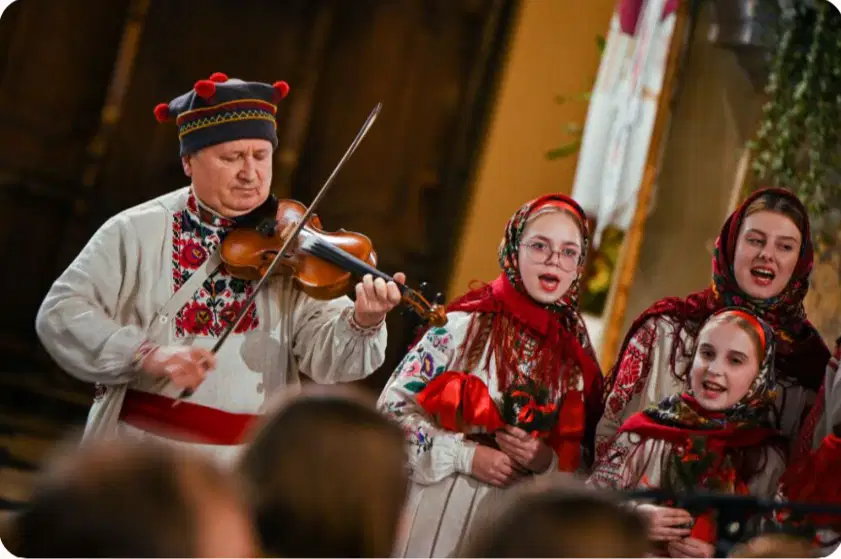
The image shows a Christmas celebration in Ukraine. What parts of surface culture can you observe in the image?
12
Deep Culture
Deep culture is not as easy to observe. Rules, behaviors, and ways of thinking are parts of deep culture. Deep culture involves a culture's ideas about what behavior is morally right, what manners are polite, and how people should interact.
Understanding deep culture involves knowing how a culture expects people to behave and what values many people share.

13
Deep Culture
Deep culture relates to questions such as:
How much do people value group identity, and how much do they value individual identity?
In many Asian languages, people say their family name first, as in "Smith Chris."
In many European languages, people say their individual name first, as in "Chris Smith."
How are people expected to behave when visiting someone's home?
In Turkey, it is customary to remove your shoes when entering someone's home.
How do age and gender influence how people talk or interact?
In some Jewish, Christian, and Islamic places of worship, men and women sit separately.
How is it decided whom someone marries?
Most marriages in India are arranged by family members or matchmakers.
What roles and responsibilities are expected of different family members?
In some Latin American families, the oldest brother is expected to take care of his siblings.
14
Categorize
What clothes people wear
What responsibilities an older sibling has
what food people eat
how people are expected to speak to strangers
Aspects of culture are listed below. Decide if they are surface culture or deep culture.
15
Language
Language is an important part of culture. Language gives people a shared identity and can make a certain place feel distinct from others. People use language to pass their ideas from one generation to the next.
Language is part of surface culture. You can hear a language spoken or see it written down. However, language can also reveal deep culture. It can reflect a culture's ideas and influence how people interact.
Greek language has different words for "love." These include words for love between friends, a parent's love for a child, and romantic love. These words show that Greek culture has various ideas about different types of love.
Chinese, Japanese, and Korean languages all have different words for an older sibling or younger sibling. These words show the importance of age and rank in relationships between siblings.
16
Language and Geography
Geographers are interested in how languages spread and change. A language family is a group of languages that come from the same base language. Italian, Spanish, French, and several other languages are part of a language family called the romance languages. These languages have their roots in Latin.

17
Language and Geography
Geographers also compare the number of speakers a language has.
Some languages are used in small communities and have only a few thousand speakers.
The language with the most speakers is English. Around 1.5 billion people around the world speak English. Most of these speakers did not learn English as their main language since birth, but learned it as a second language.
The language with the most native speakers, or people who have learned the language since birth, is Mandarin Chinese. It has about 1.3 billion native speakers. Most Mandarin speakers live in China.
18


19
Religion
A religion is a system of beliefs and practices, especially related to beliefs about one or more gods.
Religion is an important part of deep culture. Religions share their beliefs with people on how they should live their lives and the difference between right and wrong. They teach ideas about God or gods and what happens after death. For many people, religion shapes how they live their daily lives and how they behave.
Religion also has some influence on surface culture, such as the celebrations, festivals, and important days that people observe.
Not everyone in a country follows the same religion. However, followers of the same religion often form a community. Their shared beliefs give them a cultural identity.
20
Religion
People practice thousands of religions throughout the world. The five largest religions, listed in order of number of followers are:
Christianity (about 32 percent of the global population);
Islam (about 26 percent of the global population);
Hinduism (about 15 percent of the global population);
Buddhism (about 7 percent of the global population); and
Judaism (less than 1 percent of the global population).
Within these religions, different groups or individuals may have some differences in their beliefs and practices.

21

Important Note: This map shows the MOST COMMON religion in each country/area. People within each area have different beliefs. Ex- 70% of the US population follows Christianity. The other 30% of the population does not follow any religion or follows a different religion.
22
Multiple Choice

Which religion is the most common in South America?
Christianity
Islam
Hinduism
Buddhism
23
How People Learn Culture
Cultures develop and continue between generations because people learn from the influences around them.
Family
Family is usually a person's earliest influence. Adults teach children right, wrong, and how to behave. Children learn how to interact with others from how their family members interact.
School
Schools can directly teach people proper behavior.
Schools also teach a culture's values. School assignments could encourage students to express their own ideas, or they could encourage people to imitate their teachers' ideas. Schools could teach values such as patriotism, diversity, or tradition.
24
How People Learn Culture
How you learn culture
Community
A person is influenced by the communities around them. Communities may be classmates, members of a religious group, or people in the neighborhood.
People learn what is acceptable behavior by observing the behaviors of the people around them.
Communities keep traditions alive.
People may act or talk similarly to the people they meet most often.
Media
Media influences culture by spreading ideas.
Characters in movies and television can serve as role models for what a society considers good behavior.
News sources share information about what is happening within the community, country, or world.
Media spreads surface culture, such as art and entertainment.
25
Match
Match the scenario to the influence it best represents.
Gerald's older sister advises him on how to get along with his peers.
Gabriella's class learns about the values of freedom and equality in the United States.
Trang makes a new set of friends and gradually starts to talk similarly to them.
Tucker watches movies that show people using teamwork to solve problems.
Family
School
Community
Media
Family
School
Community
Media
26
Let's Recap
Culture is an important part of human geography. It is the shared beliefs, customs, and behaviors of a group of people. It includes surface culture and deep culture.
Multiple influences help people learn the culture of where they live.


27
Open Ended

Describe the surface culture and deep culture of your community.
Lesson 2.15: Culture
Show answer
Auto Play
Slide 1 / 27
SLIDE
Similar Resources on Wayground

20 questions
South Asia Review
Presentation
•
6th Grade
21 questions
The Ancient Egyptian Pharaohs
Presentation
•
6th Grade
21 questions
Longitude and Time Zones (2020)
Presentation
•
6th Grade
21 questions
King John and the Magna Carta - Ducksters
Presentation
•
6th Grade
20 questions
Getting to Know You
Presentation
•
6th - 7th Grade
22 questions
Australia History
Presentation
•
6th Grade
22 questions
Governments (11/02)
Presentation
•
6th Grade
18 questions
Economic systems
Presentation
•
6th Grade
Popular Resources on Wayground
10 questions
How much do you know about our Portrait of an Eagle?

Quiz
•
10th Grade
10 questions
Fast Food Slogans
Quiz
•
6th - 8th Grade
21 questions
Continents and Oceans
Quiz
•
6th Grade
20 questions
Parts of Speech
Quiz
•
5th Grade
16 questions
Subject & Predicate
Quiz
•
5th Grade
25 questions
Multiplication Facts
Quiz
•
5th Grade
12 questions
Map Skills
Quiz
•
3rd Grade
22 questions
Continents and Oceans
Quiz
•
5th Grade
Discover more resources for Social Studies
10 questions
Exploring the Age of Exploration: Key Events and Figures

Interactive video
•
6th - 10th Grade
13 questions
13 Colonies Map Quiz
Quiz
•
6th - 8th Grade
12 questions
7 Continents and 5 Major Oceans
Quiz
•
6th Grade
10 questions
Pillars of Free Enterprise
Quiz
•
6th - 8th Grade
26 questions
QA 1 Review
Quiz
•
6th - 8th Grade
8 questions
Geography of Mesopotamia
Presentation
•
6th Grade
10 questions
Exploring the 13 Colonies Regions
Interactive video
•
6th - 10th Grade
20 questions
Latitude and Longitude Practice
Quiz
•
6th Grade