

1.3 Packet & circuit switching

Presentation
•
Computers
•
11th Grade
•
Medium

Roy Duguid
Used 2+ times
FREE Resource
54 Slides • 30 Questions
1

2

Teams > Component 1 > Packet Switching and Layers > Complete Do Now
3
A local area network (LAN) is any network that covers a small geographical area, typically located on a single site. All the hardware for a LAN tends to be owned and controlled by the organisation using it. LANs are typically connected using: UTP cable Fibre optic Wi-Fi

4
A wide area network (WAN) is any network that covers a large geographical area. When multiple LANs physically located in different areas are connected, they form a WAN. The infrastructure that connects LANs to form a WAN is leased from telecommunication companies who own and manage it. WANs are typically connected by: Telephone lines Fibre optic cables Satellite links

5
Multiple Choice
LAN stands for .....
Lower area network
Local area network
Local area net
last ace note
6
Multiple Choice
The network in a school or office is usually a ..
LAN
PAN
WAN
7
Multiple Choice
A network of cash machines is connected in a .
LAN
WAN
PAN
8

9

10

11

12

13

14

15

16

17

18

19

20

21
Multiple Choice
Define latency
22
Multiple Choice
What does circuit switching create between the source and destination?
A permanent link
A temporary and dedicated link of fixed bandwidth
An encrypted link
A multipath route
23
Multiple Choice
What is a characteristic of packet switching?
Packets always take the same route
It supports only encrypted data
Packets can arrive out of order
It reserves bandwidth in advance
24
Multiple Choice
What provides the basis for traditional telephone networks?
Packet switching
Router-based networking
Internet Protocol
Circuit switching
25
Multiple Choice
What is guaranteed by using circuit switching?
The most secure connection
The lowest cost
The fastest speed
The quality of the transmission
26
Multiple Choice
What is a downside of circuit switching?
It is more expensive
It requires more complex infrastructure
It can waste a lot of potential bandwidth
It cannot support real-time video
27
Multiple Choice
Why is packet switching considered more affordable and efficient than circuit switching?
Because it requires more complex infrastructure
Because it uses less electricity
Because all bandwidth can be used at once
Because it guarantees the quality of transmission
28
Multiple Choice
How does packet switching send data?
Through a single dedicated path
In one large block
In sequential order
Into smaller blocks sent independently
29
Multiple Choice
What does packet switching maximize?
Bandwidth
Cost
Security
Transmission time
30
Multiple Choice
What does packet switching require less of compared to circuit switching?
Bandwidth
Complex infrastructure
Time to transmit
Data packets
31
Multiple Choice
What is a summary characteristic of circuit switching?
No physical path for packets
Reserves bandwidth in advance
Supports store and forward transmission
Very little bandwidth wastage
32
Multiple Choice
What is a summary characteristic of packet switching?
Physical path between source and destination
Causes a lot of bandwidth wastage
Packets travel independently
All packets use the same path
33
Multiple Choice
What is a key question to answer after watching the video?
How does the internet work?
What is the difference between circuit and packet switching?
What is the best method for data transmission?
How to build a network?
34
Multiple Choice
What does packet switching not guarantee?
The quality of the transmission
Efficient use of bandwidth
Affordability
Independence of packet routes
35
Multiple Choice
Why can packets in packet switching arrive out of order?
Because they are encrypted
Because they take the same route
Because they take different routes
Because they are all sent at once
37

38

39

40

41

42

43

44

45

46

47

48

49

50
51
Multiple Choice
What is a data packet?
52
Multiple Choice
What are the main components of a data packet?
53
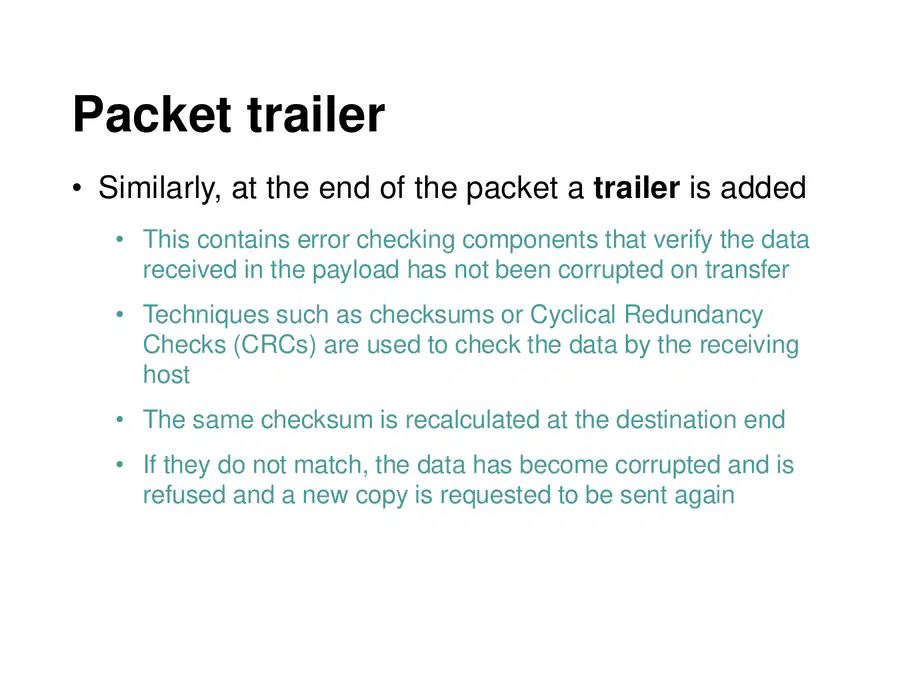
Multiple Choice
What is the purpose of the checksum in a data packet?
54
Multiple Choice
What happens if a packet is lost or corrupted during transmission?
55
Multiple Select
List all ITEMS a TCP/IP packet switching network packet contains
Source and Destination IP Address
Packet number / sequence
Error detection codes
Payload
The encryption key
56

57

58
The main difference between a router and a gateway is that a router controls traffic within a network, while a gateway connects different networks:
A router's purpose is to connect devices to the internet and manage data within a network. It receives data packets from devices and chooses the best route for each packet to reach its destination.
Routers can also protect information from security threats and prioritize which computers get access to the internet.
A gateway's purpose is to connect two networks and allow data to be exchanged between them. It does this by translating the protocols between the different networks. Gateways can also be used to provide a connection to the internet. In the past, gateways and routers were separate devices, but it's now common for their functions to be combined in a single device called a router.
59

61

62

63

64

65

66

67

68

69

70

71

72

73

74

75

76
Multiple Select
What are advantages of dividing network transmission into layers?
Network communication components are standardised which helps to ensure that different types of hardware and software are able to communicate.
Through separating the overall network communication processes it makes troubleshooting easier should an error occur.
To ensure that if changes are made in one layer they do not affect any other layers
Through dividing overall network communication into smaller, individual components it makes the software development process more straightforward.
Its easier
77
Multiple Select
Which of these is correct?
The APPLICATION layer encodes/decodes the message in a form that is understood by the sender and the recipient.
Transport layer - breaks down the message into small chunks (packets). Each packet is given a packet number and the total number of packets.
Network layer - adds the sender’s IP address and that of the recipient. The network then knows where to send the message, and where it came from.
Data link layer - enables the transfer of packets between nodes on a network, and between one network and another.
MAC addressing is used by the Network/Internet layer.
78
Multiple Choice
The purpose of the Application layer is
Prepares or presents the data (email, file, message) for /from transmission - including applying encryption/decryption
Ensures reliable transmission of data across the network.
Ensures the data is correctly routed through the network
Responsible for encoding the data to be transmitted on the actual cabled or wireless channel.
79
Multiple Choice
The purpose of the Transmission layer is
Prepares or presents the data (email, file, message) for /from transmission - including applying encryption/decryption
Ensures reliable transmission of data across the network.
Ensures the data is correctly routed through the network
Responsible for encoding the data to be transmitted on the actual cabled or wireless channel.
80
Multiple Choice
The purpose of the Internet (or Network) layer is
Prepares or presents the data (email, file, message) for /from transmission - including applying encryption/decryption
Ensures reliable transmission of data across the network.
Ensures the data is correctly routed through the network
Responsible for encoding the data to be transmitted on the actual cabled or wireless channel.
81
Multiple Choice
The purpose of the Network Access(or Data Link) layer is
Prepares or presents the data (email, file, message) for /from transmission - including applying encryption/decryption
Ensures reliable transmission of data across the network.
Ensures the data is correctly routed through the network
Responsible for encoding the data to be transmitted on the actual cabled or wireless channel.
82
Categorize
The industry standard for sending emails between servers.
SMTP stands for Simple Mail Transfer Protocol.
It is used to send emails from a client to a server or between servers.
POP3 stands for Post Office Protocol version 3.
It is used to retrieve emails from a mail server.
POP3 downloads emails to the client and typically deletes them from the server.
It allows users to access their emails offline after downloading.
POP3 is simpler than IMAP and is suitable for users who access their email from a single device.
IMAP stands for Internet Message Access Protocol.
It allows users to access and manage their email on a remote mail server.
It supports multiple device access, allowing users to view the same email from different devices.
IMAP allows for email synchronization, meaning changes made on one device are reflected on all devices.
It supports folder management, enabling users to organize their emails into different folders on the server.
Organize these options into the right categories
83

84
Component 1 > Packet switching 2025
Show answer
Auto Play
Slide 1 / 84
SLIDE
Similar Resources on Wayground

80 questions
Argumentative Writing
Presentation
•
10th Grade
77 questions
Romanisation - Révision synthèse
Presentation
•
10th Grade
83 questions
USH Review: UNIT 1
Presentation
•
11th Grade
79 questions
Origins of Cold War- DAY 2
Presentation
•
11th Grade
78 questions
Compound Words - Page 46
Presentation
•
11th Grade
80 questions
B4U7-9 Sentence Patterns Practice
Presentation
•
11th Grade
78 questions
Joints and Articulations
Presentation
•
11th Grade - University
78 questions
Nervous Tissue
Presentation
•
12th Grade
Popular Resources on Wayground
20 questions
Math Review

Quiz
•
3rd Grade
15 questions
Fast food
Quiz
•
7th Grade
20 questions
Context Clues
Quiz
•
6th Grade
20 questions
Inferences
Quiz
•
4th Grade
19 questions
Classifying Quadrilaterals
Quiz
•
3rd Grade
20 questions
Figurative Language Review
Quiz
•
6th Grade
20 questions
Equivalent Fractions
Quiz
•
3rd Grade
10 questions
Identify Fractions, Mixed Numbers & Improper Fractions
Quiz
•
3rd - 4th Grade
Discover more resources for Computers
10 questions
Fact Check Ice Breaker: Two truths and a lie
Quiz
•
5th - 12th Grade
10 questions
Video Games
Quiz
•
6th - 12th Grade
15 questions
Memorial Day Trivia
Quiz
•
KG - 12th Grade
12 questions
Name that Candy
Quiz
•
KG - 12th Grade
20 questions
Guess The App
Quiz
•
KG - Professional Dev...
30 questions
K/H Final Review Part 1
Quiz
•
9th - 12th Grade
40 questions
NCFE Earth and Environmental Science Released Test
Quiz
•
9th - 12th Grade
22 questions
Revise and Edit Final Review 3
Quiz
•
8th - 12th Grade