

Untitled Lesson

Presentation
•
Chemistry
•
8th Grade
•
Practice Problem
•
Hard

Kate Strangfeld
FREE Resource
80 Slides • 0 Questions
1


how to use
These slides were created with educators in mind. Use these slides as is or duplicate and adapt to
suit your purposes. We ask that you leave the Bite Scized logo on the slides as a form of attribution.
YouTube | Website | Instagram
thank you
Thank you so much for checking out our materials. It is because of you that we are able to
make incredible, high quality content. If you like our content, please make sure that you like
and subscribe to our YouTube channel and sign up for membership on our website (if you
have not already). Thank you!
2


YouTube | Website | Instagram
terms of use
© Copyright 2022. bite scized. All rights reserved. Permission is granted to physically or digitally copy
pages specifically designed for student or teacher use by the original purchaser or licensee.
This work is licensed under a Creative Commons Attribution-NonCommercial-NoDerivatives 4.0 International
License. You may not use the material for commercial purposes. You must give appropriate credit, provide a
link to the license, and indicate if changes were made. You may do so in any reasonable manner, but not in
any way that suggests the licensor endorses you or your use.
3

The Science
Behind
Popping Boba
4


1.1 What is popping boba
made of?
5

turn and talk
In this lesson, we’ll be
exploring popping boba.
Have you ever had boba
before? What types and
flavors?
6


initial ideas
What is popping boba and how is it made?
Directions:
1.Complete part 1 based on your own
prior knowledge and observing the
store-bought boba.
-What is the texture like?
-What does it reminds you of?
2.
Add any curiosities or questions in the
“explore” box. Try to have at least ONE
by the end of the class.
7


popping vs. traditional boba
There are different types of boba.
Optional: To learn more about different
types, read “What is popping boba” in the
Popping Boba Anchor Reading.
8


popping vs. traditional boba
Popping Boba:
Gel exterior
Juice interior
“Pops” when
some force is
applied
Traditional
Boba:
One texture
Chewy
Doesn’t pop
with force
9


google forms: pre-lesson
Let’s consider what we already know.
Directions:
1.Go to provided google form link.
2.
Click “before” for the first question.
3.
Answer the questions to the best of
your ability.
You are not expected to
know the answers to these
questions yet. It’s okay to
be unsure or wrong. We’d
rather see you take a risk!
This slide is only intended for teachers part of our Science and Cooking for Secondary Educators Program.
10


ingredients in popping boba
Two key ingredients in most
popping boba are calcium
chloride (or calcium lactate)
and sodium alginate.
11


ingredients in popping boba
Two key ingredients in most
popping boba are calcium
chloride (or calcium lactate)
and sodium alginate.
How could we further explore
what these ingredients are?
12


unpack
1.Write down sodium alginate in one box
(left) and calcium chloride in the other
box (right).
2.
Read “What makes up popping boba?”
in the Science Behind Boba Anchor
Reading and complex the “unpack” box.
Sodium Alginate
Calcium Chloride
13


debrief
2. Unpack: What are two key ingredients in popping boba?
Name:
Chemical Formula:
Positive Ion:
Negative Ion:
Name:
Chemical Formula:
Positive Ion:
Negative Ion:
14


debrief
Alginate is a polyatomic ion.
What does that mean?
15


debrief
A polyatomic ion is an ion that is made of
more than one atom.
●poly= many
●atomic= atom
Together, this group of atoms makes
up a single ion and carries a negative
(1-) charge.
We’ll explore other examples next
class.
Learn more here.
16


debrief
The ratio of calcium:chloride is 2:1 in calcium
chloride.
Why is this?
17


reviewing atomic structure
Let’s walk through why calcium chloride
has this formula by analyzing the atomic
structure and properties of calcium and
chloride ions.
Directions: Complete “Breaking Down
Calcium Chloride in Popping Boba” in
your handouts.
18


1.2 What happens when
we combine sodium
alginate and calcium
chloride?
19


frame
Today we will be looking at calcium chloride and sodium
alginate.
How do you think calcium chloride and sodium alginate
behave in water?
Try to backup your idea with reasoning.
20


exploring ionic compounds
Directions: Complete “Exploring
Different Ionic Compounds”.
Here, you will…
●identify the charges of ions and
the ratio of ions in different ionic
compounds
●look at examples of polyatomic
ions
●look at how these different ionic
compounds behave in water
(through a PhET Interactive)
21


exploring ionic compounds
How to set up your PhET
Simulation:
1.Click the “micro” tab.
2.
See more solutes by
clicking the arrow.
3.
Click and move the
shaker to add it to
water.
22


model
Based on what we learned, let’s
begin to develop a model of
calcium chloride and sodium
alginate solutions.
Directions: Complete box 1 and 2
in “particulate level”.
We will add in details about
“macroscopic level” after your
lab.
23


lab
Directions: Complete Lab: What
happens when we combine
sodium alginate and calcium
chloride?
In this lab, we will analyze the
properties of each substance
and then combine them to
observe what happens.
24


post-lab
Only watch this
video after
completing the
lab. This shows
the results!
25


post-lab
What do you think the gel-like
substance may be? Specifically
on a particulate level?
It’s okay to be uncertain! Try to
backup your thinking with
evidence and reasoning.
26


1.3 Why did a gel form?
27


model
Today we’ll be focusing in on
the substance that was
created when we combined
sodium alginate and calcium
chloride.
Begin by describing what you
saw on a macroscopic level.
28


model
Now let’s go back to what we
discussed in the post-lab.
Let’s first discuss…
-What could the substance be?
-List all the possibilities.
-What properties and data do
we have to draw on to help
us?
29


what could the gel be?
This substance could be a
variety of things. Look at the list
of possibilities.
Discuss with your partner which
substances you think we can rule
out. Explain your thinking.
Possible Products:
-Calcium (Ca2+)
-Sodium (Na+)
-Alginate (C6H10O7)-
-Chloride (Cl-)
-Calcium Alginate
-Sodium Chloride
-Calcium Sodium
-Alginate Chloride
30


what could the gel be?
The fact that this gel is insoluble in liquid
suggests it is not an ion.
Considering their electron configuration
and charge, we can rule out any
substances that are made of ions with
the same charge (e.g. two positive ions
cannot bond ionically).
Possible Products:
-Calcium (Ca2+)
-Sodium (Na+)
-Alginate (C6H10O7)-
-Chloride (Cl-)
-Calcium Alginate
-Sodium Chloride
-Calcium Sodium
-Alginate Chloride
31


what could the gel be?
The fact that this gel is insoluble in liquid
suggests it is not an ion.
We may recognize sodium chloride as
table salt- and draw on our previous
experience that when we add salt to
water, it does not gel. It is soluble and
dissolves.
Possible Products:
-Calcium (Ca2+)
-Sodium (Na+)
-Alginate (C6H10O7)-
-Chloride (Cl-)
-Calcium Alginate
-Sodium Chloride
-Calcium Sodium
-Alginate Chloride
32


what could the gel be?
If calcium alginate forms, what would
its chemical formula be?
Look at your notes to look at the
molecular structures of calcium and
alginate. Then consider what type of
bond would form.
Possible Products:
-Calcium (Ca2+)
-Sodium (Na+)
-Alginate (C6H10O7)-
-Chloride (Cl-)
-Calcium Alginate
-Sodium Chloride
-Calcium Sodium
-Alginate Chloride
33


what could the gel be?
The chemical formula of calcium
alginate is Ca(C6H10O7)2
Take a moment to turn and talk to
explain why this ratio of ions exists.
Possible Products:
-Calcium (Ca2+)
-Sodium (Na+)
-Alginate (C6H10O7)-
-Chloride (Cl-)
-Calcium Alginate
-Sodium Chloride
-Calcium Sodium
-Alginate Chloride
34


read
Directions: Read “Gels and
Crosslinking” in the Science
Behind Popping Boba Anchor
Reading.
As you read, take jots about
anything you think helps us
answer the question: What is the
gel? How and why does it form?
35


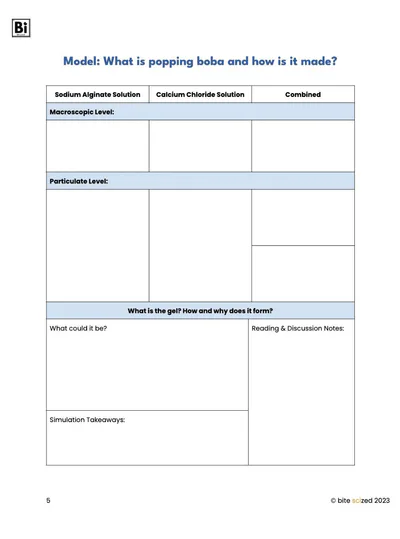
simulation
In this next activity, we are going to
further explore how charges affect
attraction.
Directions: As we go through the
simulation, take notes in your handout in
the “simulation takeaways” box.
36


simulation
Directions: Go to this simulation.
1.Setup: Remove the checkbox that says
“show electric field.”
2.
What do you notice occurs in the electric
field and forces between charged particles
when you change the charge value?
3.
Compare sodium alginate and calcium
alginate:
a.
Mimic sodium alginate: Set Particle B to
-1 and Particle A to 1.
b.
Mimic calcium alginate: Change
Particle A to 2.
Click to go
to the
interactive!
37


crosslinking
Why does crosslinking occur?
There are strong electrostatic
attractions between calcium
ions and alginate strands.
Why? They are oppositely
charged ions.
38


crosslinking
Why does crosslinking happen?
Calcium ions have a +2 charge. This is
important because it means…
-They displace the sodium ions. They
have a stronger attraction/pull (+2
charge vs. +1 charge).
-They can interact with multiple
alginate strands. This creates a
crosslink between strands.
This locks the alginate strands together in
a web, or gel.
displace
Attract and crosslink
39


crosslinking
In the reading, you see an
analogy about beads. Let’s look
at another one!
Before it gels, it’s as if the
alginate strands are like pasta
or noodles.
They slip by each other easily.
40


crosslinking
When we mix the
substances, we create
sticky points between the
noodles.
Imagine we added
something sticky to stick
certain noodles together
at certain points.
How would this change
how they move?
41


crosslinking
They move less easily.
It’s the same idea
when we combine
sodium alginate and
calcium chloride.
The molecules are in a
gel and cannot slide
past each other.
“sticking” points
restricts free flow
movement
42


centimeter
crosslinking
These sticking points caused by strong
electrostatic attractions are sometimes
referred to as crosslinks or bridges.
Within our beads analogy, these
bridges are probably about a few
centimeters long.
Within our noodles, these bridges are
probably about a millimeter long.
With our substances, these bridges are
about a nanometer long.
It’s all about scale.
nanometer
millimeter
43


what else?
So far we’ve spent our focus
solely on the gel.
Was anything else formed in this
chemical reaction?
Consider what we started with:
sodium alginate and calcium
chloride.
Possible Products:
-Calcium (Ca2+)
-Sodium (Na+)
-Alginate (C6H10O7)-
-Chloride (Cl-)
-Calcium Alginate
-Sodium Chloride
-Calcium Sodium
-Alginate Chloride
44


what else?
45


modeling activity
Get in a small group and make a model.
How can you represent the cross-linking that is going on?
46
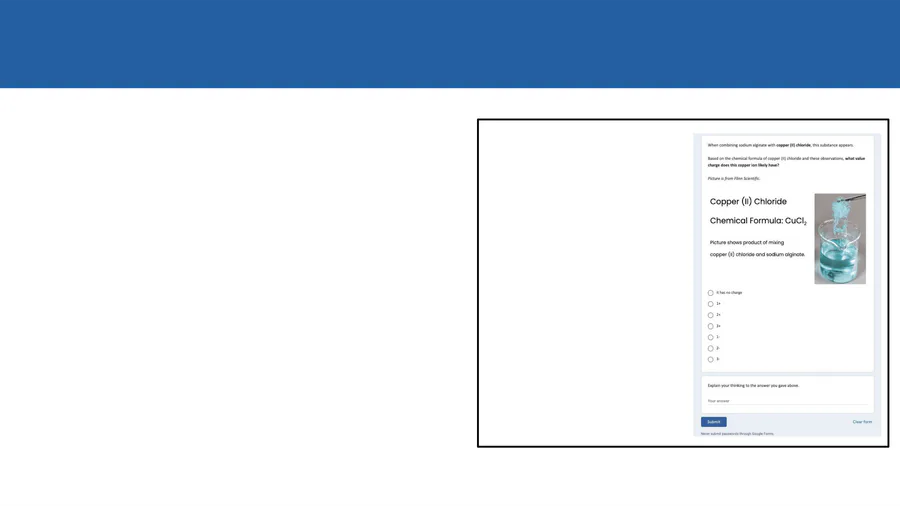

Let’s apply what we have learned to
consider if we could use other ionic
compounds in place of calcium
chloride.
Directions: Complete the Google
form, “What else could we use to
create a gel?”
assess
47


google forms: mid-lesson
Let’s consider what we already know.
Directions:
1.Go to provided google form link.
2.
Click the appropriate section for the first question.
3.
Answer the questions to the best of your ability.
This slide is only intended for teachers part of our Science and Cooking for Secondary Educators Program.
48


1.4: How do we create a gel
coating and keep the inside
of the sphere a liquid?
49


Day 1: Lab
50


Directions: Identify and
explain what types of
bonds are present in
calcium alginate and
sodium chloride, as well as
in the products formed in
this reaction.
review
51


So we have seen how we can create a
gel, which is one important component
to popping boba. But is it the only
component?
How is the popping boba different from
our gelled product?
initial ideas
52


Directions:
1.Go to the handout: How do we create a
sphere with an outer gel layer?
2.
Complete the observe section to
compare products we’ve seen.
Be ready to share out.
observe
53


observe
Gel Blob
Sphere with Gel
Layer
54


How can we create a sphere that only has
the outer layer gelled?
Directions: Jot down your initial ideas in
the first unpack box.
initial ideas
gelled
not gelled
55


By controlling and
manipulating the way we
add sodium alginate to the
calcium chloride bath, we
can create a sphere.
Watch the video to see what
you will do.
lab (part 1)
56


Now we know how to form a sphere.
But how can we control the thickness
of the gel layer?
lab (part 2)
57


Directions:
1.Briefly answer the question now having
completed the lab.
2.
Consider: How can we control how thick the
gel layer is?
a.
Fill in the blank to write out the
question.
b.
Jot down initial ideas.
initial ideas
thick
Thick gel layer
Thin gel layer
58


In this lab, you will let the sodium alginate sphere
sit in the calcium chloride bath for different
amounts of time. You will use a teaspoon (not a
dropper) to add in the sodium alginate.
Directions:
1.Complete the pre-lab to consider…
●how using a teaspoon is different than
using a dropper (like the previous lab)
●Predict what you think will occur
2.
Complete the lab.
lab (part 2)
59


Directions: Complete post-lab questions.
Then we will discuss what you noticed
next class.
post-lab
60


Day 2: Unpack
61


Why do you think this happened? What is going
on on a particulate level to explain these results?
Directions: Go to the handout: How do we
create a sphere with an outer gel layer?
1.Briefly re-answer the question: How can we
control how thick the gel layer is? In the
“after the lab section” of your chart.
2.
Jot down initial ideas to consider what is
going on a particulate level.
Be ready to share out.
review + initial ideas
thick
62


Share Out: Why do you think this happened?
What is going on on a particulate level to explain
these results?
share out
thick
63


read
Directions: Read “Gelling &
Diffusion” in the Science Behind
Popping Boba Anchor Reading.
Add jots to your “reading” and
“model” box.
64


watch
Directions: Watch
3:27-4:37 of the video.
Turn and Talk: Why does
the amount of time the
sphere sits in the bath
matter?
65


whiteboard
What was different about these trials?
66


whiteboard
30 seconds
1 minute
3 minutes
67


review
Diffusion: movement of particles in a
liquid from high to low concentration
Calcium ions surrounding the drop
diffuse into the drop. As they do this,
crosslinking occurs.
A variety of factors can influence the
speed and degree at which this
occurs.
68


diffusion
Wait, so is only calcium diffusing here?
However, some move more
quickly than others.
Smaller molecules move, or
diffuse, more quickly. Here, the
difference in size is HUGE.
In reality, all particles in the liquid are diffusing.
69


Directions: With a small group on
a large piece of paper, develop a
model to show and explain what
the inside and outer layer looks like
on macroscopic and particulate
level.
Your model should…
●Include both the outside layer
and inside
●Explain what impacts the
thickness of the gel layer and
why
model
Outside
Layer:
Inside:
70


model
Outside:
Inside:
71


1.5: How can we make a
flavored popping boba?
72


frame
Today we will make flavored popping
boba. This is a two part lab.
In part one, you’ll make your flavored
mixture and do a brief test.
In part two, you’ll design your own
experiment to determine how long the
sphere should sit in the bath for the
ideal texture.
73


frame
Option 2 (more complex):
How will changing the concentration of
calcium chloride affect the final
process and product?
What we’ve been using: 1% calcium
chloride solution
What happens if we use…
0.5% calcium chloride solution?
2% calcium chloride solution?
74


lab
Directions:
1.Take ~10 minutes to complete part 1.
2.
Once done with part 1, begin to plan
your experiment for part 2 by
completing steps 1-4.
3.
Once you have completed step 4,
have your designed experiment
checked before you move onto
completing it.
75


lab
Directions: Once you have
completed part 2 of your lab,
complete the post-lab questions.
76


review
How is popping boba made?
Review what we have learned so
far!
Use your notes and the Science
Behind Popping Boba Anchor
Reading for help.
77


google forms: post-lesson
Let’s consider what we have learned.
Directions:
1.Go to provided google form link.
2.
Click “after” for the first question.
3.
Answer the questions to the best of
your ability.
This is your opportunity
to show what you have
learned.
This slide is only intended for teachers part of our Science and Cooking for Secondary Educators Program.
78


alternate lab
79


lab: apple popping boba
Directions:
Watch this
video, and then
complete
Lab 4: Apple
Popping Boba
by following the
directions in
your student
handout.
80

reflect
1.What was something new
you learned?
2.
What piqued your curiosity?
how to use
These slides were created with educators in mind. Use these slides as is or duplicate and adapt to
suit your purposes. We ask that you leave the Bite Scized logo on the slides as a form of attribution.
YouTube | Website | Instagram
thank you
Thank you so much for checking out our materials. It is because of you that we are able to
make incredible, high quality content. If you like our content, please make sure that you like
and subscribe to our YouTube channel and sign up for membership on our website (if you
have not already). Thank you!
Show answer
Auto Play
Slide 1 / 80
SLIDE
Similar Resources on Wayground

71 questions
Get the Nutrition Facts and Use Them
Presentation
•
6th - 8th Grade
79 questions
recycling
Presentation
•
6th - 9th Grade
87 questions
Chapter 2 Section 6: Investigate
Presentation
•
8th Grade
69 questions
Equilibrium
Presentation
•
10th - 11th Grade
84 questions
EOT REVIEW LESSON - GRADE 8
Presentation
•
8th Grade
65 questions
Ch 3: Chemical Composition of Matter (Part 1)
Presentation
•
6th Grade
70 questions
1f-1h Chemical bonds Edexcel
Presentation
•
8th Grade
72 questions
ES Human Impact on Earth's Resources
Presentation
•
9th Grade
Popular Resources on Wayground
10 questions
Safety Day 2026 – Student Review

Quiz
•
9th Grade
21 questions
Continents and Oceans
Quiz
•
6th Grade
20 questions
Parts of Speech
Quiz
•
5th Grade
16 questions
Subject & Predicate
Quiz
•
5th Grade
25 questions
Multiplication Facts
Quiz
•
5th Grade
12 questions
Map Skills
Quiz
•
3rd Grade
22 questions
Continents and Oceans
Quiz
•
5th Grade
15 questions
Rounding Decimals
Quiz
•
5th Grade
Discover more resources for Chemistry
20 questions
Physical or Chemical Change/Phases
Quiz
•
8th Grade - University
20 questions
Counting Atoms
Quiz
•
8th Grade
33 questions
Quizizz Savvas S3 T6 L3 Changes in Matter Review
Quiz
•
7th - 8th Grade
12 questions
Reading the Periodic Table
Quiz
•
7th - 8th Grade
20 questions
States of Matter
Quiz
•
8th Grade
20 questions
Counting Atoms Practice
Quiz
•
8th Grade
20 questions
Atomic Structure, Valence Electrons, Periods and Groups
Quiz
•
8th Grade
16 questions
Find the Number of Protons, Neutrons, and Electrons
Quiz
•
8th Grade