Plate Tectonics Test
Presentation
•
Science
•
6th - 8th Grade
•
Practice Problem
•
Easy
+2
Standards-aligned
Joe Chavez
Used 8+ times
FREE Resource
0 Slides • 35 Questions
1
Multiple Choice
What are the two types of crust?
Ocean and basin
Lower and upper
Continental and oceanic
2
Multiple Choice
3
Multiple Choice
This famous fault in California has a lot of earthquakes!
New Madrid
Denali Fault
San Andreas Fault
4
Multiple Choice
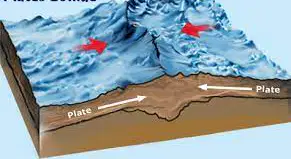
What type of boundary is shown in the diagram?
Divergent
Convergent
Slide/Transform
5
Multiple Choice
This is the driving force behind the movement of tectonic plates:
6
Multiple Choice
A land feature that is produced at a convergent boundary is:
7
Multiple Choice
Which section of Earth is the largest?
The Mantle
The Inner Core
The Outer Core
The Crust
8
Multiple Choice
What do we call it where you see the Oceanic Crust and Lithosphere going under the Continental Crust and Lithosphere?
Subduction
Sinking
Reduction
9
Multiple Choice
Which diagram shows what happened between the two plates as they moved away from each other?
Diagram A: A new plate from underneath filled in the gap that was created by the plates moving apart.
Diagram B: Sand and dirt filled in the gap that was created by the plates moving apart.
Diagram B:, Sand and dirt filled in the gap that was created by the plates moving apart.
Diagram C: Ocean water filled in the gap that was created by the plates moving apart.
Diagram D: Soft, solid rock from underneath the plates rose and hardened, adding solid rock to the edges of both plates.
10
Multiple Choice
Fossil remains of Lystrosaurus (an extinct four-legged animal) have been discovered in India and South Africa. When they were living, all the Lystrosaurus lived together on land, and they could not swim. However, now there is an ocean between the Lystrosaurus fossils. What could explain how these fossils got so far apart?
India and South Africa are parts of different plates. The plates slowly moved far apart as soft, solid rock from underneath got added to the edges of the plates over millions of years.
India and South Africa are parts of different plates. The plates floated away from each other across the ocean.
India and South Africa are parts of different plates. The plates slowly moved apart as new plates from underneath got added between them over millions of years.
India and South Africa are parts of different plates. The plates were sometimes pushed far apart by earthquakes, and soft, solid rock from underneath got added to the edges of the plates.
11
Multiple Choice
Patterns on this map tell us that . . .
volcanic activity and earthquakes happened in the following order: volcanic activity, earthquake, volcanic activity, earthquake, and so on.
volcanic activity and earthquakes happened in random locations all over the ma
volcanic activity and earthquakes happened in similar areas.
12
Multiple Choice
This is a map of the world’s earthquake epicenters. What do you think causes earthquakes to continue to occur in these areas?
They are along a mountain range
They are along a plate boundary
The earthquakes are caused by nearby volcanoes
13
Multiple Choice
If Mr. Chavez were taking a 4 hour nap between two converging tectonic plates, by the time he woke up, what would have happened?
He gets smashed!
Nothing because it will take million of years for them to move enough to squish him
The plates are moving away from each other so he would fall down in the mantle and burn till he's crsipy
He would flex his muscles and push the plates apart! (of course)
14
Multiple Select
South America and Africa look to fit together like a puzzle.
This does not support the theory of Pangaea
This does support the theory of Pangaea
15
Multiple Choice
Which oceanic plate in the above picture must be more dense?
The plate on the left (the plate with the volcano on it)
The plate on the right (without the volcano)
16
Multiple Choice
Yellowstone National Park marks the location of a huge:
17
Multiple Choice
18
Multiple Choice
At transform boundaries, tectonic plates:
move apart
slide past each other
collide
19
Multiple Choice
At convergent boundaries, the tectonic plates:
move apart
slide past each other
collide
20
Multiple Choice
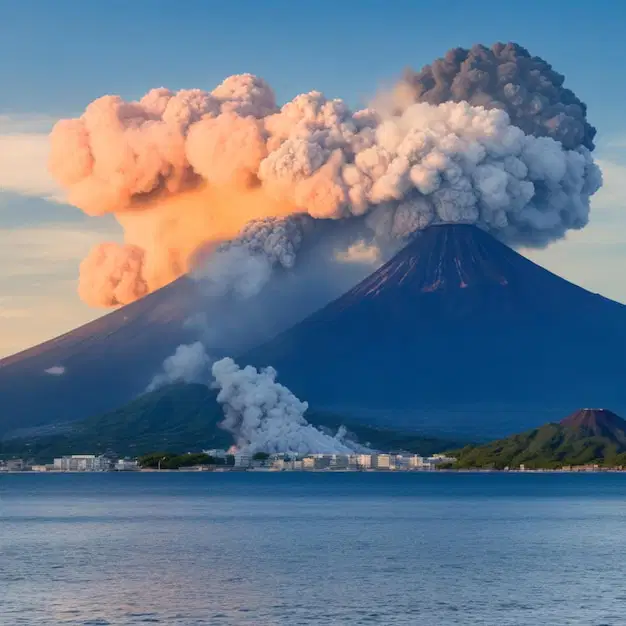
Name this volcano:
Shield
CInder Cone
Composite
21
Multiple Choice
Name this volcano:
Shield
CInder Cone
Composite
22
Multiple Choice
The fossil plant Glossopteris has been found in Africa, Australia, India, South America, and Antarctica. This evidence helps support the idea that:
the continents have always been at the same locations they are now
the continents have moved
the continents were all once covered by ice
23
Multiple Choice
Based on the current position of the continents, in what general direction did South America drift away from Pangaea?
East
West
North
South
24
Multiple Choice
Where is Earth's heat energy most concentrated?
The mantle
The core
The crust
25
Multiple Choice
The San Andreas fault is an example of which kind of boundary?
transform
divergent
convergent
26
Multiple Choice
Three different types of tectonic plate boundaries are shown. Which diagram would show that earthquakes are often formed as a result of stress that builds at the edges of two plates?
A
B
C
27
Multiple Choice
Three different types of tectonic plate boundaries are shown below. Which diagram would show magma rising in between two plates and reaching the surface where it eventually cools to form new rock?
A
B
C
28
Multiple Choice
Alfred Wegener named his single supercontinent ____________, which means "all Earth" in ancient Greek.
Pandora
Gandowandaland
Pangea
29
Multiple Choice
What type of fossils were noticed by Wegener that were found on different continents?
30
Multiple Choice
31
Multiple Choice
What is the correct order (starting from the surface) of Earth’s layers?
crust, outer core, inner core, mantle
mantle, outer core, inner core, crust
crust, mantle, outer core, inner core
32
Multiple Choice
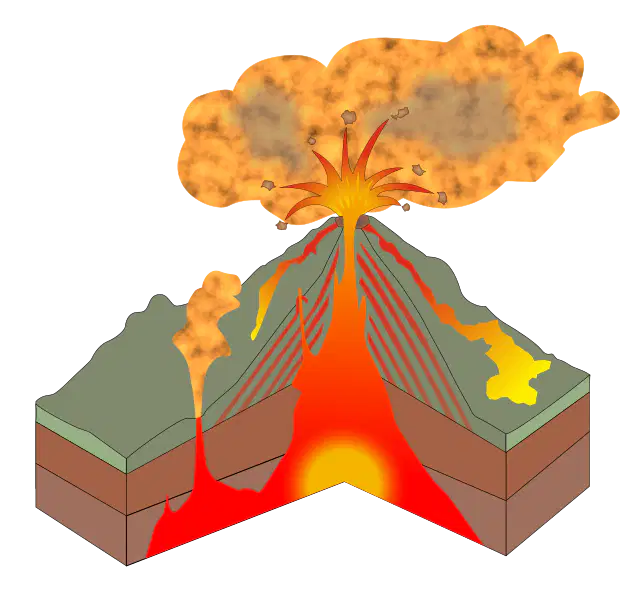
Starting with the innermost part of the volcano, pick the correct order of the following items:
crust, outer core, inner core, mantle
mantle, outer core, inner core, crust
magma, lava, ash
33
Multiple Choice
34
Multiple Choice
A huge hole that is left behind when a volcano collapses is called a:
Lake
Vent
35
Multiple Choice
What is the difference between magma and lava?
Magma is outside of the volcano while lava is inside
Magma and lava are on the inside
Magma is in the volcano and lava is outside of the volcano
What are the two types of crust?
Ocean and basin
Lower and upper
Continental and oceanic
Show answer
Auto Play
Slide 1 / 35
MULTIPLE CHOICE

Similar Resources on Wayground
26 questions
Lab Safety
Presentation
•
6th - 8th Grade
29 questions
DNA, chromosomes, and genes
Presentation
•
6th - 8th Grade
27 questions
The Geologic Time Scale
Presentation
•
6th - 8th Grade
27 questions
Plant & Animal Cells
Presentation
•
6th - 8th Grade
27 questions
Refraction and Lenses
Presentation
•
6th - 8th Grade
27 questions
Gravitational Forces
Presentation
•
6th - 8th Grade
31 questions
Forces and Motion
Presentation
•
6th - 8th Grade
26 questions
1.2.3 Moving Cellular Material
Presentation
•
6th - 8th Grade
Popular Resources on Wayground
20 questions
Math Review
Quiz
•
3rd Grade
15 questions
Fast food
Quiz
•
7th Grade
20 questions
Context Clues
Quiz
•
6th Grade
20 questions
Inferences
Quiz
•
4th Grade
19 questions
Classifying Quadrilaterals
Quiz
•
3rd Grade
20 questions
Figurative Language Review
Quiz
•
6th Grade
20 questions
Equivalent Fractions
Quiz
•
3rd Grade
10 questions
Identify Fractions, Mixed Numbers & Improper Fractions
Quiz
•
3rd - 4th Grade
Discover more resources for Science
16 questions
Interactions within Ecosystems
Presentation
•
6th - 8th Grade
26 questions
Amplify Chemical Reactions
Quiz
•
6th - 8th Grade
20 questions
Rocks and The Rock Cycle
Quiz
•
6th Grade
16 questions
Photosynthesis and Cellular Respiration Review
Quiz
•
7th Grade
15 questions
Punnett Squares
Quiz
•
6th Grade
20 questions
genetics, punnett squares, heredity
Quiz
•
7th Grade
18 questions
Oceans, Atmosphere, Climate Vocabulary Amplify
Quiz
•
6th Grade
49 questions
NC Released EOG 8 Science (2024)
Quiz
•
8th Grade