Search Header Logo
G10_SOUND WAVES

G10_SOUND WAVES

Assessment

Presentation

Physics

10th Grade

Medium

NGSS
MS-PS4-2, HS-PS4-1, MS-PS4-1

Standards-aligned

Created by

Physics Physics

Used 4+ times

FREE Resource

25 Slides • 40 Questions

1

media

SOUND WAVES

2

media

Learning Objectives :

1.

Describe the production of sound by vibrating sources.

2.

Describe the longitudinal nature of sound waves.

3.

State the approximate range of frequencies audible to human as
20-20,000Hz.

4.

Know that a medium is needed to transmit sound waves.

5.

Know that, in general, sound travels faster in solids than in liquids
and faster in liquids than in gases.

6.

Know that the speed of sound in air is approximately 330-350 m/s.

7.

Describe an echo as the reflection of sound waves.

8.

Describe how change in amplitude and frequency affect the
loudness and pitch of sound waves.

3

media
media

Where does sound come from ?

3

4

media
media
media

Where does sound come from ?

Things that vibrate make sounds. To vibrate means to move backwards and forwards very quickly.

Not all sounds are the same. Sounds can vary in both loudness and
pitch.

Sound is produced when an object vibrates the air around it, and this vibration can be represented as a wave that travels through space.

the vibration of the air produces a sound originating from the collision.

4

5

media

5

6

media

6

7

media

SOUND WAVES is

Sound travels from a vibrating object to our ears.

This is called a sound wave.

When an object vibrates, it moves backwards and forwards. Every time the object vibrates forward, the air in front of the object gets pushed forward. Sound wave is longitudinal waves.

When the particles in front of the object vibrate, those particles make other particles in front of them vibrate. This makes a sound wave.

7

8

media
media
media
media
media
media
media
media
media
media
media
media
media
media
media
media

RANGE FREQUENCY:

9

media

9

The human ear responds to sounds with frequencies in the range from 20 Hz to 20,000 Hz. This is called the audible range of the human ear. Drums, guitar strings, tuning fork, human vocal cords and diaphragms of loudspeakers are examples of audible range of sound
Audible sound waves whose frequencies are less than 20 Hz are in the infrasonic range. Sound
produced by earthquakes, thunder, volcanoes are in Infrasonic range. Human Ear cannot hear this
sound but elephants and whales can hear this.
Frequencies above 20,000 Hz are in the ultrasonic range. The audible range of dogs, cats, moths
and mice
extends into ultrasound frequencies. They can hear very high frequencies that humans
cannot.

A sound wave of frequencies above 20 kHz is called ultrasound. Properties of ultrasound are due
to its high frequencies. The energy carried by ultrasound is very high. It can travel along a well
defined straight path. Due to its small wavelength, it does not bend appreciably and has a high
directivity.

10

Multiple Choice

A sound wave is a pressure wave; regions of high (compressions) and low pressure (rarefactions) are established as the result of the vibrations of the sound source. These compressions and rarefactions result because sound

1

is more dense than air and thus has more inertia, causing the bunching up of sound.

2

waves have a speed that is dependent only upon the properties of the medium.

3

is like all waves; it is able to bend into the regions of space behind obstacles.

4

is able to reflect off fixed ends and interfere with incident waves

5

vibrates longitudinally; the longitudinal movement of air produces pressure fluctuations.

11

Multiple Choice

Which range of frequencies typically can be heard by a 10 year-old child?

1

20 Hz-2000 Hz

2

20 Hz-20 000 Hz

3

200 Hz-2000 Hz

4

200 Hz-20 000 Hz

12

Multiple Choice

Question image

Three loudspeakers vibrate at different frequencies of 5 Hertz, 25 kiloHertz, and 50 kiloHertz.

Which row shows whether the vibration from each loudspeaker can be heard by a human?

1

A

2

B

3

C

4

D

13

Multiple Choice

What is vibration?
1
how loud a sound is
2
the back and forth movement of matter
3
how high or low a sound is
4
the loudness or softness of a sound

14

Multiple Choice

A part in a longitudinal wave where the particles are spread apart
1
compression
2
rarefaction
3
crest
4
trough

15

Multiple Choice

The part of a longitudinal wave where the particles of the medium are close together.
1
rarefaction
2
compression
3
crest
4
trough

16

media

SOUND WAVES on the move

Sound waves travel by making particles vibrate. Sound will travel through
anything that has particles: gas, liquid or solid.

Sound waves move the same way in gases, liquids and solids.

The sound wave makes the particles vibrate backwards and forwards.

The substance that the sound wave moves through is called the medium.

Therefore, solids, liquids and gases can all be a medium for sound.

10

17

media
media

11

SOUND WAVES on the move

18

media
media

Vibration in Vacuum

As there are no particles in a vacuum, there is nothing to vibrate to make a sound wave.

Therefore, sound will not travel in a vacuum.

Space is a vacuum. If sound waves could travel through space, we would be able to hear the Sun

12

19

Multiple Choice

Material (matter) through which a wave travels
1
medium
2
Doppler Effect
3
sound
4
pitch

20

Multiple Choice

Question image

Astronaut 1 uses a hammer to mend a satellite in space. Astronaut 2 is nearby. There is no air in space. Compared with the sound heard if they were working on Earth, what does astronaut 2 hear?

1

a louder sound

2

a quieter sound

3

a sound of the same loudness

4

no sound at all

21

Multiple Choice

Question image

The sound from a loudspeaker must pass through two materials to reach a microphone.

1

A

2

B

3

C

4

D

22

Multiple Choice

Question image

The speed of sound is different in different states of matter.

The speed of sound in water is 1500 m/s.

Which row correctly compares the speed of sound in ice and the speed of sound in steam with the speed of sound in water?

1

A

2

B

3

C

4

D

23

Multiple Choice

The speed of sound depends on these two things:

1

The type of medium and the temperature of the medium

2

Speed of the medium and temperature of the medium

3

Temperature of the medium and sound of the medium

4

None of the above

24

Multiple Choice

A wave that requires a medium through which to travel
1
mechanical wave
2
chemical wave
3
electromagnetic wave
4
pitch

25

media
media
media
media
media

Example :

13

26

media

Reflection of Sound

One property of all waves is that they can be reflected from surfaces.
Therefore, sound waves can be reflected.

A sound wave travelling towards a wall will hit the wall and come back.
Sound waves reflect best from large, smooth, flat surfaces.
Surfaces such as glass, tiles, flat metal and smooth concrete give good reflections of sound.

When the sound wave hits a wall, it is reflected back. The reflection of a
sound wave is called an echo.

14

27

media

Useful Echoes

Echoes can be useful.

  1. Bats use echoes to find insects for food. The bat makes a sound.
    The sound wave reflects off the insect – there is an echo. The bat can work out where the insect is
    from the time taken for the echo to reach the bat, and the direction the echo comes from.

  1. Boats can use echoes to find the depth of water under the boat.

    A sound is sent from the bottom of the boat. The sound travels through the water and reflects off
    the solid ground. The echo comes back to the boat.

    The time taken for the echo to come back can be used to work out the depth.

  1. Echoes can also be used to make images from inside the body.

    Sounds sent into the mother’s body echo back out of her body.

    This method is used to make the image of the unborn baby.

15

28

media
media

Unwanted Echoes

Sometimes echoes are unwanted.

For example, when recording music, echoes
change the sound.

A room with large flat walls would give many
echoes.

In a theatre, the audience needs to hear the
voices of people on the stage. If there were
echoes in a theatre, the voices would not be
clear. Theatres are designed to stop echoes.
Theatres usually have no large flat surfaces that
could cause echoes

16

29

media
media
media

Reflection of Sound Formula

17

ECHO Formula :

30

media
media

18

31

media
media

19

32

media
media
media
media

Example :

33

media
media
media
media

Example :

34

Multiple Choice

A tennis player hits a ball hard and 0.40 s later hears the echo from a wall.

The speed of sound in air is 330 m/s.

How far away is the player from the wall?

1

66 m

2

132 m

3

264 m

4

825 m

35

Multiple Choice

A loudspeaker on the boat produces a pulse of sound in the sea. The echo of the pulse is received back at the boat after 3.0 s. The depth of the sea under the boat is 2250 m.

From this information, what is the speed of sound in the sea water?

1

330 m/s

2

750 m/s

3

1500 m/s

4

6750 m/s

36

Multiple Choice

A ship sends a pulse of sound vertically downwards to the sea bed. An echo is heard 0.4 seconds later.

If the speed of sound in the water is 1200 m/s , how deep is the water below the ship?

1

240 m

2

480 m

3

1500 m

4

3000 m

37

Multiple Choice

Sound travels by wave motion.

Which property of waves causes echoes?

1

diffraction

2

dispersion

3

reflection

4

refraction

38

Multiple Choice

A reflected sound wave
1
frequency
2
pitch
3
echo
4
rarefaction

39

Multiple Choice

Question image

Sonar and echolocation use ----- to detect objects under water.

1

Refraction

2

Reflection

40

Multiple Choice

Question image
Why is the school library covered with carpet?
1
So everyone can make a lot of noise
2
to help absorb sounds to keep it quiet
3
because it looks good
4
to help absorb sounds so it can stay noisy

41

Multiple Choice

Question image

How is the use of sound waves helpful to this whale?

1

It makes it easier to obtain oxygen.

2

It makes the water warmer.

3

It signals fish to move out of the whale's path.

4

It helps the whale locate food.

42

Multiple Choice

You and your father inspect an empty house with the hopes of buying it. You walk through the rooms talking to one another, and you notice that your voices and footsteps are echoing in the big, empty house. What causes the echo?
1
sound waves reflecting off smooth, flat surfaces throughout the house
2
sound waves moving around the large rooms
3
sound waves moving slowly through air
4
sound waves refracting around corners in the empty rooms

43

media
media
media

The two most important physical qualities of sound are frequency and
amplitude.

Frequency is the speed at which a sound wave vibrates, and it determines the pitch of a noise.
Higher frequency sounds have a higher pitch, like a flute or a bird chirping,
while lower frequency sounds have a lower pitch, like a tuba or a large dog barking.

The amplitude of a sound wave can be thought of as the strength of the vibrations as they travel through the air, and it determines the perceived loudness of the sound.

22

44

media
media
media
media
media
media
media

23

45

media
media
media
media
media
media
media

24

46

Multiple Choice

Question image

A police car siren emits two different sounds P and Q. These are produced alternately. The diagram represents the sound emitted.

1

A

2

B

3

C

4

D

47

Multiple Choice

Question image

The diagram represents two sound waves.

1

A

2

B

3

C

4

D

48

Multiple Choice

Question image

The diagrams show the wave shapes of two different sounds. The scales are the same in each diagram.

How does sound 2 compare with sound 1?

1

Sound 2 is louder than sound 1

2

Sound 2 is quieter than sound 1

3

Sound 2 has a higher pitch than sound 1

4

Sound 2 has a lower pitch than sound 1

49

Multiple Choice

The diagrams represent the waves produced by four sources of sound. The scales are same for all the diagrams.

Which sound has the highest frequency?

1
2
3
4

50

Multiple Choice

Sounds are produced by vibrating objects. A certain object vibrates but a person nearby cannot hear any sound.

Which statement could explain why nothing is heard?

1

The amplitude of the sound wave is too large

2

The frequency of the vibration is too high

3

The sound waves are transverse

4

The speed of the sound wave is too high

51

Multiple Choice

The frequency of a musical note is increased.

A student hearing the sound detects an increase in which property?

1

loudness of the sound

2

pitch of the sound

3

speed of the sound waves

4

wavelength of the sound waves

52

Multiple Choice

Question image

Two sounds X and Y are produced by loudspeakers.

The amplitude and frequency of each sound wave is given in the table.

How does sound Y compare with sound X?

1

Y is louder and has a higher pitch

2

Y is louder and has a lower pitch

3

Y is quieter and has a higher pitch

4

Y is quieter and has a lower pitch

53

Multiple Choice

A tuba player plays a loud note on her tuba.

She then plays a quiet note of the same pitch.

Which property of the sound wave she produced has changed?

1

frequency

2

wavelength

3

amplitude

4

speed

54

Multiple Choice

Question image

Between waves F and G, which is lower in pitch?

1

Wave F

2

Wave G

55

Multiple Choice

Question image

Between waves C and H, which is lower in volume?

1

Wave C

2

Wave H

56

Multiple Choice

What does pitch depend on?
1
amplitude 
2
frequency
3
intensity 
4
volume of sound

57

Multiple Choice

Question image
When comparing the two waves that are shown, how would Wave A (green wave) differ than Wave B (black wave)?
1
Wave A and B have the same amplitude, but wave B (black) has a lower pitch.
2
Wave A and B have the same amplitude, but Wave A has a lower pitch. 
3
Wave A and B have the same pitch, but Wave A is a softer sound. 
4
Wave A and B have the same pitch, but Wave B is a softer sound. 

58

Multiple Choice

What does an increase in amplitude of a sound wave indicate?

1

Increase in pitch

2

Increase in speed

3

Increase in loudness

4

Increase in frequency

59

Multiple Choice

Question image
What is changed in the second picture?
1
Someone is talking louder in picture 2
2
Someone is talking softer in picture 2
3
Someone is talking lower pitch in picture 2
4
Someone is talking higher pitch in picture 2

60

Multiple Choice

Question image
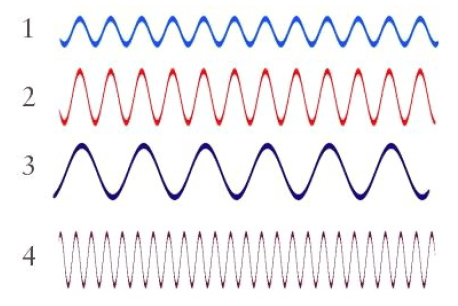
Which wave in the diagram has the greatest frequency?
1
1
2
2
3
3
4
4

61

Multiple Choice

If you want to change the pitch of a sound, you have to change the ___
1
frequency
2
amplitude
3
speed
4
volume

62

Multiple Choice

A sound wave with low amplitude produces which type of sound?

1

High

2

Low

3

Loud

4

Soft

63

Multiple Choice

Question image
What is changed in the second picture?
1
Someone is talking louder in picture 2
2
Someone is talking softer in picture 2
3
Someone is talking lower pitch in picture 2
4
Someone is talking higher pitch in picture 2

64

Multiple Choice

Question image

Diagram shows 3 types of sound waves generated from speaker. Which of the following statements is true?

1

P has a higher pitch than Q

2

Q has a higher pitch than R

3

R has the highest pitch

4

P, Q and R have the same pitch

65

media

THANKS

25

Do you have any questions ?

media

SOUND WAVES

Show answer

Auto Play

Slide 1 / 65

SLIDE