

Plate Tectonics, Earthquakes, and Volcanoes

Presentation
•
Science
•
10th Grade
•
Hard

Joseph Anderson
FREE Resource
46 Slides • 14 Questions
1

2
Describe and relate the distribution of active volcanoes, earthquake epicenters, and major mountain belts to Plate Tectonic Theory

3
15 items - Multiple Choice

4
Multiple Choice
What is the outermost layer of the Earth?
crust
inner core
mantle
outer core
5
Multiple Choice
The crust and upper mantle make up Earth’s _________.
asthenosphere
continents
core
lithosphere
6
Multiple Choice
Which statement about the Earth’s crusts is CORRECT?
Continental and oceanic crusts have the same weight.
Continental crust is heavier than oceanic crust.
Continental crust is thicker than oceanic crust.
Oceanic crust is thicker than continental crust.
7
Multiple Choice
What do we call the continuously moving part of the earth’s crust?
fault
fissure
fracture
plate
8
Multiple Choice
Which theory states that the entire crust is broken and is continuously moving?
Continental Drift
Plate Tectonics
Seafloor Spreading
Titanic Theory
9
Multiple Choice
Which of the following is NOT a result of Plate Tectonics?
earthquake
fault lines
landslides
mountains
10
Multiple Choice
This earthquake type happens when the shifting of Earth’s plates is driven by the sudden release of energy within some limited region of the rocks of Earth.
aftershock
foreshock
tectonic
volcanic
11
Multiple Choice
How are tsunamis created?
A submarine earthquake causes huge amount of water to be displaced.
Differences in temperature cause hot seawater to rise.
The gravitational pull of the moon causes the ocean water to rise.
Topography underwater cause disturbances in the oceans’ current.
12
Multiple Choice
A land mass that projects well above its surroundings is a mountain. What do you call a chain of mountains?
mountain area
mountain chain
mountain range
mountainous
13
Multiple Choice
It is the location on the Earth's surface directly above the focus of an earthquake.
center
direct center
epic center
epicenter
14
Multiple Choice
If an earthquake begins while you are in a building, the safest thing for you to do is ______.
call home
duck near a wall
get under the strongest table, chair or other piece of furniture
lie flat on the floor and cover your head with your hands
15
Multiple Choice
Why is it important to be aware of places prone to earthquakes?
to identify what crop must be stored
to identify when to evacuate
to locate where to stay best
to perform necessary precautions
16
Multiple Choice
Which statement BEST describes the location of majority of earthquake epicenters relative to the location of volcanoes around the world?
They are far adjacent.
They are always 3 kilometers away from each other.
They are situated at the same location
They are not necessarily relevant.
17
Multiple Choice
How will you relate the distributions of mountain ranges, earthquake epicenters, and volcanoes?
Mountain ranges are found in places between where volcanoes and earthquake epicenters are also situated.
Mountain ranges are found in places where volcanoes and/or earthquake epicenters are also situated.
Mountain ranges are found only in places where earthquake epicenters are situated.
Mountain ranges are found only in places where volcanoes are situated.
18
Triangulation Method-is a method used by seismologists to determine the location of earthquake epicenter using 3 seismic stations
Earthquake-is the vibration of the Earth due to the rapid release of energy
Seismology is the study of earthquakes and seismic waves that move through and around the earth
Seismologist-is a scientist who studies earthquakes and seismic waves and their results, like tsunamis, and landslides
19
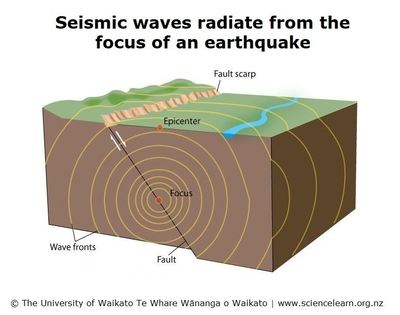
Focus or known as “hypocenter” is the point within the Earth where an earthquake or an underground explosion originates
Epicenter -is the point on the earth's surface vertically and directly above the hypocenter (or focus)
Seismic station -a station for recording oscillations (movements) of the earth’s surface caused by earthquakes and is the primary processing of the records obtained*
Seismograph or known as seismometer, is an instrument used to detect and record earthquakes
20
Seismogram is a visual record that is created by a seismograph
P-Wave travels faster than other seismic waves and hence is the first signal or wave from an earthquake to arrive at any affected location or at a seismograph that’s why it is also called as primary wave
S-Wave - is the second wave from an earthquake to arrive at any affected location that’s why it is also known as the secondary wave
Arrival Time - is the time that a seismic wave (like P and S waves) arrives at a seismic station
Lag Time - is the difference between arrival times of p and s waves
21
How do these changes occur?
What do you think are the positive and negative effects of these changes to us?
How can we prepare, react, and adapt to the upcoming changes?
22

23
The crust is the outermost layer of Earth, and it is the one we live on.

24

25
Continental Crust - thick (10-70km), buoyant (less dense than oceanic crust), mostly old
Oceanic Crust - thin (~7 km), dense (sinks under continental crust), young
26

27
28
It explains the features and movement of Earth's surface in the present and the past.
29

30
A theory that Earth's outer shell is divided into several plates that glide over the mantle, the rocky inner layer above the core.
The modern version of continental
drift, a theory first proposed by scientist Alfred Wegener in 1912.
31
If you look at a map of the world, you may notice that some of the continents could fit together like pieces of a puzzle.

32

33
•Below the lithosphere (which makes up the tectonic plates) is the Asthenosphere.
34

35
“Plates” of lithosphere are moved around by the underlying hot mantle convection cells
36
In the mantle hot material rises towards the lithosphere
The hot material reaches the base of the lithosphere where it cools and sinks back down through the mantle.
The cool material is replaced by more hot material, and so on forming a large “convection cell” (as pictured in the diagram).

37

38

Yellowstone Caldera
A map of Yellowstone National Park, Wyoming, shows the outline of the caldera of the massive Yellowstone supervolcano last erupted about 640,000 years ago.
39
Potentially Active Volcanoes in Western United States

40
How do structure and composition of the earth cause geologic activities and physical changes?
What are the possible movements of lithospheric plate movements?
What proves the movements of the tectonic plates?
41

42
The way an earthquake feels depends on where you are, where the earthquake is, and how big the earthquake is
43

44
is a vibration of the earth produced by the rapid release of energy most often because of the slippage along a fault in the earth’s crust.
45
46
SEISMIC WAVES
47

48
in SEISMOGRAPHS
49

50
A seismogram is a visual record that is created by a seismograph.
A seismograph is a piece of equipment that records earthquake
movements.
51

52
It was invented in 1935 by Charles F. Richter of the California Institute of Technology as a mathematical device to compare the size of earthquakes.
The Richter scale is used to rate the magnitude of an earthquake, that is the amount of energy released during an earthquake.
53
54
The energy that travels through the earth and is recorded on seismographs.
55
Two types of seismic waves
are categorized vibrations from an earthquakes
travel through the earth in different ways and at different speeds
can be detected and analyzed.
56
* Primary waves arrive at the detector first
P waves travel through any kind of material,
Secondary waves arrive at the detector of a seismometer second
S waves only travel through solids.
Because of the difference in velocity between P and S waves, the distance of earthquake epicenter from the recording station can be determined.

57

58

59
Triangulation Method-is a method used by seismologists to determine
the location of earthquake epicenter using 3 seismic stations

60

Show answer
Auto Play
Slide 1 / 60
SLIDE
Similar Resources on Wayground

52 questions
Endogenic Processes I
Presentation
•
11th Grade
52 questions
GASES
Presentation
•
10th Grade
53 questions
Untitled Lesson
Presentation
•
KG
56 questions
สรุปบทเรียนการแทรกสอดและการเลี้ยวเบนของแสง
Presentation
•
KG
57 questions
Biology - Units 3 and 4 Review
Presentation
•
9th - 10th Grade
56 questions
Biology 10.2, 10.3, & Cell Division Gizmo
Presentation
•
9th Grade
54 questions
Metamorphic Rocks Lesson
Presentation
•
9th - 10th Grade
58 questions
Ecology
Presentation
•
9th Grade
Popular Resources on Wayground
10 questions
How much do you know about our Portrait of an Eagle?

Quiz
•
10th Grade
10 questions
Fast Food Slogans
Quiz
•
6th - 8th Grade
21 questions
Continents and Oceans
Quiz
•
6th Grade
20 questions
Parts of Speech
Quiz
•
5th Grade
16 questions
Subject & Predicate
Quiz
•
5th Grade
25 questions
Multiplication Facts
Quiz
•
5th Grade
12 questions
Map Skills
Quiz
•
3rd Grade
22 questions
Continents and Oceans
Quiz
•
5th Grade
Discover more resources for Science
10 questions
Exploring Chemical and Physical Changes

Interactive video
•
6th - 10th Grade
10 questions
Decoding the Periodic Table of Elements
Interactive video
•
6th - 10th Grade
10 questions
Exploring the Periodic Table
Interactive video
•
6th - 10th Grade
14 questions
Physical and Chemical Changes
Quiz
•
10th Grade
22 questions
Periodic Table Review
Quiz
•
9th - 12th Grade
10 questions
Exploring the States of Matter
Interactive video
•
6th - 10th Grade
10 questions
Exploring Physical and Chemical Changes
Interactive video
•
6th - 10th Grade
21 questions
Macromolecules and Enzymes Study Guide
Quiz
•
9th - 10th Grade