

Sanctions Lesson 1

Presentation
•
Professional Development
•
12th Grade
•
Practice Problem
•
Hard

Qamar Ak
FREE Resource
71 Slides • 0 Questions
1

MEANING OF SANCTIONS
Sanctions are defined as measures or actions taken against a target to influence its behaviour, policy,
or actions. For our purposes, we have adopted a practical definition to recognize the use of
sanctions as a policy instrument. Sanctions have three components:
§ an economic action
§ taken against a target (a state, class of persons, an individual person, or even a function)
§ to influence the target’s actions
Sanctions can be:
• Restricting Trade, financial transactions, diplomatic relations, and movement
• Can be specific or general in their implementation and enforcement
• Also known as RESTRICTIVE MEASURES
2

HISTORY OF SANCTIONS
ECONOMICS SANCTIONS : The history of sanctions dated back to the 5th century. The Athenians
levied economic sanctions, banning citizens of Megara from accessing markets in the Athenian
empire - the Megarian Decree in 432 BC.
TRADE EMBARGOES: Sanctions were alternatives to war and evolved near the end of the 19th
century.
3

UNILATERAL SANCTIONS AND MUTILATERAL SANCTIONS
§ UNILATERAL SANCTIONS
§ MULTILATERAL SANCTIONS
4

PURPOSE OF SANCTIONS
Sanctions are an alternative against the use of force, an extension of a nation’s foreign policy to
bring about another nation’s change in behavior or foreign policy.
Use of sanctions
• Deterrence
• Prevention
• Punishment
Sanctions can target geography or activities. Geographic sanctions target specific countries or
regions, as in the cases of sanctions against North Korea or Crimea. Thematic sanctions focus on
particular issues or concerns that may cut across geographic boundaries, as in the case of counter-
narcotics sanctions. The EU has historically imposed geographic sanctions. In recent years, the EU
has adopted activity - or issue-based sanctions as well, including those promoting human rights.
5

PURPOSE OF SANCTIONS
§ Preventing war – Azerbaijan/Armenia Pakistan/India
§ Promoting democratic values- Syria
§ Punishing human rights abusers- China
§ Preventing nuclear proliferation and the proliferation of weapons of mass destruction-NK, Iran, Cuba
§ The freeing of captured citizens-
§ The restoration of sovereign lands- Crimea
6

PURPOSE OF SANCTIONS
Sanctions affecting behavioural change
§ Aimed to affect behavioral change through
§ Deterrence
§ Prevention
§ Punishment
7


EXISTENCE OF SANCTIONS
8

SANCTIONS GOALS
§ Toachieve enviromental objectives or human rights protections
§ Sanctions have been used in response to perceived breaches of many different types of
international standards, and for various purposes, including to influence actions. Examples of
thematic sanctions include:
§ The strengthening of human rights or labour rights
§ The freeing of captured citizens
§ The reversal of captures of land
9

USE OF SANCTIONS
PROTECTION OF FINANCIAL SYSTEM FROM INTERNATIONALCRIMINALS
• Criminals are not limited by geography
• Sanctions can be imposed to influence actions that lead to a reduction of money laundering,
terrorist financing, and the trafficking of illegal goods by reducing the flow of funds
• A sanction might aim to prevent corrupt officials from embezzling and from accessing financial
services in order to illegally launder money taken while they were ruling their country.
• USA PATRIOT ACT of 2001: Rules about deposits made into foreign bank accounts. The law states
that funds deposited in a foreign bank are subject to US jurisdiction if that foreign bank has an
interbank account in the US as well. This is because the US considers the overseas deposited
funds to also make up part of those interbank funds.
• This means that the assets of the foreign bank located at the US bank may be subject to forfeiture
if the foreign bank or one of its customers is involved in violations of sanctions or in other criminal
activity, even if the activity does not directly relate to the foreign bank’s deposits in the US. The
law applies regardless of the foreign bank’s location.
10

WHO IMPOSES SANCTIONS
• Governments and intergovernmental organizations, such as the UN and the EU, impose (i.e.,
create) sanctions through the passing of laws and regulations. These laws and regulations may
also be called “resolutions” in the case of the UN and “restrictive measures” in the case of the EU.
No matter what they are called, they are sanctions. However, at this stage, these sanctions are
merely embodied in paper and still need to be enforced.
11

GLOBALIZATION
• The effectiveness of sanctions is often determined by the number of participating countries. This
is especially true due to globalization.
• Globalization weakens sanctions because a globalized market makes it easier to replace and
reroute trade channels. Because of the expanding market, countries acting on their own without
international support have become much less effective, especially as the global economic power
of those countries diminishes.
• If a country’s trade is cut off in one way, the country will find another way to get what it wants.
One way to stop these leaks is for countries to work together as a group in order to cut off the
target from every side. It should be noted that because sanctions are a matter of foreign policy,
nations may vary in their level of commitment to sanctions enforcement.
12

UNILATERAL/MULTILATERAL/AUTNONOMOUS SANCTIONS
• The United States is most known for its unilateral sanctions.
• Multilateral sanctions are sanctions supported by more than one country. The UN is the best
example of multiple countries acting together to enforce a sanctions regime.
• Autonomous sanctions occur when a single entity, whether a government, such as Australia, or a
coalition of governments, such as the EU, acts to enforce a sanctions regime. Because multilateral
sanctions require a broader consensus among nations that may have different interests, for
example, among the five permanent members of the UN Security Council, most countries have
their own version of autonomous, unilateral sanctions.
13

UNILATERAL/MULTILATERAL/AUTNONOMOUS SANCTIONS
• EU has its own Autonomous Sanctions.
• The primary states and organizations imposing sanctions are as follows:
• United Nations (UN) (multilateral)
• United States (US) (unilateral)
• European Union (EU) (multilateral)
14

UN IMPOSING SANCTIONS
• The UN uses sanctions as a measure to achieve international peace and security based on
Article 41 of Chapter VII of its founding charter.
Key criteria for targeting individuals and entities by the UN Security Council:
• Threats to peace, security, or stability
• Violations of human rights and international humanitarian law
• Obstructing humanitarian aid
• Recruiting or using children in armed conflicts
15

UN IMPOSING SANCTIONS
• TARGETED SANCTIONS: The UN prefers targeted sanctions (sanctions against a specific person)
over comprehensive sanctions against a country or region because the latter have greater impact
on developing economies. Civilians, particularly women and children, in those areas are already
vulnerable due to being economically disadvantaged.
• Multilateral sanctions are more difficult to enact as they require more countries to have the same
foreign policy objectives. During the Cold War, the US and Russia were often at odds with each
other, so enacting sanctions in the UN was more difficult. During the period between 1978 and
1981 when the Soviet Union completed a nuclear research reactor in Tajoura, the US named Libya
as a state sponsor of terrorism. With the thawing of the Cold War, the UN Security Council, which
included both Russia and the US, adopted Resolution 748. The resolution imposed sanctions on
Libya, including an arms embargo and travel restrictions.
16

USA IMPOSING SANCTIONS
• More sanctions regulations than any other country
• The US president is given broad authority to impose sanctions under an act of Congress, such as
the International Emergency Economic Powers Act (IEEPA) or the Trading with the Enemy Act
(TWEA).
17

USA IMPOSING SANCTIONS
• OFAC (Office of Foreign Assets Control): It is the agency within
the Department of the Treasury responsible for implementing
the financial sanctions. It may work in consultation with other
agencies, such as the Department of State. A core component of
OFAC sanctions is the Specially
Designated Nationals and
Blocked Persons list, or SDN list. The SDN list contains the names
and
identifiers of individuals, companies, vessels, and other
entities whose assets are to be blocked or frozen.
• Bureau of Industry and Security (BIS): The BIS is within the
Department of Commerce. It maintains the Denied Persons List,
which is a list of persons for whom export privileges have been
denied. The BIS also administers the Export Administration
Regulations (EAR). The EAR applies to commodities, technology,
software, and other things subject to export controls.
18

USA IMPOSING SANCTIONS
• Section 311 of the USA PATRIOT Act: The Act directs the US Treasury to designate a financial
institution or jurisdiction as being of “primary money laundering concern” based on numerous
jurisdictional and institutional factors, including the extent to which the institution is used to
facilitate or promote money laundering.
• Fin CEN (the Financial Crimes Enforcement Network (FinCEN): In 2005, Fin CEN designated Banco
Delta Asia, a bank in Macau, China, as being a primary money laundering concern for allegedly
violating Treasury sanctions against North Korea. However, prior to the designation becoming
effective, the bank suffered a large number of withdrawals. Even before the Treasury had
instituted a formal rule against Banco Delta Asia, the threat of designation alone had triggered the
run on the bank. Its deposits were depleted by 34% within days, and it had to go into a
receivership.
19

EUROPEAN UNION IMPOSING SANCTIONS
• EU RESTRICTIVE MEASURES: The EU’s restrictive measures (another term for sanctions) are
prepared by the European External Action Service and agreed upon by the Council of the
European Union.
• These are adopted to “bring about a change in policy or conduct of those targeted, with a view to
promoting the objectives of the [EU’s] Common Foreign and Security Policy [CFSP].”
• As a matter of policy, the EU implements all sanctions enacted by the UN Security Council.
• The EU does not need to pass any additional resolutions or transpose UN resolutions into EU law.
However, as with its own EU sanctions,
• Member States of the EU are required to adopt their own legislation for monitoring and enforcing
sanctions, such as penalties for violations.
20

FATF – FINANCIAL ACTION TASK FORCE –
INFLUENTIAL ORGANIZATIONS
• FATF’s influence is derived from the widespread adoption of its recommendations and its blacklist
and greylist.
• Moreover, Member States of the United Nations are expected to follow FATF recommendations as
per a number of UN Security resolutions, including Resolution 2462 issued in March 2019.
21

FATF – FINANCIAL ACTION TASK FORCE –
INFLUENTIAL ORGANIZATIONS
BLACKLIST:
A list of countries that FATF has determined are noncooperative in the international fight against
money laundering and terrorist financing. This list includes countries such as Iran and North Korea.
Member countries of FATF are expected to apply countermeasures against blacklisted countries to
guard the international financial system from the risks arising out of those jurisdictions.
22

FATF – FINANCIAL ACTION TASK FORCE –
INFLUENTIAL ORGANIZATIONS
GREYLIST:
A list of countries that FATF has determined do not merit inclusion on the blacklist but have strategic
deficiencies in their anti-money laundering and counterterrorism financing regimes. Additionally,
these countries have not made sufficient progress or otherwise committed to action
plans to
address the deficiencies identified by FATF. Ongoing failure to address these deficiencies
could
eventually result in being moved from the greylist to the blacklist. Members of FATF are expected to
use caution and consider the particular risks of those countries on the greylist.
23

FATF – FINANCIAL ACTION TASK FORCE –
INFLUENTIAL ORGANIZATIONS
Consequences:
• A country places in greylist may lose access to the global financial system.
• A country places in greylist may lose access to the global financial system.
• Pakistan loses an estimated $10 billion annually as a result of its designation because
nongovernmental organizations and other financial actors avoid the operational and reputational
risks associated with dealing with Pakistan.
• Mutual Evaluation Reports (MERs):
• FATF also evaluates countries’ compliance with its recommendations through MERs.
• MERs take into account, among other things, a country’s regulatory requirements, supervisory
framework of financial institutions, sanctions regimes, international cooperation, and— most
importantly—implementation and adherence to FATF’s recommendations.
24

OTHER JURISDICTIONS – TYPES OF
SANCTIONS IMPOSED
THE UNITED KINGDOM (UK)
• The UK’s Foreign and Commonwealth Office is responsible for setting the UK’s sanctions policy.
The Office of Financial Sanctions Implementation (OFSI) implements and administers sanctions,
including the granting of licenses, and the Financial Conduct Authority (FCA) regulates firms,
including financial institutions, to ensure they have controls in place to comply with UK laws. The
Department for International Trade implements trade measures/sanctions and embargoes.
CANADA
• Canada implements its autonomous sanctions under the Special Economic Measures Act (SEMA),
which is administered and enforced by the Minister of Foreign Affairs in Canada.
25

OTHER JURISDICTIONS - TYPES OF
SANCTIONS IMPOSED
AUSTRALIA
• Australia’s sanctions regime consists of UN Security Council sanctions, including counterterrorism
sanctions, and limited autonomous sanctions concerning Iran, Libya, Myanmar, North Korea, Syria,
Russia/Ukraine, and several other territories. Australia implements autonomous sanctions under
the Autonomous Sanctions Act of 2011. Australia’s general sanctions policy is set by the
Department of Foreign Affairs and Trade (DFAT). The Australian Transaction Reports and Analysis
Centre (AUSTRAC) is also engaged in regulating financial institutions and ensuring compliance
with Australian law. Like the United States and European Union, Australia has implemented
targeted sanctions and a partial embargo of the Crimea region following Russia’s annexation of
Crimea and Sevastopol in March 2014. Australia does not impose secondary sanctions, and
Australian sanctions generally do not have “extraterritorial” effects.
SINGAPORE
• Singapore, like most Asia Pacific countries, implements UN Security Council sanctions and limited
autonomous sanctions. Financial sanctions are administered by the Monetary Authority of
Singapore (MAS).
26

OTHER JURISDICTIONS- TYPES OF
SANCTIONS IMPOSED
INDIA
• Generally speaking, India’s economic sanctions framework is less extensive than other countries in
Asia. India also retains strong economic ties to countries, such as Iran, which are subject to various
other international sanctions regimes. Like other United Nations members, India implements UN
Security Council resolutions, in particular anti-terrorism sanctions, but India does
not have
unilateral or autonomous sanctions. Indian sanctions laws generally apply within India and do not
have “extraterritorial” effects. India does not impose secondary sanctions. The Reserve Bank of
India (RBI), the country’s central bank, publishes notifications to financial institutions in India
concerning updates to relevant sanctions lists. RBI is also the country’s primary AML/CFT regulator.
SOUTH KOREA
• South Korea implements autonomous sanctions under the Prohibition on the Financing of
Offences of Public Intimidation and Proliferation of Weapons of Mass Destruction Act (amended
in May 2014 from the original act).
27

OTHER JURISDICTIONS - TYPES OF
SANCTIONS IMPOSED
THE PEOPLE’S REPUBLIC OF CHINA
• China also implements limited autonomous sanctions concerning issues such as terrorism. The
PRC Ministry of Foreign Affairs (MOFCOM) is principally responsible for oversight of PRC sanctions
and promulgates sanctions through official announcements and through other governmental
departments such as the People’s Bank of China (PBOC) and the Ministry of Public Security (MPS).
• The PRC government may, from time to time, exert economic pressure through informal directives
aimed at state-owned enterprises or limited commercial boycotts, although such initiatives do not
impose general prohibitions applicable to the public. China does not impose secondary sanctions,
and PRC sanctions generally do not have “extraterritorial” effects.
FRANCE
• France implements both EU and UN sanctions but may also establish sanctions on its own.
28

OTHER
JURISDICTIONS
GERMANY
• Germany implements both UN and EU sanctions. It also has its own autonomous sanctions that
are implemented.
HONG KONG
• Hong Kong does not have an autonomous sanctions regime. Multiple agencies share
responsibility for the administration and enforcement of sanctions in the SAR.
29

OTHER
JURISDICTIONS
JAPAN
• Japan implements both UN Security Council sanctions and certain autonomous sanctions, which
are applicable to Japanese persons and companies and in Japan’s territory.
NEW ZEALAND
• New Zealand implements UN Security Council sanctions through the country’s Ministry of Foreign
Affairs and Trade (MFAT). New Zealand sanctions are generally applicable to New Zealand citizens,
companies incorporated in New Zealand, and activities taking place in New Zealand’s territory.
New Zealand does not have unilateral or autonomous sanctions (except travel bans) and does not
impose secondary sanctions. New Zealand’s sanctions also lack “extraterritorial” effects.
30

OTHER
JURISDICTIONS
SWITZERLAND
• Switzerland implements both UN sanctions and its own autonomous sanctions.
TAIWAN
• Although not a member of the United Nations, Taiwan generally implements and enforces UN
Security Council sanctions through the Ministry of Foreign Affairs (MFA) and the Bureau of Foreign
Trade (BFT).
31

WHO IS SUBJECT TO
SANCTIONS
1. INDIVIDUALS & ENTITIES
2. THOSE WHO ARE ELIGIBLE TARGETS OF SANCTIONS
JURISDICTION: Citizens of a country (and permanent residents) must comply with sanctions
regardless of whether they are outside of their home country. This is true for US, EU, and most other
autonomous sanctions. If a person is on vacation overseas, their country’s sanctions laws still apply.
Conversely, any individual, regardless of citizenship, must comply with the sanctions law of
any
country they are in physically.
32

WHO IS SUBJECT TO
SANCTIONS
PEOPLE WHO MUST COMPLY OFAC REGULATIONS
• US citizens and permanent residents wherever located
• Companies and other entities organized under US law
• All people and organizations, whatever their origin, physically in the United States; and
• All branches of US companies and other entities throughout the world
33

FACILITATION
• This is a different restriction, which can have a broad geographic reach, concerns activities
described under the US sanctions regime as facilitation, or “approval.”
• This essentially means that a US person may not facilitate or assist the activities of a non-US
person if those activities would violate sanctions if the non-US person were a US person. This
applies to US persons located anywhere in the world. In other words, a US person cannot do
indirectly what he or she is directly prohibited from doing.
34

EXTRATERRITORIALITY OF SANCTIONS PROGRAM
EXTRATERRITORIAL JURISDICTION
• It is the ability of a state to make, apply, and enforce laws, regulations, and other rules of conduct
in respect to persons, property, or activity beyond its territory.
•The US is the primary government engaged in applying extraterritoriality to its sanctions regime.
• The EU, believing that the practice of extraterritoriality violates international law, does not allow
for the concept of extraterritoriality in relation to the sanctions restrictions it imposes.
• The EU describes extraterritorial sanctions as sanctions that “non-US citizens and companies are
also expected to comply with” outside the jurisdiction of the US. These sanctions are also known
as “secondary sanctions” as opposed to “primary sanctions.”
35

DETERMINING SANCTIONS REGIME
• Because sanctions can target individuals, sanctioned targets can be anywhere in the world, not
just in sanctioned countries or high-risk countries.
• Foreign individuals and entities could also be caught by US sanctions where it is determined that
they have caused others to violate a US sanction.
• Sanctions are constantly changing, as exemplified by the US entering into the JCPOA under
President Obama and then exiting under President Trump.
36

DETERMINING SANCTIONS REGIME
UNITED NATIONS
• The United Nations administers various ongoing sanctions regimes. Some of these regimes target
individuals and entities specific to a Member State of the United Nations. The ISIL/Al-Qaeda
sanctions regime is not specific to any country or territory. Some countries with individuals or
entities under sanctions are:
• Democratic People’s Republic of Korea
• Iran
• Libya
• Mali
• Somalia
37

DETERMINING SANCTIONS REGIME
UNITED NATIONS
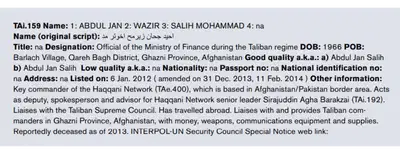
• The United Nations (UN) also maintains its United Nations Security Council Consolidated List,
which includes all persons and entities that are subject to UN sanctions. An example of a person
on the list and provided information is shown below:
United Nations Security Council Consolidated List
38

DETERMINING SANCTIONS REGIME
• UNITED STATES
• The US OFAC administers various sanctions programs, which are either comprehensive or
targeted. Examples of those targeted sanctions include Counter Narcotics Trafficking Sanctions,
Global Magnitsky Sanctions, and Transnational Criminal Organization sanctions. Examples of
comprehensive sanctions include Iran Sanctions and North Korea Sanctions. The entire list of
OFAC sanctions regimes can be found on OFAC’s website.
• Moreover, OFAC administers the widely known Specially Designated Nationals and Blocked
Persons list, commonly referred to as the SDN list. This is a published list of individuals and
companies “owned or controlled by, or acting for or on behalf of, targeted countries.” It also lists
individuals, groups, and entities, such as terrorists and narcotics traffickers, designated under
programs that are not country-specific. Collectively, such individuals and companies are called
“specially designated nationals” or SDNs. Their assets are blocked and US persons are generally
prohibited from dealing with them. The list is frequently updated.
39

DETERMINING SANCTIONS REGIME
EUROPEAN UNION
• EU sanctions in force include those issued by the United Nations as well as the autonomous
sanctions issued by the European Union. The EU has the second-highest number of active
sanctions programs, second only to the US. The EU provides an EU Sanctions Map for an overview
of its various active sanctions programs. The EU sanctions programs are categorized by:
• Those adopted by the EU and UN
• Thematic overviews
v Chemical weapons
v Cyberattacks
v Terrorism
•Country
• Measures
v Arms embargoes
v Asset freezes
v Embargoes on dual-use goods
40


DETERMINING SANCTIONS REGIME
EU also provides a consolidated list of those
sanctioned as below:
41

DETERMINING SANCTIONS REGIME
DIFFERENCE BETWEEN EU SANCTIONS AND US SANCTIONS
• EU sanctions must be reviewed and renewed at periods no longer than a year, and can even be as
short as three months; most US sanctions are open-ended and remain in force until a decision is
made to lift them.
• US sanctions are generally much broader in scope, targeting a much wider range of goods and
many more persons.
• US sanctions may be extraterritorial whereas EU sanctions prohibit extraterritoriality.
• US sanctions include those entities owned 50% or more by a sanctioned target (SDN) and
aggregate beneficial ownership, but do not include entities controlled by a sanctioned target. EU
sanctions include entities owned more than 50% by a sanctioned target, but also include entities
controlled by a sanctioned target even if ownership is not more than 50%.
42

EXEMPTIONS & EXCEPTIONS (LICENSES)
OBJECTIVE
• Minimizing the risk of assets being used by a sanction’s target to engage in restricted activities,
and
• Meeting the human rights or basic needs of a target while avoiding unintended economic
consequences for unrelated industries and parties.
EXCEPTIONS
Those exemptions can be based on purpose or class of person, or achieved through a licensing
regime. Most sanctions regimes contain general licenses for acquiring legal services, including OFAC,
which allows for providing legal services to sanctions targets for the following, among other things:
• Compliance with US and state laws so long as it is not related to the facilitation of sanctioned
activity
• Representation before an agency with respect to US sanctions
• Representation where the US law requires access to legal counsel at the public’s expense, for
example, in criminal proceedings
43

SANCTION TYPES
EXCEPTIONS
It is important to understand how to identify the various categories and types of sanctions, as the
meanings of words are important to a strong governance, risk management, and compliance
framework.
Types of Sanctions
• Trade Sanctions
• Financial Sanctions
• Comprehensive Sanctions
• Targeted Sanctions (Smart Sanctions)
• Sectoral Sanctions
• Travel Bans
44

SANCTION TYPES
ECONOMIC SANCTIONS
Economic sanctions can be divided into trade sanctions and financial sanctions. Economic sanctions
are intended to impact targets in two primary ways:
• Imposing trade sanctions that limit the target country’s exports or restrict its imports
• Imposing financial sanctions that impede finance (including reducing aid)
45

SANCTION TYPES
TRADE SANCTIONS
Embargoes are trade sanctions that intend to limit the targeted country’s imports and exports. Trade
sanctions in the form of limits on a country’s exports aim at reducing its foreign sales and its foreign
exchange. Trade sanctions in the form of limits on a country’s imports (or the sanctioning country’s
exports to the target country) aim to deny the targeted country critical goods. When the sanctioning
country exports a large percentage of total global output, the imposition of export restrictions may
cause higher prices for alternative sources and for alternative goods.
TRANSSHIPMENT
It is the shipment through intermediate countries prior to the goods’ final destination. This can
become risky as these intermediate countries might be sanctioned, as in the case of shipping goods
first through a port of Iran prior to landing in Afghanistan. Sanctions regimes may also specifically
prohibit transshipment of goods.
46

SANCTION TYPES
Arms embargoes
These are a specific type of embargo that only applies to weapons and dual-use goods, which are
goods that can be used for both civilian and military purposes.
The Wassenaar Arrangement
The Wassenaar Arrangement on Export Controls for Conventional Arms and Dual-Use Goods and
Technologies, or the Wassenaar Arrangement (WA), includes 42 states that have committed to
greater responsibility and transparency in the exports of weapons and dual-use goods. The core
objective of the WA is to provide information to members on those entities whose application for
export licenses for providing certain goods were denied.
47

SANCTION TYPES
FINANCIAL SANCTIONS
• Financial sanctions may come in many forms. Governments may impose financial sanctions by
prohibiting government loans and intergovernmental loans to targeted countries, or they may
interrupt their commercial finance by labelling them as non-cooperative or of primary money
laundering concern.
• This hurts the economy by causing the target country to pay higher interest rates and also by
drying up their funding, as creditors avoid the additional credit risk or the risk of being
sanctioned themselves.
• Sanctions may also come in the form of asset freezing. For asset freezes, the assets of a
sanctioned target are required to be held or “frozen,” and the sanctioned target cannot access or
use them. This comes most often in the form of frozen bank accounts (or “blocked” bank
accounts, as they are more commonly called in the US).
48

SANCTION TYPES
COMPREHENSIVE SANCTIONS
• Comprehensive sanctions aim to prevent all transactions between a sanctioning country and the
sanctioned country. Comprehensive sanctions nonetheless generally allow for exemptions for
humanitarian and medical purposes under a general license.
• However, outside of those exemptions, there can be no imports, exports, provision of financing,
exchange or distribution of technology, or any other financial or trade activity.
• Comprehensive sanctions would also include a full trade embargo and a cease of diplomatic
relations.
49

SANCTION TYPES
TARGETED SANCTIONS (SMART SANCTIONS)
• Targeted sanctions, sometimes called “smart sanctions,” allow for greater discrimination in
imposing sanctions, especially considering that a particular geographic location can contain many
different ethnicities, minorities, and other groups.
• The idea is that the policy and behavior of the government is not necessarily reflective of the
attitudes of the people being governed. Targeted sanctions also reject the philosophy that causing
civilian pain and unrest leads to political change, or hold that if it does, such a trade-off is not
acceptable.
50

SANCTION TYPES
SECTORAL SANCTIONS
• This type of sanction is even narrower than targeted sanctions. Sectoral sanctions target key
entities as well as sectors of a country’s economy. These sanctions are meant to be highly
tailored. Sectoral sanctions prohibit certain types of transactions with certain people or entities in
the targeted country within a targeted sector of the economy. Sectoral sanctions are very
dependent on fact when applied.
• The corresponding list is called SSI: Sectoral Sanctions Identification, which is published by OFAC.
51

SANCTION TYPES
TRAVEL BANS
• Travel bans are sanctions that limit where an individual can travel.
• They often come in the form of denying visas to individuals, such as political and military leaders
of the sanctioned country.
• These travel bans can undermine leaders’ legitimacy, illustrate moral resolve, and also cut off
these individuals from accounts that they may hold overseas.
• Travel bans are most effective when used with other types of sanctions.
52

SANCTION TYPES
CONSEQUENCE FOR NON-COMPLIANCE
• Can result in civil penalties and criminal punishments, even prison
• OFAC uses its enforcement guidelines as the method for determining whether additional
investigation is merited, whether there should be a civil penalty, and if so, what the amount of
the civil penalty should be.
• Another consideration is whether the entity voluntarily self-disclosed the potential violation. If a
company determines that it has violated OFAC sanctions, it may file a voluntary self-disclosure,
taking the position that the violation only constitutes a civil violation as opposed to a criminal
violation. However, a company may file a voluntary self-disclosure and OFAC may disagree with its
filings or the nature of the violation (civil or criminal).
• In response to a violation, OFAC may take no action, or may take a number of actions, including
issuing a caution, imposing a civil monetary penalty, or even referring the case for criminal
prosecution.
53

SANCTION TYPES
Consequences to the Organization
• Sanctions are generally strict liability for organizations.
• Strict liability means the organization is liable even if it did not intend to violate the sanctions or
knowingly violate the sanctions.
• Organizations are also liable even if they have robust sanctions compliance programs in place.
• When assessing a penalty on an organization, OFAC takes into account whether the organization
acted knowingly and how sophisticated the organization’s sanctions compliance program is.
54

REPUTATIONAL DAMAGE
• Reputational damage or reputational risk is the risk of losing financial capital, market share, good
will, or other revenue because of negative perception about a firm’s reputation.
• Fines and penalties, especially when they are ongoing because a firm fails to remediate the
issues, also may impact valuations and investor portfolios.
55

REGULATOR EXPECTATIONS
• Be demonstrably aware of international sanctions obligations.
• Be compliant at all times with the applicable sanctions requirements.
• Focus on implementing appropriate systems and controls to mitigate sanctions risks.
• Implement appropriate measures to ensure asset freezing and account blocking controls are
applied effectively.
• Do not ignore “low-risk” areas or assume there are no sanctions risks present
• Do not rely on intermediaries or other financial institutions to screen customers they have
referred without first verifying such screening has occurred.
• Review outsourcing partners who assist in the management of sanctions risk, (e.g., parties who
conduct screening and investigations).
• Ensure that employee sanctions training includes “red flags.”
• Periodically test sanctions controls to ensure they are fit for their purpose and not being
circumvented by staff members.
56

RISK ASSESSMENT
• Risk assessment is an important tool that allows a business to identify and assess the extent to
which it may be exposed to risk. In global banking, risk assessments form the foundation of a
sound sanctions compliance program.
• A well-planned and well-formulated risk assessment allows a business to understand its risk
profile and then determine its risk appetite for undertaking business in situations in which there
could be an elevated sanctions risk.
57

RISK APETITE
• The amount of risk that a firm is willing to accept in pursuit of value or opportunity.
• A firm’s risk appetite reflects its risk management philosophy and comfort level for
undertaking business in situations in which there could be an elevated sanctions risk.
• A business should determine its risk appetite based on the resources it has to invest in
controls, staffing, and measures to protect its reputation.
• Regulators frequently expect businesses to be able to explain how they decide what types of
customers to accept, based on the level of sanctions risk they have determined they can
manage.
58


RISK FORMULA: INHERENT RISK, CONTROL EFFECTIVENESS, AND
RESIDUAL RISK
59

RISK FORMULA: WHAT IS INHERENT RISK, CONTROL
EFFECTIVENESS
Inherent risk: It is the level of sanctions risk that exists before controls are applied to mitigate them.
There are four main inherent risk categories:
• customers,
• products and services,
• countries, and
• delivery channels
Control Effectiveness: Control effectiveness (also referred to as mitigation measures or quality of
risk management) is the measurement of the quality of controls used to mitigate a business’
inherent risks. These controls should be both appropriate and effective to mitigate the identified
sanctions risks.
60

CONTROL EFFECTIVENESS - CONTROLS
LIST OF CONTROLS TO BE USED WITHIN THE SANCTIONS COMPLIANCE PROGRAM
• Governance Policies and procedures
• Know your customer/due diligence (including beneficial ownership)
• Management information
• Recordkeeping and retention
• Sanctions blocks/rejections
• Monitoring
• Training and awareness
• Independent testing
61

RESIDUAL RISKS
The residual risk is the amount of risk or danger associated with an action or event remaining after
natural or inherent risks have been reduced by risk controls.
So a business has four options for managing the remaining or residual risk:
1. Transfer
2. Avoid
3. Mitigate the risk
4. Accept
62

GOOD AND POOR PRACTICES
SANCTIONS RISK ASSESSMENT
GOOD PRACTICES
• Conduct a risk assessment that is suited to the
business’ size and complexity
• Account for customers’ directors and beneficial
owners
• Record the methodology and procedures used
• Validate the accuracy of the data
• Include a mixture of both qualitative
and
quantitative analysis
• Use the
same
methodology
for
each
risk
assessment
POOR PRACTICES
• Omit suppliers, businesses partners, and other
third parties
• Conduct the assessment based on a poor
understanding of requirements
63

STAYING CURRENT ON SANCTIONS
• Sanctions are continually changing
• Includes requiring vendors to provide updated lists
• Monitoring government websites through subscriptions
• Creating tailored news alerts
• Useful resource is the ACAMS newsletter moneylaundering.com
• Stay abreast of current changes facing the European sanctions regime
• Source of Information - The UN Security Council website
• OFAC website for additional information and register for Recent Action updates
64


POLICIES, PROCEDURES, AND INTERNAL CONTROLS
SANCTIONS COMPLIANCE POLICIES, PROCEDURES, AND INTERNAL CONTROLS
65

TESTING AND AUDITING
WHY IS TESTING AND AUDITING REQUIRED?
• Audits assess the effectiveness of current processes and identify any inconsistencies between the
policies and day-to-day operations
• Ensures that an organization can rectify any weaknesses or deficiencies that are identified
• Necessary updates can include improving and/or recalibrating elements of the sanctions
compliance program to account for any shifting risks or changes to the sanctions environment
• An effective internal audit department develops and maintains an audit risk assessment to
determine audit priorities
• Helps develop and maintain detailed audit testing programs for every area
66

EMPLOYEE TRAINING
Training program should be provided to all appropriate employees and personnel on a periodic
basis by financial institutions
TRAINING PROGRAM SHOULD ACCOMPLISH:
• Provide job-specific knowledge based on need
• Communicate the sanctions compliance responsibilities for each employee
• Hold employees accountable for sanctions compliance training through assessments
67

EMPLOYEE TRAINING
COMPONENTS OF AN EFECTIVE TRAINING PROGRAM
• Provide job-specific knowledge based on need
• An effective training program should explain the relevant sanctions laws and regulatory
expectations and cover the institution’s policies and procedures used to mitigate sanctions
compliance risks.
• Training will include both formal training courses and ongoing communications—emails,
newsletters, periodic team meetings, intranet sites, and other means that facilitate the sharing of
information—that serve to educate employees and maintain their awareness of sanctions
compliance requirements.
68

EMPLOYEE
TRAINING
IDENTIFYING THE TARGET AUDIENCE
Training programs must extend beyond full-time and part-time employees to include contractors,
consultants, interns, apprentice placements, and/ or secondees (colleagues from other offices,
branches, or subsidiaries)
WHO SHOULD BE PROVIDED WITH TRAINING:
1.Customer-facing staff
2.Operations personnel
3.Sanctions compliance staff
4.Independent testing staff
5.Senior management and board of directors
69

EMPLOYEE
TRAINING
TRAINING TOPICS
• General background and history pertaining to sanctions, such as sanction types, evasion tactics,
and consequences of noncompliance
• Legal framework of what sanctions laws apply to institutions and their employees
• Penalties for sanctions noncompliance, including criminal and civil penalties, fines, jail terms, and
internal sanctions (e.g., disciplinary action up to and including termination of employment)
• Internal policies and procedures, including customer due diligence, enhanced due diligence,
ongoing due diligence, and any additional sanctions-relevant policy elements
• Review of the internal sanctions risk assessments
• Legal record-keeping requirements
• Sanctions filtering and blocking requirements
• Reporting requirements
70

EMPLOYEE TRAINING
TRAINING METHODS
• Identify the issues that need to be
communicated and decide how best to
disseminate the message
• Identify the audience by functional area as well • Consider tests as a means to evaluate how well
• Consider whether handouts would be helpful to
reinforce the message of the training and serve
as a reference tool after training has concluded
the training was understood, and implement a
mandatory passing score
• Consider using case studies in the training to
illustrate points and emphasize the practical
application of the course content
• Include time for discussion
• Consider the audience’s attention span, and
plan to teach small, easy-to-digest, easy-to-
categorize issues
• Track attendance. Ask attendees to sign in for
each session, and issue reminders if make-up
sessions are needed
71


EMPLOYEE TRAINING
TRAINING TIMING AND LOCATIONS
• Institution’s training should be ongoing and on a regular schedule
• Existing employees should at least attend an annual training session
• New employees to received training within a reasonable period of time
• Changes in software, systems, policies, procedures, and regulations should call for training
sessions
• Any significant regulatory order or news story naming the institution should also require
emergency training session
• Some institutions have training centres that allow trainees to escape the distractions of daily
work activity and focus on learning new information.
MEANING OF SANCTIONS
Sanctions are defined as measures or actions taken against a target to influence its behaviour, policy,
or actions. For our purposes, we have adopted a practical definition to recognize the use of
sanctions as a policy instrument. Sanctions have three components:
§ an economic action
§ taken against a target (a state, class of persons, an individual person, or even a function)
§ to influence the target’s actions
Sanctions can be:
• Restricting Trade, financial transactions, diplomatic relations, and movement
• Can be specific or general in their implementation and enforcement
• Also known as RESTRICTIVE MEASURES
Show answer
Auto Play
Slide 1 / 71
SLIDE
Similar Resources on Wayground

69 questions
Parts and Function of a Cell
Presentation
•
11th Grade
66 questions
CCU8 Ox number and 1/2 reactions
Presentation
•
12th Grade
67 questions
EPF, Module 7: Consumer Skills
Presentation
•
12th Grade
65 questions
Ch. 10 Urology review
Presentation
•
12th Grade
65 questions
ENEM - CÓDIGOS E LINGUAGENS - ARTE
Presentation
•
12th Grade
65 questions
Biomolecules
Presentation
•
11th Grade
65 questions
Pre-icfes intensivo 1
Presentation
•
11th Grade
67 questions
Heart lecture
Presentation
•
12th Grade
Popular Resources on Wayground
10 questions
How much do you know about our Portrait of an Eagle?

Quiz
•
10th Grade
10 questions
Fast Food Slogans
Quiz
•
6th - 8th Grade
21 questions
Continents and Oceans
Quiz
•
6th Grade
20 questions
Parts of Speech
Quiz
•
5th Grade
16 questions
Subject & Predicate
Quiz
•
5th Grade
25 questions
Multiplication Facts
Quiz
•
5th Grade
12 questions
Map Skills
Quiz
•
3rd Grade
22 questions
Continents and Oceans
Quiz
•
5th Grade