
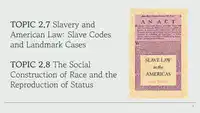
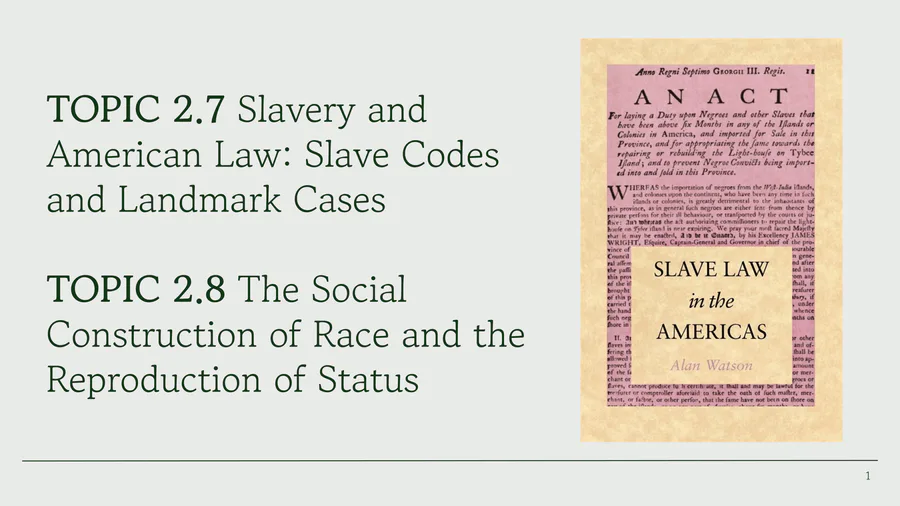
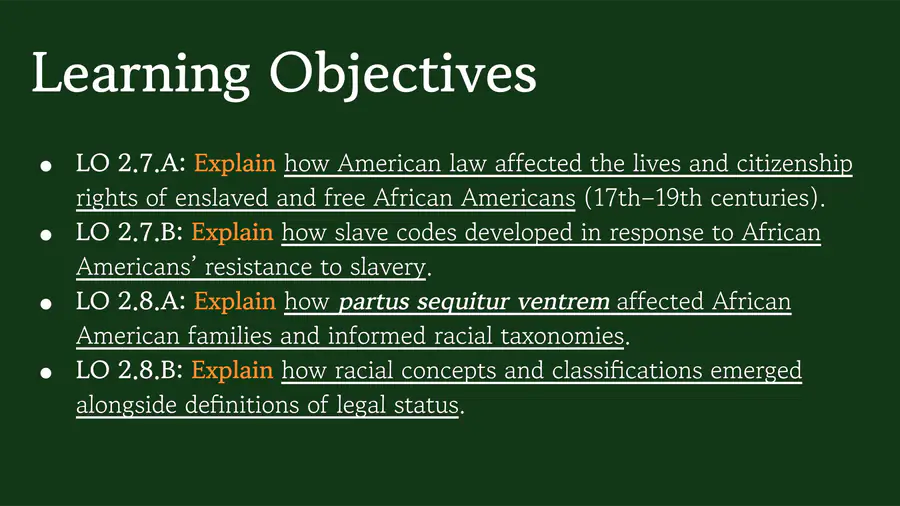
TOPIC 2.7/2.8 Lesson

Presentation
•
Social Studies
•
12th Grade
•
Practice Problem
•
Medium

Cydney Gobourne Doughty
Used 1+ times
FREE Resource
11 Slides • 7 Questions
1
2


5


8

9


11

12
Multiple Choice
Which colony implemented the Code Noir as a set of slave laws?
English colonies
French colonies
Spanish colonies
Dutch colonies
13
Multiple Choice
How did slave codes define the condition of chattel slavery?
As a voluntary labor agreement
As a temporary condition based on debt
As a race-based, inheritable, lifelong condition
As a form of indentured servitude
14
Multiple Choice
How did South Carolina's 1740 slave code respond to the Stono Rebellion?
By prohibiting enslaved people from gathering, drumming, and learning to read
By granting enslaved people more rights
By banning all forms of punishment
By abolishing slavery in the colony
15
Multiple Select
Which clauses embedded slavery into the nation’s founding document, protecting slaveholders' interests. (Select ALL that apply).
Seperate but Equal
Fugitive Slave Clause
Three-Fifths Compromise
Clause prohibiting Congress from banning the slave trade until 1808
16
Multiple Choice
Which U.S. Supreme Court case declared that African Americans could never be U.S. citizens?
17
Multiple Choice
What legal principle determined a child's enslaved status based on their mother?
Habeas corpus
In loco parentus
Three-Fifths Compromise
18
Multiple Choice
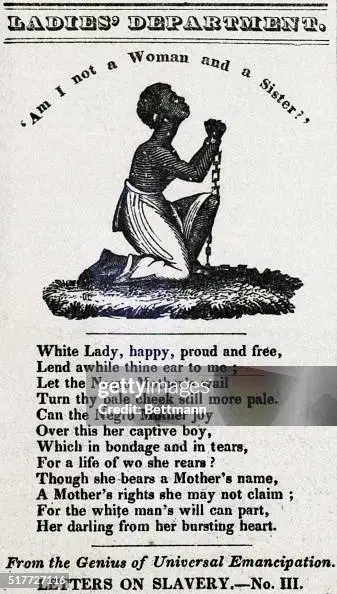
What was the significance of the image “Am I Not a Woman and a Sister?” published in 1849 in The Liberator?
It was a promotional piece for slavery.
It was used to promote the idea that women, particularly black women, were inferior.
Show answer
Auto Play
Slide 1 / 18
SLIDE
Similar Resources on Wayground

14 questions
American Government: Foundations of Government
Presentation
•
12th Grade
13 questions
Unit 2 Test Review
Presentation
•
12th Grade
15 questions
VSC 3.1--Articles of Confederation: Strengths and Weaknesses
Presentation
•
11th Grade
15 questions
Gilded Age
Presentation
•
11th Grade
14 questions
AP 10 Q4 M3
Presentation
•
12th Grade
11 questions
Income Tax Brackets
Presentation
•
12th Grade
15 questions
Beginning the Journey in Literacy
Presentation
•
12th Grade
12 questions
The Accounting Equation
Presentation
•
12th Grade
Popular Resources on Wayground
15 questions
Grade 3 Simulation Assessment 1

Quiz
•
3rd Grade
22 questions
HCS Grade 4 Simulation Assessment_1 2526sy
Quiz
•
4th Grade
16 questions
Grade 3 Simulation Assessment 2
Quiz
•
3rd Grade
19 questions
HCS Grade 5 Simulation Assessment_1 2526sy
Quiz
•
5th Grade
17 questions
HCS Grade 4 Simulation Assessment_2 2526sy
Quiz
•
4th Grade
20 questions
Equivalent Fractions
Quiz
•
3rd Grade
24 questions
HCS Grade 5 Simulation Assessment_2 2526sy
Quiz
•
5th Grade
20 questions
Math Review
Quiz
•
3rd Grade
Discover more resources for Social Studies
15 questions
AP Gov Required SCOTUS Cases
Quiz
•
10th - 12th Grade
48 questions
Civics EOC Practice Questions
Quiz
•
12th Grade
50 questions
US History EOC Review
Quiz
•
9th - 12th Grade
18 questions
Foundational Documents
Quiz
•
11th - 12th Grade
30 questions
AP Psychology Unit 5: Mental and Physical Health
Quiz
•
12th Grade
40 questions
Stuffa
Quiz
•
9th - 12th Grade
38 questions
Government Unit 4/5 Review
Quiz
•
12th Grade
19 questions
AP Gov Required documents
Quiz
•
12th Grade