
Search Header Logo
Lesson #24: The Homefront

Lesson #24: The Homefront

Assessment

Presentation

Social Studies

10th Grade

Practice Problem

Medium

Created by

Jacob Smith

Used 3+ times

FREE Resource

44 Slides • 16 Questions

1

media

2

Open Ended

Question image

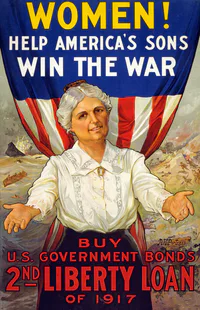
Identify two or more key details. The details can be from the picture or the words found on the poster.

3

Open Ended

Question image

What feelings might this poster have created for people during this time?

4

Open Ended

Question image

Identify two or more key details. The details can be from the picture or the words found on the poster.

5

Open Ended

Question image

What feelings might this poster have created for people during this time?

6

media

7

media

8

media

9

Multiple Choice

Question image

What impact did the labor shortage caused by men going to war have on women in the United States during World War I?

1

Women were discouraged from working outside the home.

2

Women were offered jobs in offices, shops, and factories previously reserved for men.

3

Women were required to serve in the military.

4

Women were excluded from participating in the war effort.

5

Massive numbers of previously unemployed women started seeking employment.

10

media

11

media

12

media

13

media

14

media

15

media

16

media

17

media

18

media

19

media

20

media

21

Multiple Select

Question image

What strategies did the U.S. government use to create a united war effort? (Choose Three)

1

Created anti-German movies & pamphlets

2

Spread propaganda in many languages to reach immigrants

3

encouraged people to save materials that could be recycled

4

Made speaking German illegal on American soil

22

media

23

media

24

media

25

media

26

media

27

media

28

media

29

media

30

media

31

media

32

Match

Question image

Match each group to their contributions during World War I.

wearing outfits with less fabric

agreeing to avoid unrest while the country was at war

encouraged ordinary citizens to buy liberty bonds

producing more food than before

women

labor unions

celebrities

farmers

33

media

34

media

35

media

36

media

37

media

38

media

39

Multiple Select

Question image

Using the map, which states were locations that African Americans migrated AWAY from during the Great Migration?

1

Texas

2

Ohio

3

Georgia

4

Mississippi

5

New York

40

Multiple Select

Question image

Using the map, which cities were locations African Americans migrated to during the Great Migration?

1

Detroit

2

Atlanta

3

New York City

4

Chicago

5

Baltimore

41

media

42

Multiple Select

Question image

How did World War I contribute to the Great Migration? (Select two)

1

Southern states used the war as a justification to expand Jim Crow laws.

2

Wartime manufacturing expanded in the North, creating new jobs that Black southerners sought to fill.

3

Black Americans served disproportionately in World War I, and many left home after returning from the war.

4

World War I led to a temporary drop in immigration from Europe, creating job openings for Black southerners.

5

German workers were forced out of jobs, creating openings for Black southerners.

43

Multiple Choice

Question image

Which of these did not occur for African Americans during World War I?

1

The army completely integrated their units.

2

Changing settling patterns led to racial tensions and riots.

3

Many African Americans moved north for jobs.

4

Community leaders disagreed about whether or not to support the war.

44

media

45

media

46

media

47

media

48

media

49

media

50

media

51

media

52

media

53

media

54

media

55

Open Ended

Which constitutional amendment in the Bill of Rights was violated during World War I?

56

media

57

Dropdown

Question image
Although most ​
supported the war, they faced much suspicion because they were not seen as Americans. In 1917, Congress passed the ​
, which prohibited spying or otherwise hurting the war effort. Later, they passed the ​
, which prohibited much criticism of the ​
. In ​
, the Supreme Court said that those acts did not qualify as free speech.

58

Match

Drag each term to its correct definition.

beginning during World War I, the mass movement of millions of African Americans from the rural South to cities in the North and Midwest in order to take jobs in industry

an organization, established by a group of pacifist women in 1915 in response to World War I beginning in Europe, that called for arms limitations and mediation to take the place of combat in Europe

a government agency created by President Woodrow Wilson in 1917, during World War I, to promote pro-war propaganda to the American public

a government-issued bond sold during World War I to raise money for the Allied war effort

Great Migration

Women's Peace Party

Committee on Public Information

liberty bond

59

Match

Drag each term to its correct definition.

a law passed by Congress in 1918 to make it illegal to say anything disloyal, profane, or abusive about the government or the war effort

a nickname for members of the Industrial Workers of the World (IWW), an anticapitalist labor organization founded in 1905

a law passed by Congress in 1917 to make it illegal to spy, interfere with government foreign policy, or resist the military draft

the 1919 Supreme Court case that declared that Charles Schenck's propaganda efforts against the military draft were illegal under the Espionage Act of 1918 and were not protected by his First Amendment right to freedom of speech

Sedition Act

Wobblies

Espionage Act

Schenck v. United States

60

Open Ended

Question image

In 2-3 sentences describe how Americans helped the war effort on the Homefront during World War I. Use evidence from the Lesson!

*WARNING THIS QUESTION IS WORTH 4 POINTS!!!

media

Show answer

Auto Play

Slide 1 / 60

SLIDE
