Search Header Logo
Ocean Features

Ocean Features

Assessment

Presentation

Science

9th - 12th Grade

Medium

NGSS
MS-ESS2-3, MS-ESS2-2, MS-ESS2-1

+9

Standards-aligned

Created by

Josiah Lawrence

Used 2+ times

FREE Resource

32 Slides • 55 Questions

1

media
media
media
media

2

Word Cloud

What are some words that describe the Ocean? Or words that come to mind?

3

media
media
media

4

Multiple Choice

Question image

Most geologists think that the movement of Earth's tectonic plates is caused by

1

the rotation of the Earth.

2

the Earth's magnetic field.

3

subduction.

4

convection currents.

5

Multiple Choice

The pieces of Earth's crust that compose the lithosphere
1
Tectonic plates
2
Core
3
Asthenosphere
4
Fault

6

Multiple Choice

Which layer of Earth is characterized by rock that is plastic, or soft enough to flow?
1
asthenosphere
2
crust
3
lithosphere
4
inner core

7

Multiple Choice

Plate Tectonics is repsonsible for the

1

Geological afeatures on the earth's crust.

2

The dominate winds on planet earth and other weather features.

3

The amount of liquid water recycled in the ocean.

4

The biodiversity in the geosphere as well as magnetosphere.

8

media
media
media
media

9

media

10

media

11

Multiple Choice

Question image

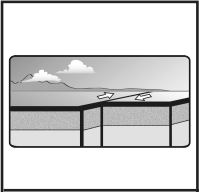
What type of boundary is this?

1

convergent

2

divergent

3

transform

12

Multiple Choice

Question image

What type of boundary is this?

1

convergent

2

divergent

3

transform

13

Multiple Choice

Question image

What type of boundary is this?

1

convergent

2

divergent

3

transform

14

Multiple Choice

The point where one plate slides beneath another is known as the ______________.

1

lithosphere

2

Pangaea

3

subduction zone

4

tectonic

5

Wegener

15

Multiple Choice

Question image

What geologic feature/event would you most likely to find at a divergent boundary between two pieces of oceanic crust?

1

Rift Valley

2

Mid-Ocean Ridge

3

Island Arc

4

Flat land

16

Multiple Choice

Question image

Use the diagram to answer the question. What results as the two oceanic plates converge?

1

formation of a deep sea trench and island volcanoes

2

earthquake activity and appearance of a transform fault

3

volcanic eruption along both oceanic plate edges

4

formation of a continental mountain range

17

media
media
media

18

media

19

Multiple Select

Mid-ocean ridges are the sites of intense _________ activity.

1

emotional

2

volcanic

3

earthquake

4

mathematical

20

Multiple Select

Question image

___________ is the process by which

new oceanic lithosphere (sea floor) forms as magma rises to Earth’s surface and solidifies at a mid-ocean ridge.

1

Continental drift

2

Sea-floor spreading

3

Plate tectonics

4

Mid-ocean range

21

Multiple Select

Old oceanic crust is more dense than new oceanic crust because it is _______________.

1

hot

2

moving toward a deep-ocean trench

3

cool

4

closer to the mid-ocean ridge

22

Multiple Choice

The OLDEST seafloor is located? 
1
Closest to the mid-ocean ridge
2
Farthest from the mid-ocean ridge

23

media
media

24

media
media

25

media

26

Multiple Select

Question image

Magnetic reversal is the process by which ________________.

1

the Earth's north and south magnetic poles periodically change places

2

the continents once formed a single landmass, broke up, and drifted to their present locations

3

new oceanic lithosphere (sea floor) forms as magma rises to Earth’s surface and solidifies at a mid-ocean ridge

27

Multiple Select

Throughout Earth's history, the north and the south magnetic poles have switched places many times.

1

true

2

false

28

Match

Match the following

Paleomagnetism

Plate Tectonics

Sea-Floor Spreading

Trench

Magma

the study of magnetic minerals in rock

theory of how lithospheric plates move and change shape

process by which new ocean floor forms as magma rises and solidifies at the Mid-Ocean Ridge

long, narrow, steep depression that forms on the sea floor as a result of subduction

liquid rock produced under the Earth's surface

29

media
media
media

30

media

31

Multiple Choice

Question image

What two crustal features occur near every subduction zone?

1

Volcanoes and Trenches

2

Rift Valleys and Mid Ocean Ridges

3

Volcanoes and Rift Valleys

4

Mid Ocean Ridges and Trenches

32

Multiple Choice

A valley in the ocean created when one lithosphere plate subducts under another

1
Canyon
2
Ridge
3
Mountain
4

Deep-ocean Trench

33

Multiple Choice

Mountain-building generally occurs at what type of boundary?

1

convergent

2

divergent

3

transform

34

media

35

media
media

36

media

37

Match

Question image

Match the following

continental slope

seamount

abyssal plain

mid ocean ridges

volcanic island

A

B

C

D

E

38

Multiple Choice

The feature found near the oldest part of the ocean would likely be

1

continental shelf, or rise

2

Abyssal Plain

3

Hydrothermal Vents

4

Abyssal Hills

39

Multiple Choice

the newest ocean floor would be found where

1

mid ocean ridge

2

The Gulf of Mexico

3

The South Pacific

4

The Red Sea

40

Multiple Choice

The Mariana __________ is the deepest known place on Earth

1

Volcanoe

2

Seamount

3

Ridge

4

Trench

41

Multiple Choice

Which best represents the order of seafloor features as you move from the shoreline to the deep ocean?
1
 Continental slope – continental shelf- continental rise – mid-ocean ridge
2
 Continental rise – continental shelf – mid-ocean ridge -  continental slope
3
 Continental shelf – continental slope – continental rise – mid-ocean ridge
4
   Mid-ocean ridge – continental rise – continental shelf- continental slope

42

Multiple Select

Question image

The letter "A" represents what part of the ocean?

1

Continental Rise

2

Continental Shelf

3

Seamounts

4

Continental Slope

5

Beach / Shoreline

43

Multiple Choice

This is the deepest part of the ocean floor and the flattest part on Earth.

1

continental rise

2

abyssal plain

3

continental shelf

4

continental slope

44

media
media

45

media

46

media

47

media

48

media
media

49

Multiple Choice

Hotspots are volcanoes that form...

1

at convergent plate boundaries.

2

at divergent plate boundaries.

3

at transform plate boundaries.

4

in the middle of a tectonic plate.

50

Multiple Choice

Question image

Which island is the oldest?

1

A

2

B

3

C

4

D

5

E

51

Multiple Choice

Question image

What type of island is pictured here?

1

Raised coral island

2

Volcanic island

3

Continental island

4

Coral atoll

52

media
media
media

53

media
media

54

Multiple Choice

What is special about marine life in the intertidal zone 
1
cannot live under water
2
must be able to live underwater and on land
3
have strong shells covering their bodies
4
only plants can live in this zone

55

Multiple Choice

swim in the actively in the open ocean
1
plankton
2
nekton
3
benthos
4
pelagic

56

Multiple Choice

live in or on the ocean floor
1
plankton
2
nekton
3
benthos
4
pelagic

57

Multiple Choice

Question image

On the image, the water area between the low tide mark of the intertidal zone and the edge of the continental shelf, right before the continental slope is called:

1

nautical zone

2

benthic zone

3

nueston zone

4

neritic zone

58

Multiple Choice

Which zone is rich in nutrient due to upwelling?

1

intertidal

2

neritic

3

open ocean

59

media
media

60

media

61

media

62

Multiple Choice

Question image

Which of the following is the best answer based on this statement: This zone is the largest zone in the ocean.

1

Neritic

2

Intertidal

3

Oceanic

4

Sunlight

63

Multiple Choice

Which process occurs in the ocean and contributes large amounts of oxygen to the atmosphere?
1
digestion by fish
2
decomposition by bacteria
3
respiration by zooplankton
4
photosynthesis by phytoplankton

64

Multiple Choice

A snaggletooth fish has a glowing lure that extends from its chin to attract prey. In which ocean zone does this fish most likelylive?
1
bioluminescent zone
2
intertidal zone
3
neritic zone
4
oceanic zone

65

Multiple Choice

Which statement best describes how nutrients move in the ocean as a result of upwelling?
1
Nutrients move from estuaries into the intertidal zone.
2
Nutrients move from warm, shallow areas to deep, colder areas.
3
Nutrients move from the neritic zone to the intertidal zone.
4
Nutrients move from deep, colder areas to warm, shallow areas.

66

Multiple Choice

Question image

Which ocean zone allows plants to grow??

1

midnight zone

2

photic zone

3

twilight zone

4

intertidal zone

67

Multiple Choice

Question image

Phytoplankton are abundant in this ecosystem, because they are buoyant and float in the upper part of the water.

1

Intertidal zone (high tide)

2

Ocean (aphotic zone)

3

Ocean (photic zone)

4

Intertidal zone (low tide)

68

media
media
media
media
media

69

media
media
media

70

media

71

media

72

Multiple Choice

Which light zone contains the majority of marine animals? 
1

photic, or neretic (coastal) or epipelagic

2

benthic

3

aphotic

4

pelagic zones

73

Multiple Choice

List the following pelagic zones in order from surface of the ocean to the bottom: 
1
abyssopelagic,  bathypelagic,  epipelagic ,mesopelagic
2
epipelagic, bathypelagic, abyssopelagic,  bathypelagic
3
epipelagic, mesopelagic, bathypelagic, abyssopelagic
4
mesopelagic,  epipelagic,     bathypelagic,    abyssopelagic

74

Multiple Choice

The word "pelagic" is at the ending of the zones we are studying. What does "pelagic" mean? 
1
relating to a type of dolphin
2
it means blue 
3
relating to a type of turtle
4
relating to the open sea

75

Multiple Choice

Why are most marine animals found in the photic zone?
1
It is so dark there that all animals have adapted to it
2
The sunlight in that area allows for photosynthesis
3
The wind from that area helps marine animals to swim
4
The photic zone helps to shelter marine animals away from predators

76

Multiple Choice

More people have been to the moon than have explored the deep _____________.

1

trench, or hadopelagic zone.

2

twilight, or mesopelagic zone.

3

sunlight, or epipelagic zone.

4

dark, or bathypelagic zone.

77

Multiple Choice

_____________ zone is the common name of the mesopelagic zone because the diffused light from the sun is dim in this zone.

1

Sunlight

2

Twilight

3

Midnight

4

Afternoon

78

media
media
media
media

79

media
media

80

media

81

Multiple Choice

 As the temperature of ocean water changes from 10 to 30 degrees C, how does the density change?
1
The water becomes more dense
2
The water becomes less dense
3
 The density does not change 
4
 It is impossible to predict

82

Multiple Choice

 The density of ocean water is influenced by what two factors?
1
 Salinity and temperature
2
Water color and chlorophyll
3
 Dissolved gases and dissolved solids
4
 Dissolved carbon and trace elements

83

Multiple Choice

The temperature and salinity of the ocean change the most:
1
Near the surface
2
 Near the bottom
3
 Near Antarctica
4
Near the equator

84

Multiple Choice

Question image
T4 - Seawater is typically denser than freshwater due to seawater’s —
1
Greater depth
2
Lower freezing point
3
Smaller mass
4
Higher salinity

85

Multiple Choice

The gradual increase in density as depth increases is the

1

halocline

2

pycnocline

3

metacline

4

thermocline

86

Multiple Choice

Salt water has a lower freezing temperature than fresh water.

1

True

2

False

87

Multiple Choice

The an increase in depth corresponds with unstable temperatures.

1

True

2

False

media
media
media
media

Show answer

Auto Play

Slide 1 / 87

SLIDE