

Law of Conservation of Matter

Presentation
•
Science
•
6th - 8th Grade
•
Hard

James Gonzalez
FREE Resource
13 Slides • 19 Questions
1
Join My Quizziz and Enter your First Name
Write notes as I go through the slides
Live Instruction + Test Graded as Assessment 40%
2
3
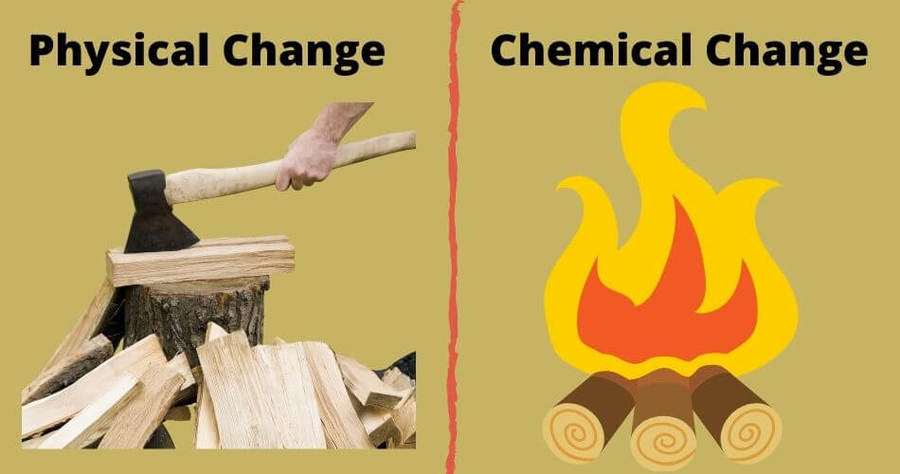
There are two types of changes in matter; physical change and chemical change. As the names suggest, a physical change affects a substance’s physical properties and a chemical change affects its chemical properties.
4

occur when there is a change to one or more physical properties
does not result in a change in chemical identity
are reversible in many cases
5

occur when one substance changes into another after a chemical reaction
"ingredients" are called reactants and end results are called products
irreversible
6

7

8
Multiple Choice
A physical change...
changes the physical properties of an object, but does not create a new substance.
creates a new substance and cannot be undone.
9
Multiple Choice
A chemical change
changes the physical properties of an object, but does not create a new substance.
creates a new substance and cannot be undone.
10

Production of gas/bubbles
Production of odor
Change in color
Formation of precipitate
Exothermic/Endothermic reaction
Release of light
Identifying chemical changes
Signs of a chemical change
11
Chemical reactions tend to happen more quickly at higher temperatures. When temperatures are higher, atoms and molecules have more kinetic energy which enable them to move around and rearrange more quickly and easily.

12
Multiple Choice
What kind of change occurs if matter changes in amount, size, or shape?
substance change
chemical change
physical change
elemental change
13
Multiple Choice
Which of the following is NOT an example of a physical change?
Smashing a soda can
Wood breaking apart
Salt dissolving in water
Iron rusting
14
Multiple Choice
15
Multiple Choice
16
Multiple Choice
17
Multiple Choice
18
Multiple Choice
sour milk
burning wood
breaking a pencil
rust
19
Match
Chemical
Chemical
Physical
Physical
Chemical
Chemical
Chemical
Physical
Physical
Chemical
20
21

This law states that mass cannot be created or destroyed during a physical or chemical change. The mass you have before the change is always equal to the mass after the change. For example, a chemical reaction between 93g of mercury and 7g of oxygen will produce 100g of mercuric oxide.
22

23

24
Multiple Choice
Which of the following describes the law of conservation of mass?
In a reaction, atoms are created or destroyed.
In a reaction, atoms are not lost or made.
In a reaction, the mass of the product may be more or less than the reactants.
In a reaction, mass never stays the same.
25
Multiple Choice
Destroyed a little bit
Invisible
Transformed, changed
None of the above
26
Multiple Choice
a total of 40g of products
a total of 10g of products
a total of 80 g of products
a total of 20g of products
27
Multiple Choice
What is the reactant in the following equation?2NaHCO3 -> Na2CO3 + CO2 + H2O
NaHCO3
Na2CO3
CO2
H2O
28
Multiple Choice
According to the Law of Conservation of Mass, what happens to the wood and oxygen when it is burned?
The wood disappears.
It stays the same chemically.
The atoms in the wood and oxygen rearrange and form smoke and ash.
Nothing.
29
Multiple Choice
The number to the lower side of an element is a
Charge
Coefficient
Superscript
Subscript
30
Multiple Choice
The number in front of a compound or element is a
Subscript
Coefficient
Superscript
Charge
31
Labeling
Label the following equation.
32
Poll
Which level best describes where you are at the end of this lesson?
Level 1 - I need help to differentiate between physical and chemical changes
Level 2 - I am able to differentiate between physical and chemical changes; as well as give examples on my own
Level 3 - In addition to performing tasks at level 2, I can also describe how temperature affects chemical changes
Level 4 - Not only can I perform level 3 tasks, I can also demonstrate that mass is conserved when substances undergo physical and chemical changes.
Join My Quizziz and Enter your First Name
Write notes as I go through the slides
Live Instruction + Test Graded as Assessment 40%
Show answer
Auto Play
Slide 1 / 32
SLIDE
Similar Resources on Wayground

23 questions
Scientific Method
Presentation
•
6th - 8th Grade
25 questions
Nature of Science
Presentation
•
6th - 8th Grade
25 questions
Physical and Chemical Changes Review
Presentation
•
8th Grade
27 questions
Unit 1: Nature of Science Review
Presentation
•
6th - 8th Grade
27 questions
Structure of Matter
Presentation
•
6th - 8th Grade
26 questions
Forces (Contact and Non-Contact)
Presentation
•
6th - 8th Grade
27 questions
MS-PS1-2: Chemical Interactions
Presentation
•
6th - 8th Grade
23 questions
Ecosystem Vocabulary
Presentation
•
6th - 8th Grade
Popular Resources on Wayground
10 questions
How much do you know about our Portrait of an Eagle?

Quiz
•
10th Grade
10 questions
Fast Food Slogans
Quiz
•
6th - 8th Grade
21 questions
Continents and Oceans
Quiz
•
6th Grade
20 questions
Parts of Speech
Quiz
•
5th Grade
16 questions
Subject & Predicate
Quiz
•
5th Grade
25 questions
Multiplication Facts
Quiz
•
5th Grade
12 questions
Map Skills
Quiz
•
3rd Grade
22 questions
Continents and Oceans
Quiz
•
5th Grade
Discover more resources for Science
17 questions
7.6D Aqueous Solutions
Quiz
•
7th Grade
20 questions
Scientific Method and Variables
Quiz
•
8th Grade
20 questions
Scientific method and variables
Quiz
•
8th Grade
27 questions
Counting Atoms - Subscripts
Quiz
•
8th Grade
10 questions
6.6D - Relative Density Review
Quiz
•
6th Grade
20 questions
Claim, Evidence and Reasoning (CER)
Quiz
•
6th - 8th Grade
18 questions
Counting Atoms
Quiz
•
7th - 8th Grade
20 questions
Density
Quiz
•
6th Grade