Search Header Logo
Hs Ls2

Hs Ls2

Assessment

Presentation

Biology

9th - 12th Grade

Hard

Created by

James Gonzalez

FREE Resource

26 Slides • 23 Questions

1

Unit 4 Pt1 - Biodiversity (4.1-.4)

Taxonomy, Dichotomous Keys and The 3 Domains of Life

HS-LS2-1: Use mathematical and/or computational representations to support explanations of factors that affect carrying capacity of ecosystems at different scales.

HS-LS2-2: Use mathematical representations to support and revise explanations based on evidence about factors affecting biodiversity and populations in ecosystems of different scales.

HS-LS2-6: Evaluate claims, evidence, and reasoning that the complex interactions in ecosystems maintain relatively consistent numbers and types of organisms in stable conditions, but changing conditions may result in a new ecosystem.

HS-LS2-7: Design, evaluate, and refine a solution for reducing the impacts of human activities on the environment and biodiversity.

2

3

Multiple Choice

What are the three domains of life?

1

Plants, animals, fungi

2

Bacteria, Archaea, Eukarya

3

Mammals, reptiles, birds

4

Prokaryotes, Eukaryotes, Protists

4

Multiple Choice

Which domain do bacteria belong to?

1

Archaea

2

Eukarya

3

Protista

4

Bacteria

5

Multiple Choice

Which kingdom includes autotrophs?

1

Plantae

2

Animalia

3

Fungi

4

Protista

6

Multiple Choice

What is the main purpose of taxonomy?

1

To determine genetic relationships

2

To organize organisms by size

3

To study DNA and cell structure

4

To name and classify species

7

media

8

media

9

media

10

media

11

media

12

media

13

media

14

media

15

media

16

media

17

media

18

media

19

media

20

media

21

media

22

media

23

Multiple Choice

Question image

If two organisms belong to the same order, then they must also belong to the same...

1

Species

2

Class

3

Family

4

Genus

24

media

25

media

26

Multiple Choice

Question image

Within families, organisms are placed into groups called...

1

Genus

2

Kingdom

3

Class

4

Phylum

27

media

28

media

29

Multiple Choice

Which scientists came up with the kingdom classification system?

1

Robert Hooke

2

Carol Linnaeus

3

Anton Van Leeuwenhoek

4

Carl Woese

30

media

31

media

32

Multiple Choice

An organism's scientific name is based on how it is classified. Which of the following levels of classification determine the name?

1

kingdom & phylum

2

class & species

3

domain & order

4

genus & species

33

34

Multiple Choice

What is the purpose of a dichotomous key?
1
to find a common ancestor
2
to show the evolution of organisms
3
to show relationships between organisms
4
to identify organisms

35

Multiple Choice

What step do we always start with when using dichotomous keys?
1
1
2
2
3
3
4
4

36

Multiple Choice

When using a dichotomous key to identify organisms, what do we look at?
1
physical features
2
weather patterns
3
environment
4
diet

37

Multiple Choice

Question image

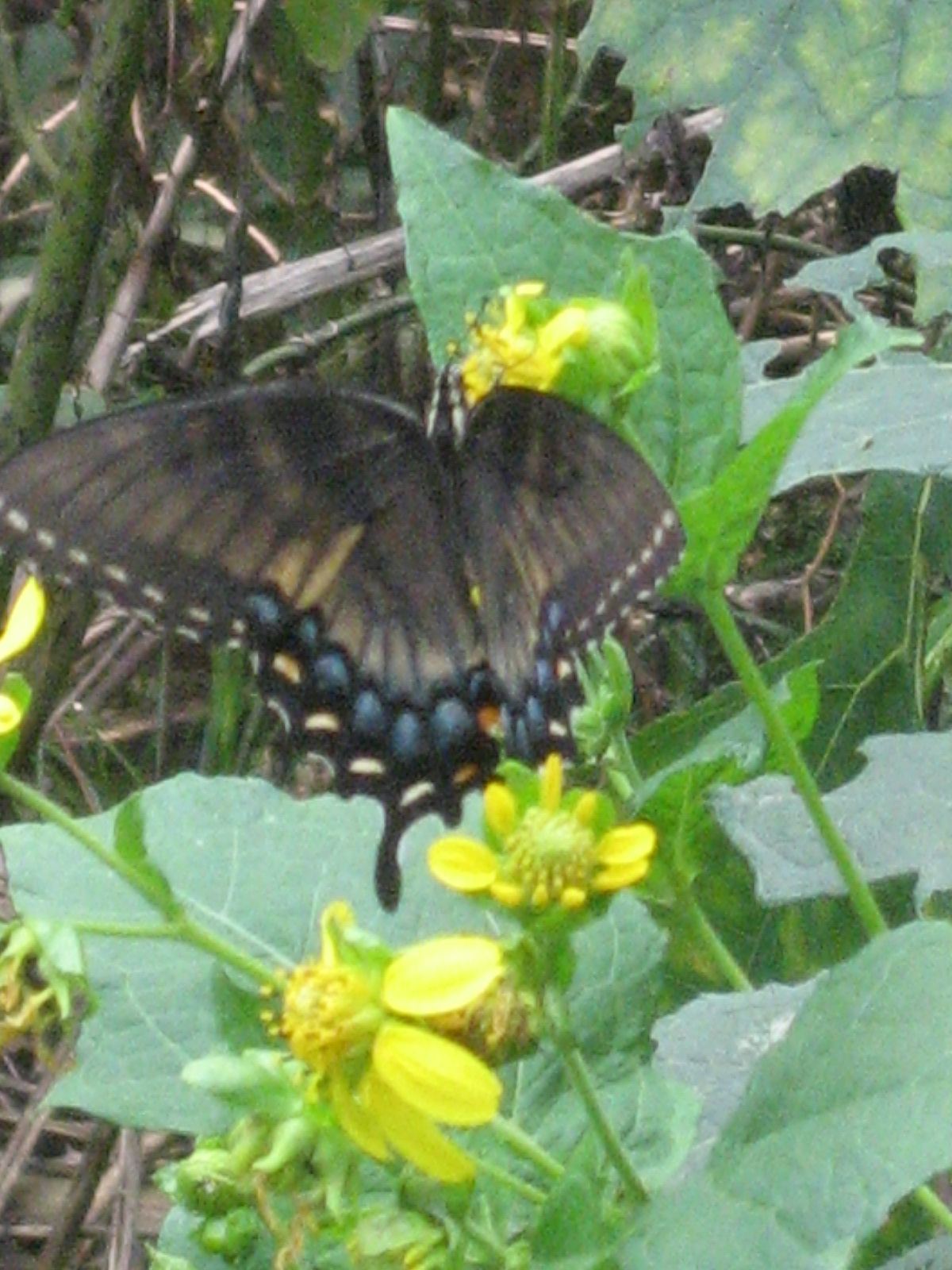
Butterflies usually are identified by the colors and patterns on their wings. Butterflies have four wings: The two wings near the butterfly’s head are “forewings” while the wings near the butterfly’s tail are “hindwings.” You can use the following dichotomous key to identify four common butterfly species in North America.

Based on the key, what species of butterfly is shown below?

1

Papilio glaucus

2

Papilio polyxenes

3

Danaus plexippus

4

Colias philodice

38

Multiple Choice

Largest and most general group into which organisms are classified is called...

1

Species

2

Class

3

Domain

4

Family

39

Multiple Choice

Question image

Simple leaves have a single leaf on a petiole, or stem, while compound leaves have more than one leaflet on a petiole. This unknown leaf can be identified using the dichotomous key. Which tree does the unknown leaf come from?

1

Ungnadia speciosa

2

Sophora secondiflora

3

Salix nigra

4

Quercus laceyi

40

Multiple Choice

The science of describing, classifying, and naming living things is called:
1

Geology

2

Biology

3

Taxonomy

4

Chemistry

41

Multiple Choice

The more classification levels that two organisms share,

1

the closer together on earth they live.

2

the easier it is to tell them apart.

3

the more related they become because of many shared characteristics.

4

the more distance is between them due to lack of shared characteristics.

42

Multiple Choice

Question image
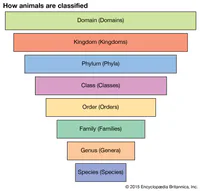
The 8 levels of classification, most broad to most specific.
1

Domain, Genus, Family, Order, Class, Phylum, Kingdom, Species

2

Domain, Species, Kingdom, Genus, Phylum, Family, Class, Order

3

Domain, Kingdom, Phylum, Class, Order, Family, Genus, Species

4

Order, Kingdom, Species, Domain, Phylum, Family, Class, Genus

43

Multiple Choice

Fill-in-the-blank:
Domain--Kingdom--Phylum--____________
1

Order

2

Family

3

Class

4

Species

44

Multiple Choice

Which of the following is the correct way to show the scientific name for tiger?

1

Panthera Tigris

2

Panthera tigris

3

panthera Tigris

4

panthera tigris

45

Multiple Choice

Scientists around the world use a standardized taxonomic system. Why would scientists want to use a taxonomic system that is standardized?

1

In order to avoid confusion with the identification of organisms

2

Because Linnaeus established the system

3

So that Latin names can be applied for a practical purpose

4

In order to place organisms in different groups

46

Multiple Choice

Who first proposed binomial nomenclature as a way of classifying organisms?
1

Carl Linnaeus

2

Carl's Jr.

3

Charles Darwin

4

Carl Woese

47

Multiple Choice

Term given to describe the two-name naming system is:

1

dichotmous key

2

binomial nomenclature

3

2 scientific names

4

binomial key

48

Multiple Choice

The scientific name for an organism is made from the:
1

class and family name

2

genus and species name

3

domain and kingdom name

4

kingdom and phylum name

49

media

Let's see who our winners are and head back to the

Live Lesson Room for Chat Q&A!

Unit 4 Pt1 - Biodiversity (4.1-.4)

Taxonomy, Dichotomous Keys and The 3 Domains of Life

HS-LS2-1: Use mathematical and/or computational representations to support explanations of factors that affect carrying capacity of ecosystems at different scales.

HS-LS2-2: Use mathematical representations to support and revise explanations based on evidence about factors affecting biodiversity and populations in ecosystems of different scales.

HS-LS2-6: Evaluate claims, evidence, and reasoning that the complex interactions in ecosystems maintain relatively consistent numbers and types of organisms in stable conditions, but changing conditions may result in a new ecosystem.

HS-LS2-7: Design, evaluate, and refine a solution for reducing the impacts of human activities on the environment and biodiversity.

Show answer

Auto Play

Slide 1 / 49

SLIDE