Search Header Logo
Intro to Evolution Review

Intro to Evolution Review

Assessment

Presentation

•

Science

•

9th - 12th Grade

•

Easy

•
NGSS
MS-ESS1-1, MS-LS4-2, MS-LS4-1

+10

Standards-aligned

Created by

Kaitlynn Chrzan

Used 2+ times

FREE Resource

18 Slides • 55 Questions

1

Intro to Evolution Review

2

As you Proceed:

  • Read through the slides

  • Answer the questions

  • score >80%

3

Multiple Choice

Why are advantageous traits more likely to be passed onto offspring?

1

Because organisms with them are more likely to survive and reproduce.

2

Because organisms with them have dominant alleles.

3

Because organisms with them have recessive alleles.

4

Because the trait is an acquired phenotype.

4

Multiple Choice

Question image

A population consisting of brown beetles and green beetles migrate into a grassy field and eat along the grass throughout the day. There are various birds living in the area that consume insects for survival. If you were to come back to this population after several generations, what would you expect to see due to natural selection?

1

There would be a higher frequency of brown beetles in the population

2

There would be a higher frequency of green beetles in the population

3

There would be an equal amount of green and brown beetles in the population

5

Multiple Choice

Which is NOT an example of mimicry:

1

The fur of an arctic fox turns white in winter to match the snow

2

An alligator snapping turtle's tonge looks like a worm, so he lures fish to his mouth

3

A bad tasting butterfly & a good tasting butterfly look similar, so birds don't eat either kind

6

Multiple Choice

Women often have complications during labor while giving birth to very large babies, whereas very small babies tend to be underdeveloped. As a result, medium sized babies are ones that end up surviving to adulthood.

Which pattern of natural selection does this scenario represent?

1

Disruptive

2

Directional

3

Stabilizing

7

Multiple Choice

Seed cracker birds have either large beaks or small beaks. They do not have medium sized beaks because medium sized beaks do not allow for adequate seed cracking.

Which pattern of natural selection does this scenario represent?

1

Disruptive

2

Directional

3

Stabilizing

8

Forces of Evolution

Forces of evolution: causes populations to change

  • ​Mutations: changes in DNA

  • Gene flow: individuals immigrate or emigrate

  • Genetic drift: random changes that occur in small populations

  • Natural selection: organisms with favorable traits survive and reproduce

9

Genetic Drift

Two types of genetic drift

  • Bottleneck effect: only a few individuals survive and reproduce

  • Founder effect: a small portion of the population moves and starts a new population

10

Multiple Choice

A forest fire ignites and kills many members of a population of rattlesnakes. This is an example of:

1

gene flow

2

genetic drift

3

mutation

11

Multiple Choice

Genetic diversity is increased through:

1

genetic drift

2

gene flow

12

Multiple Choice

Question image

This image is an example of:

1

genetic drift

2

gene flow

13

Multiple Choice

 Genetic Drift is more likely to happen in... 
1
aquatic populations
2
small populations
3
terrestrial populations
4
older populations

14

Multiple Choice

A few deer wander out of their native woods into a completely new park where no deer had ever been before. They go on to create an entirely new population.
1
gene pool 
2
founder effect
3
bottleneck
4
mutation

15

Multiple Choice

The more genetic variation a population has,

the more likely it is for some individuals to

1

evolve

2

migrate

3

survive

4

mutate

16

Multiple Choice

Mutations are important because they bring about

1

death of the organism in which they develop

2

genetic variation needed for a population to evolve

3

benefits for the individual, not for the population

4

changes in genotype, but not phenotype

17

Match

Match the following

Mutation

Gene Flow

Genetic Drift

Bottle Neck

Founders Effect

Change in DNA sequence

Increases genetic variation

Usually decreases genetic variation

Population gets smaller (Natural Disaster)

Starting a new population

18

Multiple Select

Select all answers below that describe the founder effect.

1

Changes allele frequencies

2

Occurs when a new population arises from only a few individuals

3

Can result in a loss of genetic diversity

4

Is caused by a disaster that kills off most individuals in a population

19

Multiple Choice

Which of the following could not be a possible cause of the bottleneck effect?

1

Overhunting of northern elephant seals

2

A forest fire that destroys most of a population of deer

3

A crop that is destroyed by blight

4

A small group of fish that are added to a pond

20

Multiple Choice

Genetic Diversity is increased through this process.

1

Gene Flow

2

Genetic Drift

21

Multiple Choice

As a population recovers from reduction due to the bottleneck effect, the population will experience -

1

a loss of genetic dicversity.

2

migration.

3

no change to allele frequency.

4

genetic regulation.

22

media

23

media

24

Multiple Choice

p + q = 1. If p represents the dominant allele frequency, what would q represent?

1

the homozygous dominant genotype frequency

2

the recessive allele frequency

3

the total amount of alleles in the population

4

a measure of fitness in the population

25

Multiple Choice

p + q always equals 1. Which answer choice best explains this?

1

1 individual could have a dominant or a recessive allele.

2

The population is in Hardy-Weinberg equilibrium. The 1 indicates that the population has not evolved.

3

In terms of frequency, 1 is the highest possible number you can have.

4

In terms of frequency, 1 is the same as 100%. All alleles in a population added up give you 100% of the alleles.

26

Multiple Choice

Question image

Which values can be plugged into the equation? p + q = 1

1

0.6 and 0.16

2

0.6 and 0.4

3

0.4 and 0.16

4

0.48 and 0.36

27

Multiple Choice

If 0.49 + 0.42 + 0.09 = 1 (p2 + 2pq + q2 = 1), what is the value for p?

1

0.09

2

0.07

3

0.7

4

0.9

28

Multiple Choice

Which of these is a condition that MUST be met for Hardy-Weinberg equilibrium?

1

extremely small population size

2

no natural selection

3

gene flow

4

nonrandom mating

29

Multiple Choice

Which is NOT an assumption of Hardy-Weinberg equilibrium?

1

natural selection

2

large populations

3

no mutations

4

no migration

5

random mating

30

Multiple Choice

If all 5 Hardy-Weinberg assumptions are true, a population is said to be in genetic equilibrium. This means

1

it is evolving

2

it is NOT evolving

31

Multiple Choice

The allele frequency of p=.20 What is the percentage of Heterozygous Dominant genotype?

1

.80

2

.04

3

.32

4

.64

32

Multiple Choice

The allele frequency of p=.20 What is the percentage of recessive genotype?

1

.80

2

.04

3

.32

4

.64

33

Multiple Choice

The allele frequency of p=.20 What is q?

1

.80

2

.04

3

.32

4

.64

34

Multiple Choice

A population's recessive allele frequency 25%. What is the percentage of the Homozygous Dominant genotype?

1

.5625

2

.3750

3

.0625

4

.25

5

.5

35

Multiple Choice

64% of the population has the recessive phenotype. What is the percentage of the recessive genotype?

1

.04

2

.32

3

.64

4

.2

5

.8

36

Multiple Choice

A population's recessive allele frequency 25%. What is the percentage of the Heterozygous genotype?

1

.5625

2

.3750

3

.0625

4

.25

5

.5

37

Multiple Choice

64% of the population has the recessive phenotype. What is the percentage of the heterogeneous genotype?

1

.04

2

.32

3

.64

4

.2

5

.8

38

Multiple Choice

If a population experiences no migration, is very large, has no mutations, has random mating, and there is no selection, which of the following would you predict?

1

The population will evolve, but much more slowly than normal

2

The makeup of the population's gene pool will remain virtually the same as long as these conditions hold.

3

The composition of the population's gene pool will change slowly in a predictable manner.

4

Dominant alleles in the population's gene pool will slowly increase in frequency while recessive alleles will decrease.

5

The population probably has an equal frequency of A and a alleles.

39

Multiple Choice

It can be harder for small island populations to evolve. Why?

1

They are at genetic equilibrium.

2

They have more phenotypic plasticity.

3

They have less genetic diversity.

4

They exhibit disruptive selection.

40

Multiple Choice

Why are advantageous traits more likely to be passed onto offspring?

1

Because they are more likely to survive and reproduce.

2

Because they come from dominant alleles.

3

Because they come from recessive alleles.

4

Because the organism knew it needed that trait, survives, and passes it on.

41

Multiple Choice

If there are 400 red flowers, 200 pink flowers, and 100 white flowers. Solve for the frequency of the dominant allele.

1

0.76

2

0.86

3

0.57

4

0.71

42

Multiple Choice

If there are 400 red flowers, 200 pink flowers, and 100 white flowers. Solve for the frequency of the recessive allele.

1

0.28

2

0.14

3

0.38

4

0.42

43

Multiple Choice

If a population is suffering from genetic drift, which of the Hardy-Weinberg conditions is not being met?

1

no gene flow

2

random mating

3

extremely large population size

4

no mutations

44

Multiple Choice

If the frequency of recessive allele is 0.2, what is the frequency of the homozygous recessive individuals?

1

0.04

2

0.16

3

0.4

4

0.8

45

media

46

media

47

Multiple Choice

Anaerobic means

1

with oxygen

2

without oxygen

48

Multiple Choice

Aerobic means

1

with oxygen

2

without oxygen

49

media

50

media

51

media

52

media

53

Multiple Choice

The cells that came first were simple _____ cells.

1

prokaryotic

2

eukaryotic

3

muticellular

54

Multiple Choice

Over time these simple cells evolved to use oxygen then became more complex ________ cells.

1

prokaryotic

2

eukaryotic

3

unicellular

55

Multiple Choice

The changes of species over time
1

Embryonic 

2

Natural selection 

3

Mimicry 

4

Evolution 

56

media

57

media

58

Multiple Choice

Question image
Which layer is the youngest
1

1

2

2

3

3

4

4

59

Multiple Choice

How do fossils provide evidence that evolution has happened on Earth?
1

Fossils show how the sizes of certain animals has changed drastically over millions of years

2

Fossils show that some species have gone extinct

3

Fossils show how life forms present today are different than those from the past

4

Different sedimentary rock layers provide evidence for how the environment has changed over time

60

media

61

media

62

Multiple Choice

Question image
Some organisms that share a common ancestor have features that have different functions, but similar structures.  These are known as
1

vestigial structures

2

analogous structures

3

homologous structures

4

fossil structures

63

Multiple Choice

Question image

Vestigial structures

1

structures that perform a similar function but are not similar in origin

2

remnants of once-important structures that have slowly lost all or most of their function

3

features found in different organisms that share structural similarities but may have very different functions

4

preserved remains of an organism

64

Multiple Choice

Humans, birds, whales, and lizards all have similar arm bones. What is the reason for this?
1

The function of these bones is the same in all animals

2

They live in similar environments

3

They have a common ancestor

4

All organisms resemble humans

65

Multiple Choice

Question image

What best describes the hind leg bones seen in the whale?

1

The bones are analogous structures to the fins of living fish.

2

The bones are vestigial structures that had a function in an ancestor.

3

The bones are homologous structures to the wings of butterflies.

4

The bones are fossil structures from an extinct ancestor.

66

media

67

Multiple Choice

Question image
The diagram illustrates an embryonic stage of two organisms.

Which of the following can be determined by observing the embryos shown in the diagram
1

The organisms share a common ancestry.

2

The organisms belong to the same genus.

3

The organisms are native to the same geographic areas.

4

The organisms will grow into anatomically similar adults.

68

media

69

Multiple Choice

If two organisms have similar traits of DNA they are probably
1

share a common ancestor

2

share a common environment

3

share a common population

4

speciation

70

Multiple Choice

Question image
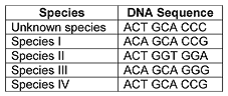
According to this data, the unknown bacterial species is most closely related to: 
1

Species I

2

Species II

3

Species III

4

Species IV

71

Multiple Select

Question image

Which of the pictures above would be examples of homologous structures? (pick 2)

1

1

2

2

3

3

72

Dropdown

The fossils found closer to the surface of the ground are generally -


73

Multiple Choice

Do organisms "decide" to evolve and change?
1
Yes, they know they need to change to survive 
2
No, they change because of natural selection

Intro to Evolution Review

Show answer

Auto Play

Slide 1 / 73

SLIDE