

Heating and Cooling

Presentation
•
Science
•
4th Grade
•
Hard

Joseph Anderson
FREE Resource
10 Slides • 16 Questions
1

Melting and freezing point
Mr. Najib
2

•
•
•
•
3
4

5

6
Multiple Choice
What is the result of heating a solid material to its melting point?
The solid becomes more dense
The solid changes state from a solid to a liquid
The solid becomes less dense
The solid remains in its solid state
7
Multiple Choice
How do the particles in a solid behave when heated?
They become more closely packed together
They start to vibrate faster and faster
They move away from each other
They become less closely packed together
8
Multiple Choice
When the particles in a solid have enough energy to move about, what is the resulting state?
Gas
Liquid
Solid
Plasma
9

10

11
Multiple Choice
What happens to a material when it is heated to a temperature higher than its melting point?
It remains in its solid state
It melts
It becomes more dense
It becomes less dense
12
Multiple Choice
What is the melting and freezing point of a material considered to be?
A flexible point
A critical temperature
A barrier
A transition state
13
Multiple Choice
What happens to a material when it is cooled to a temperature lower than its freezing point?
It remains in its liquid state
It freezes
It becomes more dense
It becomes less dense
14

15
Wondered about chocolate
The freezing point of chocolate is around -10°C. This means that if we store chocolate at a temperature below this point, it can cause tiny ice crystals to form. These ice crystals can make the chocolate taste and feel different. To keep chocolate tasting and feeling the same, we should store it in a cool, dry place where it won't get too hot or too cold.
Now that you know about the melting and freezing point of chocolate, let's see how much you've learned with these multiple-choice questions!

Have you ever wondered why chocolate can be soft and melted in your mouth one moment, and then hard and crunchy the next? It's all because of something called the melting and freezing point of chocolate!
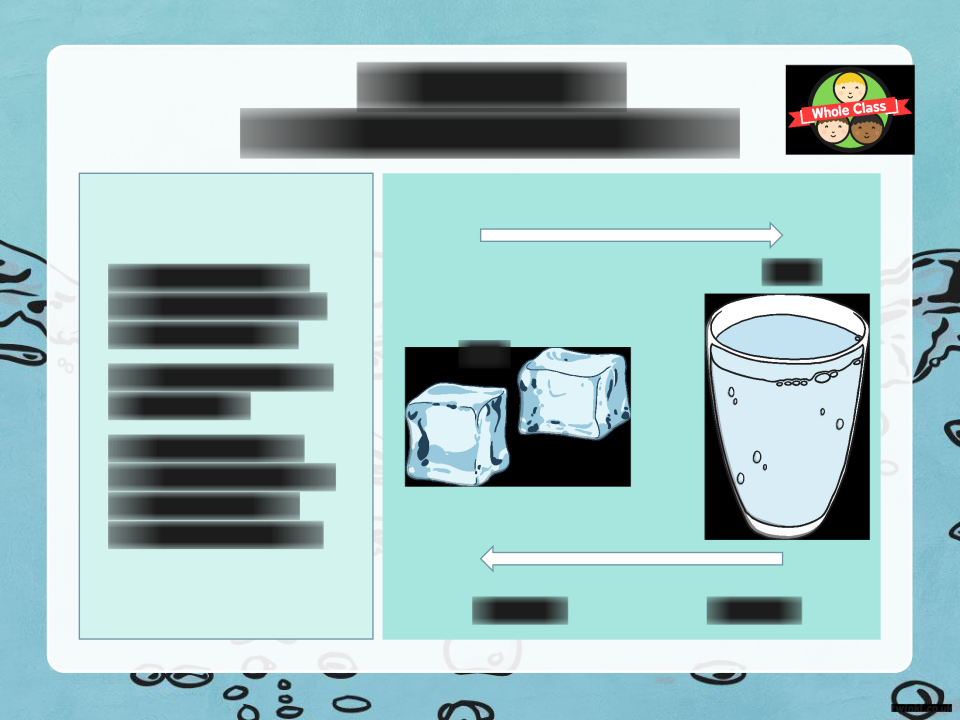
Chocolate is made from cocoa solids, cocoa butter, sugar, and milk solids. When these ingredients are mixed together, they form a smooth and creamy texture that we all love to eat. The melting point of chocolate is around 31-32°C, which means that when the temperature of the chocolate rises above this point, the cocoa butter starts to melt and the chocolate becomes liquid.
16
Multiple Choice
What are the ingredients in chocolate?
Cocoa solids, sugar, and milk solids
Cocoa solids, cocoa butter, sugar, and milk solids
Cocoa solids, cocoa butter, and sugar
17
Multiple Choice
What is the melting point of chocolate?
31-32°C
-10°C
0°C
18
Multiple Choice
What happens when the temperature of chocolate rises above its melting point?
The chocolate becomes solid
The cocoa butter starts to melt
The chocolate retains its original texture
19
Multiple Choice
What is the freezing point of chocolate?
31-32°C
-10°C
0°C
20
Multiple Choice
What can happen if we store chocolate at a temperature below its freezing point?
The chocolate will taste and feel the same
Tiny ice crystals can form
The chocolate will become solid
21
Multiple Choice
What is the best place to store chocolate to keep it tasting and feeling the same?
In a warm, humid place
In a cool, dry place
In a hot, dry place
22
Multiple Choice
What happens when the temperature of chocolate is cooled down below its melting point?
The chocolate becomes liquid
The chocolate retains its original texture
The cocoa butter starts to melt
23
Multiple Choice
Why is it important to know about the melting and freezing point of chocolate?
So we can store it properly
So we can make it soft and melted
So we can make it hard and crunchy
24
Multiple Choice
What happens when the cocoa butter in chocolate starts to melt?
The chocolate becomes solid
The chocolate becomes liquid
The chocolate retains its original texture
25
Multiple Choice
What is the texture of chocolate when it's made?
Hard and crunchy
Soft and melted
Smooth and creamy
26

•
•
•
•
Melting and freezing point
Mr. Najib
Show answer
Auto Play
Slide 1 / 26
SLIDE
Similar Resources on Wayground

20 questions
Outer Planets
Presentation
•
4th Grade
21 questions
The Water Cycle
Presentation
•
4th Grade
19 questions
Electricity
Presentation
•
4th Grade
18 questions
Stars and Constellations
Presentation
•
4th Grade
18 questions
Plants
Presentation
•
6th - 8th Grade
18 questions
Weather Tools
Presentation
•
4th Grade
20 questions
How Vaccines work?
Presentation
•
4th Grade
20 questions
Earth and Moon Review
Presentation
•
4th Grade
Popular Resources on Wayground
28 questions
US History Regents Review

Quiz
•
11th Grade
36 questions
Biology Regents Review
Quiz
•
9th - 10th Grade
20 questions
Math Review
Quiz
•
3rd Grade
38 questions
Regents Life Science General Review
Quiz
•
9th Grade
20 questions
Math Review
Quiz
•
6th Grade
21 questions
EOY Grade 6 Benchmark Assessment - Content Skills
Quiz
•
6th Grade
20 questions
Inferences
Quiz
•
4th Grade
20 questions
Figurative Language Review
Quiz
•
6th Grade
Discover more resources for Science
20 questions
Inferences
Quiz
•
4th Grade
15 questions
Character Analysis
Quiz
•
4th Grade
30 questions
Multiplication Facts 1-12
Quiz
•
2nd - 5th Grade
5 questions
Synonyms
Quiz
•
3rd - 6th Grade
25 questions
4th Grade End of Year Math Review
Quiz
•
4th Grade
77 questions
Mixed Multiplication and Division Facts
Quiz
•
4th Grade
10 questions
Summer I Spy
Presentation
•
2nd - 5th Grade
18 questions
Trivia Questions
Presentation
•
1st - 6th Grade