

First Law of Thermodynamics

Presentation
•
Chemistry
•
12th Grade
•
Hard

Joseph Anderson
FREE Resource
42 Slides • 25 Questions
1
2

3
4

5
6
Multiple Choice
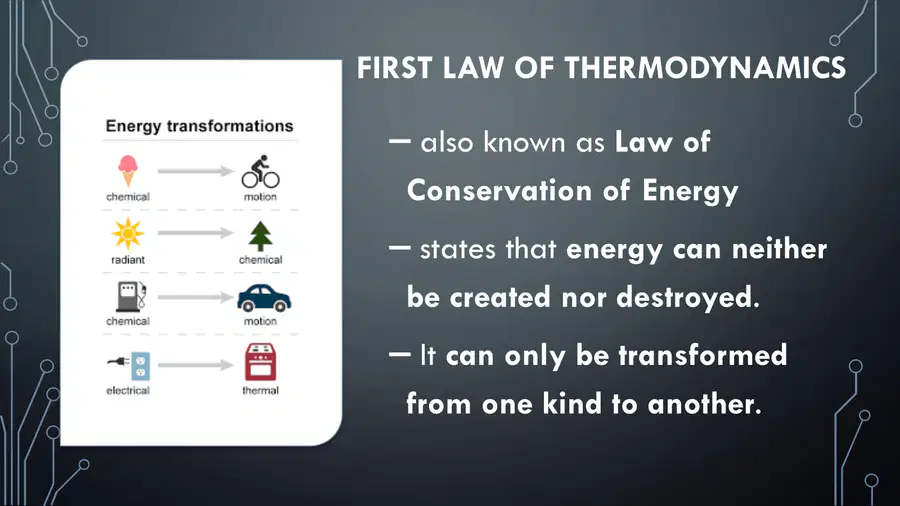
The Law of <blank> states that energy cannot be created nor destroyed only transferred
Specific Heat
Exothermic Reaction
Conservation of Energy
Potential Energy
7
Multiple Choice
The Law of Conservation of Energy is also known as...
First Law of Thermodynamics
Second Law of Thermodynamics
Third Law of Thermodynamics
Newton's First Law
8
9
10

11
12
13
Multiple Choice
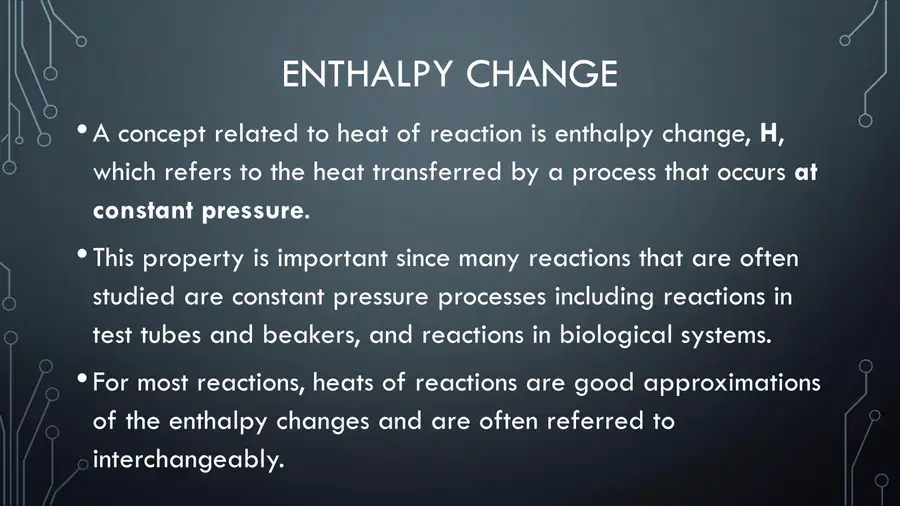
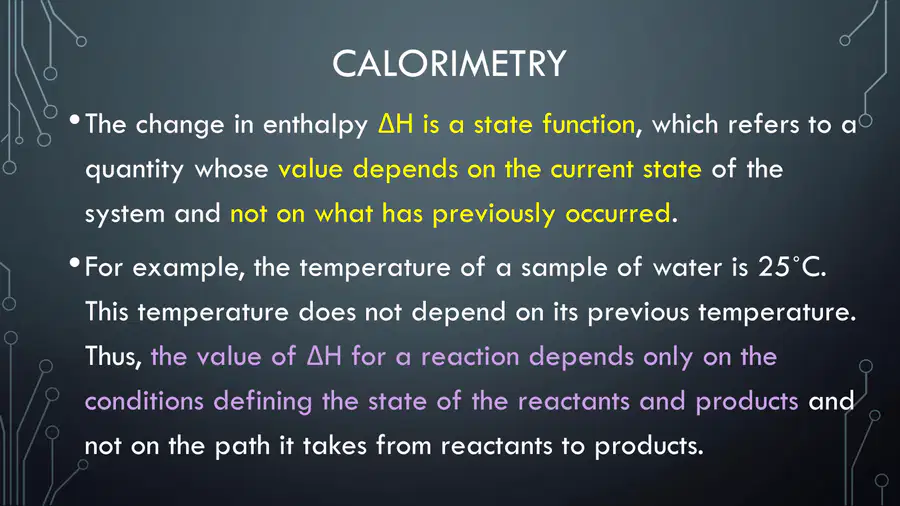
The change in the energy between a chemical reaction and the surroundings at constant temperature is called
enthalpy change
enthalpy
enthalpy profile
dynamic enthalpy
14

15
16
17
Multiple Choice
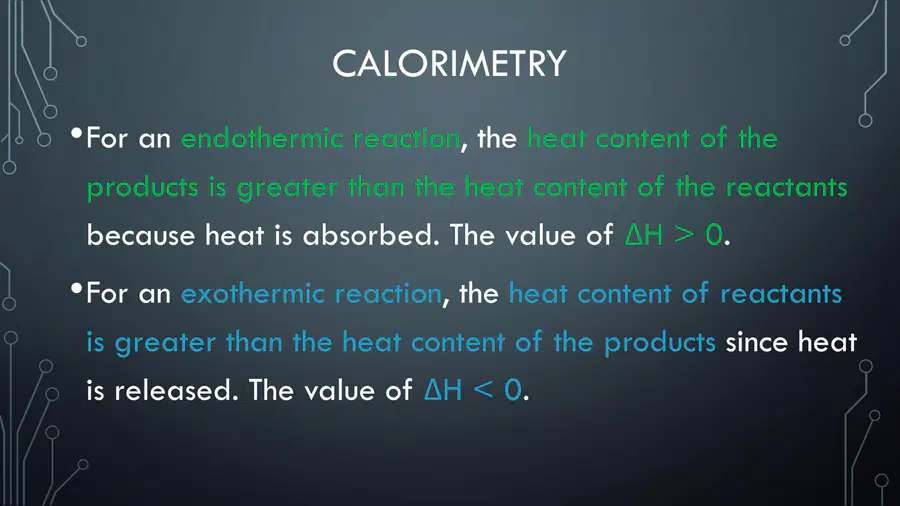
The heat of reaction refers to
The heat released after burning 1 mole of a substance.
The amount of heat needed to melt 1 mole of a solid.
The heat released by 1 mole of a substance as it changes from a liquid to a solid.
The heat released or absorbed during a chemical reaction.
18
19
20
21

22
Multiple Choice
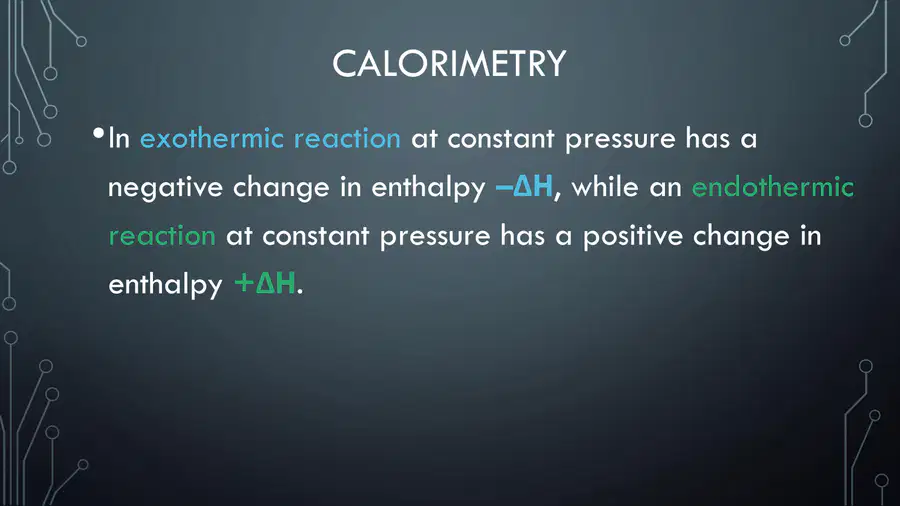
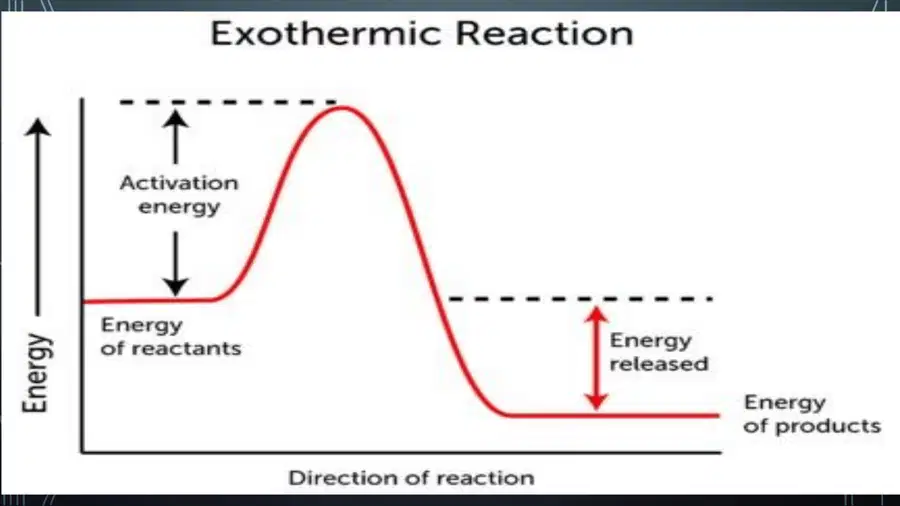
Changes in enthalpy in an exothermic reaction is
Positive
Negative
Constant
Neutral
23
Multiple Choice
A reaction is allowed to take place in an insulated container containing 100mL of water. If the reaction is exothermic, what happens to the temperature of water?
The temperature of the water goes down.
The temperature of the water goes up.
The temperature of the water does not change.
None of the above.
24
Multiple Choice
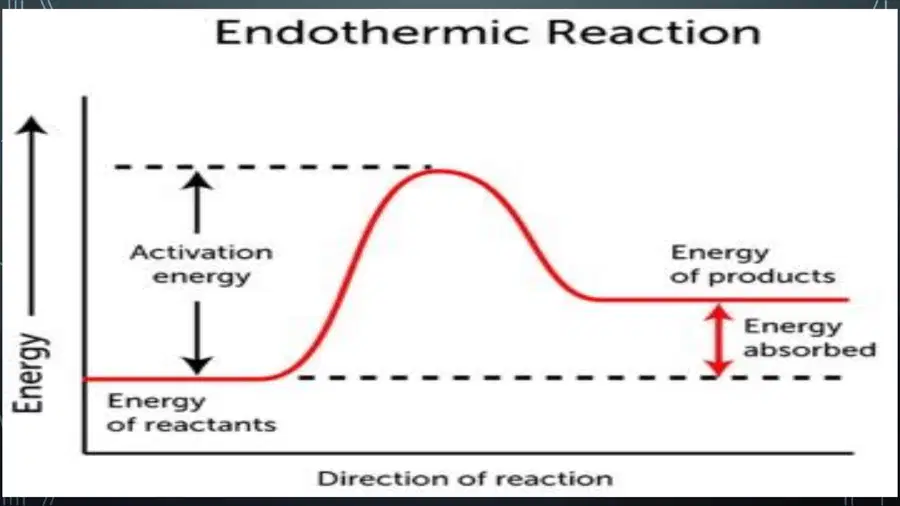
Which of the following does NOT describe an endothermic reactions?
absorption of energy
ΔH > 0
Hreactant < Hproduct
-ΔH
25

26
Multiple Choice
Given the hypothetical thermochemical equation:
A + B → C + D ΔH = -430 kJ/mol
Which among the following statements is correct about this reaction?
The equation may be written as
A + B → C + D
Δ H=430 kJ/mol
The reaction is exothermic.
The heat content of C and D is greater than the heat content of A and B.
The heat content of A and C is greater than the heat content of B and D.
27
Multiple Choice
The thermochemical equation showing the formation of ammonia (NH3) from its elements is:
N2(g) + 3H2(g) → 2NH3(g) ΔH = -92 kJ/mol
This equation shows that 92 kJ of heat is:
Lost to the surroundings when one mole of hydrogen is used up in the reaction.
Absorbed from the surroundings when one mole of nitrogen reacts.
Absorbed from the surroundings when one mole of ammonia is formed.
Lost to the surroundings when 2 moles of ammonia is formed.
28
29
Multiple Choice
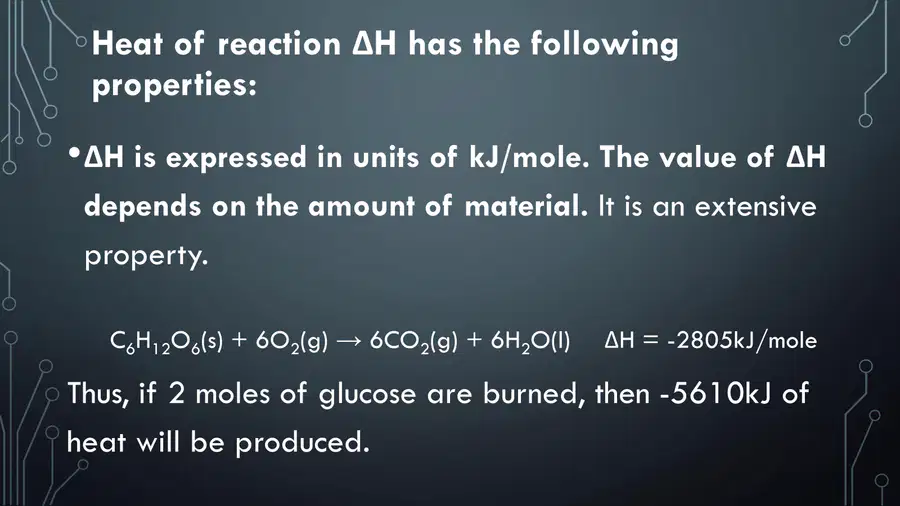
ΔH is expressed in units of
cal
kJ/mol
J
kcal
30
31
32
33
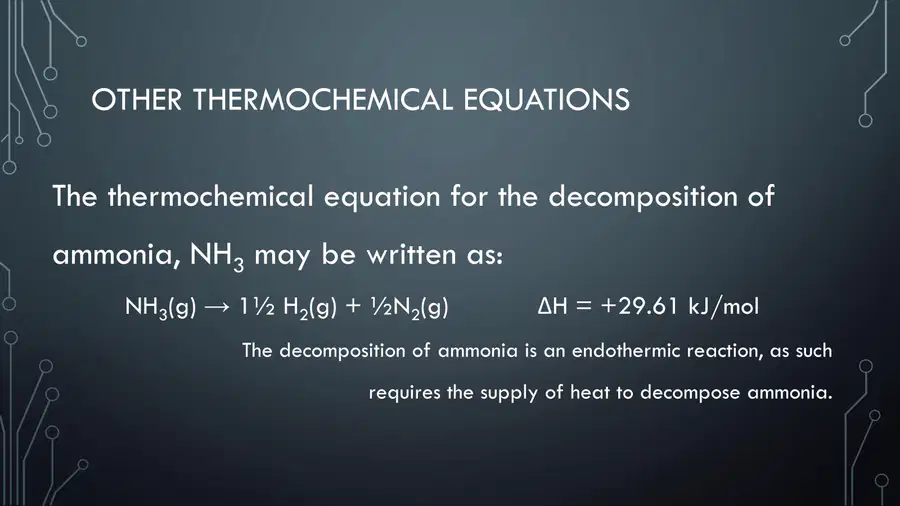
34
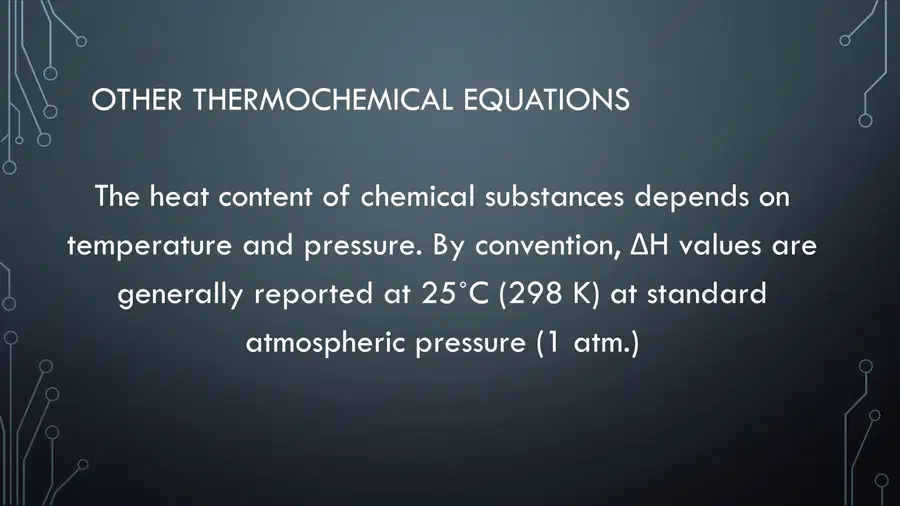
35
Multiple Choice
The standard condition for enthalpy changes is/are
the pressure of 1 atm
normal physical state
temperature 298K
all of these
36
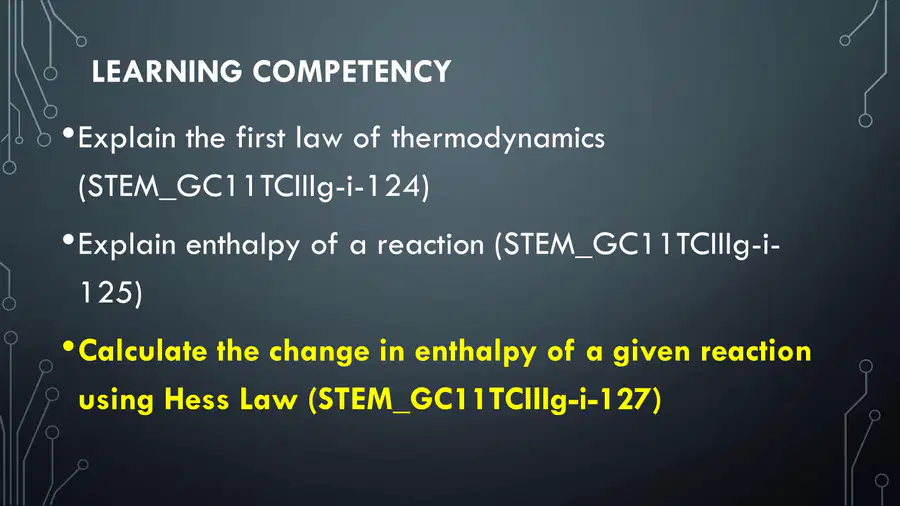
37
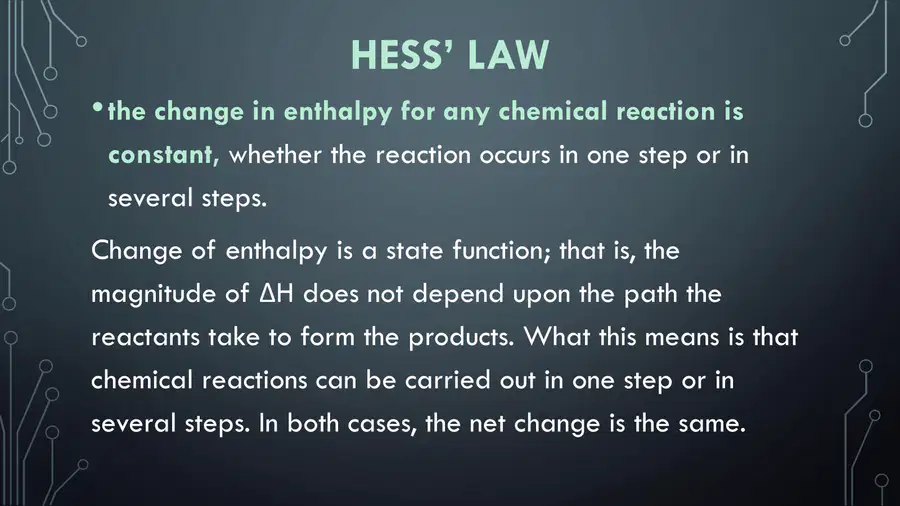
38
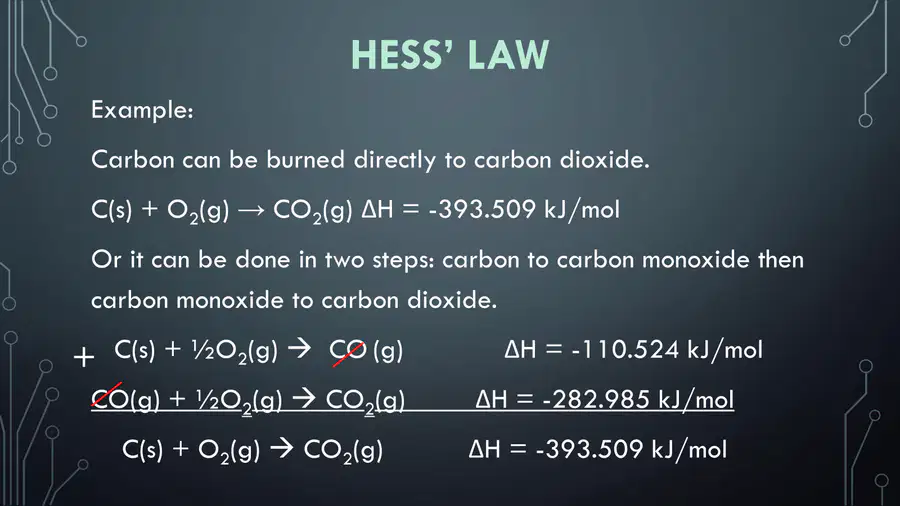
39
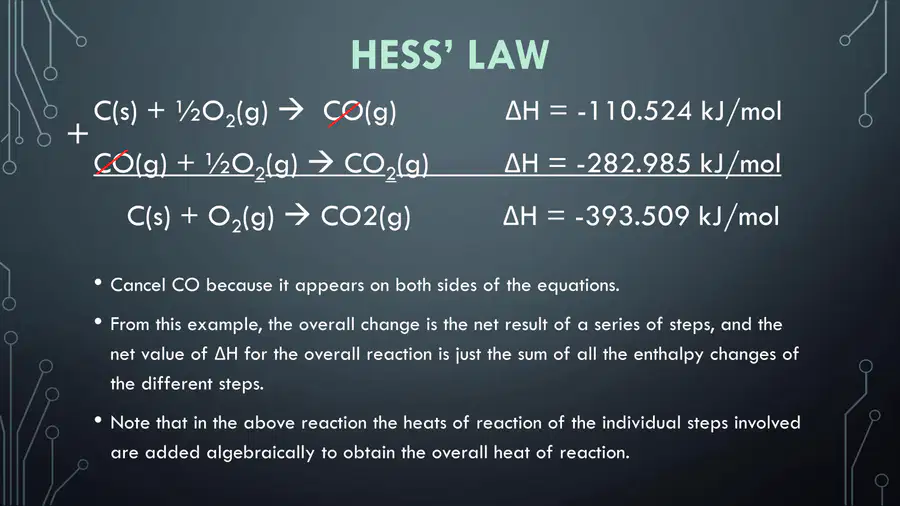
40

41
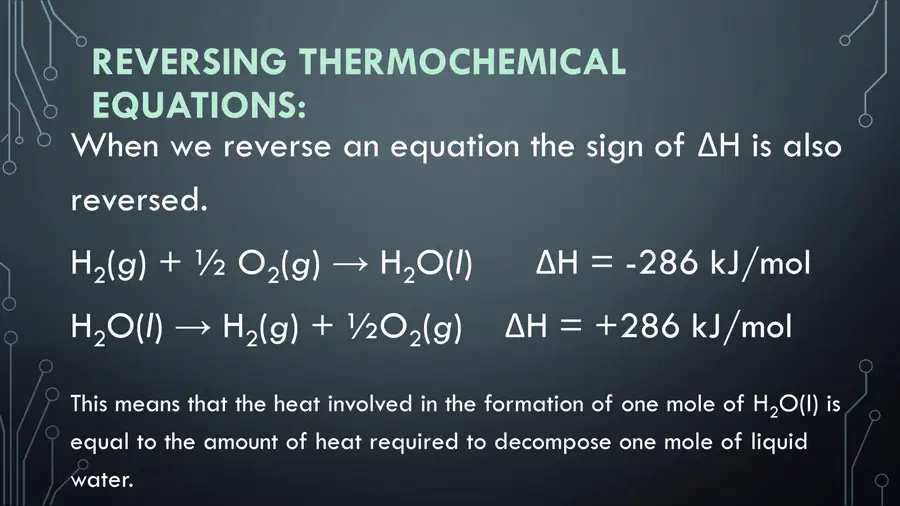
42

43
Multiple Choice
An oxyacetylene torch is a tool that mixes and burns oxygen and acetylene to produce an extremely hot flame. This tool is used to cut steel or weld iron and other metals. The temperature of the film can reach 3480˚C. The burning of acetylene is given by the thermochemical equation:
C2H2(g) + 1½CO2(g) → CO2(g) + H2O(l) ΔH = -1301.1 kJ/mol
For the reaction,
2CO2(g) + 2H2O(l) → 2C2H2(g) + 3CO2(g)
What is the ΔH for the reaction?
ΔH = +1301.1 kJ/mol
ΔH = +2602.2 kJ/mol
ΔH = -1301.1 kJ/mol
ΔH = -2602.2 kJ/mol
44
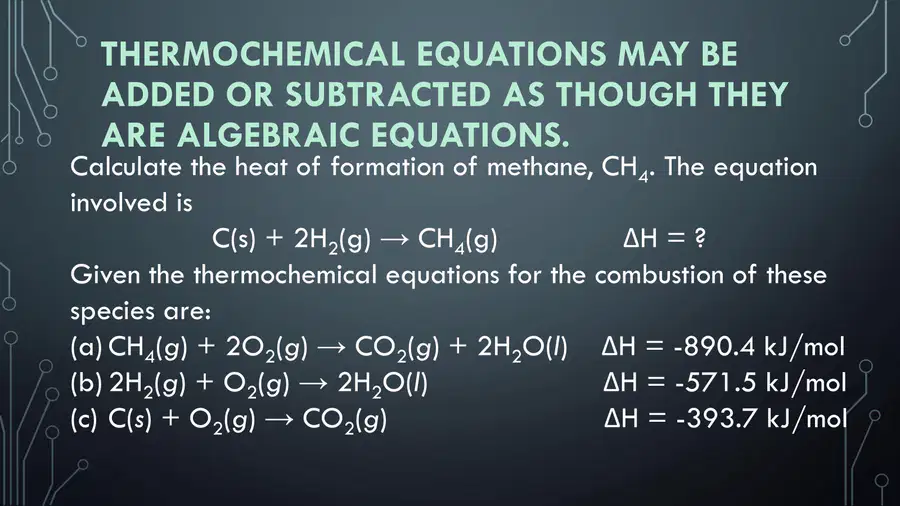
45
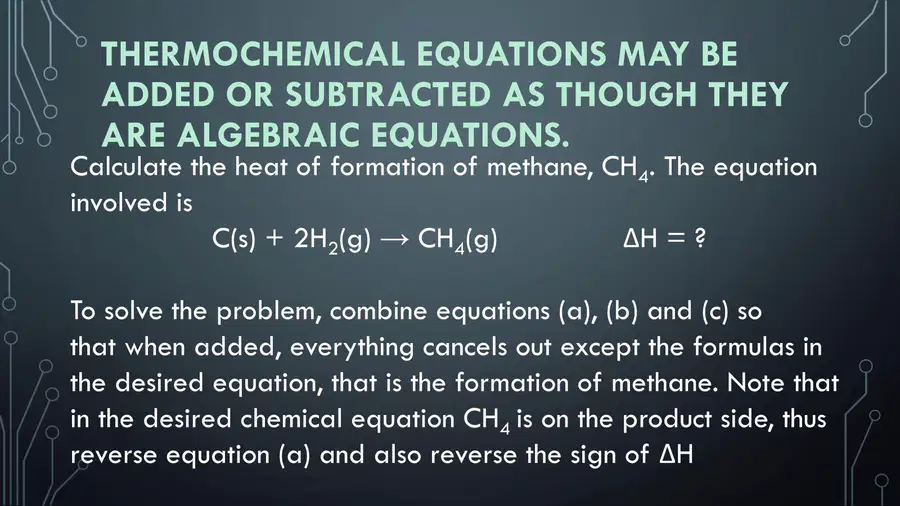
46
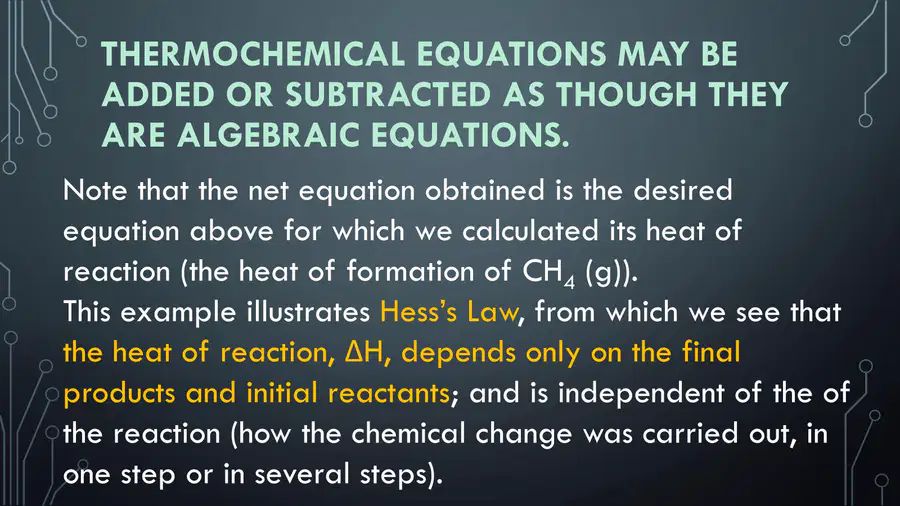
47

48
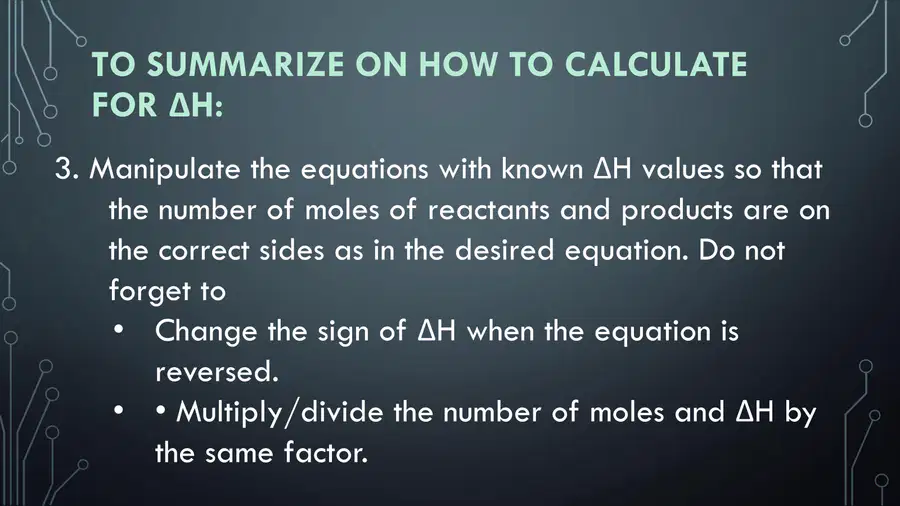
49

50
Multiple Choice
Solving for ΔH involves
Reversing all given chemical reactions.
Manipulating the equation so that the reactants and products are on the desired side of the equation
Change the sign of ΔH
Removing all reactants that are on the same side of the equation
51

52

53
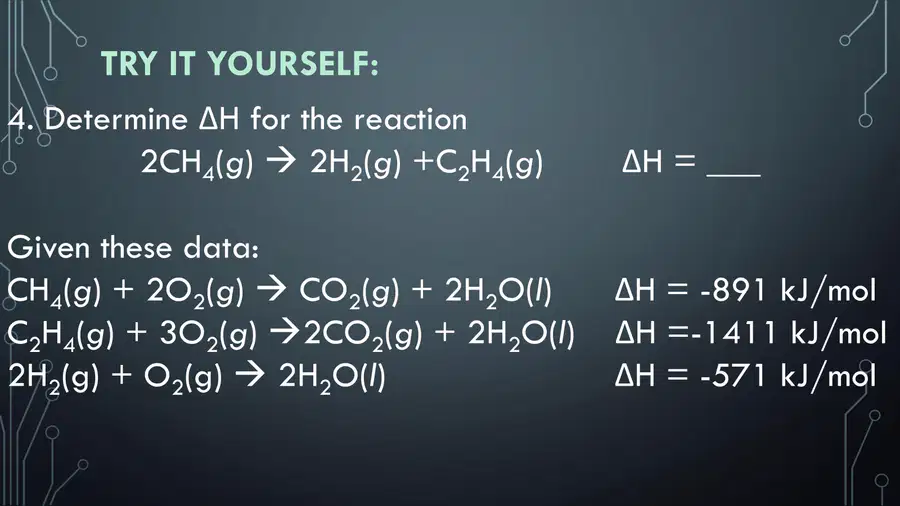
54

55
Fill in the Blanks
Type answer...
56
Fill in the Blanks
57
Fill in the Blanks
58

EVALUATION
59
Multiple Choice
The variations in enthalpy that can not be detected per calorimeter can be detected with the aid of
Newton’s law
Krebs law
Hess’s law
Ohm’s law
60
Multiple Choice
Changes in enthalpy in an exothermic reaction is
Positive
Negative
Constant
Neutral
61
Multiple Choice
The change in the energy between a chemical reaction and the surroundings at constant temperature is called
enthalpy change
enthalpy
enthalpy profile
dynamic enthalpy
62
Multiple Choice
Given the hypothetical thermochemical equation:
A + B → C + D ΔH = -430 kJ/mol
Which among the following statements is correct about this reaction?
The reaction is exothermic.
The equation may be written as A + B → C + D 430 kJ/mol
The heat content of C and D is greater than the heat content of A and B.
The heat content of A and C is greater than the heat content of B and D.
63
Multiple Choice
The thermochemical equation showing the formation of ammonia (NH3) from its elements is:
N2(g) + 3H2(g) → 2NH3(g) ΔH = -92 kJ/mol
This equation shows that 92 kJ of heat is:
Lost to the surroundings when one mole of hydrogen is used up in the reaction.
Absorbed from the surroundings when one mole of nitrogen reacts.
Absorbed from the surroundings when one mole of ammonia is formed.
Lost to the surroundings when 2 moles of ammonia is formed.
64
Multiple Choice
An oxyacetylene torch is a tool that mixes and burns oxygen and acetylene to produce an extremely hot flame. This tool is used to cut steel or weld iron and other metals. The temperature of the film can reach 3480˚C. The burning of acetylene is given by the thermochemical equation:
C2H2(g) + 1½CO2(g) → CO2(g) + H2O(l) ΔH = -1301.1 kJ/mol
For the reaction,
2CO2(g) + 2H2O(l) → 2C2H2(g) + 3CO2(g)
What is the ΔH for the reaction?
ΔH = +1301.1 kJ/mol
ΔH = +2602.2 kJ/mol
ΔH = -1301.1 kJ/mol
ΔH = -2602.2 kJ/mol
65
Multiple Choice
The standard condition for enthalpy changes is/are
the pressure of 1 atm
normal physical state
temperature 298K
all of these
66
Multiple Choice
The heat of reaction refers to
The heat released after burning 1 mole of a substance.
The amount of heat needed to melt 1 mole of a solid.
The heat released by 1 mole of a substance as it changes from a liquid to a solid.
The heat released or absorbed during a chemical reaction.
67
Multiple Choice
The Law of <blank> states that energy cannot be created nor destroyed only transferred
Specific Heat
Exothermic Reaction
Conservation of Energy
Potential Energy
Show answer
Auto Play
Slide 1 / 67
SLIDE
Similar Resources on Wayground

60 questions
Selective Incorporation
Presentation
•
12th Grade
59 questions
Potential Energy; Stored Energy
Presentation
•
University
64 questions
C09.4 Covalent Bonding Lecture
Presentation
•
12th Grade
62 questions
excretory system and homeostasis
Presentation
•
12th Grade
60 questions
Oxidation of Elements Lesson
Presentation
•
University
61 questions
LIGHT
Presentation
•
KG
61 questions
Federalism
Presentation
•
12th Grade
60 questions
Biotechnology
Presentation
•
12th Grade
Popular Resources on Wayground
10 questions
Factors 4th grade

Quiz
•
4th Grade
10 questions
Cinco de Mayo Trivia Questions

Interactive video
•
3rd - 5th Grade
13 questions
Cinco de mayo
Interactive video
•
6th - 8th Grade
20 questions
Math Review
Quiz
•
3rd Grade
20 questions
Main Idea and Details
Quiz
•
5th Grade
20 questions
Context Clues
Quiz
•
6th Grade
20 questions
Inferences
Quiz
•
4th Grade
19 questions
Classifying Quadrilaterals
Quiz
•
3rd Grade
Discover more resources for Chemistry
20 questions
Types of Chemical Reactions
Quiz
•
9th - 12th Grade
25 questions
Enthalpy - endo/exo and PED
Quiz
•
11th - 12th Grade
17 questions
Types of Chemical Reaction
Presentation
•
7th - 12th Grade
120 questions
Chemistry Final Review
Quiz
•
9th - 12th Grade
47 questions
Q1 Chem Review
Quiz
•
10th - 12th Grade
15 questions
Half-Life
Quiz
•
9th - 12th Grade
15 questions
Unit 10 Review
Quiz
•
9th - 12th Grade
20 questions
Acids and Bases Properties
Quiz
•
9th - 12th Grade