

Interdependence Within Environmental Systems

Presentation
•
Science
•
10th Grade
•
Hard

Joseph Anderson
FREE Resource
26 Slides • 9 Questions
1
Category 5

Interdependence with Environmental Systems (B.11 and B.12)
2
Interpret ecological relationships and adaptations of organisms in different ecosystems
I Will...
Know that interdependence and interactions occur within an environmental system
We Will...
Win for the Day!
B.12 (B) Compare variations and adaptations of organisms in different ecosystems
3
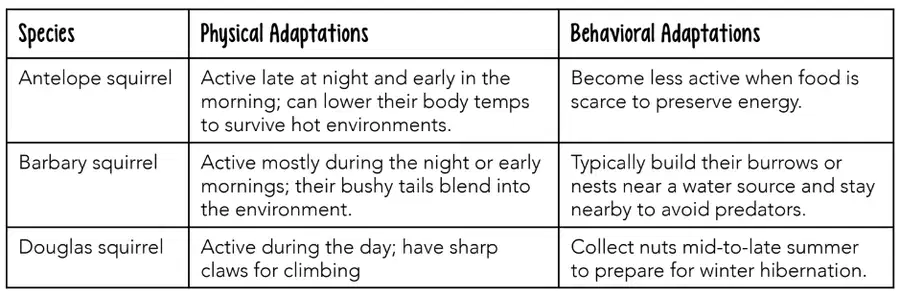
Adaptations of Organisms
4
Biomes
Desert
Species: Antelope Squirrel
Active during cooler parts of the day, can lower body temp to survive the hot desert, and can become less active to survive the desert's lack of food

5
Biomes
Grasslands
Species: Barbary Squirrel
Grasslands are prone to predation, lives near water - less likely to be seen, bushy tail blends in - camouflage

6
Biomes
Temperate Forest
Species: Douglas Squirrel
Collect and store nuts - preparing for winter. They climb trees for food and to avoid/escape predators

7
Open Ended

Red foxes can be found in temperate rain forests, taigas, and grasslands. Their fur is usually a
combination of pale yellows, reds, grays, and browns. Arctic foxes found in the tundra have white
fur. Describe how this variation among the fox family is an adaptation for their particular environment:
8
Red foxes can be found in temperate rain forests, taigas, and grasslands. Their fur is usually a combination of pale yellows, reds, grays, and browns. Arctic foxes found in the tundra have white fur. Describe how this variation among the fox family is an adaptation for their particular environment:
Color helps them camouflage or blend into the environment. Gives them the ability to hide from predators and also hunt for prey.
9
Open Ended

How is the kangaroo rat specifically adapted to the desert?
10
How is the Kangaroo rat specifically adapted to the desert?
The kangaroo rat is specifically adapted to the desert with its ability to have low water needs and legs that allow them to escape predators.

11
Interpret ecological relationships and adaptations of organisms in different ecosystems (flow of matter and energy)
I Will...
Know that interdependence and interactions occur within an environmental system
We Will...
Win for the Day!
12
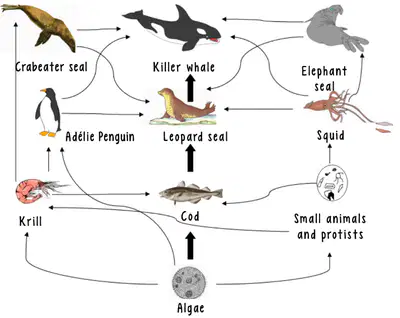
What are food webs?
A food web is an interconnected map of multiple food chains.
Producer
Primary
Secondary
Tertiary
Quaternary
13
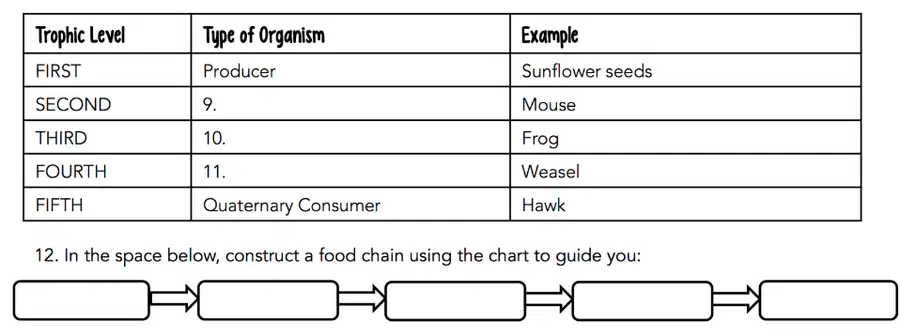
Primary
Secondary
Tertiary
14
Reorder
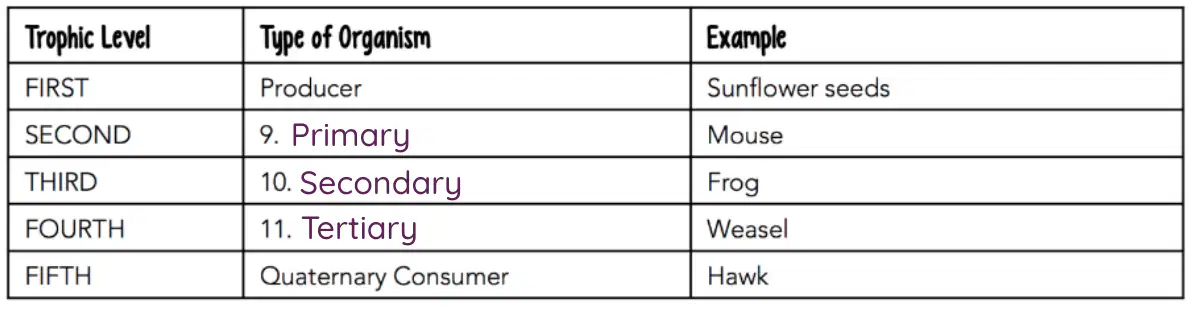
Reorder the following organisms into the correct trophic level order.
Sunflower seeds
Mouse
Frog
Weasel
Hawk
15
Energy Pyramid
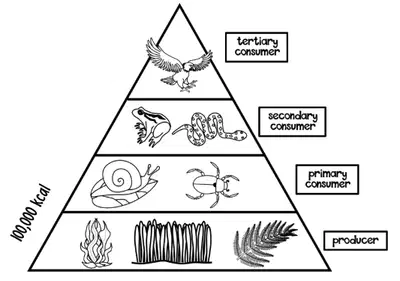
The model at left depicts an energy pyramid
The 10 percent law: Approximately 10% of the energy available in one trophic level is passed on to the next.
Much of the energy available in the trophic levels is lost as heat
16
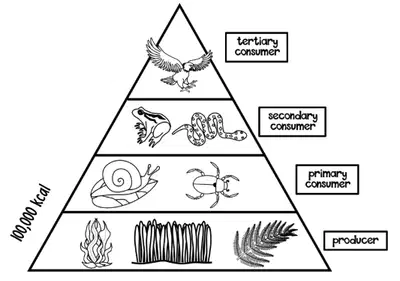
Notice that there are 100,000 kcal (energy) found within the producers in the ecosystem represented by the model below. For the remaining trophic levels, write how many kcal (energy) you can expect to find.
17
Labelling
Label each trophic level with their specific energy/kcal
10 kcal
10,000 kcal
100,000 kcal
1,000 kcal
100 kcal
18
Notice that there are 100,000 kcal (energy) found within the producers in the ecosystem represented by the model below. For the remaining trophic levels, write how many kcal (energy) you can expect to find.
10,000 kcal
1,000 kcal
100 kcal
19
Interpret ecological relationships and adaptations of organisms in different ecosystems
I Will...
Know that interdependence and interactions occur within an environmental system
We Will...
Win for the Day!
20
21
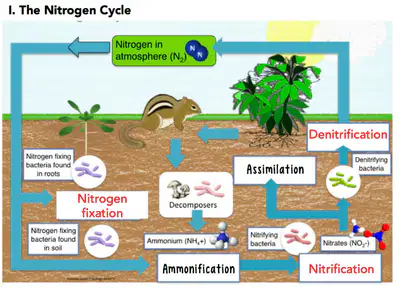
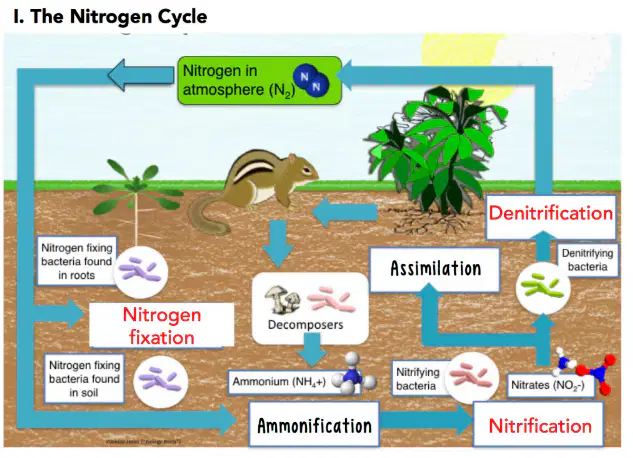
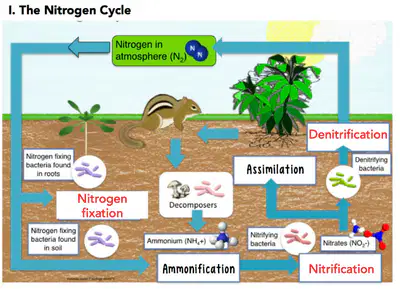
1. Nitrogen Fixation: atmospheric nitrogen is converted into ammonia by rhizobium
2. Assimilation: nitrogen and ammonia from Nitrogen Fixation absorbed into specific tissues for algae and higher plants
3. Ammonification: decomposing dead matter and waste to make ammonia and ammonium
4. Nitrification: bacteria transforms soil ammonia into nitrates (absorbed/used by plants and bacteria)
5. Denitrification: the process that converts nitrate to nitrogen gas, thus removing bioavailable nitrogen and returning it to the atmosphere
22
Bacteria that live in the soil, water, or plant roots can fix (make usable) nitrogen from the atmosphere so that plants can use it
Denitrifying bacteria remove nitrogen from the soil and return it to the atmosphere.
23
24
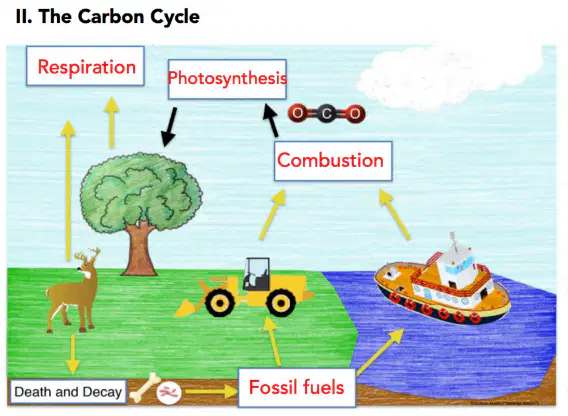
Carbon enters the atmosphere as CO2. (combustion/respiration)
CO2 is absorbed by autotrophs such as green plants. (photosynthesis)
Animals consume plants, thereby, incorporating carbon into their system.
Animals and plants die, their bodies decompose and carbon is reabsorbed back into the atmosphere. (decomposition)
25
Carbon found in the atmosphere is mostly found in the molecule carbon dioxide
Name two ways carbon is released into the atmosphere: combustion (organic molecules burned in the presence of oxygen giving off carbon dioxide, water and energy) and respiration
26
Multiple Choice
Which natural process removes carbon from the atmosphere?
photosynthesis
cellular respiration
microorganisms
27
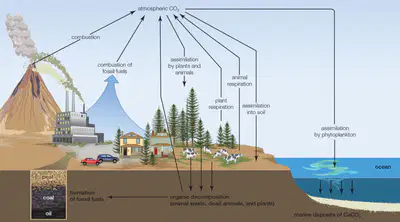
Removes plants that remove carbon dioxide from the atmosphere
Deforestation
Releases excess carbon dioxide into the atmosphere
Burning of Fossil Fuels
Disrupting the Carbon Cycle

28
Interpret ecological relationships and adaptations of organisms in different ecosystems
I Will...
Know that interdependence and interactions occur within an environmental system
We Will...
Win for the Day!
29
Ecosystem Stability
The stability of an ecosystem is determined by its capability to remain constant under the pressures of a changing environment or changing populations. The more species an ecosystem contains, the more stable or healthy the ecosystem.
30
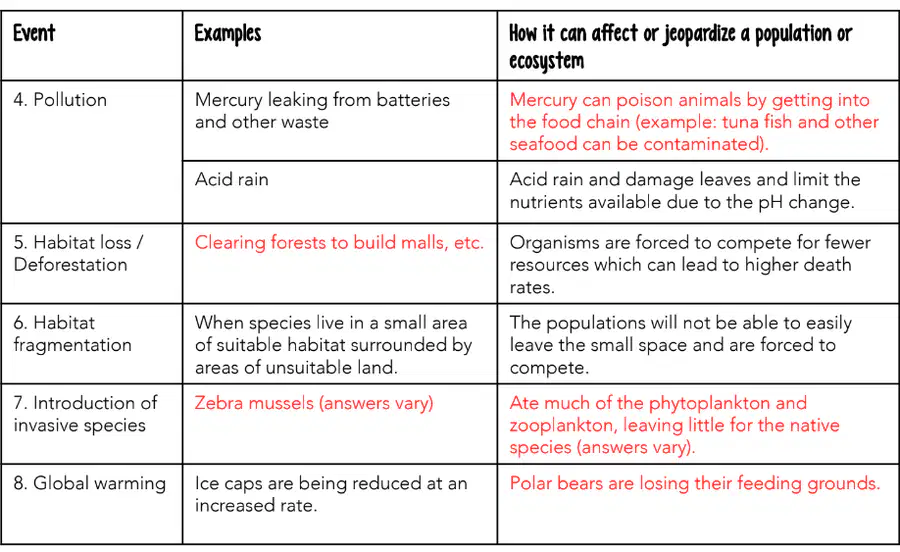
Loss of Biodiversity Occurs From:
Global Warming
Pollution
Deforestation
Natural Disaster
31
32
Multiple Choice
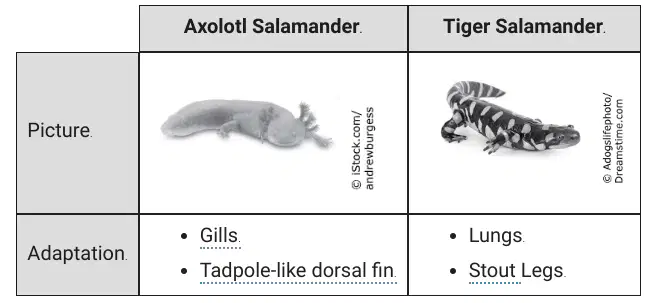
Q1: Some adaptations of two species of salamanders are in the table shown.
Which statement best compares the areas where the axolotl and tiger salamanders live based on their adaptations?
Axolotl salamanders live on land near fresh water.
Tiger salamanders live in lakes.
Axolotl salamanders live in trees.
Tiger salamanders live in caves.
Axolotl salamanders live in caves.
Tiger salamanders live in trees.
Axolotl salamanders live in lakes.
Tiger salamanders live on land near fresh water.
33
Multiple Choice
Q 44: Which model best represents the amount of energy available for use at each trophic level represented in the food chain?
34
Multiple Choice
Q25: When sawdust is added to soil, organisms in the soil will use all the available nitrogen to break the sawdust down.
What effect will the lack of nitrogen have on the plants that are near the sawdust?
A.
The plants will not be able to grow.
B.
The plants will grow faster than before.
C.
The plants will be replaced with new plants.
D.
The plants will evolve to no longer need nitrogen.
35
Multiple Choice
Q8: Kelp forests are critical ecosystems that provide habitats to a variety of animals, including sea urchins, sea stars, sea anemones, crabs, jellyfish, snails, and fish. They also provide hunting grounds for mammals, including sea otters, sea lions, seals, and many different birds. In recent years, scientists have documented an increase in shark attacks on sea otters in and around kelp forests.
Which consequence is most likely to occur in kelp forests as a result of increased predation of sea otters?
Kelp forests will become more stable due to the decrease in otter predation pressure.
Kelp forests will become more stable as sharks replace otters as the top predator in the food chain.
Kelp forests will become less stable due to the increase in the size of the otters' prey populations.
Kelp forests will become less stable as sharks will also eliminate the prey of otters.
Category 5
Interdependence with Environmental Systems (B.11 and B.12)
Show answer
Auto Play
Slide 1 / 35
SLIDE
Similar Resources on Wayground

29 questions
Unit 6.1 & 6.2 CFA Point Recovery
Presentation
•
9th Grade
29 questions
Heating and Cooling Curves
Presentation
•
9th Grade
27 questions
Big Bang Theory
Presentation
•
9th Grade
28 questions
Problem and Solution
Presentation
•
10th Grade
28 questions
Absolute Monarchs
Presentation
•
10th Grade
26 questions
Evolution: Evidence Homologous Body Structures
Presentation
•
10th Grade
30 questions
Know Your Lab Equipment
Presentation
•
10th Grade
30 questions
Periodic Table Trends
Presentation
•
10th Grade
Popular Resources on Wayground
16 questions
Grade 3 Simulation Assessment 2

Quiz
•
3rd Grade
19 questions
HCS Grade 5 Simulation Assessment_1 2526sy
Quiz
•
5th Grade
10 questions
Cinco de Mayo Trivia Questions

Interactive video
•
3rd - 5th Grade
17 questions
HCS Grade 4 Simulation Assessment_2 2526sy
Quiz
•
4th Grade
24 questions
HCS Grade 5 Simulation Assessment_2 2526sy
Quiz
•
5th Grade
13 questions
Cinco de mayo
Interactive video
•
6th - 8th Grade
20 questions
Math Review
Quiz
•
3rd Grade
30 questions
GVMS House Trivia 2026
Quiz
•
6th - 8th Grade
Discover more resources for Science
100 questions
Biology EOC Review
Quiz
•
9th - 12th Grade
38 questions
Biology EOC Review Game
Quiz
•
10th Grade
25 questions
Biology EOC review Quiz
Quiz
•
9th - 12th Grade
11 questions
EOC Domain 1: Cells
Presentation
•
9th - 10th Grade
14 questions
EOC Domain 2: Genetics
Presentation
•
9th - 10th Grade
10 questions
Exploring the Human Respiratory System
Interactive video
•
6th - 10th Grade
10 questions
Exploring Newton's Laws of Motion
Interactive video
•
6th - 10th Grade
10 questions
Exploring the Formation of the Solar System
Interactive video
•
6th - 10th Grade