

Light Waves and Seeing Color

Presentation
•
Science
•
9th - 12th Grade
•
Hard

Joseph Anderson
FREE Resource
9 Slides • 26 Questions
1
Have you ever wondered what color is?

2
3
Multiple Choice
According to Kelleher, what is the first step in understanding the phenomenon of color?
Think about it as a wave
Research the spectrum and find pictures of rainbows
Visit the paint section at the local hardware store
Buy a coloring book
4
Open Ended
Explain (in your own words) why it's better to wear lighter colors (such as white and pale yellow) during the summer and better to wear darker colors (like black and charcoal gray) in the winter.
5
Multiple Choice
Why does a yellow pencil look yellow?
The sun emits all colors, but the pencil reflects yellow more than it reflects the other colors
The sun reflects all colors, but the pencil emits yellow more than it reflects the other colors
The sun emits all colors, but the pencil reflects yellow less than it reflects the other colors
The sun reflects most colors, but the pencil emits yellow less than it reflects the other colors
6
Multiple Choice
White objects reflect all colors of light and black objects absorb all colors of light.
True
False
7
But how do we see the amazing kaleidoscope of other colors that make up our world?
8
9
Multiple Choice
Why is it weird that green and red light mix to form yellow light?
Yellow light is also formed when you mix other light waves, but never complimentary colors
Light generally combines the way physical color does, so the complimentary colors should form a milky brown
Light is a wave, and two different frequencies shouldn't interact with one another
Green and red light do not mix to form yellow light
10
Multiple Choice
Why can't you see color when it's dark?
The rod cells in your retina take over in low light
The cone cells in your retina take over in low light
The pigma cells in your retina take over in low light
Color doesn't exist in dark environments
11
Multiple Choice
How many colors do TV manufacturers use in the production of televisions?
Over 1 million
100
3
25
12
Open Ended
Explain what happens when someone is color blind. Does this alter his or her ability to see in the dark?
13
Open Ended
What industries (other than television manufacturing) may benefit from the way the human eye sees color?
14
Open Ended
What would happen if you mixed blue light and red light? What would happen if you mixed blue pigment and red pigment?
15
is the ability of an organism or machine to distinguish objects based on the wavelengths (or frequencies) of the light they reflect, emit, or transmit. Colors can be measured and quantified in various ways; indeed, a human's perception of colors is a subjective process whereby the brain responds to the stimuli that are produced when incoming light reacts with the several types of cone photoreceptors in the eye.

16
(commonly referred to simply as light) is electromagnetic radiation that is visible to the human eye and is responsible for the sense of sight. Visible light has a wavelength in the range of about 380 nanometres to about 740 nm – between the invisible infrared, with longer wavelengths, and the invisible ultraviolet, with shorter wavelengths.

17
was born completely color blind, but, these days, a device attached to his head turns color into audible frequencies. Instead of seeing a world in grayscale, Harbisson can hear a symphony of color -- and even listen to faces and paintings.

18
19
Multiple Choice
Light is made up of...
electricity and waves
magnetism and waves
electricity and magnetism
electricity and energy
20
Multiple Choice
The color with the longest wavelength is...
Blue
Red
Green
Yellow
21
Multiple Choice
A shadow is created by the....
absence of light.
absence of waves.
absence of color.
blocking of sound.
22
Multiple Choice
The darkest part of a shadow is called the...
shadow
umbra
penumbra
pentagram
23
Multiple Choice
If you see a green leaf on a tree, that means...
Green is the color being reflected off the leaf.
Green is the color being absorbed by the leaf.
All the colors are being reflected off the leaf.
All the colors are being absorbed by the leaf.
24
Multiple Choice
The sky is blue because...
blue is the color most scattered or reflected by our atmosphere.
red is the color most scattered or reflected by our atmosphere.
blue is the color most absorbed by our atmosphere.
blue is complimentary to orange.
25
Multiple Choice
The most dangerous type of light in the universe is...
a microwave
an x-ray
a gamma ray
an ultraviolet wave
26
Multiple Choice
What type of light does sunblock actually block?
Radio waves
Ultraviolet
Visible Light
Infrared Light
27
Multiple Choice

In this GIF, which of the vocabulary represents what is happening in the GIF?
Absorption
Reflection
Transmission
28
Multiple Choice
29
Multiple Choice
30
Energy is only absorbed when light is absorbed.
31
Draw
Draw what happens to energy when light is reflected. Use yellow arrows to represent energy.
32
Multiple Choice
Light must be _______________ in order for the material to be affected by light.
reflected
penetrated
absorbed
surrounded
33
Multiple Choice
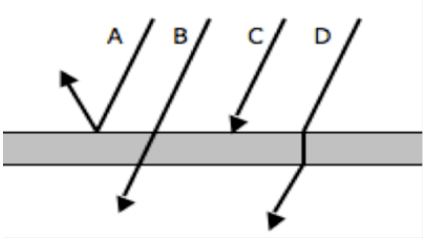
Ray B represents __.
reflection
refraction
transmission
absorption
34
Multiple Choice
Ray C represents __.
reflection
refraction
transmission
absorption
35
Multiple Choice

Have you ever wondered what color is?
Show answer
Auto Play
Slide 1 / 35
SLIDE
Similar Resources on Wayground

28 questions
Lesson 1 - Introduction to Plant Reproduction
Presentation
•
9th - 12th Grade
25 questions
SI Units of Measurement Lesson
Presentation
•
9th - 12th Grade
28 questions
Viruses
Presentation
•
8th - 12th Grade
24 questions
Nuclear Decay
Presentation
•
9th - 12th Grade
28 questions
Food Chains and Webs
Presentation
•
9th - 12th Grade
30 questions
Carbon: A Central Building Block: Tutorial
Presentation
•
9th - 12th Grade
30 questions
Unit 10: Plant Systems Overview & Notes
Presentation
•
9th - 12th Grade
27 questions
DE_Chem_1.2_Thermochemistry
Presentation
•
9th - 12th Grade
Popular Resources on Wayground
10 questions
How much do you know about our Portrait of an Eagle?

Quiz
•
10th Grade
10 questions
Fast Food Slogans
Quiz
•
6th - 8th Grade
21 questions
Continents and Oceans
Quiz
•
6th Grade
20 questions
Parts of Speech
Quiz
•
5th Grade
16 questions
Subject & Predicate
Quiz
•
5th Grade
25 questions
Multiplication Facts
Quiz
•
5th Grade
12 questions
Map Skills
Quiz
•
3rd Grade
22 questions
Continents and Oceans
Quiz
•
5th Grade
Discover more resources for Science
10 questions
Exploring Chemical and Physical Changes

Interactive video
•
6th - 10th Grade
20 questions
Atomic Structure
Quiz
•
9th Grade
10 questions
Decoding the Periodic Table of Elements
Interactive video
•
6th - 10th Grade
10 questions
Exploring the Periodic Table
Interactive video
•
6th - 10th Grade
14 questions
Physical and Chemical Changes
Quiz
•
10th Grade
22 questions
Periodic Table Review
Quiz
•
9th - 12th Grade
20 questions
Observation vs. Inference
Quiz
•
7th - 9th Grade
14 questions
Periodic Trends
Interactive video
•
11th Grade