

Mixtures

Presentation
•
Science
•
1st - 5th Grade
•
Hard

Joseph Anderson
FREE Resource
36 Slides • 17 Questions
1

5.14
2

3

4
Multiple Choice

Is this a mixture?
Yes
No
5
Multiple Choice

Is this a mixture?
Yes
No
6
Multiple Choice

Is this a mixture?
Yes
No
7
8

9

10

11

12
13
Multiple Choice

Is this a solution?
Yes
No
14
Multiple Choice

Is this a solution?
Yes
No
15
Match

Match the solvent and the solute
Solvent
Solute
Solution
Water
Sand
Solution
Water
Sand
Solution
16

17

18

19
20
Multiple Choice
Which option shows separating materials through filtration?
21
Multiple Choice
Which option shows handpicking materials to separate?
22
Multiple Choice
Which option shows separating materials with a magnet?
23
Characteristics that can be observed, measured or tested.
For example: Color, melting point, magnetism.
Some text here about the topic of discussion.
Physical Properties

24
A form of matter that is the same throughout and has specific properties.
A substance is something(things)
Some text here about the topic of discussion.
Substance

25
Multiple Choice

In a mixture, the properties of a substance ______________
do not change
change forms
turn into a liquid
become solid
26
To spread out evenly in a liquid.
Some text here about the topic of discussion.
Dissolve

27
A liquid mixture in which
One substance is mixed and dissolved evenly throughout another substance.
Some text here about the topic of discussion.
Solution

28
Multiple Choice
What is a solution?
A type of mixture where one substance dissolves in another
An ingredient.
A liquid.
A gas.
29
Multiple Choice
________ is the ability to dissolve in water.
Conductivity
Magnetism
Solubility
Reflectivity
30

31

32
Diluted Solutions Vs Concentrated Solutions
A dilute solution has a small proportion of solute when compared with a concentrated solution.
Experience Chemistry | Lesson 5.4.2

33
solute = what is being dissolved (Ex: Lemonade powder)
solvent = what is doing the dissolving (Ex: Water)
solution = the result (Ex: Lemonade)
soluble = CAN dissolve in water
insoluble = CANNOT dissolve in water
34

35

36
37
Solubility
Solubility is determined based on a substance ability to dissolve. A substance such as sand is considered to be insoluble (-unable to dissolve) because when sand and water is mixed, the solute sand, settles at the bottom. Sugar on the other hand, when mixed in water is considered to be soluble (-capable of being dissolved) because when sugar is mixed in water it dissolves evenly amongst the solvent.
38
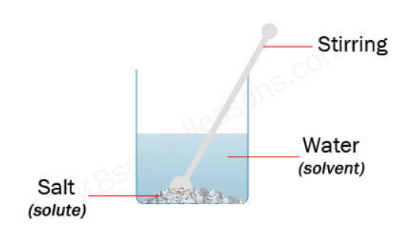
Stirring or agitating a solution increases the amount of solute/solvent interactions mechanically.
Increasing solute/solvent interactions increases rate of dissolution.
This is why you stir the Kool-aid when you add it to the water.
39
Concentration in solutions

40
Concentration refers to the amount of solute dissolved in a volume of solvent.
The more solute that is dissolved in a solvent, the more concentrated the solution is.
A solution that is not very concentrated is a dilute solution.

41
Multiple Choice
If you want to make a solution more concentrated, you should add more
solute
solvent
love
42

43
Multiple Choice

Which of the following solutions is the most diluted?
A solution of 5 grams of salt with a volume of 100 mL.
A solution of 10 grams of salt with a volume of 1000 mL.
A solution of 20 grams of salt with a volume of 1000 mL.
A solution of 50 grams of salt with a volume of 1000 mL.
44
A saturated solution is a solution in which no more solute can dissolve.
At the saturation point, all of the solute is dissolved, but adding more solute will leave some undissolved.

45
Multiple Choice
A ________ is a solution in which no more solute can dissolve.
saturated solution
unsaturated solution
supersaturated solution
46
A supersaturated solution is a solution that contains more solute than a saturated solution.
Usually, this results in undissolved material that tends to crystallize.

47
The amount of solute that will dissolve in a solvent is its solubility. Solubility depends on the solvent.

48
Temperature
Pressure
Rate of stirring/mixing
Size of solute particles
49
Separating Mixtures-Physical Means
There are many ways to separate mixtures into their components, and what you do depends on your ultimate goal
Physical methods
Decanting
Centrifuging
Filtration
Evaporation


50
Separating Mixtures- other methods
Chromatography separates components of a mixture based on how quickly different molecules dissolved in a mobile phase solvent move along a solid plane
Distillation separates mixtures based on evaporation point


51
52
Multiple Choice

In which way is solubility different than concentration?
Unlike concentration, solubility does not depend on the amount of solvent.
Solubility can change based on temperature and pressure, but concentration can only change due to the total volume of solution.
Solubility is a measurement of how much solute can possibly dissolve, but concentration is a measurement of how much solute is dissolved.
Unlike concentration, solubility depends on the amount of solute dissolved in the total solution.
53
Multiple Choice

Solubility is the ability of a solute to dissolve into a solution. Which of the following statements is true about solubility?
More solute can dissolve in a solution if its solubility is high.
More solute can dissolve in a solution if its solubility is low.
Less solute can dissolve in a solution if its solubility is high.
The amount of solute that can dissolve depends on the solvent, not solubility.
5.14
Show answer
Auto Play
Slide 1 / 53
SLIDE
Similar Resources on Wayground

44 questions
G1 Sc CA 1 Revision
Presentation
•
KG
52 questions
Earth's Features
Presentation
•
1st - 5th Grade
48 questions
La sobriété numérique
Presentation
•
KG
47 questions
Complete Sentences
Presentation
•
1st - 5th Grade
47 questions
PRIMEROS AUXILIOS
Presentation
•
1st - 5th Grade
50 questions
Jupiter and Saturn: Lesson
Presentation
•
1st - 5th Grade
46 questions
Cephalapods Lesson
Presentation
•
1st - 5th Grade
47 questions
electricity day 2 after reading thru ch.
Presentation
•
1st - 4th Grade
Popular Resources on Wayground
10 questions
Safety Day 2026 – Student Review

Quiz
•
9th Grade
21 questions
Continents and Oceans
Quiz
•
6th Grade
20 questions
Parts of Speech
Quiz
•
5th Grade
16 questions
Subject & Predicate
Quiz
•
5th Grade
25 questions
Multiplication Facts
Quiz
•
5th Grade
12 questions
Map Skills
Quiz
•
3rd Grade
22 questions
Continents and Oceans
Quiz
•
5th Grade
15 questions
Rounding Decimals
Quiz
•
5th Grade
Discover more resources for Science
20 questions
Mixtures and Solutions Practice
Quiz
•
5th Grade
10 questions
Mixtures and Solutions
Quiz
•
4th Grade
20 questions
Food Chains and Food Webs Review
Quiz
•
5th Grade
20 questions
GC Interim #1 Review 2026
Quiz
•
5th Grade
10 questions
Severe Weather Around Us
Quiz
•
2nd Grade
20 questions
5.3 Force and Motion Study Guide Review
Quiz
•
5th Grade
15 questions
Force and Motion
Presentation
•
5th Grade
19 questions
3rd Grade CUA #1 Review GC
Quiz
•
3rd Grade