

Petroleum Refining

Presentation
•
Science
•
10th Grade
•
Hard

Joseph Anderson
FREE Resource
8 Slides • 28 Questions
1
A journey into the fascinating world of crude oil, its extraction, refining, and impact on the global economy and environment.
2
Crude Oil: A Vital Resource
Crude oil is a fossil fuel that is essential for various purposes. It is used to produce fuels for transportation, heating, and electricity generation. Additionally, it serves as a raw material for manufacturing plastics and numerous petrochemicals. Crude oil is a complex mixture of compounds that can be separated through fractional distillation.
3
Multiple Choice
What is crude oil primarily used for?
Transportation fuels
Plastics manufacturing
Electricity generation
Food production
4
Multiple Choice
What term is given to a compound which contains atoms of carbon and hydrogen only?
alkene
hydrocarbon
alkane
saturated
5
Multiple Choice
Alkanes have the general formula:
CnH2n
CnH2n+1
CnH2n+2
CnHn
6
Multiple Choice
Crude oil is made up of:
Ethane
Butane
A mixture of different hydrocarbons
Extremely large hydrocarbons which are broken up once extracted
7
Multiple Choice
A fraction of crude oil is made up of:
Hydrocarbons of similar chain lengths
Numbers
Large hydrocarbons
Alkenes only
8
Crude Oil:
Trivia: Crude oil is primarily used for plastics manufacturing. It is the main ingredient in the production of various plastic products, from bottles to toys. Additionally, crude oil is also used to make synthetic fibers, such as polyester, which are widely used in the textile industry.
9
Exploring Crude Oil
Crude oil is found in sedimentary rocks under the sea bed. Oil rigs are used to drill through the sea bed and extract the oil. It is then transported through pipelines to oil tanker terminals or refineries on land. Many compounds in crude oil are hydrocarbons, containing carbon and hydrogen elements.
10
Multiple Choice
Where is crude oil found?
In sedimentary rocks under the sea bed
In igneous rocks on land
In volcanic rocks under the sea bed
In metamorphic rocks on land
11
Crude Oil:
In igneous rocks on land is where crude oil is found. It is a fascinating fact that this valuable resource is not only found under the sea bed but also in rocks on land. Crude oil is formed over millions of years and is a vital source of energy for various industries worldwide.
12
Exploring Crude Oil
Crude oil is primarily composed of alkanes, which are hydrocarbon compounds. Alkanes have a single chain of carbon atoms with hydrogen atoms bonded to them. The general formula for alkanes is CnH2n+2. Methane (CH4) and ethane (C2H6) are examples of alkanes. Alkanes play a crucial role in the world of crude oil.
13
Crude Oil: Propane
Propane is the simplest alkane with the formula C3H8. It is a saturated hydrocarbon, meaning it contains carbon atoms joined by single carbon–carbon covalent bonds. Saturated hydrocarbons have no double or triple bonds. Propane is commonly used as a fuel for heating, cooking, and transportation. It is also a key component in the production of plastics and other chemicals. Explore the world of crude oil and its various applications!
14
Multiple Choice
What is the chemical formula of propane?
C2H6
C3H8
C4H10
C5H12
15
Propane: Fun Fact
Did you know? Propane, with the chemical formula C3H8, is commonly used as a fuel for heating, cooking, and even as a propellant in aerosol cans. It is odorless, but a distinctive smell is added to detect leaks. Propane is also known as liquefied petroleum gas (LPG) and is stored under pressure to keep it in a liquid state.
16
Multiple Choice
What process is used to separate crude oil in hydrocarbons with different chain lengths?
distillation
fractional distillation
cracking
polymerisation
17
Multiple Choice
Where in the fractionating column are shorter chain hydrocarbon molecules obtained?
At the top
At the bottom
18
Multiple Choice
Fractional distillation separates crude oil based on the different __________ of the molecules in the mixture
melting point
boiling point
freezing point
chemical reactivity
19
Multiple Choice
Molecules collected at the bottom of the fractionating column tend to be...
more viscous, less flammable and less volatile
less viscous, more flammable and more volatile
more viscous, more flammable and less volatile
less viscous, less flammable and more volatile
20
Multiple Choice
Molecules collected at the top of the fractionating column tend to be...
more viscous, less flammable and less volatile
less viscous, more flammable and more volatile
more viscous, more flammable and less volatile
less viscous, less flammable and more volatile
21
Multiple Choice
Shorter hydrocarbons have:
Higher boiling points
Lower boiling points
22
Multiple Choice
Gases/LPG are used for:
Fuel in cars
Fuel for large ships
Roof and road surfacing
Domestic heating and cooking
23
Multiple Choice
Petrol is used for:
Fuel in cars
Fuel in aircraft
Domestic heating and cooking
Road surfacing
24
Multiple Choice
Kerosene (paraffin) is used for:
Fuel for cars
Domestic heating and cooking
Fuel in aircraft
Fuel for large ships and in power stations
25
Multiple Choice
Diesel oil is used for:
Fuel in cars
Fuel in aircraft
Road and roof surfacing
Fuel in some cars and larger vehicles
26
Multiple Choice
Fuel oil is used for:
Fuel in some cars and larger vehicles
Fuel for large ships and in some power stations
Roof and road surfacing
Fuel for cars
27
Multiple Choice
Bitumen is used for:
Fuel for large ships and in some power stations
Roof and road surfacing
Fuel in aircraft
Fuel in cars
28
Multiple Choice

What is the structure shown?
Methane
Propane
Ethane
Butane
29
Multiple Choice
30
Multiple Choice
31
Multiple Choice

Where do long chain hydrocarbons collect?
At the top
In the middle
At the bottom
32
Multiple Choice

Where do short chain hydrocarbons collect?
At the top
In the middle
At the bottom
33
Multiple Choice
What does viscosity tell you about a hydrocarbon?
How easy it is to ignite
How runny it is
What is boiling point is
34
Multiple Choice
The shorter the hydrocarbon, the more viscous it is
True
False
35
Multiple Choice
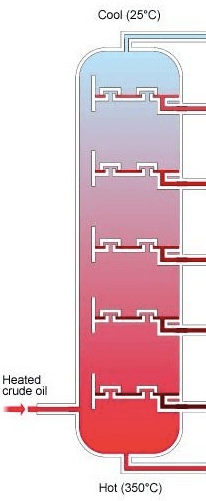
What process happens as the crude oil enters the fractionating column?
Evaporation
Condensation
Combustion
36
Multiple Choice
What process happens at each level in the fractionating column?
Evaporation
Condensation
Combustion
A journey into the fascinating world of crude oil, its extraction, refining, and impact on the global economy and environment.
Show answer
Auto Play
Slide 1 / 36
SLIDE
Similar Resources on Wayground

30 questions
Political Spectrum in Canada
Presentation
•
10th Grade
28 questions
A Moving Image Analysis - Act 1, Scene 1
Presentation
•
9th Grade
32 questions
Post War America
Presentation
•
11th Grade
27 questions
Biomass
Presentation
•
10th Grade
27 questions
Physical Geography of Latin America/Landforms and Resources
Presentation
•
9th Grade
30 questions
Star Cycle
Presentation
•
11th Grade
29 questions
Chapter 6 Section 3-4
Presentation
•
9th Grade
32 questions
ALL ABOUT SAUCES
Presentation
•
10th Grade
Popular Resources on Wayground
10 questions
Safety Day 2026 – Student Review

Quiz
•
9th Grade
21 questions
Continents and Oceans
Quiz
•
6th Grade
20 questions
Parts of Speech
Quiz
•
5th Grade
16 questions
Subject & Predicate
Quiz
•
5th Grade
25 questions
Multiplication Facts
Quiz
•
5th Grade
12 questions
Map Skills
Quiz
•
3rd Grade
22 questions
Continents and Oceans
Quiz
•
5th Grade
15 questions
Rounding Decimals
Quiz
•
5th Grade
Discover more resources for Science
10 questions
Exploring Chemical and Physical Changes

Interactive video
•
6th - 10th Grade
10 questions
Exploring the Electromagnetic Spectrum for Middle School Science
Interactive video
•
6th - 10th Grade
10 questions
Exploring Force and Motion Concepts
Interactive video
•
6th - 10th Grade
10 questions
Exploring Air Masses and Weather Fronts
Interactive video
•
6th - 10th Grade
10 questions
Exploring the States of Matter
Interactive video
•
6th - 10th Grade
10 questions
Exploring Forces: Net Force, Normal Force, Gravity, and Friction
Interactive video
•
6th - 10th Grade
10 questions
Differentiating Thermal Energy and Temperature
Interactive video
•
6th - 10th Grade
10 questions
Exploring the States of Matter and Thermal Energy
Interactive video
•
6th - 10th Grade