Search Header Logo
Physical Science Final Review

Physical Science Final Review

Assessment

Presentation

Science

KG

Hard

Created by

Joseph Anderson

FREE Resource

31 Slides • 47 Questions

1

Scientific Method- an organized set of investigation procedures

  • State the Problem

  • Gather Information

  • Form a hypothesis- a possible explanation for a problem using what you know and what you observe

  • Test the hypothesis- experiment

  • Analyze data

  • Draw Conclusion

2

Multiple Choice

Question image

A possible explanation to a problem that has not yet been tested.

1

data

2

theory

3

hypothesis

4

fact

3

Multiple Choice

Question image

This variable in an experiment is the one being deliberately changed by the scientist.

1

dependent variable

2

independent variable

3

data

4

control group

4

Multiple Choice

Question image

This variable in an experiment is the one being deliberately changed by the scientist.

1

dependent variable

2

independent variable

3

data

4

control group

5

Multiple Choice

Question image

Should experiments be repeated over and over to see if the results are the same each time?

1

yes

2

no

6

Multiple Choice

Question image

In a controlled experiment, how many variables can be worked with at a time?

1

one

2

none

3

two or more

4

how ever many makes sense.

7

Multiple Choice

Question image

Mr. S. sets up an experiment to see how the mass of a ball affects the distance it rolls off a ramp. Identify the independent variable.

1

distance traveled by the ball

2

height of the ramp

3

mass of the ball

4

weight of the ball

8

media

9

media

10

media

11

media

12

Multiple Choice

Question image
Molecules move, but they only vibrate in place.
1
Solid
2
Liquid
3
Gas

13

Multiple Choice

Question image
Which state of matter has a definite shape?
1
solid
2
liquid
3
gas

14

Multiple Choice

Matter that has no definite shape, but has a definite volume.
1
Solid
2
Liquid
3
Gas

15

Multiple Choice

Question image
Molecules change position easily and slide past one another.
1
Solid
2
Liquid
3
Gas

16

Multiple Choice

Matter that has no definite shape, nor volume.
1
Solid
2
Liquid
3
Gas

17

media

18

Kinetic Molecular Theory

  1. Gas particles have volume and empty space

    1. Large number of particles far apart most of the volume is empty space

  2. ​No attraction or repultions between the particles.

    1. The Kinetic energy overcomes the attractions forces

  3. ​Particle are in constant, linear, random motion

  4. Collisions are elastic - no kinetic energy is lost in a collision

  5. ​Kinetic Energy is directly proportional to temperature

Subject | Subject

Some text here about the topic of discussion

19

Some text here about the topic of discussion

media

20

media

21

Multiple Choice

Question image

Which container will have lower pressure?

1

First container

2

second container

22

Multiple Choice

Boyle's PV law : When _______ is held constant, the pressure and volume of a gas are ________ proportional

1

temperature, equally

2

temperature, inversely

3

mass, equally

4

mass, inversely

23

Multiple Choice

Whose law states that as pressure goes up, volume goes down?

1

Mazias

2

Boyle

3

Charles

4

Aglow

24

Multiple Choice

Charles' Law States...

1

As Volume goes up temperature goes up 

2

As Pressure goes down volume goes down 

3

As Pressure goes up volume goes down

4

As Pressure goes up temperature goes up

25

media

26

Multiple Choice

Substances that release OH- ions into a solution are known as

1

Acids

2

Bases

3

Enzymes

4

Water

27

Multiple Choice

Acids release what into a solution?

1

H+ ions

2

Hydroxide Ions (OH-)

3

water

4

salt

28

media

29

Multiple Select

Which of the following substances are considered ACIDIC? (Select all that apply)

1

orange juice

2

soap

3

sulfuric acid

4

gastric acid

30

Multiple Select

Which of the following substances are considered BASIC? (Select all that apply)

1

bleach

2

sea water

3

baking soda

4

lemon juice

31

Particle Diagrams and Density

  • We can imagine the "stuff" as particles and recognize that both the amount of particles (mass) and the space they occupy determine the density

  • Let's compare and discuss A and B...

  • Now let's compare and discuss A and C...

media

32

Multiple Choice

Question image

Which diagram shows the MOST dense object?

1

left

2

center

3

right

33

Multiple Choice

Question image

Which diagram shows the LEAST dense object?

1

left

2

center

3

right

34

Calculating Density

  • This is in the Edpuzzle video for the week and the Notes so make sure you get it down!

  • mass is typically in units of g or kg

  • volume of liquids is in mL

  • volume of liquids is in cm3

  • density has a "combined" unit of g/mL or g/cm3

media

35

Practice calculating density

36

Multiple Choice

A block of aluminum occupies a volume of 15.0 mL and weighs 45.0 g. What is its density?

1

3 g/mL

2

0.3333 g/mL

3

675 g/mL

4

I have no idea

37

Atomic Structure

media

38

media

39

media

40

media

41

media

42

media

43

Multiple Choice

What is the charge of a proton?

1

Negative

2

Positive

3

Neutral

44

Multiple Choice

What particle number is equal to the atomic number Z

1

Protons

2

Electrons

3

Neutrons

45

Multiple Choice

What is the charge of a neutron?

1

Negative

2

Positive

3

Neutral

46

Open Ended

What are the particles circulating around the Nucleus

47

media

48

media

49

media

50

Multiple Choice

What type of bond forms NaCl?

1

ionic

2

covalent

3

metallic

51

Multiple Choice

What type of bond forms  NH3NH_3  ?

1

ionic

2

covalent

3

metallic

52

Multiple Choice

What kind of bond forms H2OH_2O  ?

1

ionic

2

covalent

3

metallic

53

Multiple Choice

What type of bond forms BaS?

1

ionic

2

covalent

3

metallic

54

Multiple Choice

What type of bond forms CO2?

1

ionic

2

covalent

3

metallic

55

media

56

Multiple Choice

Which phrase describes what happens to atoms in a chemical reaction?

1

never lost or gained, just rearranged

2

sometimes lost, never rearranged

3

sometimes lost, gained, or rearranged

4

lost or gained, never rearranged

57

Multiple Choice

Which type of chemical reaction has two or more reactants to make one product?

1

combustion

2

single displacement

3

double displacement

4

synthesis

5

decomposition

58

Multiple Choice

What reaction has the following general formula:

AB --> A + B

1

Synthesis

2

Decomposition

3

Single Replacement

4

Double Replacement

5

Combustion

59

Multiple Choice

What reaction has the following general formula:

A + B --> AB

1

Synthesis

2

Decomposition

3

Single Replacement

4

Double Replacement

5

Combustion

60

Multiple Choice

What reaction has the following general formula:

A + CD --> C + AD

1

Synthesis

2

Decomposition

3

Single Replacement

4

Double Replacement

5

Combustion

61

Multiple Choice

What reaction has the following general formula:

AB + CD --> CB + AD

1

Synthesis

2

Decomposition

3

Single Replacement

4

Double Replacement

5

Combustion

62

Multiple Choice

Question image

What type of reaction involves 2 substances combining to form 1 new compound?

1

Decomposition Reaction

2

Single Displacement Reaction

3

Double Displacement Reaction

4

Synthesis Reaction

63

Multiple Choice

Which chemical reaction always starts with a hydrocarbon that reacts with oxygen and produces carbon dioxide and water?

1

Decomposition

2

Synthesis

3

Combustion

4

Single Replacement

64

REMEMBER

# of each element in reactants

MUST EQUAL

# of each element in products

65

media

66

2Al2(CO3)3

  • Al: 4 because 2 x 2 = 4

  • C: 6 because 2 x 3 = 6

  • O: 18 because 3 x 3 x 2 = 18

67

Fill in the Blank

The law of ______________ of mass says that matter cannot be created nor destroyed.

68

Multiple Choice

Which of the pictures below shows a balanced representation of

H2 + O2 → H2O?

1
2
3
4

69

media

70

media

71

media

72

media

73

Multiple Choice

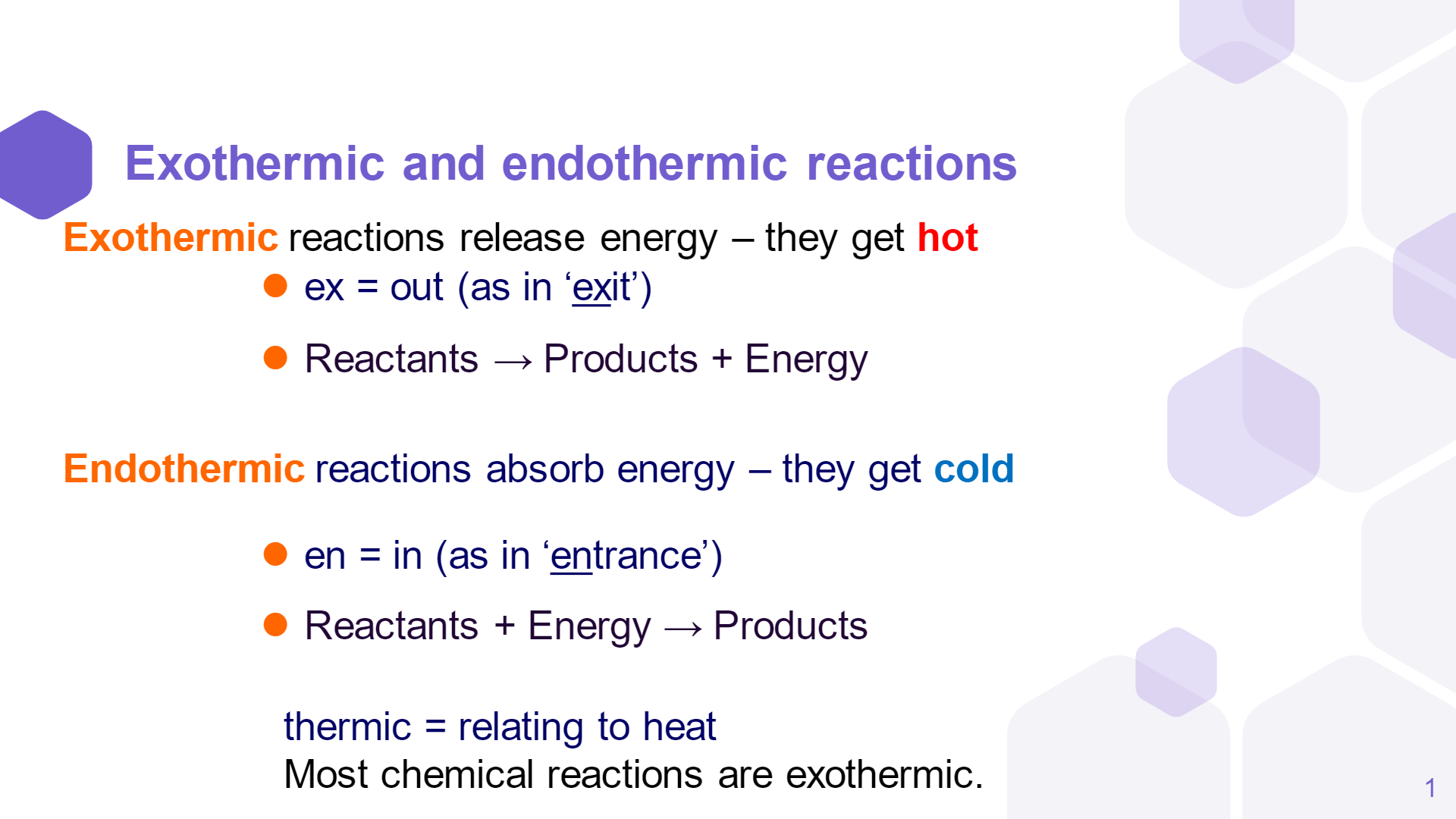
1. Equal amounts of four different substances (A-D) where added separately to equal amounts of an acid and a thermometer placed in the mixture. For which substance is the reaction the most exothermic?

1

A. temperature rises by 3 °C\degree C    

2

B. temperature falls by 5 °C\degree C   

3

C. temperature falls by 3 °C\degree C    

4

D. temperature rises by 5 °C\degree C  

74

Multiple Choice

2. The breaking of bonds in a chlorine molecule must be?

1

A. endothermic  

2

B. equilibrium   

3

C. electrolytic  

4

D.  exothermic

75

Multiple Choice

 3. Which of the following is a chemical change?

1

A. melting an ice-cube  

2

B. lighting a match  

3

C. cooling a cup of tea                    

4

D. dissolving sugar in coffee

76

Multiple Choice

5. When ammonium chloride dissolves in water the temperature falls. The type of energy change is described as?

1

A. exothermic    

2

 B. activated  

3

C. decomposition            

4

D. endothermic

77

Multiple Choice

6. Which of these processes is always exothermic?

1

A. evaporation

2

B. burning

3

C. insulation

4

D. melting

78

Multiple Choice

7. When an exothermic reaction takes place, the reaction mixture gets hotter because?

1

A.    more energy is released when new bonds are formed than is taken in when existing bonds in the reactants are broken

2

B.    exothermic changes always produce gases

3

C.    energy is always released in a chemical change which makes new substances

4

D.    in an exothermic change the products are more stable than the reactants

Scientific Method- an organized set of investigation procedures

  • State the Problem

  • Gather Information

  • Form a hypothesis- a possible explanation for a problem using what you know and what you observe

  • Test the hypothesis- experiment

  • Analyze data

  • Draw Conclusion

Show answer

Auto Play

Slide 1 / 78

SLIDE