

Relative Dating and Index Fossils

Presentation
•
Science
•
8th Grade
•
Hard

Joseph Anderson
FREE Resource
15 Slides • 11 Questions
1
DO NOW: Write what you think the example words mean in your lab manual.
Extra Credit: Find three additional words that use this root and write them and their definition in your lab manual (6 Points Max)

2

3
Multiple Choice
True or False: All plants and animals contain carbon
True
False
4
Drag and Drop
5
Reorder

Based on the law of superposition, what is the order of these rock layers, from oldest to youngest?
4
3
2
1
6
Multiple Choice
A fossil known to have lived in a particular geologic age that can be used to date the rock layer in which it is found
Index Fossil
Uncomformity
Disturbed Fossil
Intrusion
7

Understand How Scientists divide up Earth's History into a geologic timescale
Identify the reason for using a geologic time scale to observe changes in the Earth
Describe How Earth Developed during Precambrian Time?
8
What is the Geologic Time Scale?
The Geologic Time Scale: A record of the geologic events and the evolution of life forms as shown in the fossil record.
Inferences are made based on the principle of uniformitarianism
processes that operate today also operated in the past
Example: Gravity always existed

9
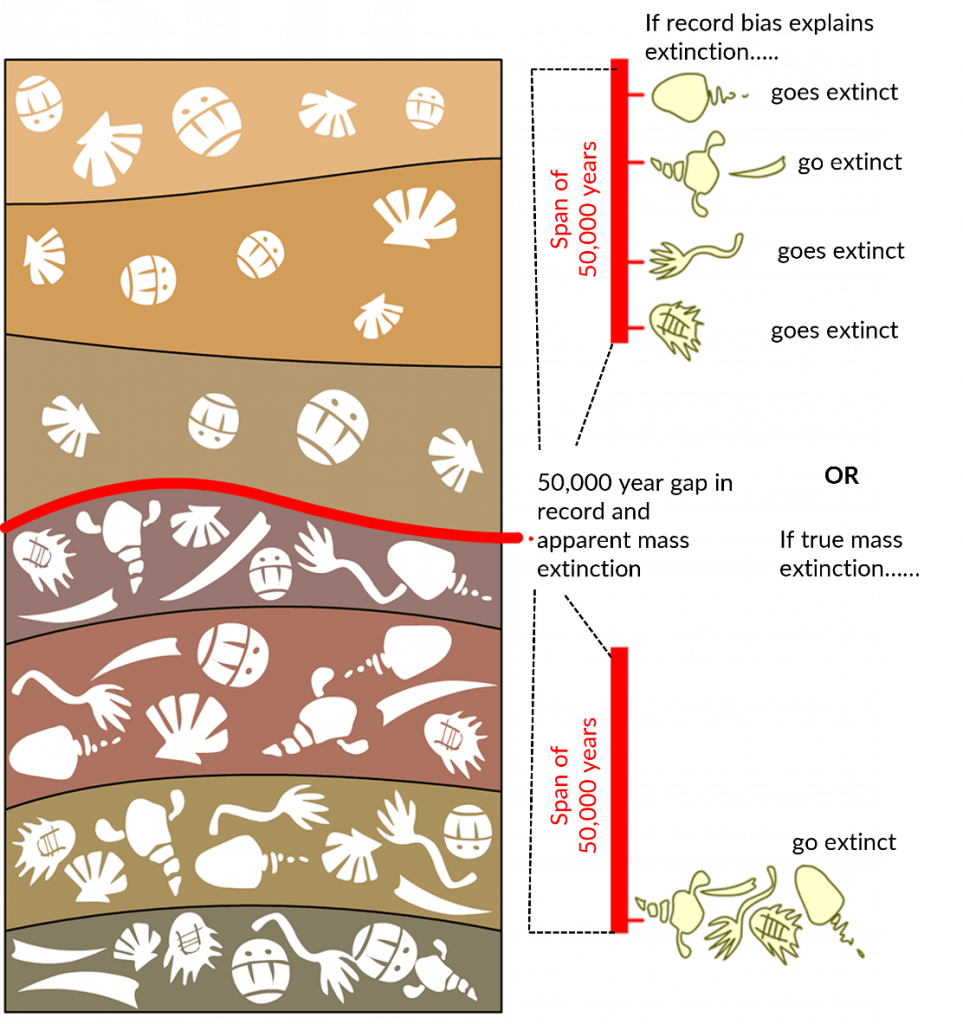
History of the Geologic Time Scale
The Geologic time scale was first developed by comparing index fossils worldwide
allowed scientists to set a relative age of rocks
radioactive dating later helped to get more exact ages in some instances
10
Dividing Geologic Time
In the fossil record, scientists found major changes in lifeforms happening at certain times
When new life appears and other life becomes extinct
These changes are used to set beginning and end points for certain times
11
Precambrian Time
The beginning of Geologic time
~88% of Earth's History
Ended 542 million years ago (MYA)
Few Fossils survive

12
Eras
We Divide all time after the Precambrian time into three large periods of time known as Eras
Paleozoic
Mesozoic
Cenozoic

13
Periods
Period: A unit of geologic time that is part of an era
Example: The Mesozoic era is made up of three periods
Triassic
Jurassic
Cretaceous
Named for areas where rocks and fossils from that period were first described
Grade 8 Ohio | Lesson 6.4 & 6.5

14
Drag and Drop
15
Multiple Choice

Scientists chose where units of geologic time began and ended based on the appearance or disappearance of life.
true
false
16
Multiple Choice

Using the geologic timeline, about how old was the Silurian Period?
542 million
199 million
420 million
40 million
17
The Formation of the Earth's Layers
The Earth Began as a ball of dust, rock, & ice in space pulled together by gravity
As it got bigger, the force of gravity increased and pulled more into it
The energy from those collisions increased the temperature of the materials and melted them into the layers of the Earth

18
The Formation of the Earth's Rocks
The oldest rocks on Earth are 4 billion years old, but Earth was formed before that
Earth collided with something else in space
One piece broke off and formed the moon at the same time
Analyzing Earth and moon Rocks show both to be about 4.6 Billion Years Old

19
The First Atmosphere
Early Earth was made up of gases like hydrogen and helium
Not conducive to life
Solar flares from the sun destroyed the first atmosphere

20
The Second Atmosphere
Two things formed the Earth's 2nd atmosphere which contains
Volcanic Eruptions
Collisions with comets
Comet: A ball of dust & ice that orbits the sun
The second atmosphere contains
Carbon dioxide,
Oxygen
Nitrogen
Other trace gases

21
The Oceans & Continents
When the Earth first formed, it was too hot for water to remain in the liquid state
As the Earth cooled, water condensed to form the oceans
The cooling also allowed rocks to harden and form the tectonic plates
22
Early Organisms
The exact beginning of life is unknown
Fossils show single-celled organisms lived 3.5 billion years ago, and all other life evolved from them
Early lifeforms received energy from the sun through photosynthesis, which released Oxygen into the atmosphere
Some Oxygen bonded to create Ozone, which blocks out Ultraviolet waves

23
Multiple Choice
Earth Formed approximately _____ billion Years ago
4.6
1000
400
3.5
24
Multiple Choice
The first life on Earth appeared approximately _____ billion Years ago
4.6
1000
400
3.5
25
Multiple Choice
Which of the following is not a part of Earth's second atmosphere
helium
oxygen
water vapor
carbon dioxide
26
Dropdown
DO NOW: Write what you think the example words mean in your lab manual.
Extra Credit: Find three additional words that use this root and write them and their definition in your lab manual (6 Points Max)
Show answer
Auto Play
Slide 1 / 26
SLIDE
Similar Resources on Wayground

18 questions
Newton's Laws of Motion Examples
Presentation
•
8th Grade
18 questions
Fossils and Geologic Time Review
Presentation
•
8th Grade
18 questions
Newton's 3rd Law of Motion
Presentation
•
8th Grade
21 questions
Newton's Laws
Presentation
•
7th - 8th Grade
19 questions
Behavior of Waves
Presentation
•
7th - 8th Grade
21 questions
Seasons
Presentation
•
8th Grade
21 questions
SSA Review
Presentation
•
8th Grade
19 questions
Nutrition
Presentation
•
8th Grade
Popular Resources on Wayground
10 questions
How much do you know about our Portrait of an Eagle?

Quiz
•
10th Grade
10 questions
Fast Food Slogans
Quiz
•
6th - 8th Grade
21 questions
Continents and Oceans
Quiz
•
6th Grade
20 questions
Parts of Speech
Quiz
•
5th Grade
16 questions
Subject & Predicate
Quiz
•
5th Grade
25 questions
Multiplication Facts
Quiz
•
5th Grade
12 questions
Map Skills
Quiz
•
3rd Grade
22 questions
Continents and Oceans
Quiz
•
5th Grade
Discover more resources for Science
20 questions
Scientific Method and Variables
Quiz
•
8th Grade
20 questions
Scientific method and variables
Quiz
•
8th Grade
27 questions
Counting Atoms - Subscripts
Quiz
•
8th Grade
20 questions
Claim, Evidence and Reasoning (CER)
Quiz
•
6th - 8th Grade
18 questions
Counting Atoms
Quiz
•
7th - 8th Grade
20 questions
Elements, Compounds and Mixtures
Quiz
•
8th Grade
10 questions
Exploring Chemical and Physical Changes

Interactive video
•
6th - 10th Grade
10 questions
Decoding the Periodic Table of Elements
Interactive video
•
6th - 10th Grade