Search Header Logo
  1. Resource Library
  2. Science
  3. Units And Measurement
  4. Triple Beam Balance
  5. Triple Beam Balance Lesson
Triple Beam Balance Lesson

Triple Beam Balance Lesson

Assessment

Presentation

Science

8th Grade

Hard

Created by

Joseph Anderson

FREE Resource

6 Slides • 22 Questions

1

Scientific Information

  • Observation vs Inference

    • Observation → a fact that is determined by using your 5 senses

      • Example: A dog measures 14 inches tall

      • You can never observe feelings - you can only infer them

    • Inference → what you think based on your observations - it can also be a prediction about the future

      • Example: It is going to rain

    • Scientific Method - An organized way of solving a problem

      • There are about 7 Steps: 

1. Problem - usually in the form of a question that you want to solve

2. Hypothesis - an educated guess based on research and knowledge

3. Design Experiment 

4. Conduct an Experiment - make and record your observations!

5. Analyze Results - use graphs and charts

6. Conclusion - what did you determine?

7. Share your results


media

2

Open Ended

Make an observation about the globe.

3

Open Ended

Make an inference about the globe.

4


Add each number the beam is pointing to.

50 + 100 + 5 = 155 grams

How do I measure mass?

  • The measure of matter inside an object (M&M → Mass & Matter)

    • Measured using a triple beam balance - Usually in grams (g)

Mass

Measurement

media

5

Fill in the Blank

6

Fill in the Blank

7

Multiple Choice

Question image
What is the mass on this triple beam?
1

221.5g

2

222.5g

3

20g

8

Multiple Choice

Question image

What is the mass of this object?

1

328 grams

2

300.2.8 grams

3

333 grams

4

302.8 grams

9

Volume

The measure of the amount of space an object takes up 

  • Measured using a graduated cylinder - Usually in (mL)

    • In a regular solid, can be measured as volume = length x width x height

    • To find the volume of an irregular shaped object you must use the dunk method!


10

media

​Volume of a Regular Solid

11

media

​The Dunk Method

Volume = 78 mL - 58 mL 

Volume = 20 mL


12

Multiple Choice

What is volume?

1

how heavy it is

2

how much space it takes up

3

how much matter is in the object

4

the shape of the object

13

Multiple Choice

What units is volume measured in?

1

grams

2

degrees

3

milliliters or cm3

4

pounds

14

Multiple Choice

Question image

Which equation would help you find the volume?

1

5-4=1 mL

2

5.6-4.8=0.8 mL

3

4-5=1 mL

4

5+4=9 mL

15

Multiple Choice

Question image

What is the volume of the rock?

1

50 mL

2

75 mL

3

25 mL

4

125 mL

16

Multiple Choice

Question image
Identify the volume of water.
1

22 mL

2

25 mL

3

15 mL

4

25 g

17

Multiple Choice

Question image

What is the volume of the chalk?

1

9 mL

2

19 mL

3

10 mL

4

20 mL

18

Multiple Choice

Question image

What is the volume of this prism?

1

20 ft3

2

8 ft3

3

40 ft3

4

11 ft3

19

Multiple Choice

Question image

What is the volume of this prism?

1

24 cm3

2

240 cm3

3

60 cm3

4

20 cm3

20

media
media

Density

How tightly packed the molecules are in an object.

Formula: density = mass/volume
d=m/V - Usually g/cm3

Doesn’t change when you cut or break an
object

Decreases when you increase the volume -
you can do this by heating it up!

Increases when you decrease the volume -
you can do this by applying pressure!

More dense sinks - less dense rises (heat
rises!) “Denser Downer”

21

Multiple Choice

Frank has a paper clip. It has a mass of 9g and a volume of 3cm3. What is its density?
1

3 g/cm3

2

1/3 g/cm3

3

27 g/cm3

4

39 g/cm3

22

Multiple Choice

What is the density of water?
1

0 g/ml

2

1 g/ml

3

10 g/ml

4

100 g/ml

23

Multiple Choice

Question image
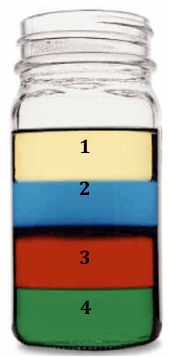
Put the liquids in order from most dense to least dense?
1

4, 3, 2, 1

2

1, 2, 3, 4

3

3, 4, 2, 1, 

4

4, 3, 1, 2

24

Multiple Choice

Question image
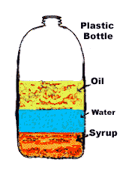
Which liquid is the least dense?
1

oil

2

water

3

syrup 

4

plastic bottle

25

Multiple Choice

What is the formula for density?
1

density = mass x volume

2

density = mass / volume

3

density = mass + volume

4

density = mass - volume

26

Multiple Choice

Why do some substances float on water?
1

they are warmer than water

2

they are cooler than water

3

they are more dense than water

4

they are less dense than water

27

Multiple Choice

Why does ice float?
1

Liquid water is less dense than solid water.

2

Solid water is less dense than liquid water.

3

Gaseous water is less dense than solid water.

4

Liquid water is less dense than gaseous water.

28

Multiple Choice

Question image
Look at this image.  Which object has the LOWEST density in water? How
1

The Ping Pong Ball because it floats to the top 

2

The bolt because it has sunk to the bottom

3

The soda cap because it is not just full of air like the Ping Pong ball

Scientific Information

  • Observation vs Inference

    • Observation → a fact that is determined by using your 5 senses

      • Example: A dog measures 14 inches tall

      • You can never observe feelings - you can only infer them

    • Inference → what you think based on your observations - it can also be a prediction about the future

      • Example: It is going to rain

    • Scientific Method - An organized way of solving a problem

      • There are about 7 Steps: 

1. Problem - usually in the form of a question that you want to solve

2. Hypothesis - an educated guess based on research and knowledge

3. Design Experiment 

4. Conduct an Experiment - make and record your observations!

5. Analyze Results - use graphs and charts

6. Conclusion - what did you determine?

7. Share your results


media

Show answer

Auto Play

Slide 1 / 28

SLIDE