Search Header Logo
AKS 6 Overview

AKS 6 Overview

Assessment

Presentation

•

Science

•

9th - 12th Grade

•

Medium

•
NGSS
MS-PS1-4, MS-PS1-2, MS-PS3-4

+8

Standards-aligned

Created by

Marissa Brown

Used 1+ times

FREE Resource

17 Slides • 30 Questions

1

AKS 6 Overview - Solutions, Solubility, Acids/Bases

By Marissa Brown

2

​What is Solubility?

​Solubility is the mass of solute that can dissolve a fixed mass of solvent at a particular temperature 

media

​Remember: a saturated solution is one where no more solute can be dissolved at that particular temperature

3

​What is the unit for solubility?

​The solubility of a solute in water is usually measured as the mass of solute that will saturate a 100g of water that is, g per 100g water

media

4

​Concentration Terminology

​Concentration Terminology: 

  • Dilute Solution (Unsaturated): Small amount of solute in a large amount of solvent. 

  • Concentrated Solution (Unsaturated): Lots of solute in a small amount of solvent (all dissolves).

media

5

​​Size of the particles

Breaking a solute into smaller pieces increases its surface area and increases its rate of solution.

​When a solute dissolves, the action takes place only at the surface of each particle. When the total surface area of the solute particles is increased, the solute dissolves more rapidly.

6

​Concentration Terminology

Saturated Solution: The maximum amount of solute dissolved in a given amount of solvent at a given temperature. To make a saturated solution you add more solute than can be dissolved.

media

7

Multiple Choice

Question image

Numbering from the left, which is most dilute?

1

1

2

2

3

3

4

4

5

5

8

​​Stirring

With liquid and solid solutes, stirring brings fresh portions of the solvent in contact with the solute.  Stirring, therefore, allows the solute to dissolve faster.

9

Multiple Choice

How do you know if a solution is saturated?

1

When you see some undissolved solute at the bottom that doesn't disappear if you stir it.

2

When it is darker colored.

3

When it is transparent.

4

When you can dissolve more solute if you stir it.

10

media

​Electrolytes

  • Soluble ionic compounds are electrolytes, while most covalent compounds are non-electrolytes (except weak acids, covered in next unit).

  • Ionic(aq) = electrolyte

  • Anything else = nonelectrolyte

11

Multiple Choice

You are given a small beaker of solution at room temp. You add a bit of solute to the solution and it dissolves. The solution was:

1

saturated

2

unsaturated

3

concentrated

4

warm

12

Multiple Choice

The substance being dissolved is called the ________

1

solvent

2

solid

3

solute

4

solvate

13

Multiple Choice

When no more solute dissolves the solution is _________

1

supersaturated

2

unsaturated

3

saturated

4

supercalifragilisticexpialidocious

14

Multiple Choice

What is a substance that is dissolved in another substance? 
1
solution
2
solute
3
solvent
4
compound

15

Multiple Choice

Kool-Aid - Powder, sugar, and water
Identify the solvent 
1
water
2
powder
3
sugar
4
powder and sugar

16

Multiple Choice

When a certain amount of solvent cannot hold any more solute it is called a ________ solution.
1
Diluted
2
Saturated

17

Multiple Choice

Question image
How does a solution become supersaturated?
1
dissolve lots of solute in it.
2
dissolve a little solute in it. 
3
dissolve more solute than you should be able to. 
4
dissolve a solvent in it. 

18

Multiple Choice

What does it mean to dilute a solution?
1
lower the concentration of solute per solvent
2
increase the concentration of solute per solvent

19

Factors affecting solubility ​

20

Increase the temperature

For liquids and solid solutes, increasing the temperature not only increases the amount of solute that will dissolve but also increases the rate at which the solute will dissolve. For gases, the reverse is true. An increase in temperature decreases both solubility and rate of solution.

21

Multiple Choice

Which of the following would dissolve the slowest?
1
a sugar cube in hot water
2
a sugar cube in cool water
3
powdered sugar in cool water
4
powdered sugar in hot water

22

Multiple Choice

A student is preparing solutions for a laboratory experiment by dissolving solid solutes in liquid solvents. Which action will increase the rate of solubility

1

lowering the temperature of the solvent

2

stirring the solute in the solution

3

increasing the pressure on the solution

4

increasing the particle size of the solute

23

Multiple Choice

Why does the rate of dissolving increase as the temperature increases?

1

The solute molecules move faster at higher temperatures

2

The solute particles become smaller at higher temperatures

3

The solvent molecules become slower at higher temperatures

4

What is the effect of agitation on the rate of dissolving?

24

Multiple Choice

What is the effect of agitation on the rate of dissolving?

1

 It decreases the rate of dissolving

2

 It has no effect on the rate of dissolving

3

It increases the rate of dissolving

4

 It changes the color of the solute

25

Multiple Choice

How does agitation help in dissolving a solute more quickly?

1

It increases the temperature of the solvent

2

 It increases the weight of the solute

3

It brings fresh solvent into contact with undissolved solid

4

It changes the shape of the solvent

26

Multiple Choice

Why does a solute with a larger surface area dissolve faster?

1

It has more solute surface area in contact with the solvent

2

 It has fewer solute particles in contact with the solvent

3

It has a higher temperature compared to other solutes

4

It has a different color compared to other solutes

27

media

28

media

29

media

30

media

31

media

32

Multiple Choice

Question image

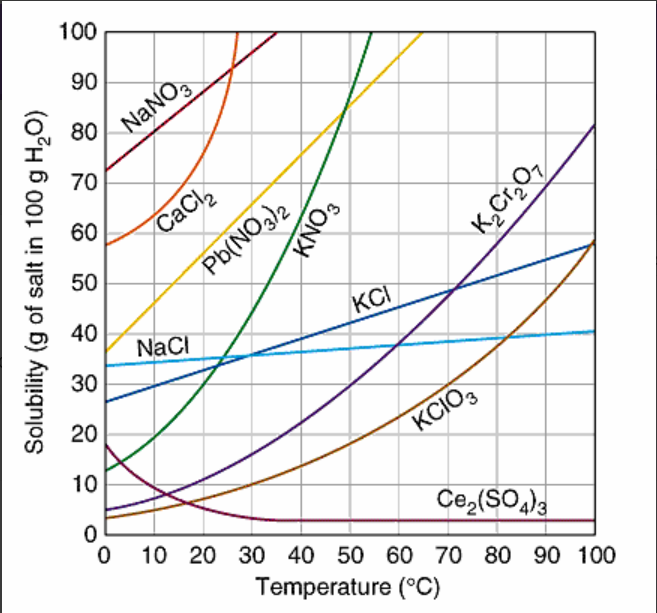
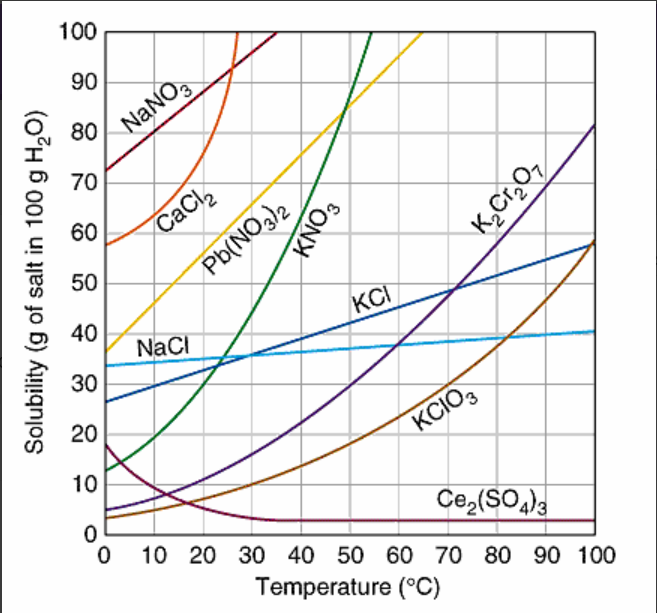
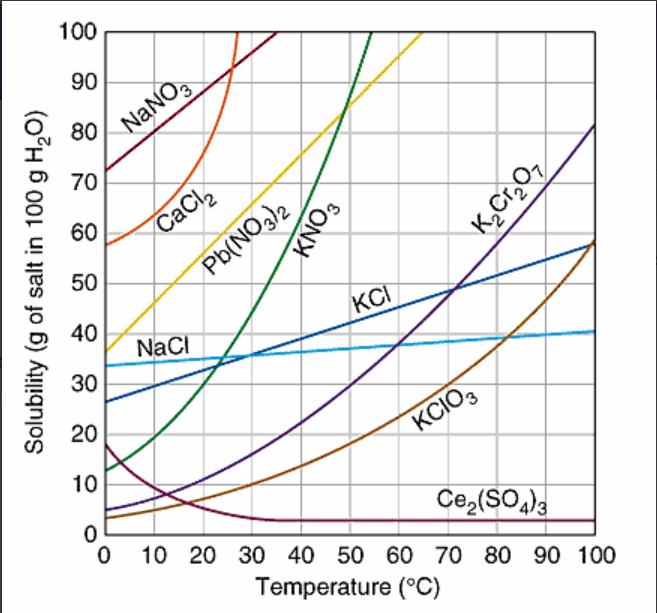
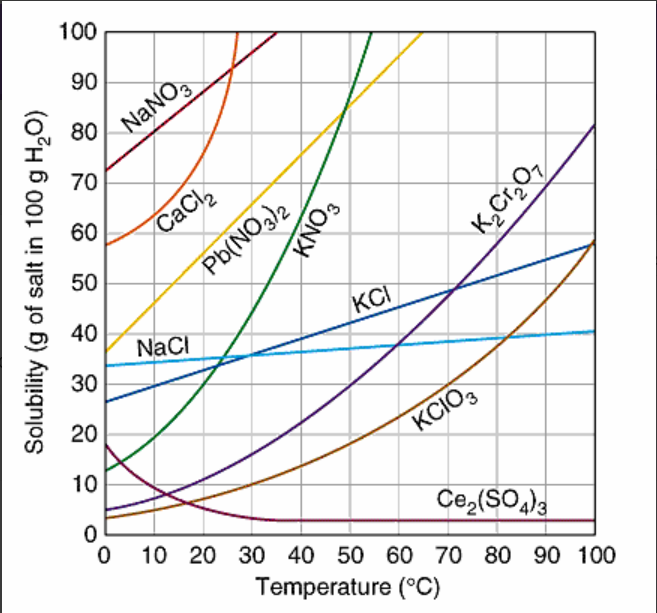
Most substances increase in solubility as temperature increases, why don't HCl, NH3, and SO2?

1

They are insoluble in water

2

They are all non-polar

3

They are all polar

4

They are all gases

33

Multiple Choice

Question image

Which substance is MOST soluble at 0oC?

1

KI

2

NaNO3

3

NaCl

4

Ce2(SO4)3

34

Multiple Choice

Question image

How many grams of K2Cr2O7, are soluble in 100 g of water at 95oC?

1

83 grams

2

75 grams

3

40 grams

4

12 grams

35

Multiple Choice

Question image

When 42 grams of potassium chloride, KCl, is dissolved in 100 grams of water at 50oC, the solution can be correctly described as:

1

supersaturated

2

saturated

3

unsaturated

36

Multiple Choice

Question image

When 20 grams of potassium chlorate, KClO3, is dissolved in 100 g of water at 80oC, the solution can be correctly describe as:

1

supersaturated

2

saturated

3

unsaturated

37

media

38

Multiple Choice

In an aqueous solution, an acid

1

absorbs hydrogen ions (H+)

2

donates hydrogen ions (H+)

3

releases oxygen gas (O2)

4
increases the pH of the solution

39

media

40

Multiple Choice

NaOH is a base because,

1
NaOH is a base because it dissociates in water to produce hydroxide ions.
2
NaOH is a base because it is highly flammable.
3
NaOH is a base because it is a gas at room temperature.
4
NaOH is a base because it produces acidic ions.

41

Multiple Choice

Which statement about bases is incorrect?

1

Bases turn red litmus paper blue

2

Bases contain hydrogen ions

3

Bases taste bitter

4

Bases have a pH 7.1-14.0

42

Multiple Choice

Which of the following is a property of an acid?

1

Form hydroxide ions

2

Have a negative charge

3

Turn litmus paper blue

4

Have a pH of 0-6.9

43

Multiple Choice

Question image

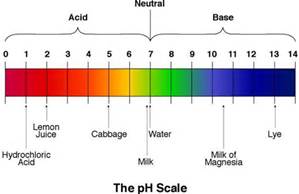
According to the pH range which substance is more acidic than cabbage juice?

1

lemon juice

2

lye

3

milk of magnesia

44

Multiple Choice

Litmus paper is made from water-soluble dyes which are extracted from lichens. This paper is used as an acid-base indicator. Which of these common household substances would turn blue litmus paper red?

1

Bleach

2

Lye

3

Ammonia

4

Vinegar

45

Multiple Choice

What is another name for a base?
1
Acid
2
Alkaline
3
pH

46

Multiple Choice

Question image

Observe the chart below. Which substance is likely an acid?

1

Substance A

2

Substance B

3

Substance C

4

Substance D

47

Multiple Choice

Milk of magnesia is a common ingredient in many heartburn and stomach medications. How does milk of magnesia act to calm and upset stomach?

1

Milk of magnesia is an acid that neutralizes stomach acid

2

Milk of magnesia is a base that neutralizes stomach acid

3

Milk of magnesia has a neutral nature which dilutes stomach acid.

4

Milk of magnesia is a base that neutralizes bases in the stomach.

AKS 6 Overview - Solutions, Solubility, Acids/Bases

By Marissa Brown

Show answer

Auto Play

Slide 1 / 47

SLIDE