Search Header Logo
Psychological Methods

Psychological Methods

Assessment

Presentation

•

History

•

12th Grade

•

Practice Problem

•

Medium

Created by

Cydney Gobourne Doughty

Used 1+ times

FREE Resource

63 Slides • 34 Questions

1

media

2

media

3

media

4

Multiple Choice

What are the five basic steps in scientific research?

1
Question, Data, Hypothesis, Review, Conclusion
2
Theory, Experiment, Observation, Analysis, Conclusion
3
Observation, Question, Hypothesis, Experiment, Conclusion
4
Data Collection, Analysis, Reporting, Review, Publication

5

media

6

media

7

media

8

media

9

Reorder

Put the steps in the correct order

Question

Hypothesis

Experiment

Results

Conclusion

1
2
3
4
5

10

media

11

Multiple Choice

What happens if the conclusions of an experiment do not support a hypothesis?

1

The hypothesis is accepted

2

The hypothesis is rejected or revised

3

The experiment is repeated

4

The results are ignored

12

Multiple Choice

Which of the following methods are used to test hypotheses?

1

Survey method

2

Observational method

3

Experimental method

4

All of the above

13

Multiple Choice

Studies are replicated to see if it produces...

1

the same results under different circumstances

2

the same results with different set of participants

3

the same results with different types of participants

4

all of theses are correct

14

media

15

Multiple Choice

Why is it important to replicate studies in psychology?

1

To confirm findings

2

To save time

3

To avoid new research

4

To change the hypothesis

16

Multiple Choice

Which of the following best describes a hypothesis?

1

educated guess

2

random guess

3

proven fact

4

unrelated assumption

17

media

18

media

19

Multiple Choice

Explain the role of a hypothesis in scientific research.

1
A hypothesis is a testable prediction that guides scientific research.
2
A hypothesis is a definitive conclusion drawn from data.
3
A hypothesis is an untestable statement about the future.
4
A hypothesis is a summary of existing research findings.

20

Multiple Choice

What do psychologists do after they analyze their research observations?

1

draw conclusions

2

ignore the data

3

start a new study

4

change the hypothesis

21

media

22

Multiple Choice

What do scientists need in order to support a theory?

1

Hypotheses

2

Opinions

3

Evidence

4

Assumptions

23

media

24

media

25

media

26

media

27

media

28

Multiple Choice

What is the survey method?

1

A method of collecting data by observing people

2

A method of collecting data by asking people directly

3

A method of collecting data by analyzing documents

4

A method of collecting data by using experiments

29

Multiple Select

What challenges might arise from using surveys to gather information?

1

Bias

2

Low response rates

3
Immediate feedback from participants
4

Misunderstanding questions

30

Multiple Choice

What are the two survey methods mentioned in the image to learn about classmates' favorite television shows?

1

Interview and anonymous submission

2

Observation and interview

3

Questionnaire and focus group

4

Experiment and observation

31

Multiple Select

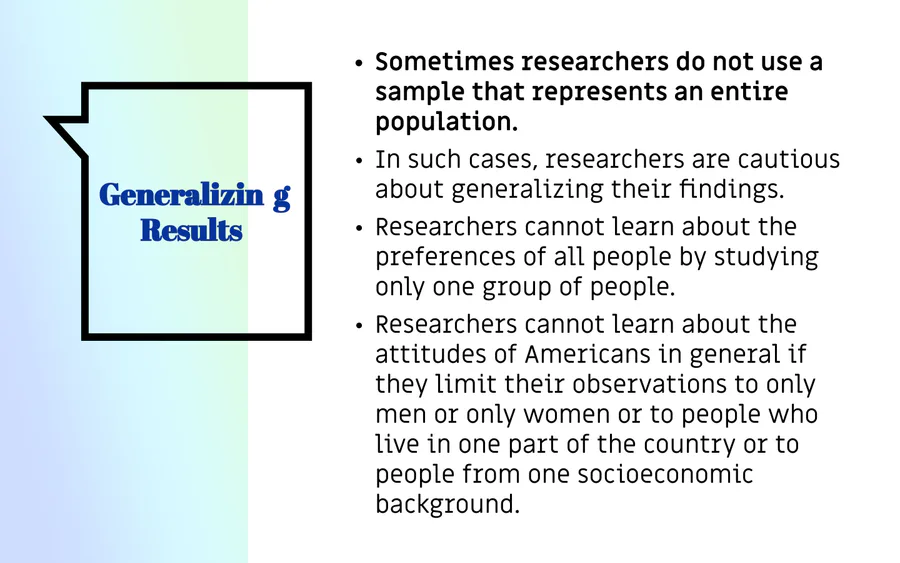
Why must researchers be careful in generalizing results?

1

To avoid volunteer bias

2

To ensure accuracy

3

To prevent misleading conclusions

4

To save time

32

media

33

media

34

media

35

media

36

media

37

Fill in the Blanks

What is the term for a predisposition to a certain point of view, despite what the facts may suggest?

38

media

39

Multiple Choice

How do psychologists select samples?

1

Randomly select any group

2

Choose based on convenience

3

Select a group that represents the target population

4

Pick the largest available group

40

Multiple Choice

Why is it important for a sample to be as similar as possible to the target population?

1

To ensure accurate representation

2

To reduce the cost of the study

3

To make the study easier to conduct

4

To increase the sample size

41

Multiple Choice

What is a stratified sample and why is it used in research?

1

A stratified sample is a random selection from the entire population to get the most accurate possible results.

2

A stratified sample involves sampling only the largest subgroup in a population providing the most data.

3
A stratified sample is used to eliminate bias by selecting only one subgroup.
4

A stratified sample involves dividing a population into subgroups and sampling from each to ensure representation.

42

Multiple Choice

How can volunteer bias affect the results of a study?

1
Volunteer bias only affects qualitative studies.
2
Volunteer bias ensures a diverse sample in research.
3

Volunteer bias can lead to unrepresentative samples and affect the reliability of study results.

4
Volunteer bias is a method to improve study accuracy.

43

media

44

media

45

media

46

media

47

media

48

media

49

media

50

media

51

media

52

media

53

media

54

Multiple Choice

_______________________ observation takes place in a specific area set aside for

observation and research.

1
Field observation
2

Naturalistic observation

3
Remote observation
4
Laboratory observation

55

media

56

Fill in the Blanks

In the

method of research, researchers select a group of

participants and then observe them over a period of time.

57

media

58

Multiple Choice

The _______________________ method of research involves observing a sample of

individuals of different ages.

1
case study
2
cross-sectional
3
longitudinal
4
experimental

59

media

60

Multiple Choice

_______________________ observation involves observing people in their normal

lives, such as at home or at school.

1
Survey observation
2
Participant observation
3
Controlled observation
4
Naturalistic observation

61

media

62

media

63

media
media

64

65

media

66

Fill in the Blanks

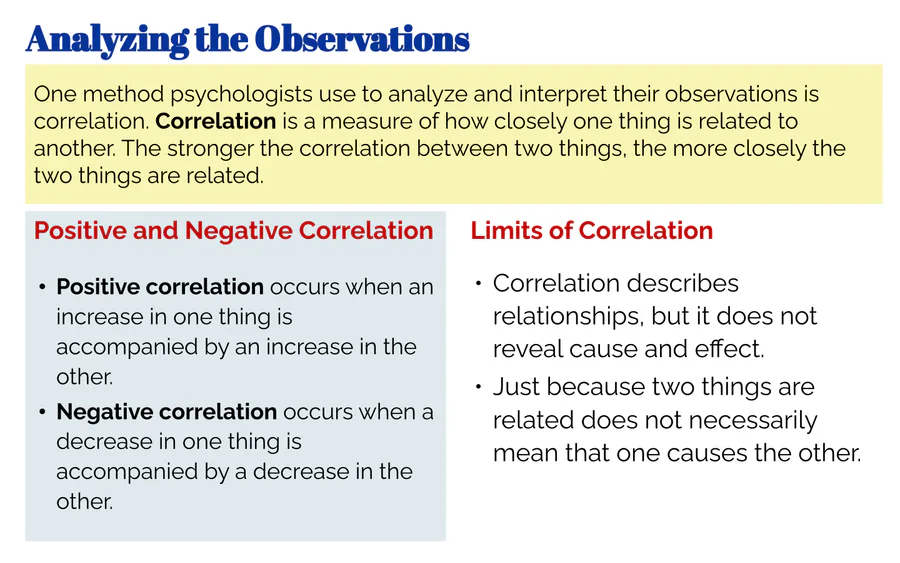
is a measure of how closely one thing is related to another.

67

media

68

Multiple Choice

A relationship in which two factors rise together is known as a

1
inverse correlation
2
independent relationship
3
positive correlation
4
negative correlation

69

media

70

Multiple Choice

Question image

What is the correlation between weight and exercize depicted in the graph?

1
There is a negative correlation between weight and exercise.
2
Weight increases with more exercise.
3
There is no correlation between weight and exercise.
4
There is a positive correlation between weight and exercise.

71

media

72

media

73

media

74

media

75

media

76

Multiple Choice

An element of an experiment that can change.

1
Constant
2
Control
3
Variable
4
Parameter

77

Multiple Choice

A substance or treatment that has no effect apart from a person’s belief in it.

1

Experiment

2
Antibiotic
3
Vaccine
4
Placebo

78

media

79

media

80

media

81

Multiple Select

Question image

Who is aware of the treatment or lack of treatment the participants are receiving in a SINGLE BLIND experiment?

1

Researcher

2

Participants

3

Eperiment Organizer

4

None of the above

5

All of the above

82

Multiple Choice

Question image

Who is aware of the treatment or lack of treatment the participants are receiving in a DOUBLE BLIND experiment?

1

Researcher

2

Participants

3

Eperiment Organizer

4

None of the above

5

All of the above

83

media

84

Math Response

What score represents the mean in the curve above?

Type answer here
Deg°
Rad

85

media
media

86

media

87

media

88

media

89

media

90

media

91

media

92

media

93

media

94

media

95

Multiple Choice

What is the Hawthorne effect?

1
The Hawthorne effect is the alteration of behavior by study subjects due to their awareness of being observed.
2
The Hawthorne effect is a method of data collection in qualitative research.
3
The Hawthorne effect refers to the impact of environmental changes on productivity.
4
The Hawthorne effect is a psychological phenomenon that occurs only in children.

96

Multiple Choice

What flaws did the Hawthorne study have, and how did these flaws affect the study’s outcome?

1
The study had a large sample size and clear control groups.
2
The flaws included extensive data analysis and no observer bias.
3
The study was conducted over a short period with precise measurements.
4

The flaws included lack of control groups, small sample sizes, and observer effect.

97

Open Ended

What are two further steps involved in scientific research?

pattern-tertiary
media

Show answer

Auto Play

Slide 1 / 97

SLIDE