GED Soc. Studies 2025 - How Economics Work in the Real World
Presentation
•
Social Studies
•
University
•
Practice Problem
•
Easy
Adesti Komalasari
Used 1+ times
FREE Resource
16 Slides • 25 Questions
1
Economics:
How Economies Work in the Real World
By Adesti Komalasari
2
Every country in the world has to answer three key economic questions: What should be produced? How should it be produced? And for whom should it be produced? The answers vary based on the type of economic system in place, but all nations are affected by global trends, government policy, and people’s needs.
In a market economy, decisions are mostly made by individuals and businesses. Prices are set by supply and demand, and competition encourages companies to be more efficient and innovative. However, because the government is less involved, this system can lead to income inequality, limited access to healthcare and education for the poor, and market failures like pollution or unsafe products.
In a command economy, the government controls all major economic decisions. It decides what to produce, how much to produce, and at what price. This system can reduce inequality and ensure basic needs are met, but it often struggles with efficiency, shortages, and lack of innovation. People may not have freedom to choose what job to take or what products to buy.
Most countries today use a mixed economy, which blends features of market and command systems. For example, in the U.S., private companies operate freely, but the government regulates things like workplace safety, environmental protection, and minimum wages. In Europe, governments also provide strong public services like free healthcare and education, funded by higher taxes.
Another important part of how economies work is how governments respond to economic cycles. When the economy slows down (a recession), people lose jobs, businesses close, and spending drops. To help, governments might lower interest rates to make borrowing cheaper, increase public spending to create jobs, or cut taxes to leave people with more money to spend.
During times of growth, governments may raise interest rates or taxes to prevent the economy from “overheating” and causing inflation, where prices rise too quickly. This balancing act is called fiscal and monetary policy, and it’s how governments try to keep the economy stable.
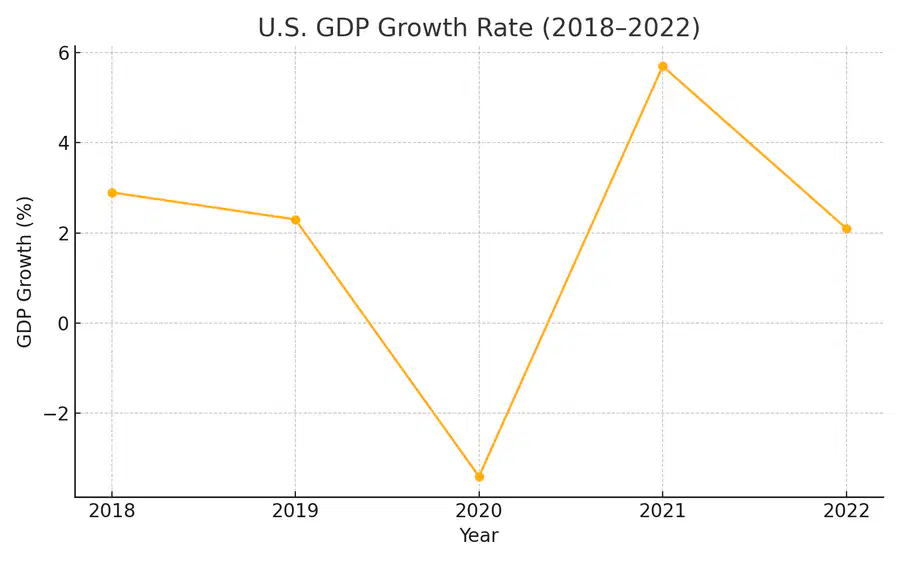
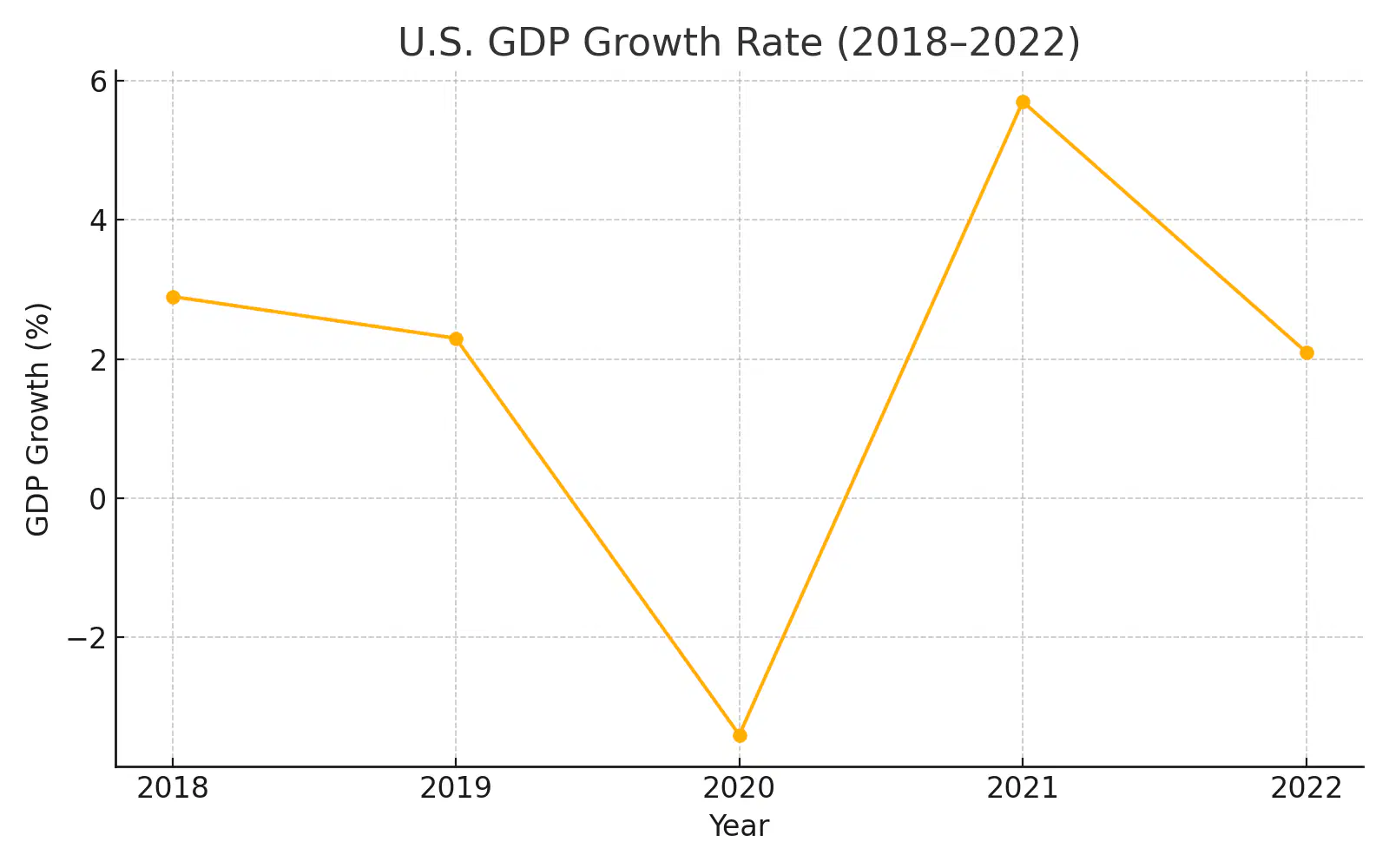
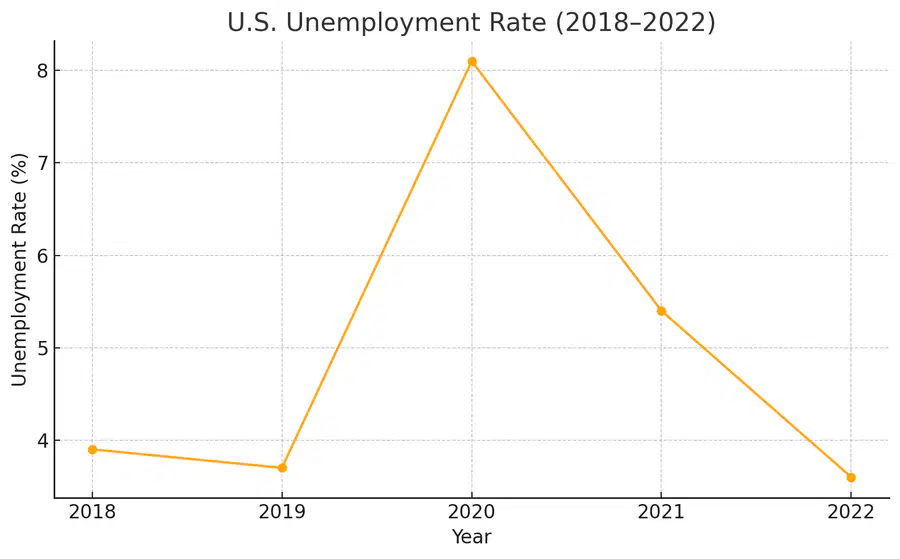
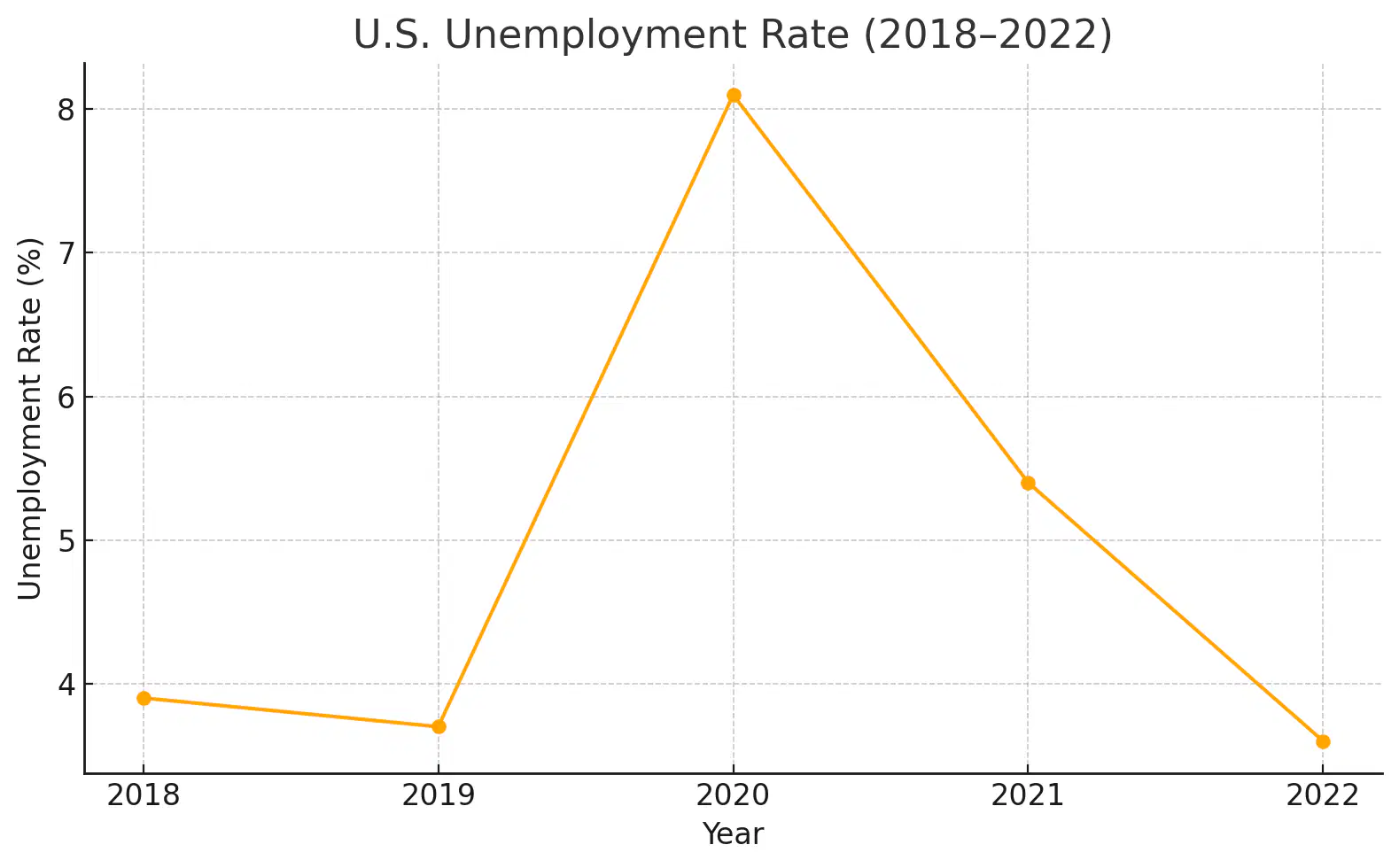
One way to measure the health of an economy is by looking at Gross Domestic Product (GDP), the total value of all goods and services produced. Another key measure is the unemployment rate, which shows how many people are actively looking for work but cannot find it. The graph you see shows changes in both GDP growth and unemployment in the U.S. from 2018 to 2022. You can see how the economy crashed in 2020 due to the COVID-19 pandemic and recovered in 2021.
Economies are also impacted by global trade, technology, and even wars or pandemics. When one country experiences trouble, others feel it too, this is called economic interdependence. A crisis in oil-producing countries, for example, can cause fuel prices to rise around the world.
Understanding economics helps us make informed decisions, not just as voters or workers, but as consumers and citizens in a world where economic forces shape almost everything we do.
3
Multiple Choice Questions
4
Multiple Choice
Why might a market economy lead to pollution or unsafe products?
Because governments do not allow innovation
Because demand for clean products is high
Because businesses may cut corners to stay competitive
Because prices are set too high
5
Multiple Choice
What is the main reason a mixed economy exists in most countries today?
To eliminate competition
To balance efficiency with social needs
To allow the government full control
To reduce global trade
6
Multiple Choice
Based on the text, what would likely happen if the government did not increase taxes during economic growth?
Inflation might worsen
More people would become unemployed
GDP would drop suddenly
Trade would stop
7
Multiple Choice
Why is GDP a useful measure of economic health?
It shows the value of a country’s exports
It tracks political stability
It shows the total value of all goods and services produced
It measures income equality
8
Multiple Choice
What can we infer about command economies from the description in the text?
They always have lower unemployment
They never experience shortages
They may limit personal and consumer freedoms
They encourage innovation through competition
9
Multiple Choice
What does the term economic interdependence suggest about global economies?
Countries only trade with neighbors
One country’s crisis can affect many others
Countries stop trading during recessions
Wars do not affect markets
10
Multiple Choice
Which statement best explains how fiscal and monetary policy are used together?
Both reduce taxes and interest rates at all times
They only apply to command economies
They are tools to keep the economy stable during ups and downs
They help businesses avoid competition
11
Matching Questions
Match the term with its meaning.
12
Match
Match the term with its meaning.
The Meanings:
A. Total value of goods and services produced
B. Government-controlled decision-making system
C. Global connection where one country’s problems affect others
D. A slowdown in economic activity and rising unemployment
E. When consumers and businesses decide prices
F. Government strategy using spending or taxes
G. Pricing system based on what people want and how much is available
Supply and demand
Recession
Fiscal policy
GDP
Market economy
G
D
F
A
E
G
D
F
A
E
13
Reading Graphs - 01
14
15
Multiple Choice
What happened to GDP in 2020?
It stayed the same
It rose sharply
It dropped significantly
It was the highest year
16
Multiple Choice
Which year had the strongest recovery?
2018
2019
2021
2022
17
Reading Graphs - 02
18
19
Multiple Choice
In which year did unemployment rise the most?
2019
2020
2021
2022
20
Multiple Choice
What trend do you observe from 2020 to 2022?
Steady increase
Unemployment remained high
Gradual recovery
No change
21
Compare two short texts
22
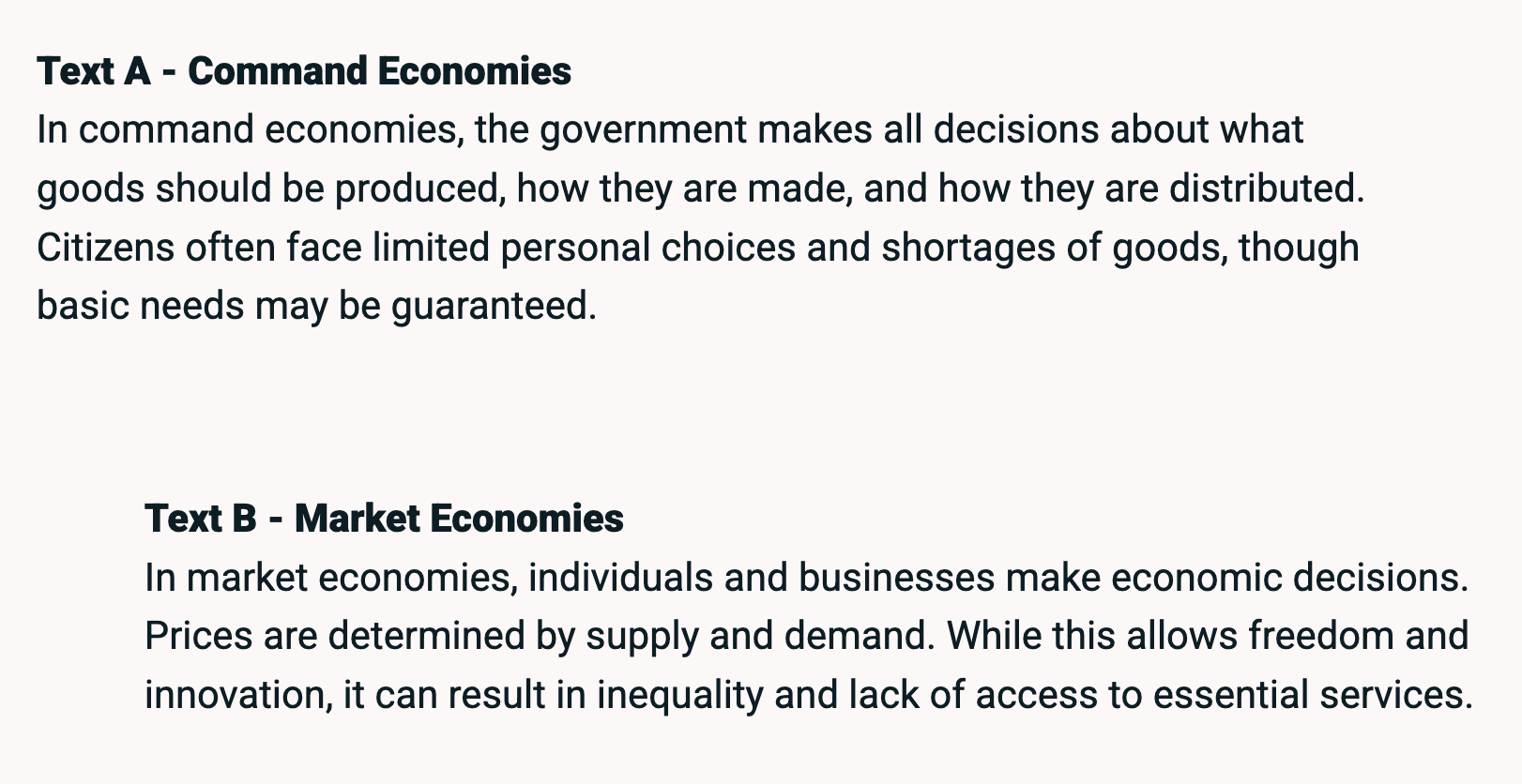
Text A - Command Economies
In command economies, the government makes all decisions about what goods should be produced, how they are made, and how they are distributed. Citizens often face limited personal choices and shortages of goods, though basic needs may be guaranteed.
Text B - Market Economies
In market economies, individuals and businesses make economic decisions. Prices are determined by supply and demand. While this allows freedom and innovation, it can result in inequality and lack of access to essential services.
23
Multiple Choice
Which text shows greater economic freedom for individuals?
Text A
Text B
Neither
24
Multiple Choice
Based on both texts, what is a potential downside of each system?
Market economies always guarantee equality
Command economies never have shortages
Market systems may ignore the poor; command systems may limit freedom
Both systems guarantee perfect efficiency
25
Multiple Choice
What conclusion can you draw when comparing these two systems?
Both systems fail completely
No system offers any personal choice
Each system has strengths and weaknesses that affect people differently
Governments should avoid influencing economies
26
Speed Reading Practice
27
Speed Reading Strategies (not necessarily in that order)
Use a Timer
Give yourself 30–45 seconds to read the whole paragraph the first time. Then go back for a deeper look only if needed.
Focus on the Big Ideas
Use the title as a clue then scan some key actions: What does the government do when the economy slows? What about when it grows too fast?
Preview the Paragraph
Quickly look for keywords like “mixed economy,” “government,” “crisis,” “inflation,” etc. to predict the topic.
Skim for Structure
Identify topic sentence (first sentence), signal words (“for example,” “on the other hand,” “these actions”), and cause-effect transitions.
28
Reading Paragraph:
In a mixed economy, the government plays a role in protecting public interest, even though most businesses are privately owned. This role becomes especially important during times of economic crisis. For example, when the economy slows down and people stop spending, the government may lower taxes or increase public spending to help people and create jobs. On the other hand, when the economy grows too fast and prices rise quickly, the government might raise interest rates to slow things down and reduce inflation. These actions are known as fiscal and monetary policy, and they help keep the economy stable. While some people argue that the government should stay out of the market, others believe that careful government action prevents bigger problems.
29
Multiple Choice
What is the main function of government action in a mixed economy according to the text?
To own all major businesses
To control what goods are sold
To support the economy during change
To reduce worker wages
30
Multiple Choice
Which sentence best shows a cause-effect relationship?
“In a mixed economy, the government plays a role…”
“These actions are known as fiscal and monetary policy…”
“When the economy slows down and people stop spending…”
“While some people argue that the government should stay out…”
31
Multiple Choice
What can be inferred about people who disagree with government intervention?
They think government action always works
They prefer the command economy model
They worry that the government might cause more problems
They do not pay taxes
32
Multiple Choice
Which of the following best describes the structure of the paragraph?
Compare and contrast of two economic systems
Definition followed by examples
Storytelling about a real-life crisis
Chronological timeline
33
Multiple Choice
What is the author’s tone toward government involvement in the economy?
Completely negative
Balanced and informative
Strongly critical
Emotionally biased
34
Speed Reading Practice
35
Text A: The Benefits of Market Economies
Market economies are often praised for encouraging innovation and efficiency. In this system, businesses compete to offer better products at lower prices, which benefits consumers. Entrepreneurs have the freedom to create new ideas, take risks, and respond to changes in demand. The competition between firms pushes them to be more productive and cost-effective. However, market economies may also lead to problems such as income inequality and lack of support for the unemployed or disabled, as profit often comes before social needs.
Text B: The Role of Government in Economic Stability
While market forces drive innovation, governments play a critical role in protecting citizens and preventing economic crises. Through tools like taxes, spending programs, and interest rate adjustments, governments can slow down inflation or stimulate the economy during a recession. For example, unemployment insurance and public healthcare provide a safety net for people during hard times. Without government regulation, businesses may engage in unsafe practices or ignore the needs of vulnerable populations. A strong public sector can ensure that the economy works for everyone, not just for those at the top.
36
Multiple Choice
Which of the following best describes a key difference between the two texts?
Text A supports innovation, while Text B opposes it
Text A focuses on business freedom, while Text B focuses on public protection
Both texts argue against government intervention
Text A discusses taxes, while Text B focuses on competition
37
Multiple Choice
According to both texts, what is one limitation of market economies?
They reduce creativity
They eliminate poverty
They may ignore social needs
They have too many rules
38
Multiple Choice
What conclusion can be drawn from comparing both texts?
Market economies and government intervention can work together to support society
Governments should stop all business activity
Competition and regulation are both harmful
Economic systems must remove taxes to work well
39
Multiple Choice
Which text provides a more positive view of government action?
Text A
Text B
Neither
40
Multiple Choice
Which sentence from Text A best contrasts with this idea from Text B: “A strong public sector can ensure that the economy works for everyone”?
“Businesses compete to offer better products at lower prices.”
“Entrepreneurs have the freedom to create new ideas…”
“Profit often comes before social needs.”
“The competition between firms pushes them to be more productive.”
41
THAT'S A WRAP
Economics:
How Economies Work in the Real World
By Adesti Komalasari
Show answer
Auto Play
Slide 1 / 41
SLIDE

Similar Resources on Wayground
36 questions
334 Intracranial Regulation
Presentation
•
University
40 questions
Luyện đề kì 1, sử 10 (mớ)
Presentation
•
KG - University
32 questions
Demokrasi Indonesia
Presentation
•
University
37 questions
Preterit UV, U, I, J verbs
Presentation
•
12th Grade
35 questions
Language I. Week 2
Presentation
•
University
35 questions
Q2. Assessment 1 Practice: Quiz
Presentation
•
KG
33 questions
CHAPTER 9: MANAGING COMMUNICATION & INFORMATION
Presentation
•
University
35 questions
Learning Styles
Presentation
•
University
Popular Resources on Wayground
15 questions
Grade 3 Simulation Assessment 1
Quiz
•
3rd Grade
22 questions
HCS Grade 4 Simulation Assessment_1 2526sy
Quiz
•
4th Grade
16 questions
Grade 3 Simulation Assessment 2
Quiz
•
3rd Grade
19 questions
HCS Grade 5 Simulation Assessment_1 2526sy
Quiz
•
5th Grade
17 questions
HCS Grade 4 Simulation Assessment_2 2526sy
Quiz
•
4th Grade
20 questions
Equivalent Fractions
Quiz
•
3rd Grade
24 questions
HCS Grade 5 Simulation Assessment_2 2526sy
Quiz
•
5th Grade
20 questions
Math Review
Quiz
•
3rd Grade
Discover more resources for Social Studies
36 questions
8th Grade US History STAAR Review
Quiz
•
KG - University
25 questions
Spanish future tense
Quiz
•
10th Grade - University
55 questions
Post Malone Addtion (Tres)
Quiz
•
12th Grade - University
15 questions
Quotation Marks vs. Italics for MLA
Quiz
•
9th Grade - University
20 questions
Disney Trivia
Quiz
•
University
50 questions
AP Biology Exam Review 2017
Quiz
•
11th Grade - University
215 questions
8th Physical Science GA Milestones Review
Quiz
•
KG - University
20 questions
Ch15_review_TEACHER
Quiz
•
University