

Ecosystem

Presentation
•
Science
•
7th Grade
•
Medium
+8
Standards-aligned

Barbara White
Used 140+ times
FREE Resource
17 Slides • 31 Questions
1

Middle School

2
Identify biotic and abiotic factors and describe the levels of organization in ecosystems.
Analyze how resource availability and competition affect organisms and populations in an ecosystem.
Develop models to describe how matter is cycled and energy flows in an ecosystem.
Explain the principle of conservation of matter within various ecosystem cycles.


3
Key Vocabulary

Habitat
The natural environment that provides an organism with all that it needs to survive.

Biotic Factor
The living or once-living parts of a habitat, such as plants, animals, fungi, and bacteria.

Abiotic Factor
The nonliving parts of a habitat, including elements like sunlight, water, soil, and temperature.

Population
All the members of a single species that live together in the same specific area.

Community
All the different populations of organisms that live together and interact in the same area.

Ecosystem
A community of organisms interacting with all the abiotic factors in their shared environment.
4
Key Vocabulary

Competition
The struggle between organisms for limited resources like food, water, and space in an ecosystem.

Resource Availability
The amount of essential resources such as food, water, and shelter that are accessible to organisms.
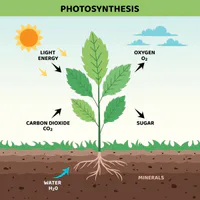
Producer
An organism that can make its own food, typically through the process of photosynthesis.

Consumer
An organism that obtains its energy by feeding on other organisms in a food chain.

Decomposer
An organism that gets nutrients by breaking down wastes and the remains of dead organisms.

Limiting Factor
An environmental factor that restricts the size, growth, or distribution of a population in an ecosystem.
5
Key Vocabulary
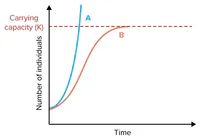
Carrying Capacity
This is the maximum population of a particular species that a given environment can support over time.
6
The Building Blocks of Ecosystems

An organism is a single living thing that lives within a specific habitat.
Biotic factors are all the living or once-living parts of an ecosystem.
Abiotic factors are nonliving parts like sunlight, water, temperature, and soil.
7
Multiple Choice
What are biotic factors?
All the living or once-living parts of an ecosystem.
The nonliving parts of an ecosystem, like sunlight and water.
A single living thing that lives in a habitat.
The place where a single organism makes its home.
8
Multiple Choice
What is the key difference between a tree and sunlight in an ecosystem?
A tree is a biotic factor, while sunlight is an abiotic factor.
Sunlight is a biotic factor, while a tree is an abiotic factor.
Both are biotic factors because they are found in nature.
Both are abiotic factors because they are not animals.
9
Multiple Choice
A fish is an organism that lives in water and eats insects. Which statement best explains the relationships between these parts of an ecosystem?
The fish, as an organism, depends on both biotic factors (insects) and abiotic factors (water) to survive.
The fish and the insects are abiotic factors because they live in water, which is a biotic factor.
The water and the fish are both organisms that depend on insects as an abiotic factor.
The insects are the only biotic factor, while the fish and water are both abiotic factors.
10
Levels of Ecological Organization
An organism is a single living thing. A species is a group of similar organisms.
A population is all the members of one species living in the same area.
A community is all the different populations that live and interact in an area.
An ecosystem is the community of organisms plus their nonliving environment.

11
Multiple Choice
Which of the following statements best defines an ecosystem?
A community of organisms along with their nonliving environment
All the members of one species living together in the same area
All the different populations that live and interact in a particular area
A single living thing or a group of similar organisms
12
Multiple Choice
What is the relationship between a population and a community?
A community is made up of different populations, while a population is made up of one species.
A population includes nonliving factors, while a community includes only living things.
A community and a population are the same size, but in different locations.
A population is a single organism, while a community is a group of organisms.
13
Multiple Choice
A biologist is studying a flock of geese, the fish they eat, and the aquatic plants in a lake. If the biologist then starts to measure the water's temperature and oxygen levels, what is the highest level of organization being studied?
Ecosystem
Community
Population
Organism
14
Abundant Resources
Population size increases when resources like food and water are plentiful.
Organisms are generally healthier and have higher rates of reproduction.
With enough resources, a population can grow toward its carrying capacity.

Scarce Resources

A lack of resources like food, water, or space limits population growth.
These shortages act as limiting factors, which can lower reproduction rates.
A population’s size will decrease if resources become too scarce to survive.
15
Multiple Choice
What is a limiting factor?
Anything that restricts a population's size and growth.
Any resource that is always abundant in an environment.
A factor that only affects individual organism health.
A process that helps a population reproduce faster.
16
Multiple Choice
How does having plentiful resources like food and water affect a population?
The population is healthier and has higher rates of reproduction.
The population immediately reaches its carrying capacity.
The population becomes more resistant to all diseases.
The population stops growing to conserve the resources.
17
Multiple Choice
A large, healthy rabbit population lives in a meadow. If a disease suddenly reduces the availability of its main food source, what is the most likely prediction for the population?
The population size will decrease due to lower reproduction rates.
The population will grow toward its carrying capacity.
The organisms will learn to live without water.
The amount of available food and space will increase.
18
Competition for Resources
Organisms compete when they need the same limited resources, like food or water.
This struggle for resources can limit the growth of a population.
Competition can happen between members of the same or different species.
For instance, sea lions and seals both compete for the same fish.


19
Multiple Choice
What causes competition to occur between organisms?
When they live in the same habitat but have different needs.
When they require the same limited resources.
When one organism is a predator and the other is prey.
When they are members of the same family.
20
Multiple Choice
Which statement best describes the relationship between the types of organisms that compete?
Competition only happens between members of the same species.
Competition only happens between members of different species.
Competition can happen between members of the same or different species.
Competition does not affect animals of different species.
21
Multiple Choice
Given that sea lions and seals compete for the same fish, what is the most likely outcome if the fish population suddenly decreases?
The growth of both populations will likely be limited due to the shared food source.
Only the sea lion population will be affected by the competition.
The fish population will increase because of the competition.
The sea lions and seals will learn to share the fish equally.
22
Matter Cycles
The Law of Conservation of Matter states that matter is not created or destroyed.
Atoms are continuously cycled between the living and nonliving parts of an ecosystem.
This means the same matter is constantly reused by different organisms over time.

Energy Flows

The Law of Conservation of Energy states it is not created or destroyed, just changes form.
Energy flows in one direction through an ecosystem, beginning with the sun.
Energy is transferred between organisms, but a lot of it is lost as heat and does not cycle back.
23
Multiple Choice
What does the Law of Conservation of Matter imply about the atoms within an ecosystem?
They are created by the sun and then used up.
They are continuously reused and not destroyed.
They are destroyed when an organism dies.
They turn into energy when transferred between organisms.
24
Multiple Choice
What is the main difference between the movement of matter and the movement of energy in an ecosystem?
Matter is cycled throughout the ecosystem, while energy flows in one direction.
Energy is cycled throughout the ecosystem, while matter flows in one direction.
Both matter and energy are completely recycled.
Both matter and energy are lost as heat.
25
Multiple Choice
Imagine a perfectly sealed glass dome containing a small, self-sufficient ecosystem with plants and animals. Based on the laws of conservation, what would most likely happen to the matter and energy inside the dome over a long period?
The total amount of matter will decrease, but the usable energy will stay the same.
The total amount of matter will stay the same, but the usable energy will decrease.
Both the total amount of matter and usable energy will stay the same.
Both the total amount of matter and usable energy will decrease.
26
Energy Roles in Ecosystems

Producers make their own food, usually from sunlight.
Consumers get energy by feeding on other organisms.
Decomposers break down dead organisms and recycle matter.

27
Multiple Choice
What is the primary way producers get the energy they need to live?
By making their own food, usually from sunlight.
By feeding on other living organisms.
By breaking down dead organisms.
By absorbing nutrients from the soil.
28
Multiple Choice
Which statement best explains the role of a consumer in an ecosystem?
It describes how energy is transferred from one organism to another.
It explains how organisms create their own food from sunlight.
It shows how matter is recycled back into the ecosystem.
It defines the role of organisms that do not need energy.
29
Multiple Choice
What would be the most likely consequence for an ecosystem if all decomposers were removed?
The recycling of matter from dead organisms back into the ecosystem would stop.
Producers would no longer be able to make their own food.
Consumers would have an unlimited supply of food.
The amount of energy in the ecosystem would increase.
30
Food Webs
A food web is a model showing how many different food chains overlap in an ecosystem.
It demonstrates how matter and energy move between producers, consumers, and decomposers.
Food webs reveal the complex feeding relationships between the organisms in a community.

Energy Pyramids

An energy pyramid is a diagram that shows the flow of energy between each feeding level.
Only about ten percent of the energy is transferred from one level to the one above it.
The rest of the energy is used for life processes or lost to the environment as heat.
31
Multiple Choice
What is the primary purpose of using models like food webs and energy pyramids in ecology?
To show how energy and matter are transferred between organisms
To list all the animals that live in a particular habitat
To explain how organisms use sunlight to make their own food
To describe the physical characteristics of different ecosystems
32
Multiple Choice
According to the principles of an energy pyramid, why is only about ten percent of energy passed from one feeding level to the next?
The energy is destroyed by the consumers at the next level
Organisms at higher levels do not need as much energy to live
Most of the energy is used for life processes or lost as heat
The energy is stored in the ground and is no longer available
33
Multiple Choice
What is the best explanation for why food webs typically have fewer organisms at the highest feeding level compared to the lowest level?
There is not enough available energy to support a large population at the top
Organisms at the top of the food web reproduce much more slowly
Producers at the bottom are better at hiding from their predators
Decomposers recycle energy more efficiently for organisms at the bottom
34
Cycles of Matter: The Water Cycle

Liquid water heats up, turns into a gas, and rises into the air.
In the cool air, water vapor turns back into liquid, forming clouds.
Water falls from clouds as rain, snow, sleet, or hail.
35
Multiple Choice
What is the name for the process where water heats up, turns to gas, rises, cools to form clouds, and falls back to Earth?
The water cycle
The carbon cycle
The nitrogen cycle
The life cycle
36
Multiple Choice
What causes clouds to form as part of the water cycle?
Liquid water heats up and turns into a gas.
Water vapor cools and turns back into a liquid.
Water falls from the sky as rain or snow.
Water rises high into the air.
37
Multiple Choice
If a large amount of liquid water on Earth's surface heats up and turns into a gas, what is the most likely next step in the process?
The water vapor would rise, cool, and form clouds.
The water would immediately freeze into hail.
The water would fall back down as rain without forming clouds.
The water would stop moving and stay in the air as a gas.
38
The Carbon and Oxygen Cycles

Producers take in carbon dioxide from the air to make their own food.
Living things use oxygen to get energy and release carbon dioxide.
Decomposers release carbon from dead organisms back into the soil and air.
39
Multiple Choice
What is the primary role of producers within the carbon cycle?
They take in carbon dioxide from the air to make their own food.
They release carbon from dead organisms back into the soil.
They use oxygen to get energy and release carbon dioxide.
They convert oxygen directly into carbon for other organisms.
40
Multiple Choice
What is the relationship between producers and other living things in terms of gas exchange?
Producers take in the carbon dioxide that other living things release.
Both producers and other living things take in oxygen for energy.
Producers release carbon into the soil, which living things then use.
Living things take in the same gases that producers release.
41
Multiple Choice
Based on the roles described, what would most likely happen if decomposers were removed from the environment?
The carbon in dead organisms would not be returned to the air and soil.
Producers would immediately stop taking in carbon dioxide from the air.
Living things would no longer be able to use oxygen to get energy.
The amount of carbon dioxide in the atmosphere would quickly increase.
42
The Nitrogen Cycle

Nitrogen is essential, but most organisms cannot use it directly from the air.
Bacteria 'fix' atmospheric nitrogen, converting it into a usable form for other organisms.
Decomposers recycle nitrogen from dead organisms back into the soil for reuse.
43
Multiple Choice
Why is the nitrogen cycle essential for most living organisms?
Nitrogen is a very rare element in the Earth's atmosphere.
Most organisms cannot use nitrogen directly from the atmosphere.
The atmosphere has too much usable nitrogen for organisms.
Nitrogen is only found in dead organisms, not in the air.
44
Multiple Choice
What is the specific function of 'fixing' bacteria in the nitrogen cycle?
To convert atmospheric nitrogen into a form that other organisms can use.
To release nitrogen from dead organisms back into the soil.
To help plants absorb nitrogen directly from the air.
To remove all nitrogen from the atmosphere.
45
Multiple Choice
Based on the roles described, what would most likely happen if all decomposers disappeared from an ecosystem?
The amount of nitrogen in the atmosphere would increase.
Bacteria would no longer be able to fix nitrogen from the air.
Nitrogen from dead organisms would not be recycled back into the soil.
Living organisms would get more nitrogen than they need.
46
Misconception | Correction |
|---|---|
Energy and matter are the same. | Energy flows through an ecosystem, while matter is recycled within it. |
Organisms high on a food web are more important. | All parts are vital, from producers to decomposers. |
Scarcity of a resource only affects one population. | Resource scarcity can impact many populations due to interconnected food webs. |
47
Ecosystems consist of living (biotic) and non-living (abiotic) components.
The availability of resources limits population size and creates competition.
Matter is cycled and reused, while energy flows in one direction.
Decomposers recycle nutrients, a process shown in food webs and energy pyramids.
48
Poll
On a scale of 1-4, how confident are you about the concepts covered in today's review?
1
2
3
4
Middle School
Show answer
Auto Play
Slide 1 / 48
SLIDE
Similar Resources on Wayground

41 questions
Earth/Space Review 3-Sun+moon+Earth
Presentation
•
8th Grade
44 questions
Evolution and Adaptation
Presentation
•
8th Grade
43 questions
Computer Hardware
Presentation
•
7th Grade
44 questions
Cells Review
Presentation
•
7th Grade
42 questions
Finding Slope and Y-Intercept from Equations, Tables and Graphs
Presentation
•
7th Grade
45 questions
Life Cycle of a Star
Presentation
•
KG - 8th Grade
41 questions
Stimulus and Response Lesson 1
Presentation
•
7th Grade
42 questions
Speed and Distance - Time Graphs
Presentation
•
6th Grade
Popular Resources on Wayground
10 questions
Safety Day 2026 – Student Review

Quiz
•
9th Grade
21 questions
Continents and Oceans
Quiz
•
6th Grade
20 questions
Parts of Speech
Quiz
•
5th Grade
16 questions
Subject & Predicate
Quiz
•
5th Grade
25 questions
Multiplication Facts
Quiz
•
5th Grade
12 questions
Map Skills
Quiz
•
3rd Grade
22 questions
Continents and Oceans
Quiz
•
5th Grade
15 questions
Rounding Decimals
Quiz
•
5th Grade
Discover more resources for Science
10 questions
Exploring Chemical and Physical Changes

Interactive video
•
6th - 10th Grade
14 questions
Week 1 Falcon Flex Fast and Curious
Quiz
•
7th Grade
42 questions
Explore Plate Tectonics and Boundaries
Quiz
•
7th Grade
21 questions
Waves and Wave Properties
Quiz
•
6th - 8th Grade
16 questions
Photosynthesis and Cellular Respiration Review
Quiz
•
7th Grade
20 questions
Food Webs + Energy Pyramids
Quiz
•
7th Grade
9 questions
Biology: Cell Structure
Interactive video
•
7th Grade
8 questions
Diffusion and Osmosis Review
Presentation
•
6th - 8th Grade