

Chapter 36a

Presentation
•
Education
•
University
•
Hard

Russell Barnell
Used 6+ times
FREE Resource
51 Slides • 28 Questions
1

2

3

4
Multiple Choice
Today’s automotive tires are filled with air, meaning they are _____. (36.1)
hydraulic
pneumatic
synthetic
all are correct
5

6
Multiple Choice
Today’s vehicles use _____ tires. (36.1)
inner tube
tubeless
off-road
bias
7

8
Fill in the Blanks
9

10
Open Ended
Compare the construction and typical uses of radial ply tires and bias ply tires.
11
Multiple Choice
Rolling resistance is increased by higher inflation pressure, proper tire design, and lower vehicle weight. (36.1)
True
False
12

13
Multiple Choice
All American passenger cars manufactured since the early 1980s have been factory equipped with _____ tires. (36.1)
bias ply
belted bias
radial
solid natural rubber
14
Multiple Select
Which of the following statements about the sidewall of a tire are correct? Multiple Answer
It is the outer rubber edge from bead to tread
It provides tire information through markings
It is responsible for the patterned surface that contacts the road
It is strengthened by belts
15

16
Multiple Choice
Which of the following is the most common tire identification system?
P-metric size designation
Alphanumeric size designation
Load/size relationship
Radial design
17

18
Multiple Select
Which of the following elements are included in a P-metric tire size designation?
Type of tire
Section width in millimeters
Height-to-width ratio
Load/size relationship
19

20

21
Multiple Choice
The comparison of a tire’s height (bead-to-tread distance) and width (sidewall-to-sidewall distance) is known as the tire’s _____ ratio. (36.2)
bias
aspect
cross-sectional
load index
22

23
Multiple Choice
What is the maximum inflation pressure typically recommended for most tires?
38-40 psi (262-275 kPa)
20-25 psi (138-172 kPa)
50-55 psi (345-379 kPa)
10-15 psi (69-103 kPa)
24

25
Multiple Choice
Why is tire pressure typically referred to as 'cold inflation pressure'?
Because it is measured when tires are cool, not heated from driving
Because it is measured in cold weather only
Because it prevents tires from freezing
Because it is the lowest possible pressure
26

27
Multiple Choice
Which of the following statements best describes how the maximum load rating of a tire is determined?
It is based on the number of plies in the tire and the recommended inflation pressure.
It is determined solely by the tire's diameter.
It depends only on the tire's tread pattern.
It is based on the tire's speed rating.
28

29
Multiple Choice
The amount of weight a tire can carry at the recommended inflation pressure is known as the _____ number. (36.2)
strength
bias
load index
wear rating
30

31

32
Multiple Select
The lower the tread wear number, the less resistant the tire is to wear. (36.2)
True
False
33

34
Multiple Choice
Which of the following tire traction ratings provides the least traction? (36.2)
AA
A
B
C
35

36
Multiple Choice
The _____ tread pattern on asymmetric tires is designed to improve cornering on dry surfaces, while the _____ tread pattern is designed to improve traction on wet surfaces. (36.3)
outer; inner
inner; outer
inner; center
center; outer
37

38
Multiple Choice
_____ tires are high-performance tires designed to rotate in a specific direction to minimize hydroplaning. (36.3)
Rotational
Directional
Radial
Bias ply
39

40
Multiple Choice
What is the significance of the three-peak mountain snowflake symbol on a tire's sidewall?
Indicates the tire is rated for severe snow conditions
Shows the tire is suitable for high temperatures
Means the tire is a retread
Indicates the tire is a compact spare
41

42

43
Multiple Choice
Which kind of spare tire is used on most new cars? (36.3)
Compact spare tire
Full-size spare tire
Collapsible spare tire
No spare tire
44

45
Multiple Select
Which of the following statements about compact or space saver spare tires is/are correct?
They are smaller than regular tires.
They have thin sidewall and tread construction.
They hold higher-than-normal air pressure.
They are designed for long-term use.
46

47

48
Multiple Choice
1. _____ tires have extremely stiff sidewall construction so they are usable for a predetermined distance after suffering a loss of air pressure. (36.3)
Steel belted
Run-flat
Synthetic rubber
None are correct
49

50
Open Ended
Why are large truck tires often recapped, and why are retreads seldom used on passenger cars?
51

52
Multiple Choice
Wear bars are small, raised sections of rubber within the tire's tread grooves designed to indicate when a tire has reached a critical level and needs replacement.
True
False
53

54
Multiple Choice
All vehicles with gross vehicle weight rating of less than 10,000 lb sold on or after September 1, 2007 in the US are equipped with a direct tire pressure monitoring system.
True
False
55

56

57

58

59
Multiple Choice
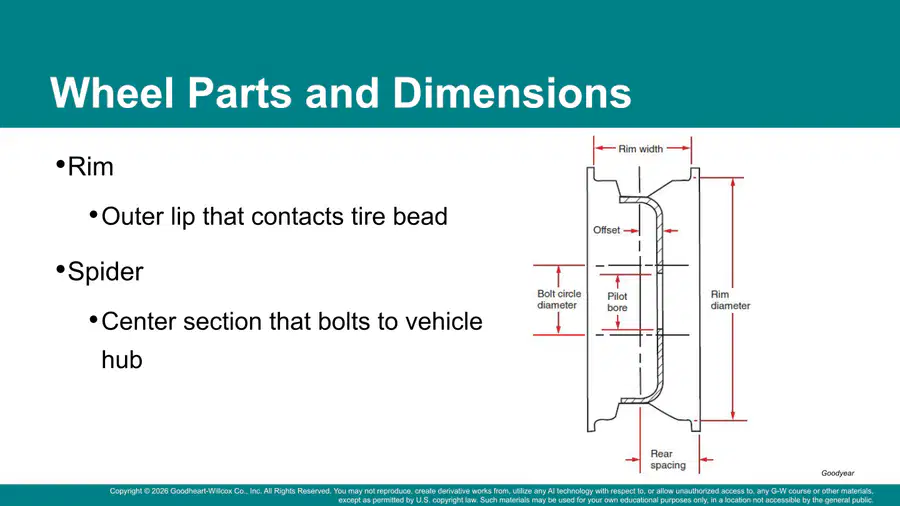
Technician A says that on passenger vehicles, the center wheel section of a drop-center wheel has a smaller diameter than the rim to ease tire installation and removal. Technician B says that the majority of automotive wheels are made of aluminum. Who is correct? (36.5)
A Only
B Only
Both A and B
Neither A nor B
60

61
62

63

64
Multiple Choice
Technician A says that depending on the vehicle manufacturer, lug nuts are manufactured with both right-hand threads (turn clockwise to tighten) or left-hand threads (turn counterclockwise to tighten). Technician B says that lug studs are press-fit into the hub or axle flange and can only be removed with manufacturer-specific tools. Who is correct? (36.5)
A Only
B Only
Both A and B
Neither A nor B
65

66

67

68

69
70

71

72
73

74

75
76

77

78
79
Open Ended
What is one key concept you learned today about tire, wheel, or wheel bearing fundamentals that you found most interesting or useful?
Show answer
Auto Play
Slide 1 / 79
SLIDE
Similar Resources on Wayground

75 questions
Designing Curriculum
Presentation
•
Professional Development
74 questions
FRESHDESK QUIZ
Presentation
•
KG - University
74 questions
Cloning
Presentation
•
University
75 questions
Unit 5 lesson 3
Presentation
•
University
72 questions
At the airport
Presentation
•
University
75 questions
Bahasa Inggris 1 - Week 08 and 09
Presentation
•
University
73 questions
First Conditional
Presentation
•
Professional Development
Popular Resources on Wayground
24 questions
PBIS-HGMS Day 10

Quiz
•
6th - 8th Grade
10 questions
HCS SCI 03 Summer School Review 3
Quiz
•
3rd Grade
11 questions
Home Scope
Quiz
•
7th - 8th Grade
15 questions
HCS SCI 05 Summer School Assessment 3 Review
Quiz
•
5th Grade
35 questions
Lufkin Road Middle School Student Handbook & Policies Assessment
Quiz
•
7th Grade
18 questions
Geo 11.3 Area of Circles and Sectors
Quiz
•
9th - 11th Grade