Search Header Logo
Module 2 Review (Macro-Water-Enzymes)

Module 2 Review (Macro-Water-Enzymes)

Assessment

Presentation

Biology

9th - 12th Grade

Medium

NGSS
HS-ESS2-5, HS-PS1-5, HS-LS1-6

+9

Standards-aligned

Created by

Gasmine Jean-Baptiste

Used 1+ times

FREE Resource

6 Slides • 27 Questions

1

​Chemistry of Biology

By Gasmine Jean-Baptiste

2

Macromolecules

Sheltered Biology

media

3

Multiple Choice

Question image
Which major macromolecule is being represented in this image? 
1

carbohydrate

2

lipid

3

protein

4

nucleic acid

4

Multiple Choice

Question image

Which macromolecule is shown?

1

lipid

2

protein

3

nucleic acid

4

carbohydrate

5

Multiple Choice

Question image

Which macromolecule is being represented in the image?

1

nucleic Acid

2

lipid

3

carbohydrate

4

protein

6

Multiple Select

Which elements can be found in proteins?

1

C

2

H

3

N

4

P

5

O

7

Multiple Choice

What makes the carbohydrate different from the lipid?

1

The shape (carbohydrate contain a ring whereas lipids are long chains)

2

The type of atoms

3

The size of the molecule

4

They don't have any difference

8

Multiple Choice

Which elements (atoms) are found in ALL the macromolecules?

1

Carbon, Hydrogen, Nitrogen

2

Carbon, Hydrogen, Oxygen, Phosphorus

3

Carbon and Hydrogen

4

Carbon, Hydrogen and Oxygen

9

Enzymes

Biological Catalysts

media

10

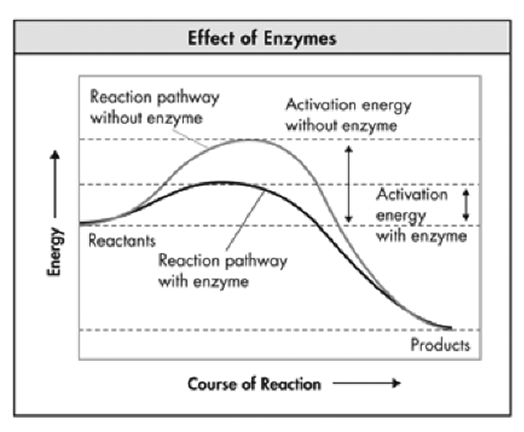
Enzymes speed up chemical reactions (Catalysts)

  • Activation energy is the energy needed to start a chemical reaction.

  • The less activation energy needed (smaller hill to climb) the faster the reaction will happen

  • Enzymes speed up reactions by lowering the activation energy

media

11

Multiple Choice

Enzymes are...
1
nucleic acids
2
proteins
3
lipids
4
carbohydrates

12

Multiple Choice

Question image

Enzymes are SPECIFIC. This means that an enzyme only works with molecules that are....

1

the right size and shape

2

broken down already

3

present in water

4

too big for the body to handle

13

Multiple Choice

Question image
Any substance that is acted upon by an enzyme is called a(n)?
1
Coenzyme
2
Substrate
3
Vitamin
4
Polypeptide

14

Multiple Choice

What will most likely happen if an appropriate enzyme is added to a chemical reaction? 
1
The reaction rate will increase.
2
The equilibrium of the reaction will be maintained. 
3
The reaction rate will decrease.
4
The reaction will stop. 

15

Multiple Choice

Question image
The graph shows how enzymes affect reactions in cells. Which statement best summarizes the information shown in the graph?
1
Enzymes increase the energy of the reactants.
2
Enzymes decrease the energy level of the products.
3
Enzyme decrease the activation energy of the reaction.
4
Enzymes reverse the direction of the reaction.

16

Multiple Choice

Question image

What can we conclude from the graph? At a a pH of 3..

1

Enzyme A works best

2

Enzyme B works best

3

Enzyme A works but low activity

4

Enzyme B works but low activity

17

Multiple Choice

Question image
Which enzyme is most efficient in a basic solution?
1
A
2
B

18

Multiple Choice

Question image

This graph shows...

1
The rate of reaction decreases with substrate concentration.
2
The rate of reaction remains constant regardless of substrate concentration.
3
The rate of reaction increases with substrate concentration until it levels off.

19

Multiple Choice

Question image
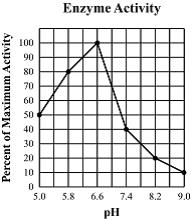
Which of the following conclusions can be drawn from this graph?
1
The optimum pH of the enzyme is 6.6.
2
The optimum pH of the enzyme is 5.8
3
The enzyme’s activity increases as pH increases 5.0 to 9.0
4
The enzyme’s activity is greater around pH of 8.0 .

20

Denaturation = to lose shape

  • Structure (shape) = function

  • If enzymes lose their shape they no longer function correctly

  • Lower enzyme function = slower reaction rates

  • Factors that can affect shape & function of enzymes: Temperature, pH, salinity (ion concentration)

media

21

Multiple Choice

Question image
What happens when enzymes are heated to a high temperature?
1
The enzymes die.
2
The shapes of the enzyme are altered denature
3
The enzymes' amino acid sequence changes.
4
The enzymes remain the same

22

media

23

Multiple Choice

The oxygen atom in water is slightly ____.

1

negative

2

positive

24

Multiple Choice

The reason water sticks to your skin is ___.

1

adhesion

2

cohesion

25

Multiple Choice

The reason there are trillions of water molecules in a droplet is because of ___.

1

adhesion

2

cohesion

26

Multiple Choice

Water's high boiling point is due to ___.

1

hydrogen bonds

2

it's polarity

3

being nonpolar

27

Multiple Select

A high specific heat means water ____. (select all that are true)

1

takes a long time to change temperature.

2

takes a lot of heat to increase temperature.

3

holds a lot of heat.

4

is good at regulating Earth's temperature.

28

Multiple Choice

Because solid water is less dense than liquid water, ___ floats.

1

solid water (ice)

2

liquid water

29

Multiple Choice

What kind of molecule is water?

1

Ionic

2

Polar Covalent

3

Nonpolar Covalent

4

Metallic

30

Multiple Choice

Question image

You body sweats to help prevent you from overheating. How does water regulate temperature?

1

it lets heat pass through it

2

it absorbs a lot of heat, then decreases in temperature

3

it absorbs a lot of heat, but only increases a little in temperature

4

heat is afraid of water and avoids it

31

Multiple Choice

Question image

A water strider can skate along the top of a pond because:

1

covalent bonds result in water cohesion (surface tension)

2

hydrogen bonds result in water cohesion (surface tension)

3

water striders have adapted to take advantage of water cohesion

4

water striders are afraid of water and avoid it

32

Multiple Choice

Water is a universal solvent because it...
1
It can be found anywhere
2
It freezes when it gets cold
3
floats when frozen
4
Dissolves most substances

33

Multiple Choice

Question image

Blood functions as a transport mechanism to take nutrients and oxygen to all cells in the body. What property of water allows for this to occur?

1

Expansion Upon Freezing

2

Universal Solvent

3

Cohesive Behavior

4

Ability to Moderate Temperature

​Chemistry of Biology

By Gasmine Jean-Baptiste

Show answer

Auto Play

Slide 1 / 33

SLIDE