Science 6 U1 And 2 Review
Presentation
•
Science
•
6th Grade
•
Medium
Yulianti Yulianti
Used 1+ times
FREE Resource
10 Slides • 51 Questions
1
By Ms. Yulianti
2
Kisi-Kisi PTS
1) Parts of The Human Reproductive System
3
Multiple Choice
Study the diagram. Identify P and Q.
4
Multiple Choice
Where does fertilisation usually take place in humans?
5
Multiple Choice
In which part of the mother’s body does foetus grow?
6
Multiple Choice
The developing baby or foetus get nutrients from the mother through ....
7
Multiple Choice
Which organ is responsible for producing eggs in females?
B. Ovary
A. Uterus
C. Fallopian tubes
8
2) Reproduction Process
9
Multiple Choice
How many months need for a zygote develops into a baby that ready to be born?
3 months
5 months
7 months
9 months
10
Multiple Choice
6. What is the term for the process by which a sperm and egg cell combine?
A. Ovulation
B. Fertilization
C. Implantation
11
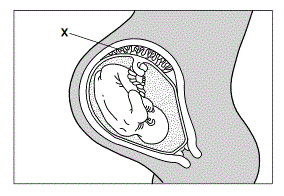
Multiple Choice
Which statement best describes an important
process carried out by structure X (placenta)
Milk passes from the mother to the foetus
Material are exchanged between foetal and maternal blood.
Maternal blood is converted into foetal blood
Oxygen diffuses from foetal blood to maternal blood.
12
4) Puberty
13
Multiple Select
During puberty which of these changes happen to both boys and girls?
(Hint: more than one answer)
Menstruation
Pubic hair grows
Skin becomes oily.
Hair grows on face.
14
Multiple Choice
During the menstrual cycle, an egg comes out of an _________ and begins a trip through the fallopian tube to the uterus.
ovary
uterus
stomach
liver
15
Multiple Choice
The cycle of menstruation period is ____ days.
28
25
21
22
16
Multiple Choice
Why do teens develop body odor (= bau badan) when they enter puberty?
They don't wash
An increase in classroom stress causes teens to smell.
Puberty hormones affect glands in your skin, and the glands make chemicals that smell bad.
17
Multiple Select
What impacts the reasons a voice will get deeper? Choose all that apply.
larynx size
thickness of vocal cords
the size of the resonating area
how tall someone is
18
5) Caring Reproductive System
19
Multiple Select
Name two ways you can reduce body odor:
Apply deodorant
Shower regularly
Don't Shower
Use Hand Sanitizer
20
Multiple Choice
You should always wear _________________.
deodorant
weight
heat
air conditioning
21
6) Reproductive Parts of A Flowering Plant
22
Labeling
Label the parts of the flower
Petal
Filament
Style
Ovary
Ovule
Anther
Stigma
23
Multiple Choice
Which group of flowers would produce the most fruit?
A
B
C
D
24
Multiple Choice
A cucumber fruit has many seeds. What does this tell you about the flower of the cucumber plant?
It has one ovary.
It has one ovule.
It has many ovules.
It has many ovaries.
25
Fill in the Blanks
Fill in the blanks:
The function of petals of a flower is to ... animals (insects).
26
Fill in the Blanks
Fill in the blanks:
The flower part that connect the stigma to the ovary is ...
27
Fill in the Blanks
Fill in the blanks:
The anthers produce
28
Fill in the Blanks
Fill in the blanks:
The female reproductive cell is found in
29
Fill in the Blanks
Fill in the blanks:
The anthers and the ... are parts of the flower involved in pollination.
30
7) Flowering Plants Reproduction
31
Multiple Choice
Which of the following correctly shows the order of processes in the reproduction of flowering plants?
32
Multiple Choice
Flowering plants produce flowers for ....
reproduction
germination
production
make the place beautiful
33
8) Pollination And Fertilisation
34
Multiple Choice
This plan has brightly coloured flowers that are useful for a process....
germination
pollination
seed dispersal
35
Multiple Choice
What type of pollination is shown in this diagram?
Cross pollination
Self pollination
Single pollination
Artificial pollination
36
Multiple Choice
What is a pollinator ?
Animals that eat meat only
Animals that reproduce by laying eggs
Animals that carry pollen from one flower to another.
Animals that eat plant only
37
Multiple Choice
cow
38
Multiple Choice
39
Multiple Choice
Fertilisation is a process whereby a male reproductive cell ___________ with a female egg cell.
clashes
fuses
competes
scatters
40
Multiple Choice
C only
A and B only
A and C only
A, B and C
41
Fill in the Blanks
Fill in the blanks:
After fertilisation, an ovary will develop into a
42
Fill in the Blanks
Fill in the blanks:
After fertilisation, the petals of a flower ... and drop off.
43
Multiple Choice
Which is NOT a characteristic of flowers that are pollinated by wind?
feathery stigma
light
sweet nectar
small petals
44
Multiple Choice
What is NOT a characteristic of seeds dispersed by wind?
wing-like structures
feathery
light
Has pods
45
9) Dispersal and Germination
46
Multiple Choice
Which of the following is NOT a characteristic of seeds dispersed by water?
has fibrous husks
has hooks
has waterproof covering
can stay afloat on water
47
Multiple Choice
When we prevent overcrowding of plants, we reduce the competition for ________________________________________.
Water, Minerals and Light
Water, Nutrients and Minerals
Water, Nutrients, Light and Minerals
Water, Light and Space
48
Multiple Choice
Which is NOT a characteristic of seeds dispersed by animals?
Fruits or seeds have hooks
Fruits are fleshy and juicy
Fruits have trapped air in their husks
Seeds are passed out through animal's droppings
49
Fill in the Blanks
Fill in the blanks:
A germinating seed gets its nutrients from its seed
50
Multiple Choice
Germination is _________________________________.
when a seed starts to grow
when an egg and pollen join together
when pollen moves stamen to stigma
when a plant makes its own food.
51
Multiple Choice
A seed needs __________, __________ and a __________ to germinate.
soil, water, air
suitable temperature, water, sunlight
air, water, suitable temperature
water, air, sunlight
52
10) Reproduction Process In Non-Flowering Plants
53
Multiple Choice
The ferns reproduce by ________
Spores
Seeds
54
Multiple Choice
Is an apple tree a flowering or non-flowering plant?
flowering
non-flowering
55
Multiple Choice
Which tree produce seeds in cones?
Seedlings
Conifers
Flowering Plants
56
Multiple Choice
Mosses reproduce by ____________
seeds
flowers
cones
spores
57
Multiple Choice
A and C only
B and D only
A, B and C only
A, B, C and D
58
Fill in the Blanks
Fill in the blanks:
Non-flowering plants such as pine trees reproduce from
59
Fill in the Blanks
Fill in the blanks:
Non-flowering plants such as moses and ferns reproduce from
60
Fill in the Blanks
Fill in the blanks:
In moses, spores develop in
61
Fill in the Blanks
Fill in the blanks:
The seeds of pine trees reproduce are found in
By Ms. Yulianti
Show answer
Auto Play
Slide 1 / 61
SLIDE

Similar Resources on Wayground
60 questions
Lesson 3 Thermal Energy Transfers
Presentation
•
6th Grade
52 questions
Density lesson
Presentation
•
6th Grade
53 questions
SCIENCE YEAR 7 REVIEW PACKET HW
Presentation
•
6th Grade
53 questions
Science 6 Soil
Presentation
•
6th Grade
57 questions
7.Science.U02.L3-5.Heat Transfer
Presentation
•
7th Grade
54 questions
6th- Types and Reading graphs Day 3
Presentation
•
6th Grade
55 questions
Graphing Motion
Presentation
•
6th Grade
54 questions
Unit 1: SCAPE. Lesson. SS. 6th Grade
Presentation
•
6th Grade
Popular Resources on Wayground
10 questions
Safety Day 2026 – Student Review
Quiz
•
9th Grade
21 questions
Continents and Oceans
Quiz
•
6th Grade
20 questions
Parts of Speech
Quiz
•
5th Grade
16 questions
Subject & Predicate
Quiz
•
5th Grade
25 questions
Multiplication Facts
Quiz
•
5th Grade
12 questions
Map Skills
Quiz
•
3rd Grade
22 questions
Continents and Oceans
Quiz
•
5th Grade
15 questions
Rounding Decimals
Quiz
•
5th Grade
Discover more resources for Science
20 questions
Elements, compounds, and mixtures
Quiz
•
6th Grade
10 questions
6.6D - Relative Density Review
Quiz
•
6th Grade
10 questions
Exploring Chemical and Physical Changes
Interactive video
•
6th - 10th Grade
20 questions
CONDUCTION,CONVECTION AND RADIATION
Quiz
•
6th Grade
20 questions
Rocks and The Rock Cycle
Quiz
•
6th Grade
19 questions
Describing and Classifying Matter
Presentation
•
6th Grade
21 questions
Waves and Wave Properties
Quiz
•
6th - 8th Grade
20 questions
Phases of the Moon
Quiz
•
6th Grade