

grade 8 Lesson 11 10/2/2025

Presentation
•
Education
•
8th Grade
•
Practice Problem
•
Hard

Deyvi Rocha
Used 2+ times
FREE Resource
14 Slides • 3 Questions
1
Multiple Choice
How are you feeling today?
2
lesson 11
By Deyvi Rocha

AGENDA
Objectives- Assessment
DIT
Key Teacher Questions
Characterization/Theme
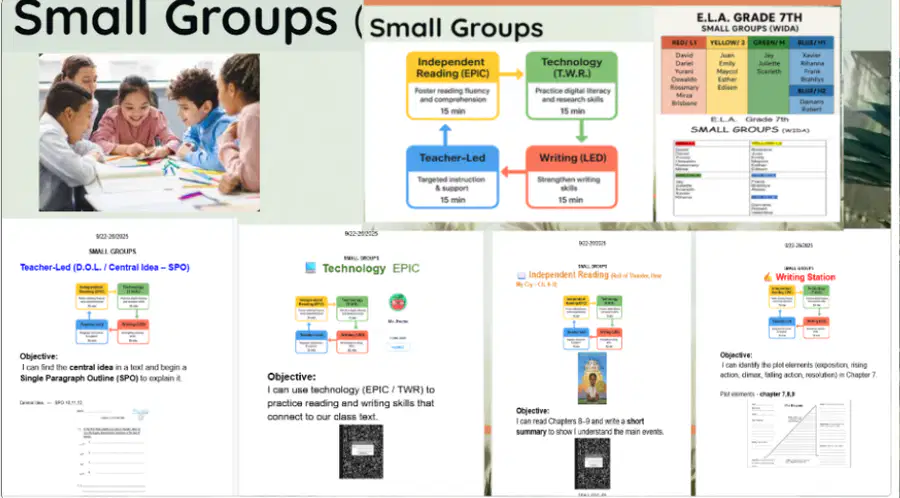
SMALL GROUPS
3
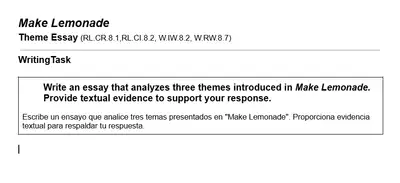
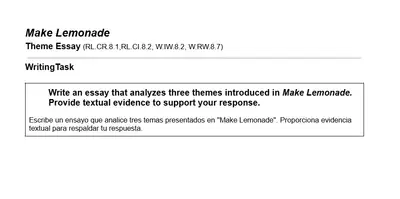
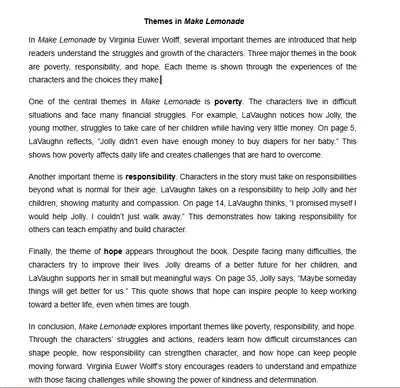
Daily Instructional Task: Theme Essay (SL.PE.8.1,SL.PI.8.4)
Using the SPO Scaffold activity, write a paragraph analyzing one theme presented in Make Lemonade.
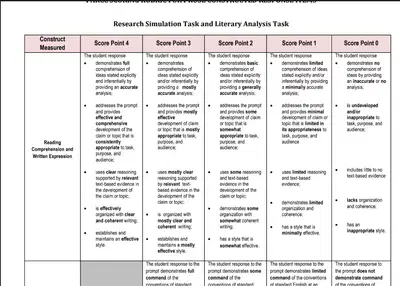
I can determine themes and analyze the relationship to the characters, setting, and plot by writing an essay that identifies 3 themes conveyed in Make Lemonade with supporting evidence..
Objectives Assessment
4
5
Key Questions
What is the most important thing to include when writing a literary analysis essay?
¿Qué es lo más importante a incluir al escribir un ensayo de análisis literario?
6
A literary essay is a prose writing in which the author subjectively reflects on a topic of interest, using expressive and stylized language to explore personal ideas and opinions. It is structured with an introduction, a written argument, and a conclusion.
Un ensayo literario es un escrito en prosa https://7esl.com/prose/ donde el autor reflexiona subjetivamente sobre un tema de interés, utilizando un lenguaje expresivo y estilizado para explorar sus ideas y opiniones personales. Se estructura con una introducción, un desarrollo argumentado y una conclusión
7
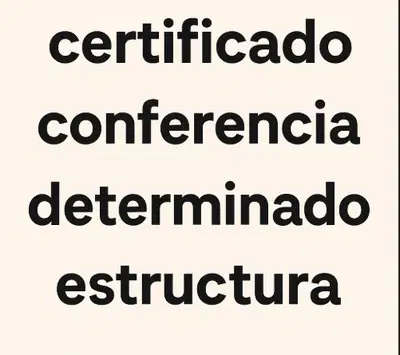
Vocabulary
certified
conference
determined
structure
8
Replace this with a header
Replace this with your body text. Duplicate this text as many times as you would like. All provided templates can be reused multiple times. Wish you a good day.
Happy teaching!
9
Characterization/Theme
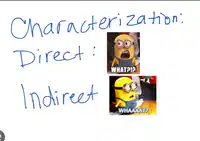
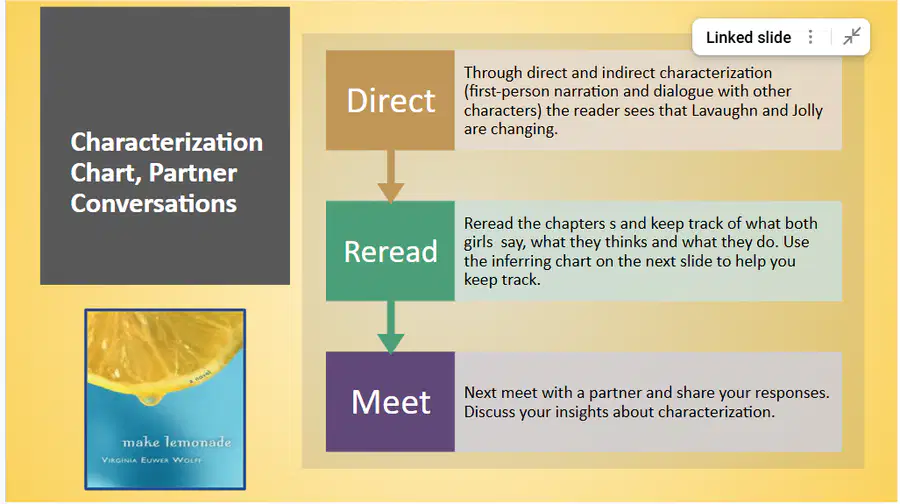
Characterization Characterization is the process by which an author develops a character in a story. Direct Characterization: The author directly tells the reader about a character's appearance, personality, or motivations.
Indirect Characterization: The reader infers character traits through the character's actions, words, thoughts, and the reactions of other characters.
Character Development: Characters can be dynamic, changing significantly throughout the story, or static, remaining largely unchanged.
Theme describes the central idea(s) that a piece of writing explores
10
Make Lemonade
Direct Characterization Example (Chapter 1): LaVaughn is described directly by the narrator as a responsible and observant girl. Evidence: “I know I’m lucky. I’ve got a good head on my shoulders, and I know how to take care of things.” Explanation: The author directly tells us that LaVaughn is responsible and mature.
Indirect Characterization Example (Chapter 5): When LaVaughn watches Jolly struggle to manage her children and home, we see her empathy and sense of responsibility. Evidence: LaVaughn helps Jolly organize the kids and household chores without being asked. Explanation: Through her actions, the reader infers that LaVaughn is caring and helpful.
11
Multiple Choice
What is characterization?
12
Multiple Choice
What is theme?
13
Replace this with a header
Replace this with your body text. Duplicate this text as many times as you would like. All provided templates can be reused multiple times. Wish you a good day.
Happy teaching!
14
15
16
17
How are you feeling today?
Show answer
Auto Play
Slide 1 / 17
MULTIPLE CHOICE
Similar Resources on Wayground

13 questions
Roanoke and Jamestown
Presentation
•
8th Grade
13 questions
Physical and Chemical Changes
Presentation
•
8th Grade
13 questions
Power, Quotient, Product Rule
Presentation
•
8th Grade
11 questions
Literatura prehispánica
Presentation
•
8th Grade
12 questions
Fossils
Presentation
•
8th Grade
12 questions
Simple Past Tense
Presentation
•
8th Grade
12 questions
grammar | capitalization
Presentation
•
8th Grade
12 questions
Living Things
Presentation
•
KG
Popular Resources on Wayground
20 questions
Math Review

Quiz
•
3rd Grade
15 questions
Fast food
Quiz
•
7th Grade
20 questions
Context Clues
Quiz
•
6th Grade
20 questions
Inferences
Quiz
•
4th Grade
19 questions
Classifying Quadrilaterals
Quiz
•
3rd Grade
20 questions
Figurative Language Review
Quiz
•
6th Grade
20 questions
Equivalent Fractions
Quiz
•
3rd Grade
10 questions
Identify Fractions, Mixed Numbers & Improper Fractions
Quiz
•
3rd - 4th Grade