

1.3.4

Presentation
•
Mathematics
•
6th - 8th Grade
•
Practice Problem
•
Easy
+7
Standards-aligned

Lauren Rullo
Used 1+ times
FREE Resource
14 Slides • 3 Questions
1
Friday, Sept. 26th
Lesson 1.3.4
By Lauren Rullo
2
3
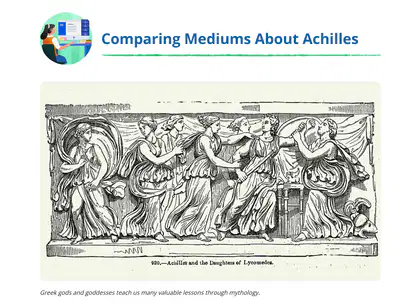
Human flaws play a key role in many Greek myths.
For example, the brave but hot-tempered warrior Achilles believes himself nearly invincible in battle.
His pride and anger drive him to make decisions that ultimately lead to his demise.
Achilles
4

This Greek myth inspired the name of part of the human body. The part of Achilles' heel that was struck by the arrow is now called the Achilles tendon.
Because the Achilles tendon is known to be one of the strongest tendons in the human body and is a critical component to movement, injuring the tendon can cause tremendous amounts of pain and months of rehab.
Achilles Tendon
5
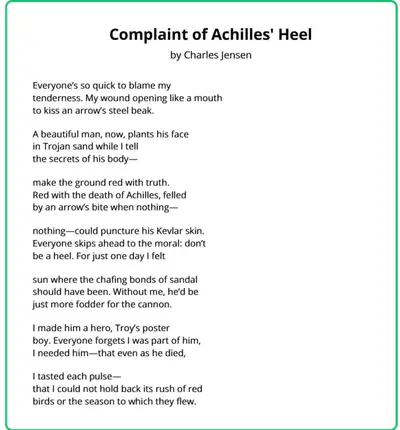
a type of literature that uses a variety of creative elements and forms to convey ideas, experiences, and emotions.
Poems often rely on rhythm, rhyme, and figurative language to express their ideas in very few words.
Poetry
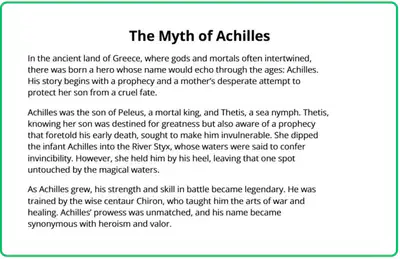
more ordinary, familiar writing. Prose is generally longer and written to reflect the way people speak.
Prose generally uses complete sentences and follows strict grammatical rules.
Prose
6
Categorize
written in lines and stanzas
uses figurative language
written in paragraphs
uses clear language and/or dialogue
Sort the items below to differentiate between poetry and prose.
7
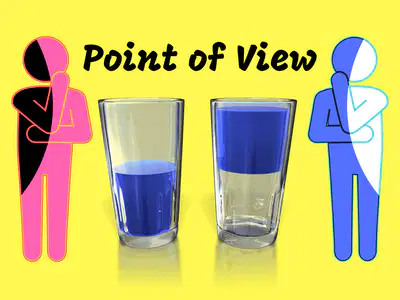
Point of view is the perspective from which a text is told.
Point of view shapes the way the reader experiences the text, including what the reader knows.
Point of View
8
Point of View
the narrator knows all of the story's events and the thoughts, feelings, and perspectives of all characters in the story. The word omniscient means “all-knowing.”
Omniscient:
the narrator only knows the thoughts, feelings, and perspectives of one character in the story. They do not know the thoughts and feelings of other characters.
Limited:
9
Multiple Choice
Why does point of view matter?
It allows the reader to understand how the author feels.
It determines how much information the reader knows about the text.
It ensures that the poem or prose is told from only one character's perspective.
10
Multiple Choice
True or False:
For an omniscient point of view, the narrator knows all of the story's events and thoughts, feelings, and perspectives of ALL characters in the story.
True
False
11
Language
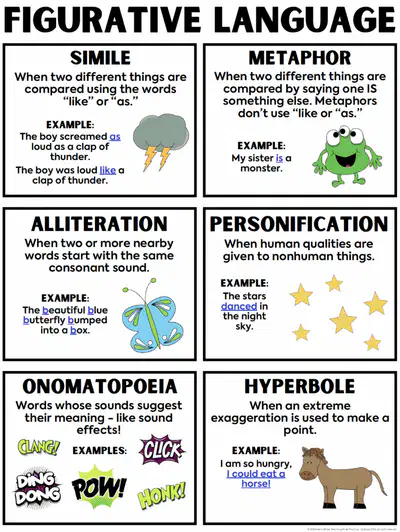
Poetry often uses figurative language such as metaphors, similes, or personification to create images and emotions.
On the other hand, prose often uses clear and direct language to explain events.
12
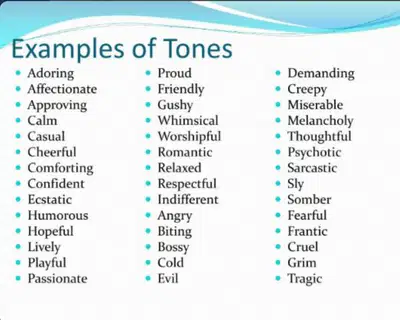
Poetry focuses on expressing feelings and ideas in a creative or dramatic way.
Prose often focuses on telling facts and events in a structured way.
Tone
Overall, poetry tends to be more expressive and playful with language and tone, while prose sticks with clear and sequential storytelling.
13
Author's Purpose
Persuade: to convince the reader to believe or do something
Inform: to teach or explain facts about a particular topic
Entertain: to engage the reader with an entertaining story
Prose
Express emotion: to bring out feelings in the reader
Reflect: to have the reader question and think about the human experience using common themes such as love, loss, and identity
Poetry
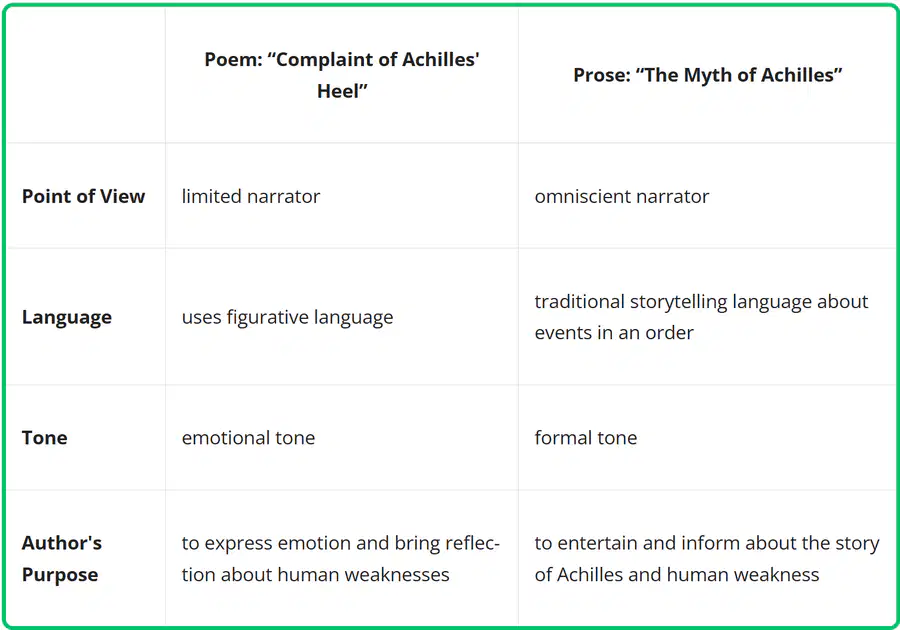
The author's purpose in poetry and prose can be the same but often differ because of point of view, language, and tone.
14
Myth-"Achilles"
Now, you are ready to read two different mediums about the myth of Achilles.
The prose text “The Myth of Achilles” recounts the story of the brave warrior Achilles' birth, participation in the Trojan War, and tragic death.
Prose
The poem “Complaint of Achilles' Heel” reflects on Achilles' death from the perspective of Achilles' heel.
Poem
15
16
17
Friday, Sept. 26th
Lesson 1.3.4
By Lauren Rullo
Show answer
Auto Play
Slide 1 / 17
SLIDE
Similar Resources on Wayground

12 questions
Equivalent Ratio Review
Presentation
•
6th - 7th Grade
13 questions
Lesson: Classifying Quadrilaterals
Presentation
•
6th - 7th Grade
13 questions
Adding and Subtracting Algebraic Terms
Presentation
•
7th - 8th Grade
11 questions
cartesian plane
Presentation
•
6th - 8th Grade
13 questions
Two-Step Equations With Integers
Presentation
•
6th - 8th Grade
10 questions
Equation Vocabulary
Presentation
•
6th - 8th Grade
10 questions
12-3 Composite Figures
Presentation
•
6th - 8th Grade
13 questions
Pre-Algebra SOL 8.11, 8.12, and 8.13 SOL Prep
Presentation
•
6th - 8th Grade
Popular Resources on Wayground
28 questions
US History Regents Review

Quiz
•
11th Grade
36 questions
Biology Regents Review
Quiz
•
9th - 10th Grade
20 questions
Math Review
Quiz
•
3rd Grade
38 questions
Regents Life Science General Review
Quiz
•
9th Grade
20 questions
Math Review
Quiz
•
6th Grade
21 questions
EOY Grade 6 Benchmark Assessment - Content Skills
Quiz
•
6th Grade
20 questions
Inferences
Quiz
•
4th Grade
20 questions
Figurative Language Review
Quiz
•
6th Grade
Discover more resources for Mathematics
20 questions
Math Review
Quiz
•
6th Grade
21 questions
EOY Grade 6 Benchmark Assessment - Content Skills
Quiz
•
6th Grade
20 questions
Math Review - Grade 6
Quiz
•
6th Grade
35 questions
MATH 6 FINAL
Quiz
•
6th Grade
44 questions
7th Math Review
Quiz
•
7th Grade
23 questions
Order of Operations
Quiz
•
6th Grade
18 questions
Subtracting Integers
Quiz
•
7th Grade
22 questions
Dot Plots and Histograms
Quiz
•
6th Grade