
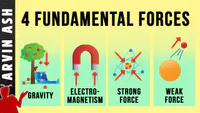
Strong Nuclear Force woth notes

Presentation
•
Science
•
9th - 12th Grade
•
Easy
+5
Standards-aligned

Dominick Virola
Used 2+ times
FREE Resource
8 Slides • 18 Questions
1
Strong nuclear force
By Dominick Virola IPC

2
Nuclear forces were discovered in the 20th century, when we began to work with the atom. Strong nuclear forces are between protons and neutrons. Weak nuclear forces occur between radioactive particles and electrons that do not experience strong nuclear force.
3
Strong nuclear force is the strongest force of the four. It holds the fundamentals of matter together. Part of the strong nuclear force keeps protons and neutrons, the nucleons, together in the nucleus of the atom even given the strong repellent force of the positively charged protons. This force acts over a very small distance, though particles have to be within the diameter of a proton of each other.
4
This force differs from the other forces in that it gets weaker as the particles get closer together. This force is actually strongest when the particles are farthest apart. Force-carrying particles called bosons, in this case specifically gluons, keep the particles “glued” together.

5
In a star, the gravity and the mass are so great that the nuclei of atoms are pushed together. As they get close enough to each other, the nuclei fuse with each other. This process causes the nuclei to lose mass and release large amounts of energy and is called fusion. This is different from the process of fission. In fission, the nucleus of an atom breaks in two, breaking the hold of the strong force. As these two new nuclei break apart, they cause other nuclei nearby to break apart, creating a chain reaction. This releases massive amounts of energy, like what is found in an atomic bomb. The nucleus can be broken apart when it is bombarded with a neutron or gamma rays. These processes take advantage of a mass defect. The mass of the nucleus is less than the mass of the protons and neutrons. The missing mass is converted into energy based on the mass–energy equivalence.
6
Mass–energy equivalence is a special idea in science that says energy and mass are related and under certain circumstances, can be converted into each other. This was explained by Albert Einstein using the equation, E=mc²,where E is energy, m is mass and c is the speed of light constant. The idea is that small amounts of mass can be converted to large amounts of energy or vice versa, large amounts of energy can be converted to small amount of mass
7
Use Your Notes from the last 3 days to answer the following questions.
This is week 8, please pay attention to your work and your grades. There are 2 weeks remaining before the report card.
Day 1 - Gravitational Force (weakest)
Day 2 - Electromagnetic Force (2nd strongest)
Day 3 - Strong Nuclear Force (strongest)
8
Multiple Choice
What is the strong force?
The strong force is a fundamental force that holds the nucleus of an atom together.
The strong force is a force that repels particles in the nucleus of an atom.
The strong force is a force that attracts electrons to the nucleus of an atom.
The strong force is a force that only affects protons in the nucleus of an atom.
9
Multiple Choice
What is the role of the strong force in atomic nuclei?
It determines the atomic number of the element.
It controls the movement of electrons in the atomic nucleus.
It holds the protons and neutrons together in the atomic nucleus.
It repels the protons and neutrons in the atomic nucleus.
10
Multiple Choice
What is the relative strength of the strong force compared to other fundamental forces?
Strongest
Nonexistent
Moderate
Weakest
11
12
Multiple Choice
A magnet has two magnetic poles. Those poles are ...
South Pole
West Pole
East Pole
West Pole
North Pole
West Pole
North Pole
South Pole
13
Multiple Choice
Can magnetism go through objects?
yes
no
14
Multiple Choice
The greater the distance between magnets, the _________ the force between them.
greater
weaker
15
Multiple Choice
16
Multiple Choice
How does increasing the charge of two objects affect the electrical force between them?
The force decreases
The force remains the same
The force increases
The force becomes zero
17
Multiple Choice
18
Multiple Choice
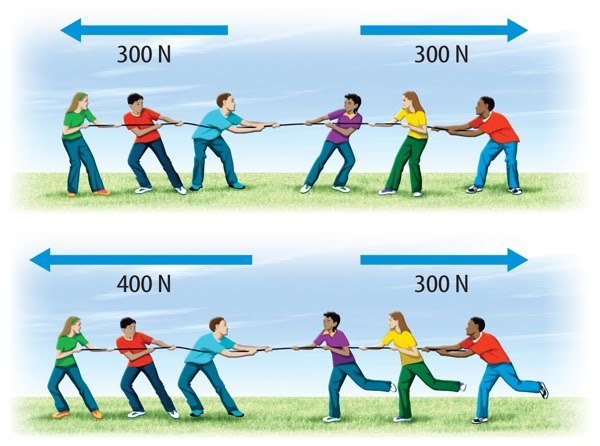
Which one is balanced?
top
bottom
both
Neither is balanced
19
Multiple Choice
20
Multiple Choice

21
Multiple Choice
22
Multiple Choice
Takes two small nuclei and combines them into a larger nucleus
Fission
Fusion
23
Multiple Choice
Which of the following forces is the weakest among the four fundamental forces?
Electromagnetic force
Gravitational force
Strong nuclear force
Weak nuclear force
24
Multiple Choice
Which of the following best describes mass-energy equivalency?
Energy can be converted into mass and vice versa
Mass and energy are unrelated
Mass is always greater than energy
Energy is always greater than mass
25
Multiple Choice
26
Multiple Choice
Strong nuclear force
By Dominick Virola IPC
Show answer
Auto Play
Slide 1 / 26
SLIDE
Similar Resources on Wayground

20 questions
Ionic, covalent and giant covalent compounds
Presentation
•
9th - 11th Grade
20 questions
Spheres of the Earth Notes & Practice
Presentation
•
9th - 12th Grade
20 questions
Energy review
Presentation
•
9th - 12th Grade
20 questions
El Pretérito
Presentation
•
9th - 12th Grade
20 questions
Properties of Water
Presentation
•
9th - 12th Grade
18 questions
Weather and Climate
Presentation
•
9th - 12th Grade
19 questions
What is photosynthesis?
Presentation
•
10th - 12th Grade
18 questions
Flow of Energy in an Ecosystem
Presentation
•
10th - 12th Grade
Popular Resources on Wayground
10 questions
How much do you know about our Portrait of an Eagle?

Quiz
•
10th Grade
10 questions
Fast Food Slogans
Quiz
•
6th - 8th Grade
21 questions
Continents and Oceans
Quiz
•
6th Grade
20 questions
Parts of Speech
Quiz
•
5th Grade
16 questions
Subject & Predicate
Quiz
•
5th Grade
25 questions
Multiplication Facts
Quiz
•
5th Grade
12 questions
Map Skills
Quiz
•
3rd Grade
22 questions
Continents and Oceans
Quiz
•
5th Grade
Discover more resources for Science
10 questions
Exploring Chemical and Physical Changes

Interactive video
•
6th - 10th Grade
20 questions
Atomic Structure
Quiz
•
9th Grade
10 questions
Decoding the Periodic Table of Elements
Interactive video
•
6th - 10th Grade
10 questions
Exploring the Periodic Table
Interactive video
•
6th - 10th Grade
14 questions
Physical and Chemical Changes
Quiz
•
10th Grade
22 questions
Periodic Table Review
Quiz
•
9th - 12th Grade
20 questions
Observation vs. Inference
Quiz
•
7th - 9th Grade
14 questions
Periodic Trends
Interactive video
•
11th Grade