Search Header Logo
Enzymes and Their Actions

Enzymes and Their Actions

Assessment

Presentation

Science

9th - 12th Grade

Medium

NGSS
HS-LS1-6, HS-PS1-4, HS-PS1-2

+12

Standards-aligned

Created by

Kurt Trout

Used 2+ times

FREE Resource

9 Slides • 24 Questions

1

​Enzymes and their actions

By Kurt Trout

2

Enzymes

Biological Catalysts

media

3

Enzymes are Biological Catalysts

  • They are proteins

  • Catalysts speed up chemical reactions

  • Structure = Function: Enzymes are specific to their Substrate (reactants). Active site of the enzymes fits together with the substrate(s)

  • Different reactions require different enzymes

media

4

2 Why do living things need chemical reactions?

  • Some reactions release energy; others require energy. Energy changes determine whether a chemical reaction will occur.

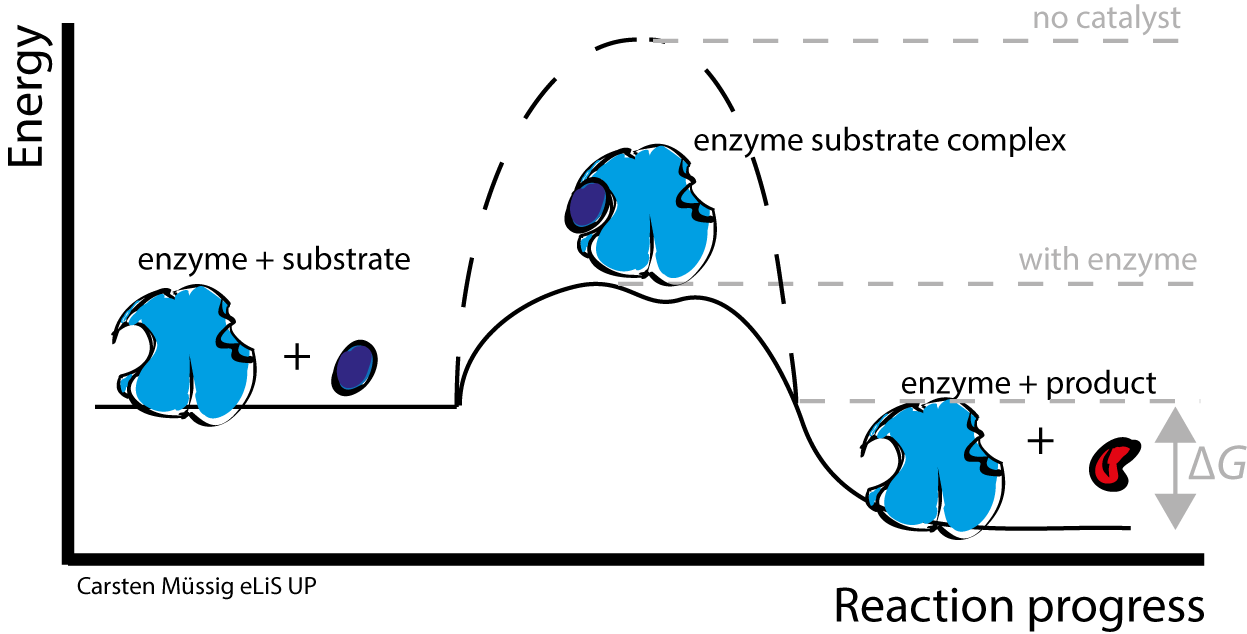
  • The energy needed to get a reaction started is called activation energy.

media

5

2 Why do living things need chemical reactions?

  • Enzymes work to lower activation energy. Enzymes are called biological catalysts.

media

6

Multiple Choice

What is the function of an enzyme?

1

to speed up chemical reactions in a cell

2

to receive messages

3

to carry molecules across membranes

4

to turn on or turn off genes

7

Multiple Choice

Question image
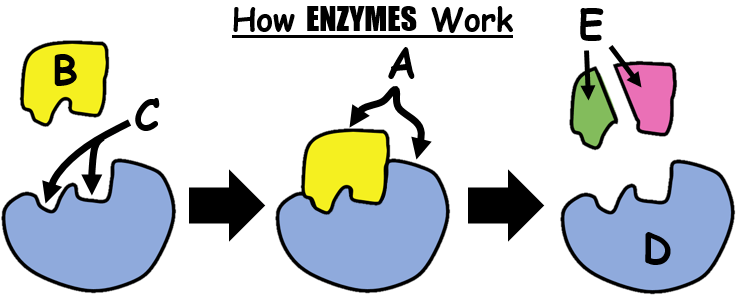
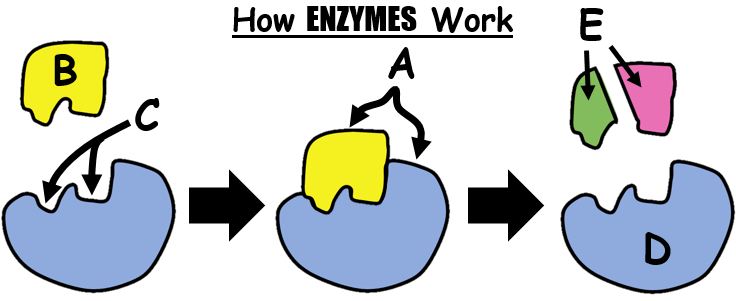
What is the name of structure A?
1
Active Site
2
Substrate
3
Enzyme-Substrate Complex
4
Product

8

Multiple Choice

Question image
What is the name of structure D?
1
Active Site
2
Substrate
3
Enzyme-Substrate Complex
4
Products

9

Multiple Choice

Question image
Letter D...
1
active site
2
enzyme
3
substrate
4
products

10

Multiple Choice

Question image
In the diagram, what is letter A? 
1
product
2
substrate
3
enzyme-substrate complex
4
active site

11

Multiple Choice

Question image
An enzyme speeds up a reaction by
1
lowering the activation energy.
2
raising the activation energy.
3
releasing energy.
4
absorbing energy.

12

Multiple Choice

Enzymes will make a reaction go _______ and use ______ energy.
1
faster, less
2
faster, more
3
slower, less
4
slower, more

13

media
media

​Means to make something. Taking 2 different monomers and putting them together to make a polymer

​​Synthesis

​Means to split, divide, break something. Taking a polymer and splitting it apart.

​​Hydrolysis

14

media

This means the reaction is using WATER, or H2O to either combine or split the molecules.

Dehydration Reactions

15

media

In this, a water molecule (H20) is used to SPLIT a polymer into smaller molecules.

Hydrolysis Reaction

16

Lysis means to break apart.
Hydrolysis means to break polymers into monomers, by using H2O. It RELEASES energy to happen.

Hydrolysis

Synthesis means to BUILD!
This is the process of putting TOGETHER monomers to make polymers, by using H2O. It REQUIRES energy.

Dehydration Synthesis

Monomers to Polymers, and back....

17

Multiple Choice

Connects monomers to form a polymer
1
Dehydration synthesis
2
hydrolysis

18

Multiple Choice

Breaks polymers to form a monomers

1
Dehydration synthesis
2
hydrolysis

19

Multiple Choice

Produces water as a by-product
1
Dehydration synthesis
2
Hydolysis

20

Multiple Choice

A _________ reaction removes a molecule of water to bond molecules together to create a polymer.

1

hydrolysis

2

water

3

dehydration synthesis

4

magical

21

Multiple Choice

Question image

Which type of reaction is shown?

1

Dehydration Synthesis

2

Hydrolysis

22

Multiple Choice

Question image

What type of reaction is shown?

1

Dehydration synthesis

2

Hydrolysis

23

Multiple Choice

Question image

Which type of reaction is shown?

1

Dehydration Synthesis

2

Hydrolysis

24

Multiple Choice

Question image
The following figure is illustrating
1

Dehydration Synthesis

2

Hydrolysis

25

Multiple Choice

Question image
The following figure is illustrating
1

Dehydration Synthesis

2

Hydrolysis

26

Drag and Drop

In a dehydration synthesis, water is used to ​
a polymer, where in hydrolysis, water is used to​
a polymer
Drag these tiles and drop them in the correct blank above
create
break apart

27

Multiple Choice

The creating of Polymers

1

Dehydration synthesis

2

Hydrolysis

28

Multiple Choice

The breaking of Polymers

1

Dehydration synthesis

2

Hydrolysis

29

Multiple Choice

Hydrolisis _____ water

1

produces

2

requires

30

Multiple Choice

Dehydration Synthesis _____ water

1

produces

2

requires

31

Hotspot

Where is the water molecule?

32

Hotspot

Click on the hydrolysis reaction

33

Hotspot

Click on the dehydration synthesis reaction

​Enzymes and their actions

By Kurt Trout

Show answer

Auto Play

Slide 1 / 33

SLIDE