

Grade 7th unit 5 LESSON 5-9 /4/13-17/2026

Presentation
•
Education
•
7th Grade
•
Practice Problem
•
Medium

Deyvi Rocha
Used 32+ times
FREE Resource
247 Slides • 33 Questions
1
Word Cloud
What kind of mood are you in? / ¿En qué estado de ánimo estás?
2
Reading conferences
MONDAY TUESDAY WEDNESDAY THURSDAY FRIDAY
Esther Emily Xavier Amberly Dominic
Dana Damaris Jay David Maycol

3
NJSLA
stands for New Jersey Student Learning Assessments.
-The NJSLA is a test that students in New Jersey take in English Language Arts (ELA) and Math.
-The test checks how well students are learning the skills they need in school.
-Teachers use the results to see what students understand well and what they might need extra help with.
NJSLA = a way to see what students have learned and what they can do next.
4
By Deyvi Rocha
UNIT 5
NJSLA
Essential Question
How can we use reading, writing, and language skills to understand texts deeply, communicate clearly, and think critically?
¿Cómo podemos utilizar las habilidades de lectura, escritura y lenguaje para comprender los textos en profundidad, comunicarnos con claridad y pensar de manera crítica?


5
Agenda 4/13-17/2026
INDEPENDENT READING 15 MIN
-Objectives - Assessment
Everybody Writes :
Vocabulary:
Mini Lesson 5 literary Analysis Essay
Activity
Independent Writing - DIT
Small group

6
Objectives Assessment


7
Everybody Writes
Quick Write (W.RW.7.7.)
“ We analyzed theme and plot. Explain the theme uncovered in The White Umbrella or The Need to Belong”
.(Turn and Talk)
“The White Umbrella” theme is about learning to accept your family and not feel ashamed of them. The girl feels embarrassed, but she learns her mother loves her and works hard.
“The Need to Belong” theme is that people want to fit in and feel accepted. When they do, they feel happy. When they don’t, they feel sad or act different.

Analizamos el tema y la trama. Explica el tema que se revela en The White Umbrella o The Need to Belong. (Giren y conversen)
8
MINI LESSON
LITERARY ANALISIS ESSAY
Goal:
Students will understand what a literary analysis essay is and how to organize one.
What is a Literary Analysis Essay?
9
A literary analysis essay is when you:
A literary analysis essay is when you:
Read a story or text Find a theme (message)
Use evidence (quotes/details)
Explain what it means
You are NOT just retelling the story. You are explaining the meaning.
Theme = the lesson or message of the story.
Examples:
Belonging is important Family love matters more than money Accepting others is important
10

11
Multiple Choice
WHAT IS LITERARY ANALYSIS ESSAY ?
12
D.I.T. GC

13
MODEL


14

15
Agenda 3/27-31/ 4/1-2/2026
INDEPENDENT READING 15 MIN
-Objectives - Assessment
Everybody Writes :
Vocabulary:
Mini Lesson 3 plot
Activity
Independent Writing - DIT
Small group
17
Objectives Assessment

18
Objectives Assessment


19
Everybody Writes
Quick Write (W.RW.7.7.)
“If the central idea is what the author wants us to understand, what might be the author’s purpose behind this text?”(Turn and Talk)
Si la idea central es lo que el autor quiere que comprendamos, ¿cuál podría ser el propósito del autor detrás de este texto? (Giren y conversen)
20

21
vocabulary
AUDIBLE
DISCREET
REVELATION

22
vocabulary
strive prominent, commonality

23
Cornell Notes
Before viewing What are the elements of plot,
How do they function, and in what main literary genre are they used? turn and talk .
SHARE
24


25
Multiple Choice
A PLOT IS..
26

27
An author's purpose
is the primary reason—to persuade, inform, or entertain—behind creating a piece of writing, sometimes referred to as P.I.E.. It dictates the content, tone, and style, helping readers understand the underlying message and evaluate the text's validity, whether it's a newspaper article, advertisement, or story.

28
Key Purposes of Writing (P.I.E.+)
To Persuade: The author attempts to convince the reader to agree with a point of view, take action, or change their behavior (e.g., editorials, advertisements, speeches).
To Inform: The author provides facts, data, and information to teach or educate the reader (e.g., textbooks, news articles, recipes).
To Entertain: The author tells a story, shares an anecdote, or uses humor to engage the reader's emotions (e.g., novels, poems, jokes).
To Describe/Reflect: The author paints a picture with words or shares personal feelings and insights (e.g., journals, travelogues, descriptive essays).
29
How to Identify Author's Purpose Analyze the Genre:
Is it a news article (inform) or a story (entertain)?
Look for Clues:
Are there facts (inform) or opinions and persuasive language like "should" (persuade)?
Consider the Tone: Is the writing lighthearted and humorous (entertain) or serious and direct (inform)?
30
READING 1 - REVIEW LESSON 1
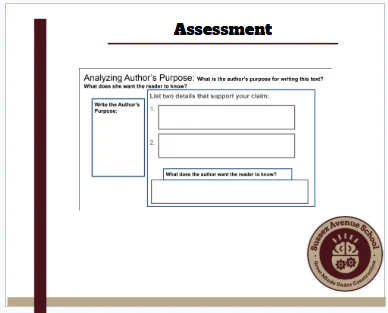
The author’s purpose is to explain how the need to belong affects people’s behavior and motivation.
List two details that support your claim:
1. Humans naturally seek relationships and social connections to feel accepted and valued.
2. When people feel rejected or excluded, it can affect their emotions, behavior, and motivation.
31
What does the author want the reader to know?
The author wants the reader to know that the need to belong is a powerful human motivation that influences how people act, feel, and connect with others.
El autor quiere que el lector sepa que la necesidad de pertenecer es una poderosa motivación humana que influye en la forma en que las personas actúan, sienten y se conectan con los demás.
32
Multiple Choice
Author's Purpose is:
33

34
35
Agenda 3/23-27/2026
INDEPENDENT READING 15 MIN
-Objectives - Assessment
Everybody Writes :
Vocabulary:
Mini Lesson 1 Launching the unit
Activity
Independent Writing - DIT
Small group
36
Objectives Assessment


37

38
Everybody Writes
Quick Write (W.RW.7.7.)
Why do people seek to belong? and How might this affect our behavior? (Turn and Talk)
¿Por qué busca la gente pertenecer algun lugar? ¿Y cómo podría esto afectar nuestro comportamiento? (Giren y conversen)
39
vocabulary
strive prominent, commonality
40
Multiple Choice
Which sentence shows the correct meaning of “strive”?
I strive to finish my homework on time.
I sleep all day instead of doing my homework.
I throw my homework away.
I eat a snack after school.
41
Multiple Choice
Which person is considered “prominent”?
A famous scientist who helps many people
A person hiding in their room.
Someone who never talks to anyone
A kid playing by themselves
42
Multiple Choice
Which example shows a commonality?
Two friends both love soccer
One friend likes cats, the other likes dogs
Two kids are in different schools
No one shares anything
43
Mini-Lesson on Annotation and Central Idea Identification
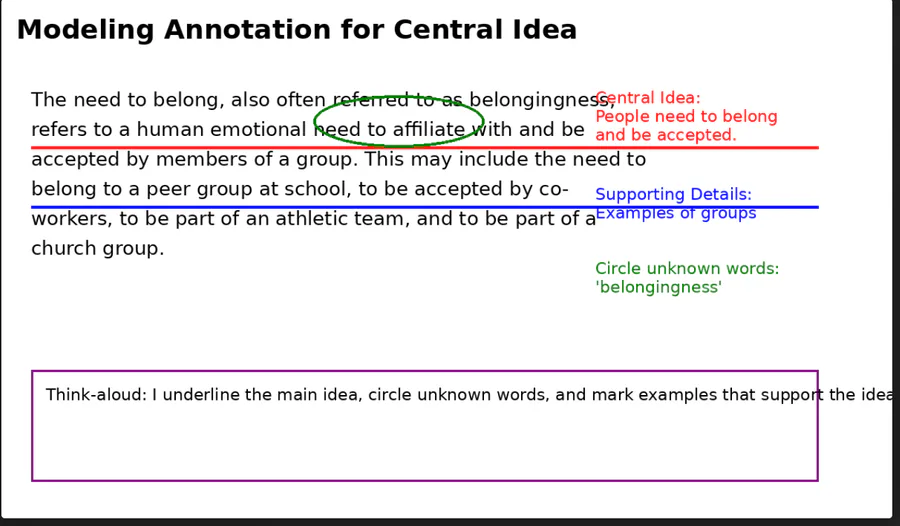
44

45
Multiple Choice
What is the central idea of a story?
The main point the author wants you to understand
Your favorite part of the story
46
47


48

49
By Deyvi Rocha
UNIT 4
THE GIVER
Essential Question
How do personal choices and the challenges we face shape who we become and influence the world around us?
¿Cómo las decisiones personales y los desafíos que enfrentamos moldean en quiénes nos convertimos e influyen en el mundo que nos rodea?

50
Agenda 3/16-20/2026
INDEPENDENT READING 15 MIN
-Objectives - Assessment
Everybody Writes :
Vocabulary:
Mini Lesson 27 literary Analysis Essay
Culminating Task
Activity
Independent Writing - DIT
Small group

51
Objectives Assessment


52
Everybody Writes
Quick Write (W.RW.7.7.)
How would you describe Jonas’s identity at the start of the novel compared to the end?
¿Cómo describirías la identidad de Jonas al comienzo de la novela en comparación con el final?
53

54

55

56

57
Multiple Choice
what is literary analysis essay ?
58
Multiple Choice
what is a claim in a essay ?
59
Multiple Choice
What is a thesis in a essay ?
60
Agenda 3/16-20/2026
INDEPENDENT READING 15 MIN
-Objectives - Assessment
Everybody Writes :
Vocabulary:
Mini Lesson 21 Drawing Conclusions
( Chapter 17-23)
Activity
Independent Writing - DIT
Small group
61
Objectives Assessment


62


63
Vocabulary:
release, respond, concept, available, precise
lanzamiento, respuesta, concepto, disponible, preciso

64
Multiple Choice
What does release most likely mean?
To set something free or let it go
65
Multiple Choice
Which word means to answer or react to something?
66
Multiple Choice
Which word refers to an idea or general understanding of something?
67
Multiple Choice
Which word means able to be used, reached, or obtained?
Respond
68
Multiple Choice
Which word means exact, correct, or accurate?
69
Everybody Writes
¿Cómo se ve afectada la sociedad por las elecciones personales?
70
Chapters 20-23
Who is Rosemary and why is she important?
What did The Giver tell Jonas he had realized about the memories?
Describe The Giver's ideas on changing things.
The Giver offered a very special memory to Jonas. What was it, and what was Jonas's response to the offer?
How does the story end? Do Jonas and Gabriel die? Do they make it to a place called “Elsewhere”?
Revisit your notes on utopias and dystopias. Is Jonas’s community more of a utopia or a dystopia? Please provide at least two reasons for your choices with examples from the story and article.
Group 2
Chapter 17-19
Describe Jonas's new level of feelings, and what caused them.
Discuss what it really means to be “released.’ How does Jonas react to this knowledge? How will this change his relationship with his father after seeing the release of the twin?
Jonas and The Giver discussed the effects to the Community if Jonas would be lost. What did they think would happen?
Describe the Release of the Newchild. What did Jonas realize as he watched the tape of the release?
Group 1
Text Dependent Questions Group Work:
71
72
Agenda 3/9-13/2026
INDEPENDENT READING 15 MIN
-Objectives - Assessment
Everybody Writes :
Vocabulary:
Mini Lesson 18-20 Opinion Writing (introduction)
Activity
Independent Writing - DIT
Small group
73
Objectives Assessment


74

75
Do you like pizza?
Is it better to have summer or winter?


Opinion = what you think or believe about something.
Opinions are personal, Opinions can be different for everyone. Opinions need reasons to support them.
76
Fact
Something that is true and can be proven.
Examples
The book The Giver was written by Lois Lowry.
Opinion
Something that someone believes or thinks.
Different people may have different opinions.
Examples
The Giver is the best book.
A fact can be checked, but an opinion is what someone thinks.

77
Partner talk
Jonas is the Receiver of Memory. →
Jonas is a brave character. →
The story takes place in a controlled community. →
Jonas's community is a bad place to live. →
How do you know?

78
Multiple Choice
WHAT IS AN OPINION ?
79
Everybody Writes
What do you remember about The Giver’s role and the memories he holds? Why are they important?
¿Qué recuerdas del papel de El Dador y los recuerdos que atesora? ¿Por qué son importantes?
80


81


82

83
Model Introduction
Imagine living in a world where no one remembers love, pain, or happiness. In the novel The Giver by Lois Lowry, the community lives without memories from the past. The main characters, Jonas and The Giver, discover that The Giver is the only person who holds all the memories. As Jonas learns more about these memories, he begins to question how his society works. I believe the people in the community should receive the memories because memories help people understand feelings and make better choices.

84

85

86


87
88
Agenda 3/2-6/2026
INDEPENDENT READING 15 MIN
-Objectives - Assessment
Everybody Writes :
Vocabulary:
Mini Lesson 16 CHARACTER PERSPECTIVE
Activity
Independent Writing - DIT
Small group
89
Objectives Assessment


90
Everybody Writes
Jonas had no idea that war existed before receiving the memory from The Giver. Do you think the world would be a better place if nobody had any knowledge or memory of war? (W.AW.7.1.)
Jonás no tenía ni idea de que existía la guerra antes de recibir el recuerdo del Dador. ¿Crees que el mundo sería un lugar mejor si nadie supiera ni recordara la guerra? (W.AW.7.1.)
The painful and desperate moods reflect the harsh memory Jonas receives, while the serious and compassionate tones show how both Jonas and the Giver respond to suffering.
91
CHARACTER PERSPECTIVE
Two kids drop their ice cream. Kid 1: “This is terrible! My ice cream fell!” 😢 Kid 2: “It’s okay! I can get another one!” 🙂 Same situation, different perspective.
92
What is Perspective?
Perspective means the way a character thinks, feels, or understands a situation in a story. Different characters can see the same event differently.
Example 2: Rain 🌧️
Child A: “Rain is fun! I can jump in puddles.”
Child B: “Rain is annoying. I wanted to play soccer.” Same event, different feelings and ideas.
93
Example
Perspective is the character’s opinion or feeling about what is happening.
Example from Chapter 16 In Chapter 16,
Jonas receives a memory of Christmas and family love from the Giver.
Jonas’s Perspective Jonas now believes love is important because he experienced it in the memory.
Example: From Jonas’s perspective, love is special and important for families.
Parents’ Perspective Jonas’s parents think the word “love” is not precise and should not be used.
94
Same situation – Different Perspectives Situation:
Talking about love Jonas: Love is real and important. Parents: The word love is not appropriate or precise.

95

96
97
Multiple Choice
what is perspective ?
98

99
100
Agenda 3/2-6/2026
INDEPENDENT READING 15 MIN
-Objectives - Assessment
Everybody Writes :
Vocabulary:
Mini Lesson 15 Mood / Tone
Activity
Independent Writing - DIT
Small groups
101
Objectives Assessment


102
Everybody Writes
What moods and tones stand out in Chapter 14 of The Giver, and how do they reflect Jonas’s experience during this chapter? (L.VL.7.3. , L.VI.7.4.)
¿Qué estados de ánimo y tonos se destacan en el capítulo 14 de El Dador, y cómo reflejan la experiencia de Jonás durante este capítulo? (L.VL.7.3., L.VI.7.4.)
The painful and desperate moods reflect the harsh memory Jonas receives, while the serious and compassionate tones show how both Jonas and the Giver respond to suffering.
103
“The Giver laid a hand on Jonas’s shoulder. ‘You will get used to this, in time,’ he said softly.”
“The pain was almost too much for Jonas to bear.”
104


105


106

107
Multiple Choice
What is the Mood and Tone of this quote?"Jonas felt scared as he ran through the dark streets."
108

In Chapter 14, Jonas feels very sad and worried because he experiences painful memories that are hard to handle. The memories of loss and suffering make him shiver and feel the cold sadness deeply. Lois Lowry uses words like “painful” and “shivered” to show how difficult these memories are for Jonas. This creates a serious and sad mood, making the reader feel the weight of his emotions. These feelings also help the reader understand how important memories are in Jonas’s world and how they shape his understanding of life and emotions. The chapter shows that growing up and learning about real emotions can be hard, but it is necessary for Jonas to understand the truth about his community.
109

110
Objectives Assessment


111
Agenda 3/2-6/2026
INDEPENDENT READING 15 MIN
-Objectives - Assessment
Everybody Writes :
Vocabulary:
Mini Lesson 13 CENTRAL IDEA
Activity
Independent Writing - DIT
Small groups
112

113
Everybody Writes
What is your reaction to the idea of Climate Control and “sameness”? Do you see any benefits of these systems? What are the downsides? (W.AW.7.1.)
¿Cuál es su reacción ante la idea del control climático y la uniformidad? ¿Ve alguna ventaja en estos sistemas? ¿Cuáles son sus desventajas?
I think climate control and “sameness” are safe, but they make life boring and take away freedom.
114
Reciprocal teaching is a way of learning to read and understand better by working together. In this method, students take turns being the “teacher” and do four main things:
Predict – Guess what the text will be about.
Question – Ask questions about the text.
Clarify – Explain or figure out confusing parts.
Summarize – Retell the main ideas in their own words.
It helps students think about the text, talk about it, and understand it deeply.
Take turns being the teacher while reading.
We guess what will happen, ask questions, figure out tricky parts, and retell the story so everyone understands it better.”
You can also add a small example: Read a paragraph together. One kid says what they think will happen next (Predict).
Another asks a question (Question).
Another explains a hard word or part (Clarify).
Finally, someone says the main idea (Summarize). It makes reading fun and easy to understand.
115
116
Agenda 2/24-37/2026
INDEPENDENT READING 15 MIN
-Objectives - Assessment
Everybody Writes :
Vocabulary:
Mini Lesson 11 POINT OF VIEW
Activity
Independent Writing - DIT
Small groups
117
Objectives Assessment


118
Everybody Writes
What is the relationship between this article and what we have learned so far about Jonas and his community of sameness and no memories?
¿Cuál es la relación entre este artículo y lo que hemos aprendido hasta ahora sobre Jonas y su comunidad de uniformidad y sin recuerdos?
119
What is Point of View?
Point of view is who is telling the story or how we see the story.
whose eyes and mind we see the story through. It is what the character knows, thinks, and feels.
Example: In The Giver, the story is mostly told through Jonas’s eyes, so we know what he notices, how he feels, and what he is thinking.
It can show:What the character sees What the character thinks or feels How the character understands the events In The Giver, the story is told from Jonas’s point of view, so we see and feel everything he experiences.
120
Multiple Choice
In Chapter 12 of The Giver, Jonas notices the color red for the first time. What does this tell us about his point of view?
Jonas is telling the story using “I” and “me.”
We see and understand the world through Jonas’s thoughts and feelings.
The story is about the Giver’s experiences, not Jonas’s.
Jonas can make everyone in the community see color.
121
Daily Instructional Task- 15min

122

123
By Deyvi Rocha
UNIT 3
90 Miles to Havana
Essential Question
How can one’s identity evolve in a lifetime?
¿Cómo puede evolucionar la identidad de una persona a lo largo de su vida?

124
Agenda 1/28-30/2026
INDEPENDENT READING 15 MIN
-Objectives - Assessment
Everybody Writes :
Vocabulary:
Mini Lesson 12 tone - mood chapter 1-23
Activity
Independent Writing - DIT
Small groups

125
Objectives Assessment


126
D.I.T. groups

127
Everybody Writes
Finish the following suspenseful story. “As the clock struck midnight, an unexpected sound echoed through the abandoned mansion …”
Termina la siguiente historia de suspenso. “Cuando el reloj dio las doce de la noche, un sonido inesperado resonó en la mansión abandonada….......”
I saw a door open by itself, and a shadowy figure looked at me. I wanted to run, but I couldn’t move.
128
Mini lesson; Character Analysis
https://docs.google.com/presentation/d/1UJJ0uVVpiPX3tv5zngE5QK20VZa4PFIoIXh2f3P0yMw/edit?usp=sharing
short suspense story:
When the clock struck midnight, a strange sound echoed in the old mansion. I saw a door open by itself, and a shadowy figure looked at me. I wanted to run, but I couldn’t move.
“

Tone Definition: Tone is the author’s attitude or feeling toward the story or the subject. In this story: The tone is suspenseful . The words “strange sound,” “shadowy figure,” and “couldn’t move” show the author wants the reader to feel tense and uneasy.
Mood Definition: Mood is the feeling the reader experiences while reading. In this story: The mood is scary and tense. Readers might feel nervous or anxious because of the midnight setting, the abandoned mansion, and the mysterious figure.
129
Mood is the feeling the reader experiences while reading.
In this story: The mood is scary and tense. Readers might feel nervous or anxious because of the midnight setting, the abandoned mansion, and the mysterious figure.
Tone is the author’s attitude or feeling toward the story or the subject.
In this story: The tone is suspenseful and eerie. The words “strange sound,” “shadowy figure,” and “couldn’t move” show the author wants the reader to feel tense and uneasy.
130
Chapter 21 — “Plans and Traps”
Mood: The mood feels tense because Julián and his friends are plotting pranks and secretly working together to target Caballo.
The reader senses excitement mixed with nervous anticipation at what might happen next.
Tone: The author’s tone here can be described as playful yet serious, showing both the fun the kids have planning their “traps” and the underlying tension of group dynamics and consequences.
Example (Mood): When the group gathers every morning to plan pranks in a democratic way, it builds suspense and energy in the camp.
Example (Tone): The narrative speaks about listening to everyone’s ideas and voting — this shows a tone that values fairness and togetherness, even in mischief.
131

132
Multiple Choice
What is tone in literature?
133
Multiple Choice
What is Mood in literature?
The author’s attitude toward the story
The feeling the reader experiences while reading
The main character’s personality
The plot of the story
134
D.I.T. groups
135


136
Agenda 1/20-23/2026
INDEPENDENT READING 15 MIN
-Objectives - Assessment
Everybody Writes :
Vocabulary:
Mini Lesson 7 Character Analysis chapter 1-8
Independent Writing - DIT
Small groups
137
Objectives Assessment


138
Objectives Assessment
Daily Instructional Task
Students will use the teacher model to create multiple Word Networks of their own for Chapter 1 vocabulary and the student selected unfamiliar words from Chapter 2:
I can clarify the meaning of vocabulary words by using a Word Network
Puedo aclarar el significado de las palabras del vocabulario utilizando una red de palabras.
139
D.I.T. groups


140
Everybody Writes
Think about a time when you disagreed with someone close to you about something important. How did you handle this situation, and what did you learn from it?
Piensa en alguna ocasión en la que hayas estado en desacuerdo con alguien cercano a ti sobre algo importante. ¿Cómo manejaste esa situación y qué aprendiste de ella?
I once disagreed with a close friend about a project. He wanted a risky, creative idea, while I preferred a safer plan. I listened to his reasons, explained mine calmly, and we found a compromise. I learned that respecting others’ views and communicating openly can turn disagreements into better solutions.
141
Mini lesson; Character Analysis
https://docs.google.com/presentation/d/1UJJ0uVVpiPX3tv5zngE5QK20VZa4PFIoIXh2f3P0yMw/edit?usp=sharing
Character analysis is the process of examining and understanding a character in a story, play, or other work of literature. It involves looking closely at who the character is, what they do, why they act a certain way, and how they change throughout the story.
“
El análisis de personajes es el proceso de examinar y comprender a un personaje en una historia, obra de teatro u otra obra literaria. Implica observar detenidamente quién es el personaje, qué hace, por qué actúa de cierta manera y cómo evoluciona a lo largo de la historia.
142
When doing a character analysis, you usually consider:
Traits – What kind of person is the character? Are they brave, shy, selfish, kind?
Feelings and Emotions – How does the character feel in different situations? Actions – What choices or actions show who the character is?
Motivations – Why does the character do what they do?
Conflicts or Problems – What challenges does the character face? Changes or Growth – Does the character learn something or change by the end of the story?
143
Example
Character: The main boy (unnamed)
Trait: I think this character is shy and self-conscious because he is embarrassed about wearing a guacamole-colored jacket. Feeling: The character feels ashamed when his classmates laugh at his jacket.
Problem: A problem the character faces is feeling different and being teased by others.
Evidence / What it shows: This shows that the character is sensitive and cares about fitting in with others.

144
Multiple Choice
What is Character analysis?
145

Groups
146
Model
Character Analysis: Julian from 90 Miles to Havana (Chapters 1–8) Julian is brave and determined. He wants to leave Cuba to find a better life in the United States. In Chapters 1–8, Julian shows his courage when he helps plan the dangerous trip across the ocean. This shows he is willing to take risks for his family. Julian’s strength is his determination and loyalty to his family. He also shows leadership because he helps others and stays calm in difficult situations. However, his weakness is that sometimes he doesn’t think about the dangers, which could put himself or others at risk. Throughout these chapters, Julian begins to understand how serious the journey is. He starts to think more carefully about his choices and the safety of his family, showing he is becoming more responsible. Example from the text: When Julian helps gather supplies and makes plans for the trip, it shows he is brave and committed to helping his family escape safely. Summary: Julian’s actions show he is brave, loyal, and learning responsibility as he faces the challenges of leaving Cuba.
147
DIT

148
149
D.I.T. groups

150
Mini lesson; Words Network
Objective:
Students will understand how words are connected by meaning and use a word network to grow vocabulary.
“Words don’t live alone. They are connected to other words. When we connect words, it helps us understand and remember them better.”
A word network is a group of words connected to one main word.
“What words are connected to happy?”
glad
joyful
excited
smile
cheerful
contento alegre emocionado sonrisa optimista
“All these words are related. They help us understand happy better.”
151
Everybody Writes
Why is it important to preview vocabulary words before reading?
think-pair-share
¿Por qué es importante repasar el vocabulario antes de leer?
Previewing vocabulary words before reading is important because it helps kids understand the story better. When you know the meanings of new words, reading is easier and less confusing. You don’t have to stop as much to wonder what a word means. Learning the words first also helps you feel more confident and ready to read.
152

153
Chapter 1 - Chapter 2 90 miles to Havana
In Chapter 1, Julian and his brothers must leave Cuba quickly to escape danger. Their parents send them away for safety, even though it is scary and confusing. The boys begin a risky journey toward freedom, not knowing what will happen next.
In Chapter 2, the boys arrive in a new place where they must start surviving on their own. Julian feels the responsibility of protecting his younger brothers. Even though they are afraid, they try to stay brave and hopeful.
154
revolution
celebration
gunshots
fear
panic
survival

D.I.T.
155
Multiple Choice
What is the best way to use a word network when reading a story like 90 Miles to Havana?
156

Small-Groups

157
Independent Reading
1. Reflection & Response Reading Journal Prompt: “What surprised you in this chapter?” or “Which character would you want as a friend? Why?”
Prediction Tracker: Students write what they think will happen next and why, using evidence from the text. Character Analysis: Pick a character and describe traits, motivations, and changes using text evidence.
EPIC Technology
2. Graphic Organizers
Character Web: Include traits, relationships, conflicts, and key actions.
Plot Chart: Include exposition, rising action, climax, falling action, and resolution.
Cause & Effect Map: Track major events and why they happen. Compare & Contrast Venn Diagram: Compare characters, settings, or events.
158
Agenda 1/5/2026
INDEPENDENT READING 15 MIN
-Objectives - Assessment
Everybody Writes :
Vocabulary:
Mini Lesson 1-2 Elements of the historical fiction genre.
Independent Writing - DIT
Small groups
159
Objectives Assessment
I can identify the elements of the historical fiction genre.
Puedo identificar los elementos del género de ficción histórica.
Daily Instructional Task
Each group is assigned one image. Using the image, the group answers the guiding questions. One student presents the group’s responses while the image is projected.
160
DIT

161
Everybody Writes
Describe a time when you have had to make a difficult or life-altering decision.
Describe una ocasión en la que hayas tenido que tomar una decisión difícil o que haya cambiado tu vida.
I had to decide whether to tell the truth when I broke my mom’s favorite vase. It was scary, but I chose to be honest. She was upset at first, but she appreciated my honesty, and I learned to take responsibility for my actions
162

163
Mini-Lesson: Historical Fiction Genre Elements (7 minutes) A nchor Chart
CORNELL NOTES
Objective
Students will identify the key elements of historical fiction and connect them to familiar texts and historical events.

“Turn and tell your partner one thing you already know about historical fiction.”
“Gírate y dile a tu compañero una cosa que ya sepas sobre la ficción histórica.”
“What did you and your partner talk about?”
164
Historical Fiction
Historical fiction mixes fact and fiction. The history is real, but the characters or story might be made up.”
“Let’s think about historical fiction books or stories you’ve already read.”
“Who can name a historical fiction text we’ve read or heard about?”
165
Examples
Number the Stars → World War II, Holocaust
The Watsons Go to Birmingham—1963 → Civil Rights Movement
Seedfolks → Modern immigration and community life
Esperanza Rising → Great Depression, migrant workers


166
Think-Pair-Share: Historical Events
Think about a historical fiction text you’ve read.”
Think: “What historical event or time period was happening in the story?”
Pair: “Turn to your partner and share the event you noticed.”
Share: Call on 1–2 pairs to share out.
“When we identify the historical events, it helps us understand why characters act the way they do.”
167
Word Cloud
Is historical fiction completely true?
168
D.I.T. Small Groups 15 min

169

170
172
By Deyvi Rocha
UNIT 2
How Can One Person Impact the Community?
Book; 145th Street
Essential Question
How do human experiences and interactions shape a community?
¿Cómo las experiencias e interacciones humanas dan forma a una comunidad?

173


174
Daily Instructional Task


175

Everybody Writes
Debate! Salty is better than sweet!
Salado es mejor que dulce!

176
Mini-lesson on Argumentative Writing:
Review argumentative essay structure and how to transfer outline to rough draft


177
Word Cloud
Argumentative essay elements
178

HATMAT
179
Full HATMAT Example (All Together)
Have you ever seen a whole neighborhood come together to make something magical? In Walter Dean Myers’s story “The Christmas Story” from 145th Street: Short Stories, Maria and the people in her neighborhood work together to bring Christmas spirit to their block. The story shows that community and kindness can bring light even in hard times. ..........................................................
180
ACTIVITY ( WHOLE CLASS)
We will use HATMAT to help us share and organize our ideas.”
HATMAT Brainstorming (6 min):
COMMUNITY


181

182
Introduction MODEL
Holidays can change how we see people. In Christmas Story by Walter Dean Myers, Mother Fletcher tells Bill that seeing the residents of Harlem celebrating Christmas might give him a different view of them. She believes that watching people dress nicely, greet each other, and enjoy the holiday can show a side of the community he does not usually notice. This is important because it shows that people are more than what we see on ordinary days or through our jobs. By looking at the neighborhood during a holiday, Bill might understand the joy, kindness, and humanity of the people around him.
183
184
Agenda 11/24/2025
INDEPENDENT READING 15 MIN
-Objectives - Assessment
Everybody Writes :
Vocabulary:
Mini Lesson 20 Argumentative Writing:
Short Story Focus - The Christmas Story
Independent Writing - DIT
Small groups


185
Objectives Assessment
I can write an analysis of a story by interpreting the relevant details and features of the text and explaining their relationship to the meaning of the work as a whole.
Daily Instructional Task:
Argumentative Writing:
Is Mother Fletcher correct? Argue for or against her belief that witnessing the residents of Harlem through this holiday frame might change the police officer’s (Bill’s) perception of the people and the place.
186
Agenda 11/14/2025
-Objectives - Assessment
Everybody Writes :
Vocabulary:
Mini Lesson 13 critical reading
Short Story Focus - Streak
Small groups
188
Vocabulary:
streak, layup, inbound, dramatic, deprived
racha, bandeja, entrada, dramático, privado
189
Anticipatory Set:
Everybody Writes
- What lesson do you think the author is trying to convey about isolation within a community? Why do you think this?
¿Qué lección crees que el autor intenta transmitir sobre el aislamiento dentro de una comunidad? ¿Por qué lo crees?
190
Say Something Strategy
Say Something strategy while reading. With the text in front of you, practice Say Something by everyone reading (pages 55- 57) to:
“When I get up in the morning I don’t even want to go to school, but I go. You know, do the right thing and all that”
191
Partner Reading students mark these spots to stop and say something: Stop after reading:
“I don’t believe in astrology, either.”
(Page: bottom 58)
Stop after reading: “Hey, when it happens,” Froggy said, “you’ll know it.”
(Page: mid 61) Stop after reading: “I’m going for the top right away,” I said. “I’m asking Celia to the dance.” “Hey, go for it.
(Page: top 64) Stop after reading: “Call the chick quick,” Froggy said.
(Page: top 67) Stop after reading: They carried me off the court and, to tell the truth, it felt pretty good. But I had blown my one chance with Celia. (Page: mid 70)
192
Close Out: During the Say Something activity, did any of your partner’s responses surprise you? If so, what were they and why were they surprising? Did you both have any similar thoughts throughout your discussion?
193
Agenda 11/11/2025
-Objectives - Assessment
Everybody Writes :
Vocabulary:
Mini Lesson 11 Close Reading Analysis (Notice & Note Signposts)
Short Story Focus - Angela’s Eyes Part 2
Small groups
194

Everybody Writes
195
Objectives Assessment
I can write an argument using text evidence to support the reasons I have offered.
I can vary sentences for effect and use words precisely while spelling correctly, using references when needed.
Review & Revise/Final Draft:
Students should review their peer editor’s comments and suggestions and make the necessary revisions to their writing. At this point, students will create the final typed draft of their opinion writing.
196
Daily Instructional Task- A Text-Dependent Question (TDQ's Quizz - TDQ's
https://docs.google.com/forms/d/1pF5XKOb1mZ2eziTKIhipbYSiiXiCfCVgRTX1GPlYZTE/edit
https://docs.google.com/forms/d/1shpu8mIqLPxt0UeDN9UPzUz9r16nbRs5-29smicfzas/edit


197
Everybody Writes
How important is it to have choices?

Think, Write, Pair, Share
MODEL
Having choices is very important because it helps us feel free and in control of our lives. When we can choose, we learn to make good decisions and take responsibility for them. Choices also help us discover what we like, what we’re good at, and who we want to be.
¿Qué importancia tiene tener opciones?

198
Spanish
English


199
Mini Lesson

200

201

202

203
Activity - groups

204

205

206
Agenda 11/3/2025
-Objectives - Assessment
Everybody Writes :
Vocabulary:
Mini Lesson 10 "Peer editing"
WEDGE
Small groups
207
Everybody Writes
Do you think Billy made the right choice in going back to the ring even though his wife did not want him to go back to fighting? Argue your claim.
¿Crees que Billy tomó la decisión correcta al volver al ring a pesar de que su esposa no quería que volviera a pelear? Justifica tu respuesta.
Think, Write, Pair, Share
MODEL
I think Billy made the right choice in going back to the ring because he wanted to prove something to himself. Fighting was his passion, and it gave him a sense of purpose and pride. Even though his wife didn’t want him to fight again, Billy needed to show that he still had strength and courage. Sometimes people have to follow their hearts, even when others don’t agree. By going back to the ring, Billy showed that he wasn’t afraid to take risks for what he believed in.
208
Everybody Writes
209
Vocabulary

210
The Last Plant
Maya walked through the empty garden where nothing had grown for years. Suddenly, she saw a small green sprout poking through the soil. She whispered, “Grandpa always said, ‘Even the smallest seed can change the world.’” As she touched the leaf, she remembered the day the drought began — the day her family had to leave their farm. Tears filled her eyes. “I thought I’d never see green again,” she said aloud. Her friend Leo ran over. “We can water it every day! Maybe more will grow!” Maya smiled. For the first time, she believed it. But then, she looked up and saw dark clouds rolling in fast. She turned to Leo. “If we work together, we can bring this garden back to life.”
211
“The Last Plant”
Maya walked through the empty garden where nothing had grown for years. Suddenly, she saw a small green sprout poking through the soil.
👉 (Contrasts and Contradictions) — Why is something growing when nothing has for years? She whispered, “Grandpa always said, ‘Even the smallest seed can change the world.’”
👉 (Words of the Wiser) — What might Grandpa’s words mean about hope and growth? As she touched the leaf, she remembered the day the drought began — the day her family had to leave their farm.
👉 (Memory Moment) — Why is Maya remembering this now? Tears filled her eyes. “I thought I’d never see green again,” she said aloud.
212
👉 (Again and Again) — Maya keeps talking about green; what does green represent to her? Her friend Leo ran over. “We can water it every day! Maybe more will grow!” Maya smiled. For the first time, she believed it. But then, she looked up and saw dark clouds rolling in fast.
👉 (Aha Moment) — Maya realizes that nature might be helping her this time. She turned to Leo. “If we work together, we can bring this garden back to life.”
👉 (Tough Questions) — Can they really restore what was lost? What will it take?
213
DIT

214
Mini lesson 10 Mini-lesson on Peer Editing "Cornell Notes"
1. Hook (1 minute): Ask: “When someone reads your writing, what kind of feedback actually helps you improve?”
“Peer editing means helping a classmate make their writing clearer, stronger, and more interesting — not just saying ‘it’s good.’
215

216
Multiple Choice
What is peer editing?
217
WEDGE Peer Editing Technique


218

219

220

221

222

223

The Missing Notebook
Maya and her best friend, Luis, always studied together. They shared notes, snacks, and jokes. One day, before the big math test, Maya couldn’t find her notebook. It had all her notes. She looked everywhere—her backpack, her locker, even the lost and found. Nothing. When she asked Luis if he’d seen it, he said no, but his voice sounded strange. At lunch, Maya saw her notebook on Luis’s desk. Her name was written right on the cover. She froze. After school, she went home angry. She wanted to text him, but she didn’t. The next morning, Luis came up to her with the notebook. “I borrowed it to study,” he said quietly. “I forgot to tell you.” Maya took it slowly. “You should have asked,” she said. The bell rang. They both walked to class, quiet but thinking.
224

225
A rebuttal is a part of an argumentative essay where you respond to the other side’s opinion — the people who disagree with you. Think of it like a polite debate in writing. You show that you understand the opposing viewpoint, but then you explain why your argument is stronger. A rebuttal is when a writer explains why the opposite side’s argument is not as strong or convincing.
Example:
Claim: “Students should wear school uniforms.” Counterclaim: “Some people say uniforms stop students from showing their style.”
Rebuttal: “That may be true, but students can still show their personalities through their actions and achievements, not just their clothes.”
Why It’s Important:
It shows you understand both sides. It makes your argument stronger and more fair. It helps convince the reader that your point of view is best.
226

227
Agenda 10/27/2025
-Objectives - Assessment
Lesson 7 (TQE).Thoughts (T):
Lingering Questions (Q) Epiphanies (E):
Everybody Writes :
Vocabulary:
Small groups
228
Objectives Assessment
I can think about the text I have read and generate thoughts, lingering questions and epiphanies (TQE).
Puedo pensar en el texto que he leído y generar pensamientos, preguntas persistentes y epifanías (TQE).
Write your OWN Thoughts, Lingering Questions, and Epiphanies about the text.
Escribe tus PROPIOS pensamientos, preguntas persistentes y epifanías sobre el texto.
229


230
Anticipatory Set (2 min):
Think - Writes- Pair - Share
Everybody Writes:
“Do you think money defines the value of a person? Why or why not?”
¿Crees que el dinero define el valor de una persona? ¿Por qué sí o por qué no?
Students write a quick 1–2 sentence response.
231
Mini Activity – Book Bits (6 min):
Divide students into small groups (4–7 students). Give each student one or two
Book Bits (mixed up, not in order).
Each student reads their bit silently and thinks about what it says about the story. Take turns sharing your bit aloud.
As a group, put the bits in order and make a mini story map.
232
Questions discussion:
Why did you put the bits in this order?
Did your story map match what you think the story will be?
Did this activity help you understand the story better?
233
Example 1: About a story where a character overcomes fear
Thoughts: I think it’s really brave how the main character faced the scary dog even though he was afraid.
Lingering Questions: Why did he wait so long to confront his fear? What would I have done in his place?
Epiphanies: I realized that being brave doesn’t mean not being scared—it means acting even when you are scared.
Example 2: About a story where friends fight but make up
Thoughts: I noticed that arguments can make friendships stronger if people are honest about their feelings.
Lingering Questions: What caused the fight in the first place? Could it have been avoided?
Epiphanies: I understood that saying sorry and listening to someone else’s side can fix problems faster than staying mad.
234
TQE Strategy in Literature: The TQE strategy helps readers think deeply about a text. It stands for:
T – Thoughts: What you are thinking about the story while reading.
Q – Lingering Questions: Questions you still have after reading.
E – Epiphanies: New insights or realizations you get from the story. Why it’s useful: Helps you understand the story better. Gives you ideas for discussions with classmates. Helps you prepare for writing about the text.
235
Reading (4 min):
Students read The Fighter independently or with a buddy.
Daily Task – TQEs (3 min):
Students write their Thoughts, Lingering Questions, and Epiphanies about the story.
In small groups, share TQEs. Decide as a group which are the top two TQEs in each category.

236
Multiple Choice
What is the TQE strategy, and how does it help you understand a story?
237

238
Daily Instructional Task:
Close out this lesson by providing students with questions they can use to reflect on their experience with improvisation.
-Think of the benefits of improvising with dialogue from a text in the classroom.
-Share and explain the rubric provided with students to help guide their discussion. - Rubric
What are they? Explain.
Students turn and talk to discuss and reflect.
Navigate the classroom as these discussions are taking place to observe, add on, or clarify as needed.
Ask for students who would like to share out.
I can perform two-minute improvisations.
I can analyze a writing prompt in order to write with confidence.
Puedo realizar improvisaciones de dos minutos. Puedo analizar un tema de escritura para escribir con confianza.
Objectives Assessment
239
Agenda 10/14/2025
-Objectives - Assessment
Launching the Unit 2
Key Questions Posed During the Lesson:
Vocabulary:
Small groups
240
Daily Instructional Task


241
responsable,
peculiar,
supersticioso,
coche fúnebre,
distinguido,
tema,
reclamo
liable,
peculiar,
superstitious,
hearse,
distinguished,
theme,
claim
english espanol
242
Anticipatory Set:
Interview with the author: Walter Dean Myers - https://www.youtube.com/watch?v=QtlkXnf3-vY
Cornell Notes Opportunity.
Before viewing For what reasons do writers write and what do they write about? While viewing Think: What would you revise in your original response?
After viewing What changes or additions if any would you make to your response?
Make all that apply. Students; turn and talk to share their answers and reasonings. -
Turn and Talk Teachers - students
navigate listening for understanding and working with students as needed.

243


How do human experiences and interactions shape a community?

244
Multiple Choice
Who is the author of the book 145th Street: Short Stories, and what genre is it?
245
lesson 1 CORNELL NOTES
Improvisation


246

In literature, improvisation means creating or performing something without a fixed plan or script. It’s when a writer or performer makes up words, dialogue, or scenes on the spot, often guided by imagination, emotion, or a situation that unfolds in the moment. He
In writing: Improvisation happens when an author writes freely, without an outline — letting ideas flow naturally. This can lead to creative discoveries or unexpected story twists.
In performance (like theater or spoken word): Improvisation means acting or speaking without prepared lines — inventing dialogue and action as the story goes along.
Purpose: It helps show creativity, spontaneity, and a writer’s or character’s authentic voice. Example: If a storyteller begins a tale and changes it while speaking — adding new characters or ending differently than planned — that’s improvisation.
247
Partner - talk

248
Multiple Choice
What is improvisation in literature?
249
Summary/ everybody writes 5min

250
Model Paragraph
Improvising dialogue from a text can help students better understand the characters, their feelings, and their motivations. By creating their own lines for the characters, students practice thinking creatively and critically, which makes the story more engaging and memorable. Working with partners or groups during improvisation also encourages collaboration, active listening, and communication skills. Students can explore different perspectives and gain a deeper connection to the text by speaking and reacting in the moment. Overall, improvisation helps students engage with literature in a dynamic way, strengthens their understanding of the story, and allows them to express their ideas confidently.
251
Multiple Choice
Did you like the lesson?
252
D.I.T 15 min

253
Small Groups


254
Lesson 3 Agenda 10/20/25
-Objectives - Assessment
Lesson 3
Key Questions Posed During the Lesson:
Vocabulary:
Mini lesson; Writing an Objective Summary
DIT; It says, I say,and so
Small groups

255
Student will read the assigned pages and complete the “It Says, I Say, And So” chart. Work with a partner to answer questions 2–4, discussing your ideas and writing your responses. Then, independently answer questions 5–6
I can analyze “Big Joe’s Funeral” by writing a short summary, using text evidence in the It Says, I Say, And So chart, identifying the theme, and explaining my thinking to others.
256
DIT

257
BEGINNING (0–15 minutes)
1. Warm-Up – “Everybody Writes” (5 min)
“Think about the street where you live. What does it look like? What’s the mood or feeling there?”
Piensa en la calle donde vives. ¿Cómo es? ¿Qué ambiente se respira allí?
Students: Write for 2 minutes → share with a partner (2 minutes) → 2 students share aloud (1 minute).

258
2. Mini-Lesson – Writing an Objective Summary (10 min)
“A summary tells only the main ideas — no opinions, no small details.”
Example Summary:
“Big Joe gets $18,000 after canceling his life insurance and decides to throw his own funeral while still alive. Peaches is upset because it reminds her of her father’s death. The story shows that we should enjoy life while we can.”

Turn and talk: “What is one big event you would include in your summary?” “¿Cuál es el evento importante que incluirías en tu resumen?” 2–3 volunteers to share.

259
Multiple Choice
When summarizing a story using the “Somebody, Wanted, So, Then” strategy, what should you do?
A) Somebody is the main character, Wanted is what they want, So is what happens because of it, Then is the outcome
B) Somebody is the author, Wanted is their opinion, So is the setting, Then is the conflic
C) Somebody is the narrator, Wanted is every detail, So is the lesson, Then is the theme
D) Somebody is the main character, Wanted is a random action, So is unrelated, Then is anything
260
MIDDLE (15–35 minutes)
3. Theme Discussion – Think, Write, Pair, Share (10 min)
“That’s what 145th Street is like. Something funny happens, like Big Joe’s funeral, and then something bad happens. It’s almost as if the block is reminding itself that life is hard, and you have to take it seriously.”
What does the narrator mean by that?
¿Qué quiere decir con eso el narrador?
1. Think quietly (1 min) 2. Write a short answer (3 min) 3. Share with a partner (5 min)

261
4. “It Says, I Say, And So” Chart (10 min)

“Now, you and your partner will fill in one or two more examples together.”
Students (8 min): Work in pairs, talk through answers, and write in chart.
262
END (35–45 minutes)
5. Reflection & Exit Ticket (10 min)
“Turn to your partner and finish this sentence:
The theme of Big Joe’s Funeral is…,,,,,,,,,,,,,,,,,,,,,,,’”
Exit Ticket Write one sentence: “The theme of Big Joe’s Funeral is __________ because __________.”
263
CORNELL NOTES
Who is Big Joe?
Why does he do it?
Why is Peaches upset?
What is one message or theme?
What does the narrator mean about “the block”?
SUMMARY / EVERYBODY WRTES
The story “Big Joe’s Funeral”.....................................
264

265
Lesson 6
Agenda
Objectives - Assessment
Vocabulary
lesson 6 Character Analysis
Short Story Focus: Baddest Dog in Harlem
DIT
Smal groups

266
I can name two characters.
I can describe how they are similar or different.
I can use “It could be that…” or “It seems like…” in my response.
Students Will
Name two characters from “The Baddest Dog in Harlem.”
Describe how the characters are similar or different.
Use the sentence stems “It seems like…” and “It could be that…” in their writing. Provide evidence from the text to support their ideas. Explain their evidence in one or two sentences.
267
Everybody writes
Anticipatory Set: Think-pair- share
The narrator was transformed after the defining moment in “The Baddest Dog in Harlem”.
Have you or someone you know gone through a defining moment that has forever changed you or them?
¿Usted o alguien que conoce ha pasado por un momento decisivo que lo ha cambiado para siempre?
268
Liable– responsible
innocent – not guilty
routine – something done every day
269
Characters Analysis C.N.
What is Character Analysis?
Character analysis is when you look closely at a character in a story to understand who they are and why they act the way they do. When you do a character analysis, you: Identify the character –Who are they?
Describe their traits – Are they brave, kind, selfish, nervous, etc.?
Look at their relationships – How do they get along with other characters?
Consider changes – Do they grow or change during the story?
Use evidence – Support your ideas with quotes or events from the text.
Why it’s important:
It helps you understand the story better. It shows you why characters make certain choices. It helps you think about the themes and lessons in the story.
270
Multiple Choice
What is Character Analysis?
271
DIT MODEL
The relationship between the narrator and the police seems full of fear and mistrust. It could be that the people in the neighborhood have seen the police use too much force before, so they don’t feel safe around them. For example, when the police arrive, they pull out their guns right away and tell everyone to get down, even though no one has done anything wrong.
Provide evidence from the text to support this: “They pulled up right in front of us and the cops come out with their guns out. Now, I wasn’t a fool and I knew when the police come tearing like that they’re looking for somebody.”
Explain your evidence: This shows that the police treat everyone as a suspect instead of trying to protect them. The narrator’s reaction—ducking down and staying silent—shows how afraid and powerless people in the neighborhood feel. It also explains why there’s so little trust between the police and the residents.
272
Daily Instructional Task


273

274
I can determine the defining moment in a text based on a close reading of plot and diction.
Students will explain why the story begins with the narrator and his friends arguing about boxers. How does this simple conversation hint at or foreshadow the conflict that happens later in the story?
275
lesson 5
Plot development:
Exposition: The beginning of the story, which introduces the setting, background information, and main characters.
Rising action: A series of events that build suspense and intensify the central conflict.
Climax: The turning point of the story, where the main conflict comes to a head.
Falling action: The events that occur after the climax, where the story's loose ends are tied up. Resolution:
The conclusion, where the conflict is resolved and the story is brought to a close.
276
Diction: The foundation of storytelling
Diction is the literary device of deliberate word choice. It influences the story's tone, builds the world, and brings characters to life.
Formal diction: Uses sophisticated, elevated language without slang or colloquialisms, often found in academic or legal texts.
Informal diction: Conversational and relaxed, reflective of everyday speech. This is common in narrative literature and gives characters a more realistic voice.
Colloquial diction: Words or phrases specific to a certain region or time period. This builds a realistic setting and a character's authenticity.
Concrete diction: Uses specific, direct, and literal language to describe tangible things. "The car is blue" is an example of concrete diction.
277
How diction shapes plot development
An author's word choice directly influences plot development by creating atmosphere, revealing character, and driving the narrative forward.
Creates mood and tone: Diction controls the emotional atmosphere of a scene. For example, a writer can describe a setting with words like "dreadful," "bleak," and "shattered" to create a dark and ominous mood, or use "warm," "rhythmic," and "treasure" to create a more relaxed and comfortable feeling.
278
Develops characters and relationships: The way characters speak—their level of formality, use of slang, or dialect—reveals their background, education, and personality. This can affect their relationships with other characters, leading to conflict or resolution that advances the plot.
Builds and resolves conflict: Strategic diction can build tension by implying threats or uncertainty, creating subtext in conversations. Conversely, it can signal a shift toward resolution by introducing more calming or direct language.
Establishes setting: Diction gives the reader insight into the time and place of the story. For example, an author can use specific colloquialisms or older-fashioned terms to evoke a sense of a past era, as Mark Twain did with the colloquial diction of the 1800s in The Adventures of Huckleberry Finn.
279
Influences pace and rhythm: An author can use short, declarative sentences to increase the pace and tension, or longer, more complex sentences to slow things down and build suspense. This rhythmic change can be used to control the reader's experience of the plot.

280
Model
At the beginning of “The Baddest Dog in Harlem,” the friends are arguing about boxers. This seems like a small talk, but it shows how people in the neighborhood pass time and talk about pride and toughness. It also hints that something more serious about violence and pride will happen later. The fight between boxers foreshadows the real conflict in the story when the police come and someone gets hurt. The author uses this simple conversation to prepare us for the tension that builds in Harlem.
What kind of mood are you in? / ¿En qué estado de ánimo estás?
Show answer
Auto Play
Slide 1 / 280
WORD CLOUD
Similar Resources on Wayground
Popular Resources on Wayground

10 questions
Safety Day 2026 – Student Review

Quiz
•
9th Grade
21 questions
Continents and Oceans
Quiz
•
6th Grade
20 questions
Parts of Speech
Quiz
•
5th Grade
16 questions
Subject & Predicate
Quiz
•
5th Grade
25 questions
Multiplication Facts
Quiz
•
5th Grade
12 questions
Map Skills
Quiz
•
3rd Grade
22 questions
Continents and Oceans
Quiz
•
5th Grade
15 questions
Rounding Decimals
Quiz
•
5th Grade
Discover more resources for Education
10 questions
Columbus Day and Indigenous People's Day

Interactive video
•
5th - 8th Grade
16 questions
Proportional and Non Proportional Relationships in Tables, Graphs, and Equations
Quiz
•
7th Grade
20 questions
Constant of Proportionality
Quiz
•
7th Grade
20 questions
Halloween Trivia
Quiz
•
7th Grade
15 questions
One-Step Equations
Quiz
•
7th Grade
20 questions
Add and Subtract Integers
Quiz
•
6th - 8th Grade
28 questions
SMS Staff by the Numbers
Quiz
•
6th - 8th Grade
16 questions
Adding and Subtracting Integers
Quiz
•
7th Grade