

Enzymes & Biochemical Reactions

Presentation
•
Biology
•
9th Grade
•
Practice Problem
•
Medium
+5
Standards-aligned

Tammy Campbell
Used 3+ times
FREE Resource
26 Slides • 25 Questions
1

2

3
Multiple Choice
Which of the following factors can influence the speed of a chemical reaction catalyzed by an enzyme?
Temperature
Enzyme concentration
pH level
All of the above
4
Open Ended
Why are enzymes important for biochemical reactions in living organisms?
5

6

7

8

9

10
Multiple Select
Select all that are true about metabolism.
It includes all chemical reactions in a cell
It only provides energy for movement
It creates key molecules needed for life
It only occurs in animals
11
Multiple Choice
Which of the following statements about chemical reactions in metabolism is correct?
Breaking a bond releases energy, forming a bond absorbs energy
Breaking a bond absorbs energy, forming a bond releases energy
Both breaking and forming bonds absorb energy
Both breaking and forming bonds release energy
12
Open Ended
Explain how the law of conservation of energy applies to metabolic reactions in living organisms.
13

14
Open Ended
Describe how carbon, hydrogen, and oxygen from sugar molecules can combine with other elements to form essential molecules for life.
15
Fill in the Blanks
The amount of energy needed to make a chemical reaction start is called
Type answer...
16
Multiple Choice
What is the main difference between catabolic and anabolic reactions in metabolism?
Catabolic reactions build larger molecules, anabolic reactions break them down
Catabolic reactions require energy, anabolic reactions release energy
Catabolic reactions break down molecules and release energy, anabolic reactions build molecules and consume energy
Catabolic reactions only occur in plants, anabolic reactions only occur in animals
17

18
Open Ended
Explain how energy is transferred between catabolic and anabolic reactions in cells.
19
Multiple Choice
Which of the following best describes the relationship between catabolic and anabolic pathways in metabolic processes?
Catabolic pathways build complex molecules using energy from anabolic pathways.
Anabolic pathways break down complex molecules to release energy for catabolic pathways.
Catabolic pathways release energy that is used to drive anabolic pathways.
Anabolic pathways release energy that is used to drive catabolic pathways.
20
21
Multiple Choice
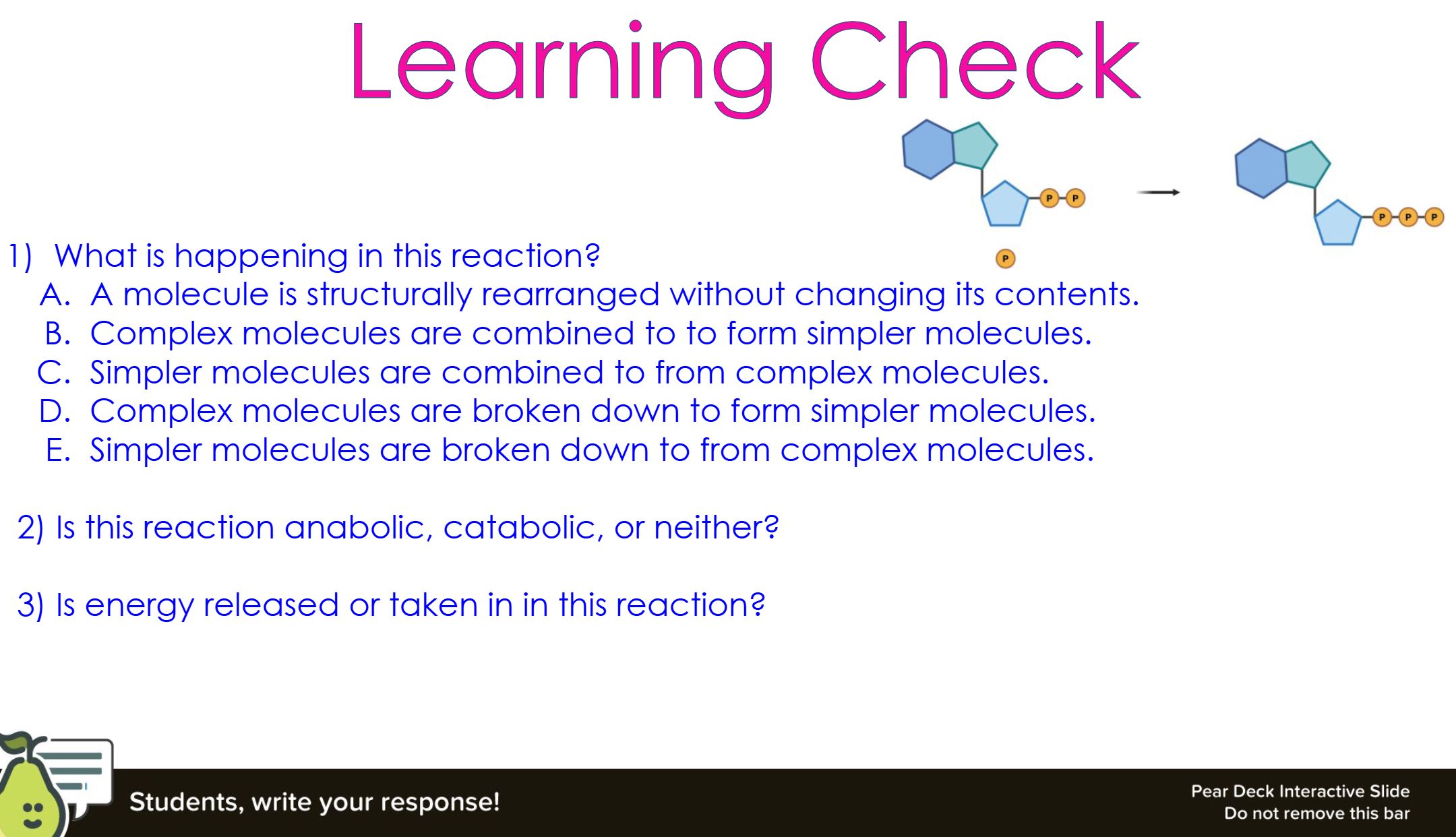
What is happening in this reaction?
A molecule is structurally rearranged without changing its contents.
Complex molecules are combined to to form simpler molecules.
Simpler molecules are combined to from complex molecules.
Complex molecules are broken down to form simpler molecules.
Simpler molecules are broken down to from complex molecules.
22

23
Fill in the Blanks
Is this reaction anabolic, catabolic, or neither?
Type answer...
24

25

26

27
Fill in the Blanks
In a chemical reaction, the substances that are changed during the reaction are called
28
Multiple Choice
Which of the following statements about reactants and products in a chemical reaction is correct?
Reactants are made by a chemical reaction, products are changed during a chemical reaction.
Reactants are changed during a chemical reaction, products are made by a chemical reaction.
Reactants and products are both unchanged during a chemical reaction.
Products are always more complex than reactants.
29
30
Multiple Choice
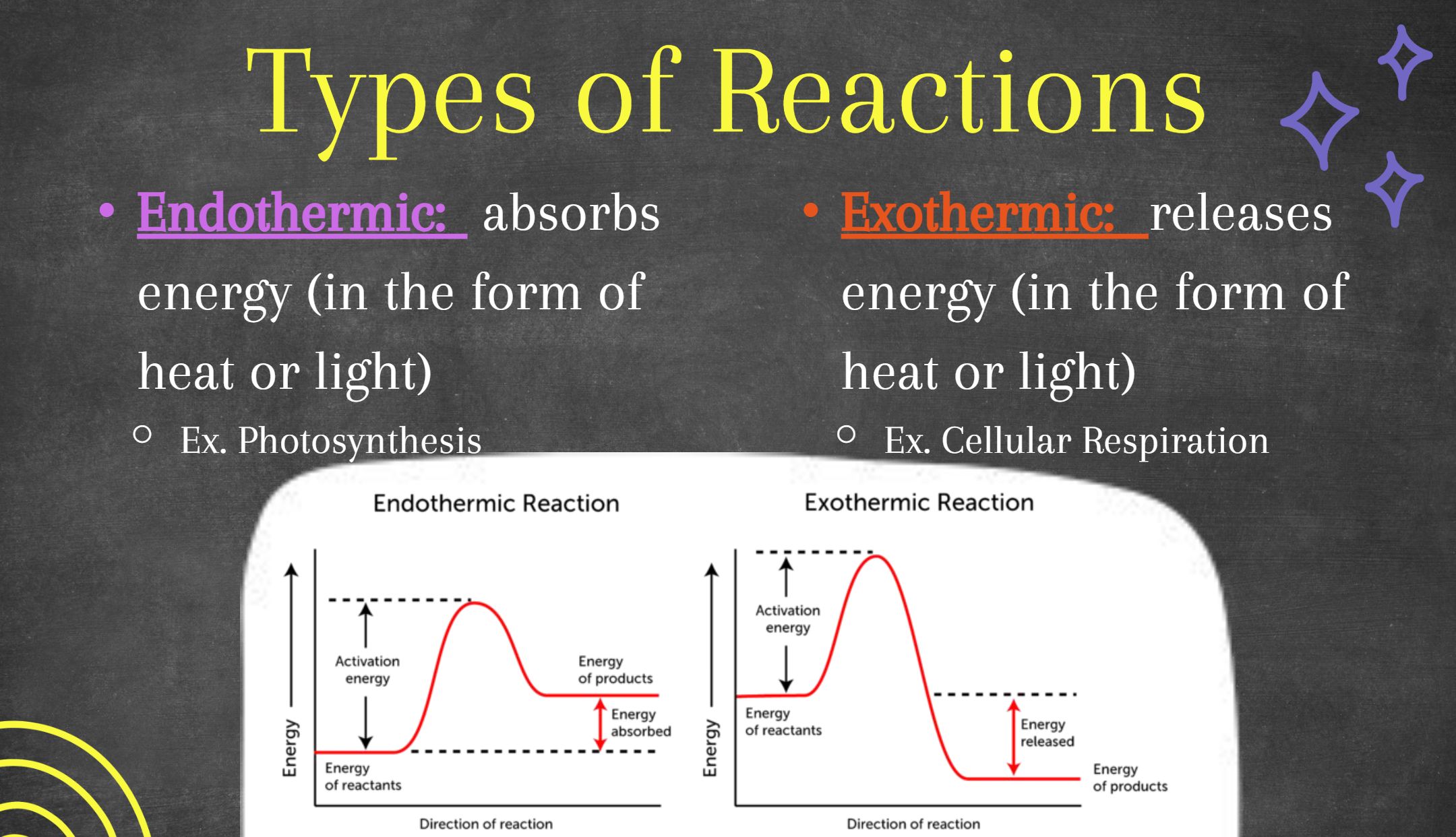
Which of the following best describes an endothermic reaction?
It absorbs energy in the form of heat or light.
It releases energy in the form of heat or light.
It produces only light energy.
It does not involve energy changes.
31
https://www.youtube.com/watch?v=-xgl-S7vH_k
32

33

34

35
Fill in the Blanks
Enzymes are also known as
36
Multiple Choice
Which of the following statements about enzymes is correct?
Enzymes lower the activation energy of biochemical reactions.
Enzymes are permanently altered after a reaction.
Enzymes slow down metabolic reactions.
Enzymes are mostly carbohydrates.
37

38
Multiple Select
Select all statements that are true about enzymes.
Enzymes bind to reactants called substrates.
Enzymes are not changed in a reaction and can be reused.
Enzymes are critical for the regulation of life’s processes.
Enzymes are only found in plants.
39

40
Multiple Choice
Which of the following best describes the specificity of enzymes?
Enzymes can bind to any molecule.
Enzymes have an active site that fits only one specific substrate.
Enzymes can react with multiple substrates at once.
Enzymes do not require a substrate to function.
41

42

43
Multiple Choice
What happens to an enzyme's activity when its active site is deformed due to environmental changes?
The enzyme becomes more active.
The enzyme loses its biological activity.
The enzyme changes its substrate.
The enzyme produces more products.
44
Open Ended
What are some ways you think we denature proteins on a regular basis without even knowing it?
45

46
Fill in the Blanks
Increasing the
47

48
Multiple Select
Which of the following factors can speed up or slow down the rate of a chemical reaction? Select all that apply.
Substrate concentration
Catalysts
Competitive inhibitors
All of the above
49
Multiple Choice
Which of the following is a factor that can influence the speed of a chemical reaction catalyzed by an enzyme?
Temperature
Color of the enzyme
Shape of the container
Amount of light in the room
50
Open Ended
Reflecting on today's lesson about enzymes and biochemical reactions, what is one question you still have or something you would like to learn more about?
51

Show answer
Auto Play
Slide 1 / 51
SLIDE
Similar Resources on Wayground

42 questions
Renewable Forms of Energy
Presentation
•
9th Grade
43 questions
Cell Transport
Presentation
•
9th Grade
44 questions
Major Cell Organelles-Eukaryotic Cells
Presentation
•
10th Grade
46 questions
13.2 The Structure of DNA
Presentation
•
9th Grade
43 questions
Intro Ecology
Presentation
•
9th Grade
43 questions
Cell Transport and Homeostasis Lesson
Presentation
•
9th Grade
42 questions
13.3 DNA Replication
Presentation
•
9th Grade
42 questions
Enzymes lesson
Presentation
•
9th Grade
Popular Resources on Wayground
10 questions
Safety Day 2026 – Student Review

Quiz
•
9th Grade
21 questions
Continents and Oceans
Quiz
•
6th Grade
20 questions
Parts of Speech
Quiz
•
5th Grade
16 questions
Subject & Predicate
Quiz
•
5th Grade
25 questions
Multiplication Facts
Quiz
•
5th Grade
12 questions
Map Skills
Quiz
•
3rd Grade
22 questions
Continents and Oceans
Quiz
•
5th Grade
15 questions
Rounding Decimals
Quiz
•
5th Grade
Discover more resources for Biology
20 questions
Cell Transport
Quiz
•
9th - 12th Grade
25 questions
photosynthesis and cellular respiration
Quiz
•
9th Grade
20 questions
Cell Cycle
Quiz
•
9th Grade
8 questions
DNA vs. RNA
Presentation
•
9th - 12th Grade
14 questions
Ecological Succession: Primary and Secondary
Quiz
•
9th Grade
20 questions
Characteristics of Life
Quiz
•
9th - 10th Grade
12 questions
Cell Cycle
Quiz
•
9th Grade
20 questions
Cell Organelles
Quiz
•
9th Grade