

iCivics Political Parties

Presentation
•
Social Studies
•
9th Grade
•
Practice Problem
•
Easy

Cyndy Harrison
Used 3+ times
FREE Resource
15 Slides • 23 Questions
1
2
3
Open Ended
Why do you think political parties play an important role in a democracy like the United States?
4
Open Ended
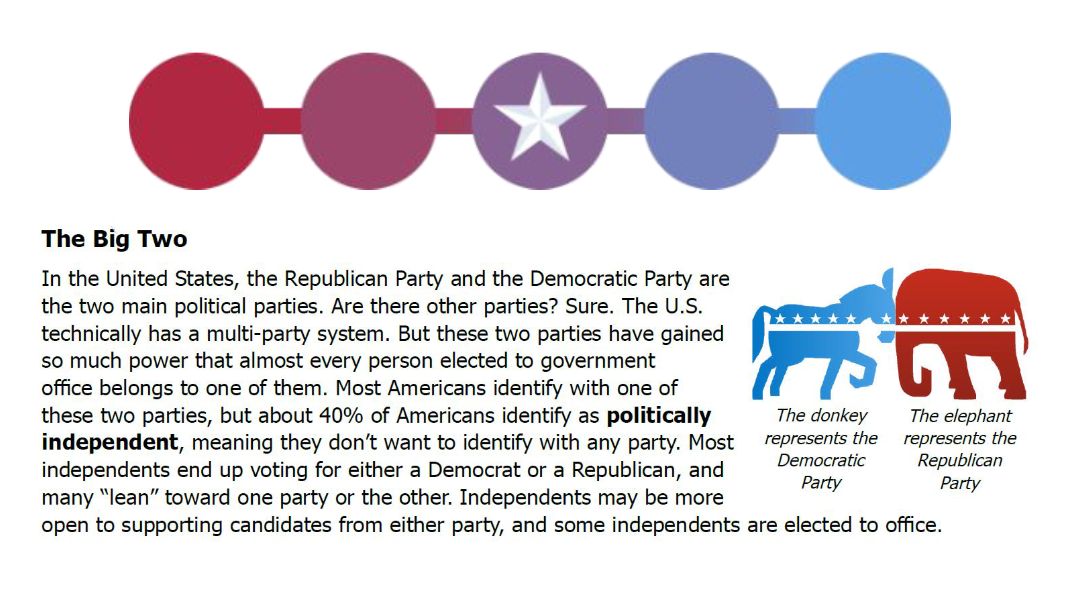
What are the two major political parties in the United States?
5
6
Multiple Choice
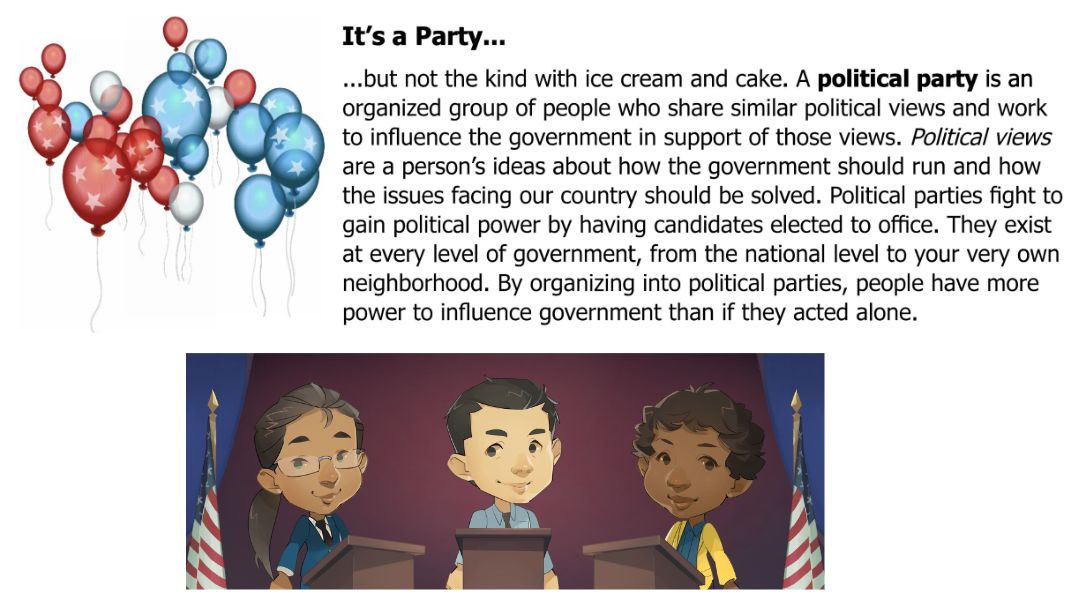
Which of the following best describes a political party?
A group of people who share similar political views and work to influence the government
A group of people who organize parties with ice cream and cake
A group of people who only vote in local elections
A group of people who avoid discussing government issues
7
8
Multiple Choice
Which of the following are symbols for the two major political parties in the United States?
Donkey and Elephant
Lion and Tiger
Bear and Eagle
Horse and Mule
9
Fill in the Blanks
According to the text, about
10
Multiple Choice
The United States has a two-party system.
True
False
11
12
Open Ended
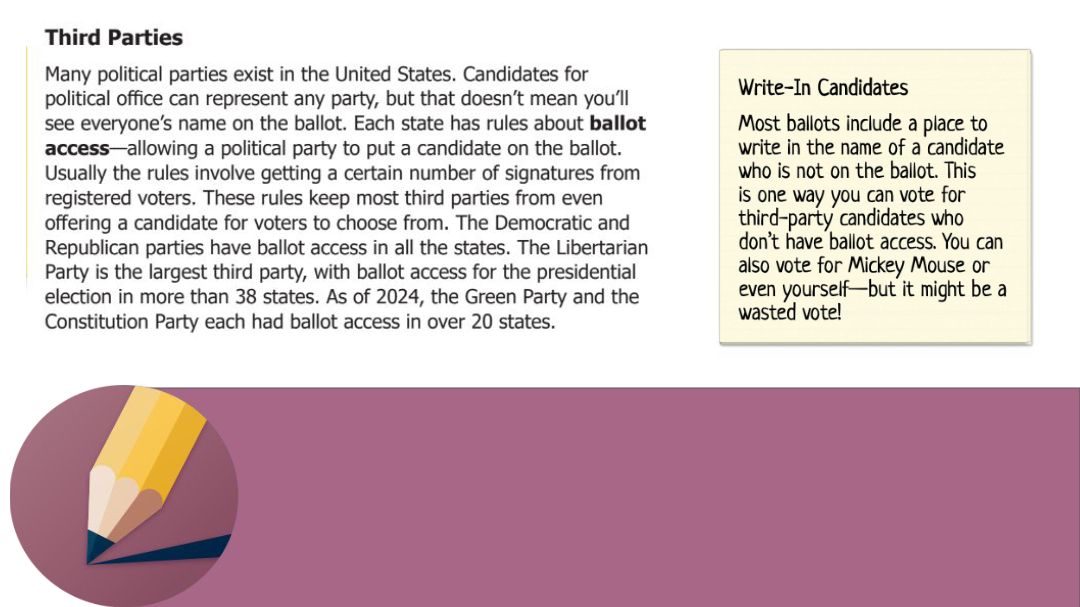
What challenges do third parties face in gaining ballot access in the United States?
13
14
Open Ended
Why do you think states have rules about ballot access? Can you think of any ways in which these rules might be unfair?
15
16
Multiple Choice
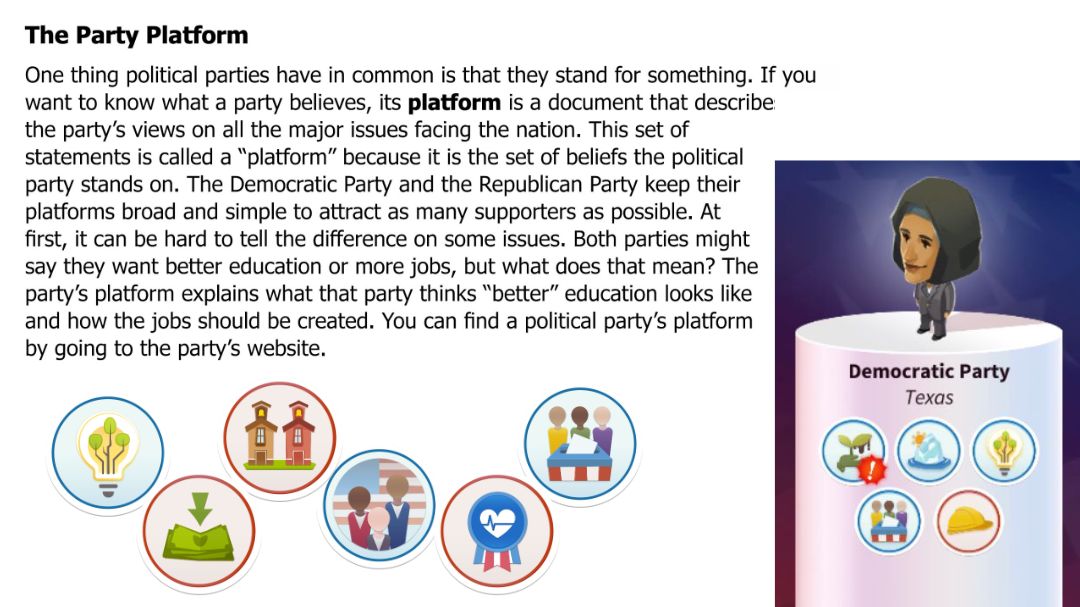
Which document describes a political party's views on major issues facing the nation?
Platform
Constitution
Manifesto
Bill
17
18
Multiple Select
What are some ways political parties support their candidates during an election season? Select all that apply.
Raising money
Educating voters
Urging people to vote
Ignoring candidates
19
Fill in the Blanks
Political parties work at all levels of government—national, state, and local. Fill in the blank: Political parties work at the
20
21
Open Ended
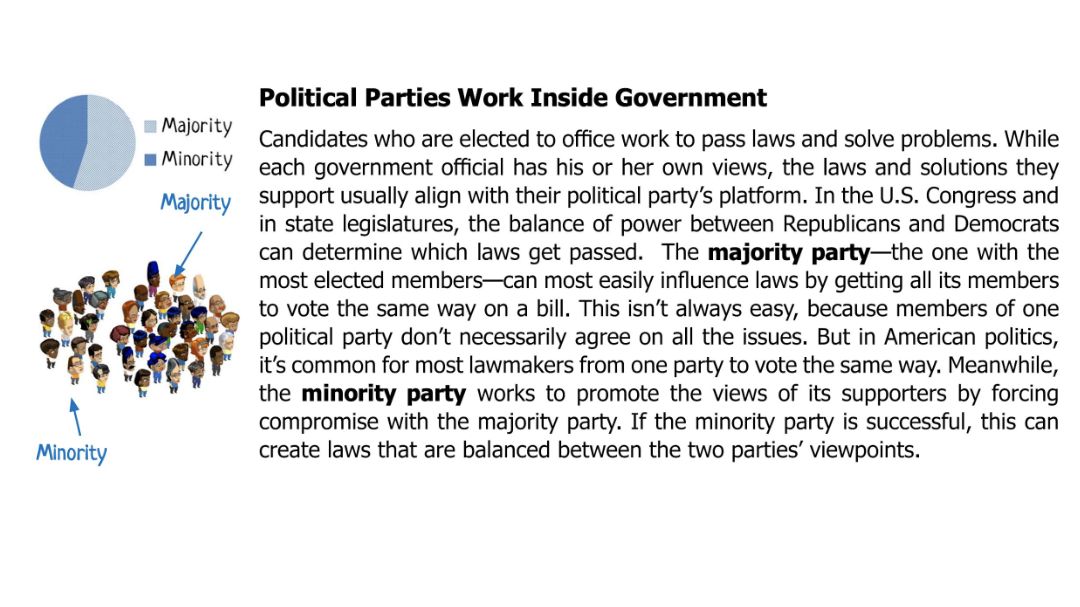
Explain the difference between a majority party and a minority party in the U.S. Congress or state legislatures.
22
Multiple Choice
In the U.S. Congress and most state legislatures, Republicans and Democrats are split into a majority party and a minority party. Is this statement true or false?
True
False
23
24
Multiple Choice
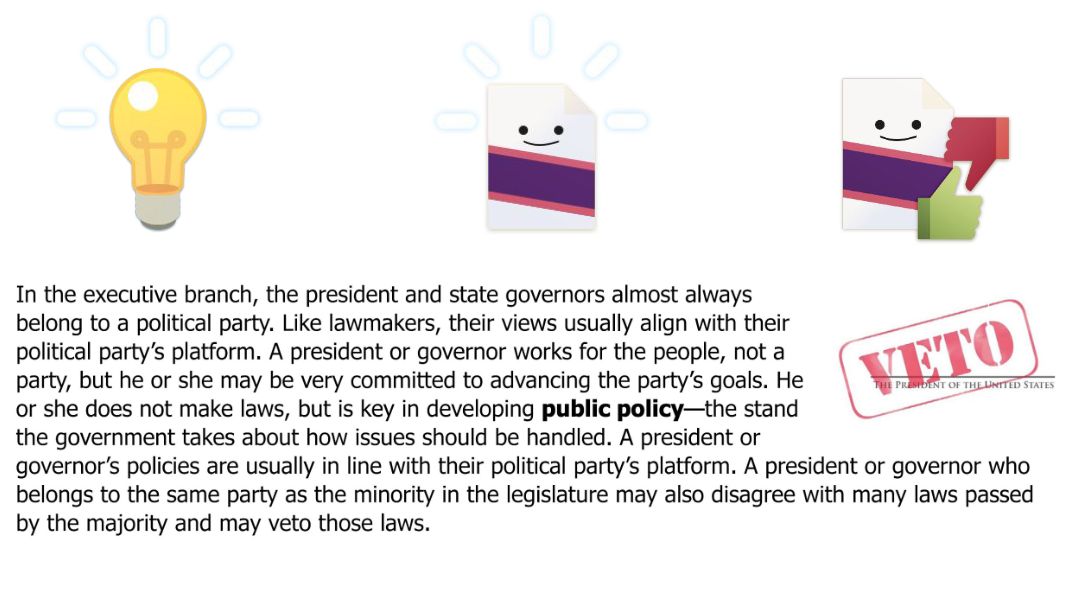
How does the political party affiliation of a president or governor influence the development of public policy?
It has no influence on public policy.
It usually aligns with the party's platform and goals.
It only influences foreign policy.
It prevents the president or governor from vetoing laws.
25
26
Multiple Choice
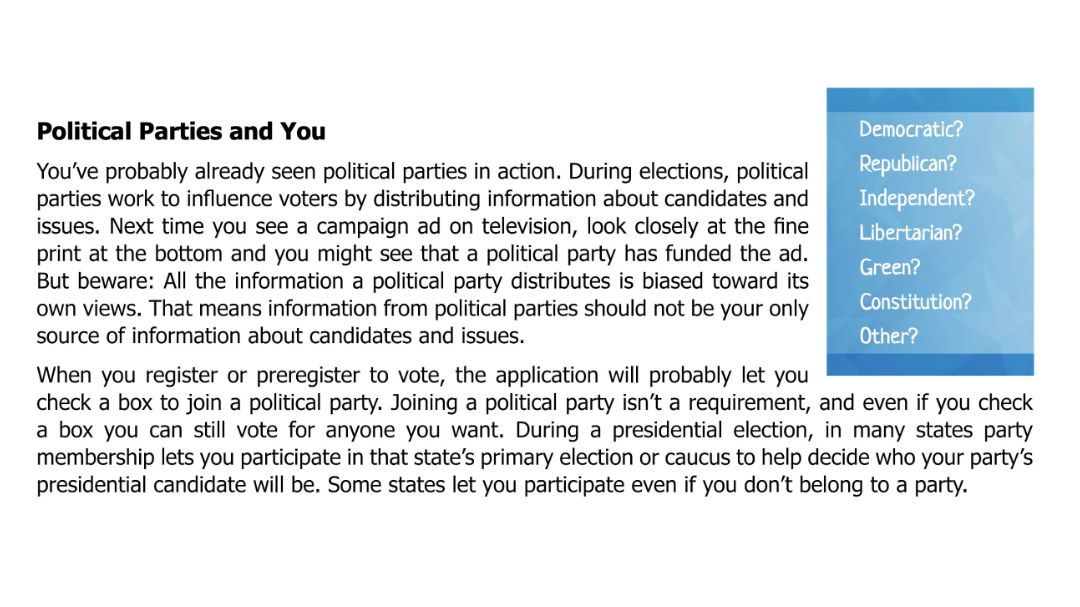
Which of the following statements about joining a political party is correct?
You must join a political party to vote.
Joining a political party is required to participate in all elections.
You can vote for anyone you want even if you join a political party.
You cannot participate in primary elections if you are not a party member.
27
Open Ended
Explain why it is important to consider information from sources other than political parties when learning about candidates and issues.
28
Open Ended
What are some advantages and disadvantages to joining a political party?
29
30
Fill in the Blanks
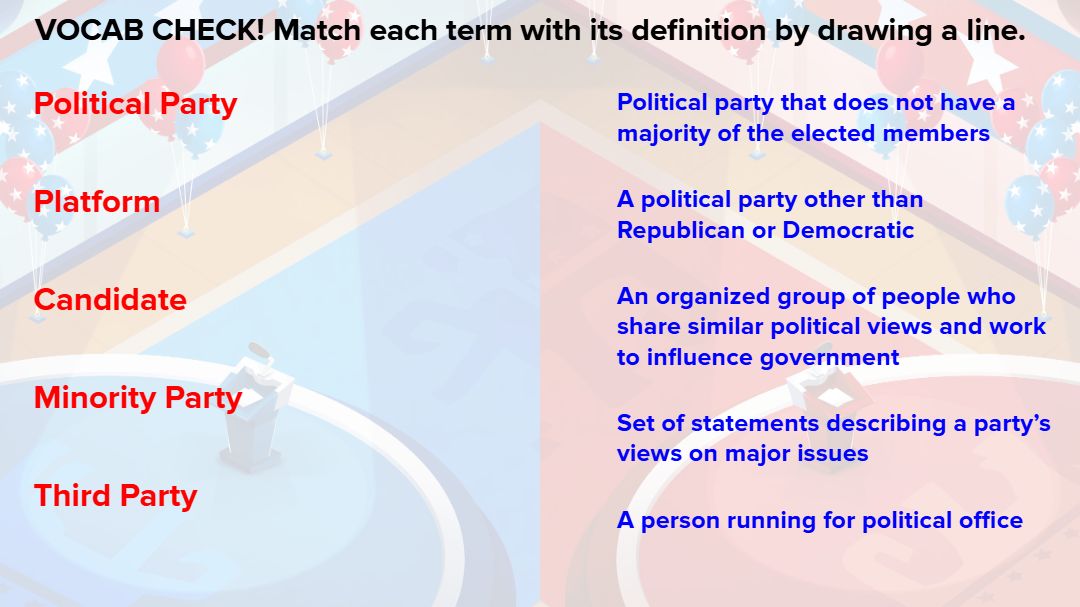
A set of statements describing a party’s views on major issues is called a
31
32
Multiple Choice
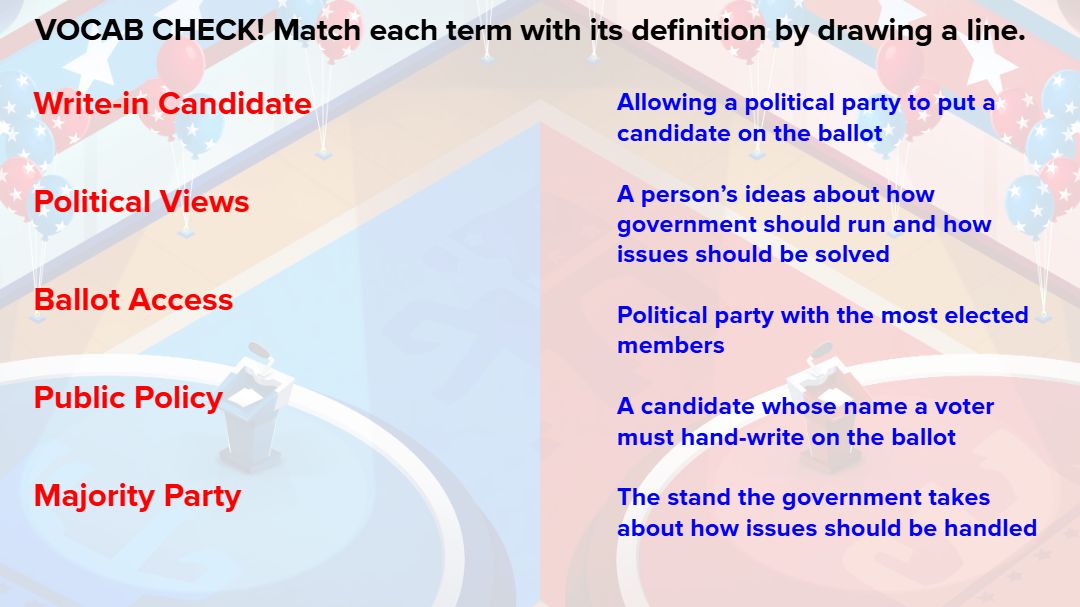
Which of the following are correct definitions for the terms 'Majority Party' and 'Public Policy'?
Majority Party: Political party with the most elected members; Public Policy: The stand the government takes about how issues should be handled.
Majority Party: A political party other than Republican or Democratic; Public Policy: Allowing a political party to put a candidate on the ballot.
Majority Party: A person running for political office; Public Policy: A candidate whose name a voter must hand-write on the ballot.
Majority Party: Set of statements describing a party’s views on major issues; Public Policy: A person’s ideas about how government should run.
33
34
Multiple Choice
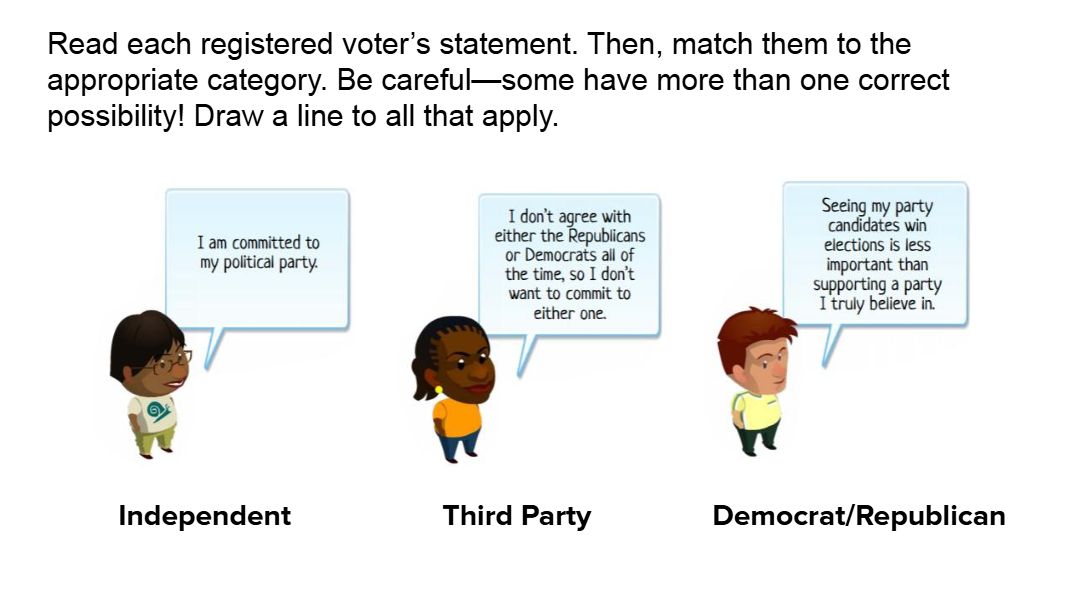
Which voter statement best reflects the perspective of a Third Party supporter?
I am committed to my political party.
I don't agree with either the Republicans or Democrats all of the time, so I don't want to commit to either one.
Seeing my party candidates win elections is less important than supporting a party I truly believe in.
35
Multiple Choice
Based on the statements provided, which voter would most likely identify as an Independent?
I am committed to my political party.
I don't agree with either the Republicans or Democrats all of the time, so I don't want to commit to either one.
Seeing my party candidates win elections is less important than supporting a party I truly believe in.
36
37
Open Ended
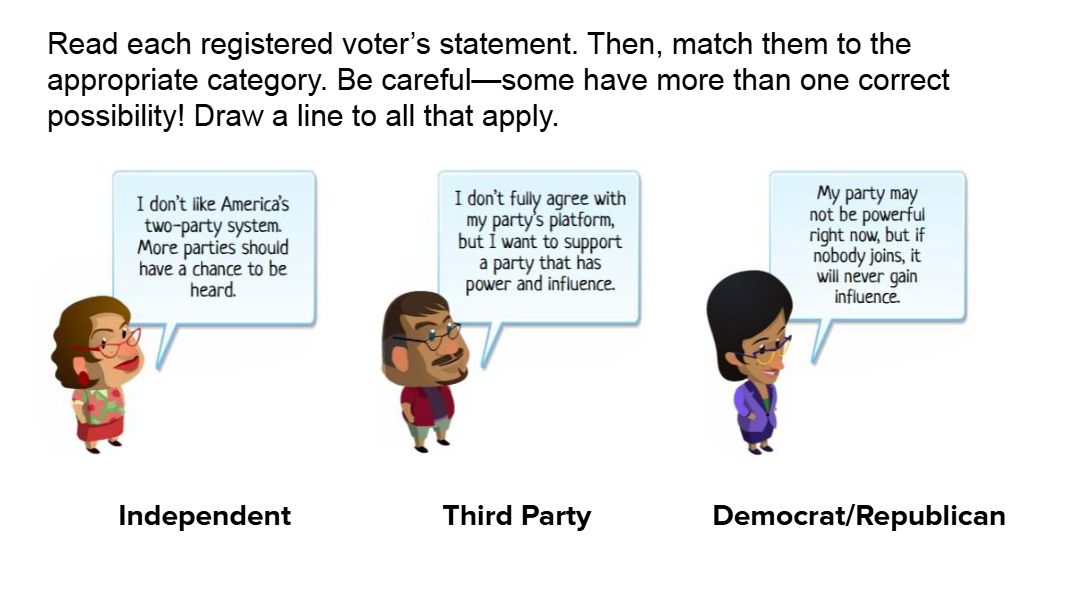
How do the statements from the voters in both images reflect the challenges and motivations for supporting third parties in the U.S. political system?
38
Open Ended
After learning about political parties, what is one question you still have or something you would like to know more about?
Show answer
Auto Play
Slide 1 / 38
SLIDE
Similar Resources on Wayground

35 questions
NC Indian Tribes
Presentation
•
8th Grade
33 questions
NM History Chapter 7 Review
Presentation
•
9th Grade
31 questions
Georgia Local Government
Presentation
•
8th Grade
35 questions
Avancemos 1 Unidad 2 leccion 2
Presentation
•
9th Grade
35 questions
Taxonomy, Three Domains Classwork
Presentation
•
9th Grade
32 questions
Happy First Day! Global 9, September 8th, 2021
Presentation
•
9th Grade
30 questions
Early Middle Ages
Presentation
•
10th Grade
34 questions
World War I
Presentation
•
9th Grade
Popular Resources on Wayground
6 questions
PRIDE Always and Everywhere
Presentation
•
12th Grade
20 questions
Lab Safety Quiz

Quiz
•
6th Grade
26 questions
KOR Review Kahoot Questions
Quiz
•
8th Grade
21 questions
Continents and Oceans
Quiz
•
6th Grade
12 questions
Unit Zero lesson 2 cafeteria
Presentation
•
9th - 12th Grade
20 questions
Parts of Speech
Quiz
•
5th Grade
10 questions
Riddles Riddles fun Riddles
Quiz
•
6th - 12th Grade
16 questions
Subject & Predicate
Quiz
•
5th Grade
Discover more resources for Social Studies
10 questions
Exploring the Age of Exploration: Key Events and Figures

Interactive video
•
6th - 10th Grade
30 questions
AP Human Geography Unit 1
Quiz
•
9th - 12th Grade
10 questions
Exploring Types of Maps for Middle Schoolers
Interactive video
•
6th - 10th Grade
27 questions
MR. DROHAN'S RECONSTRUCTION REVIEW (SY25)
Quiz
•
9th - 12th Grade
10 questions
Exploring Native American Tribes and Culture
Interactive video
•
6th - 10th Grade
22 questions
American Revolution Review
Quiz
•
9th - 12th Grade
32 questions
Unit 1A Review for Test
Quiz
•
9th Grade
22 questions
U.S. History Unit 1 - Revolutionary Advancement and Change
Quiz
•
9th - 12th Grade