
Biotech - Bacteria

Presentation
•
Science
•
8th Grade
•
Practice Problem
•
Easy

Neil Campos
Used 1+ times
FREE Resource
31 Slides • 26 Questions
1

2
3
4
5
6
7
8
Multiple Choice
Which of the following is NOT a characteristic of prokaryotic cells?
They have no organelles
Most possess peptidoglycan in their cell wall
Protein synthesis occurs in the cytosol
They have a nucleus
9
Multiple Choice
Which of the following statements best describes bacteria?
They are the most abundant and diversified group of micro-organisms on Earth, adapted for different living conditions.
They are only found in extreme environments.
They are all harmful to humans.
They can only survive in the absence of oxygen.
10
Multiple Choice
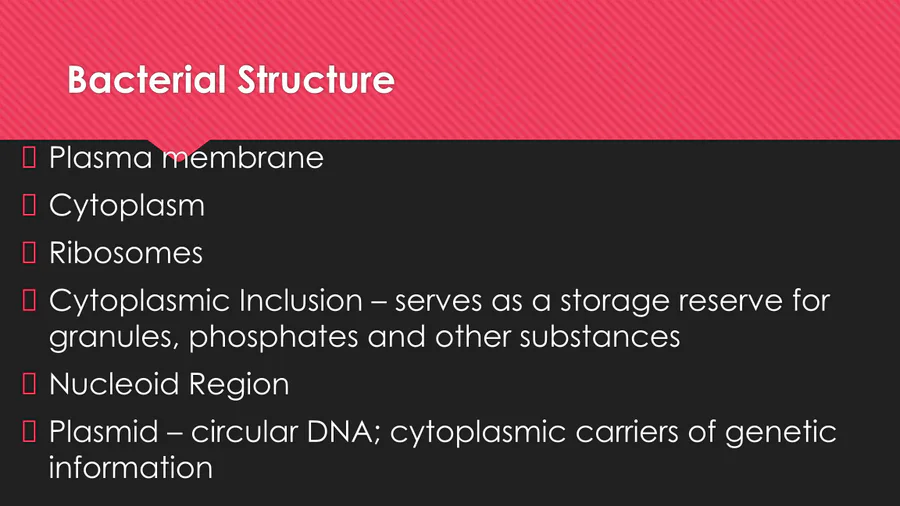
Circular DNA of Bacteria
chromatin
capsule
plasmid
pili
11
Multiple Choice
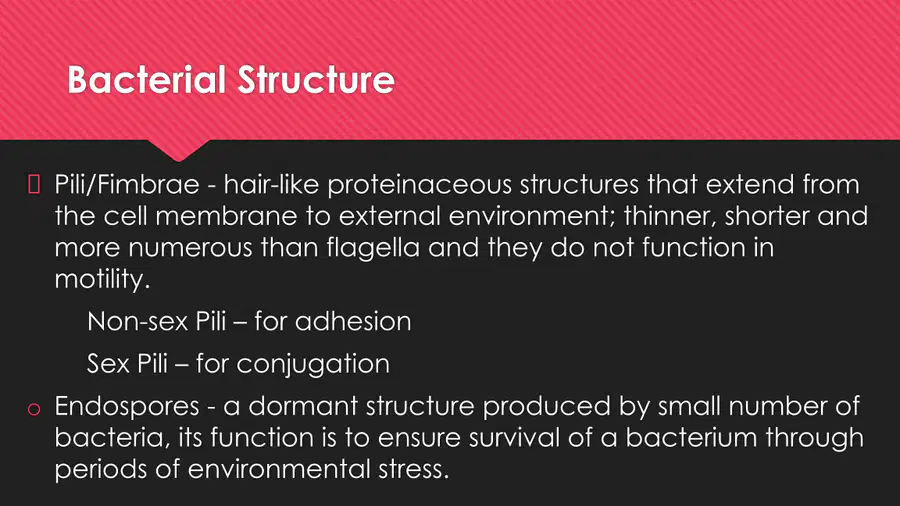
Hair-like structure used for adhesion and bacterial conjugation
flagella
capsule
pili
plasmid
12
Multiple Choice
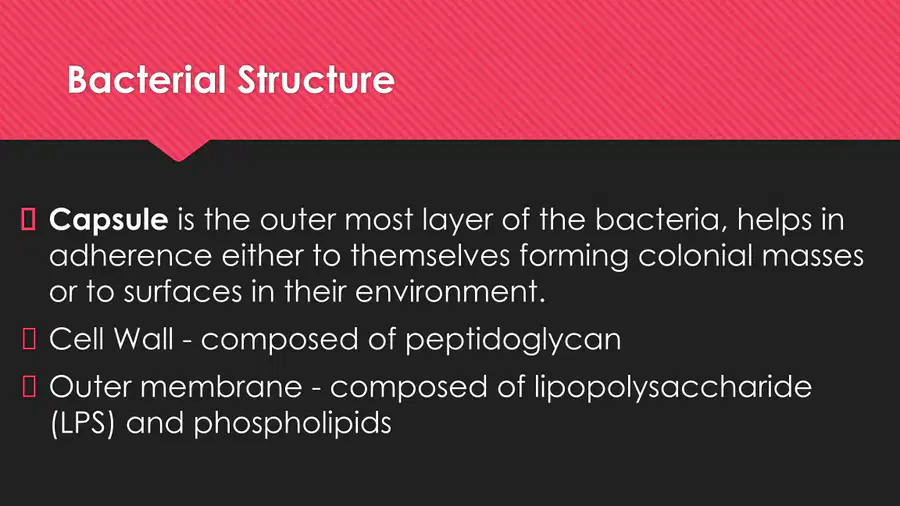
Which bacterial structure is responsible for adherence to surfaces and forming colonies?
Capsule
Cell wall
Plasma membrane
Flagella
13
Multiple Choice
Bacterial structure responsible for motility
capsule
plasmid
pili
flagella
14
Fill in the Blanks
Fill in the blank: Endospores are produced by bacteria to ensure survival during periods of environmental
15
16
Multiple Choice
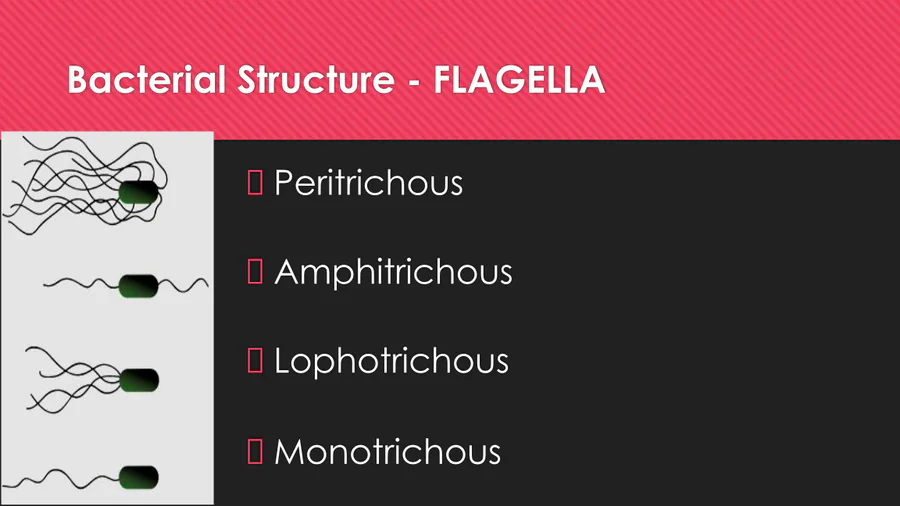
Surrounded by lateral flagella
lophotrichous
amphitrichous
monotrichous
peritrichous
17
Multiple Choice
A cluster of flagella on one polar end
lophotrichous
amphitrichous
monotrichous
peritrichous
18
Multiple Choice
Single or cluster on both polar end
lophotrichous
amphitrichous
monotrichous
peritrichous
19

20

21
22

23
24
25
Multiple Choice
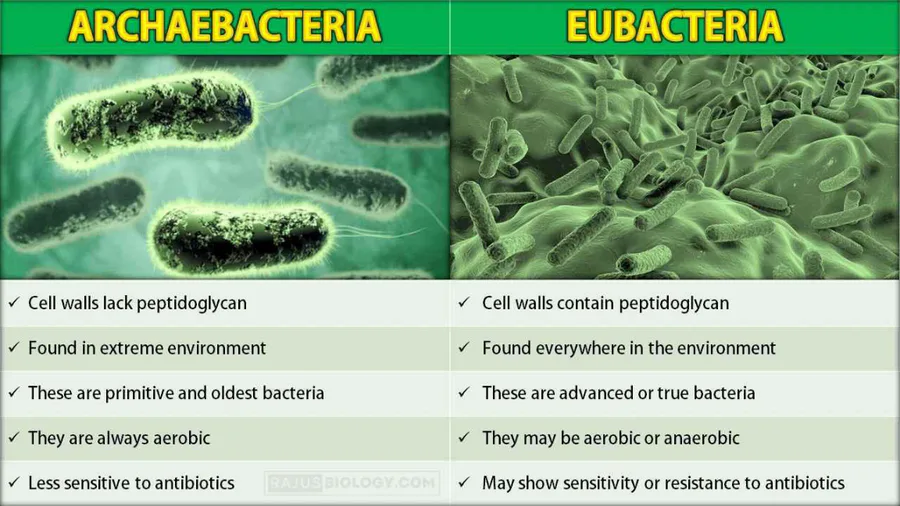
Which of the following is a key difference between archaebacteria and eubacteria?
Archaebacteria have cell walls containing peptidoglycan, while eubacteria do not.
Eubacteria are always found in extreme environments, while archaebacteria are not.
Archaebacteria are less sensitive to antibiotics, while eubacteria may show sensitivity or resistance.
Eubacteria are always aerobic, while archaebacteria may be aerobic or anaerobic.
26
Multiple Choice
Ensure survival of a bacterium through periods of environmental stress
endospores
protoplast
vibrio
coccus
27
Multiple Choice
Comma shaped bacteria
coccus
bacillus
vibrio
endospores
28
Multiple Choice
Rod shaped bacteria
coccus
vibrio
spirochete
bacillus
29
Multiple Choice
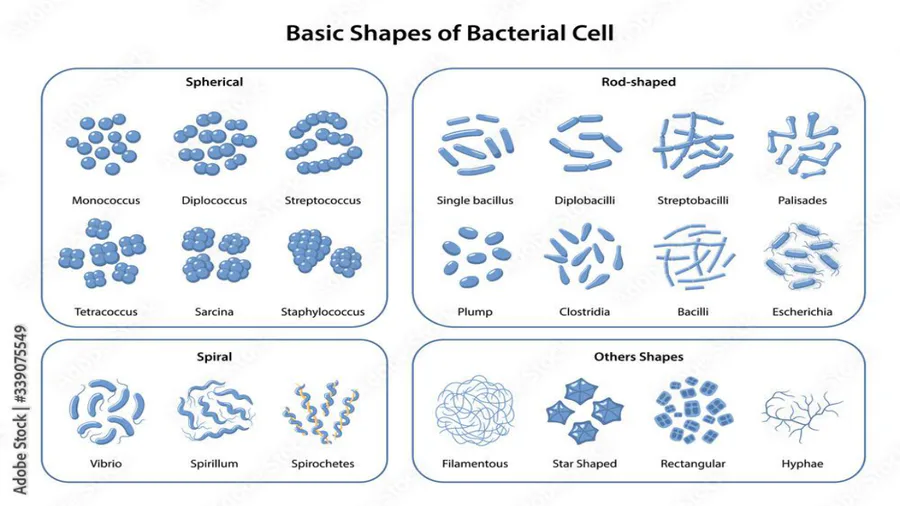
Which of the following are considered basic shapes of bacterial cells?
Cocci, Bacilli, Spirilla
Cocci, Bacilli, Amoeba
Cocci, Bacilli, Paramecium
Cocci, Bacilli, Sarcina
30
Multiple Choice
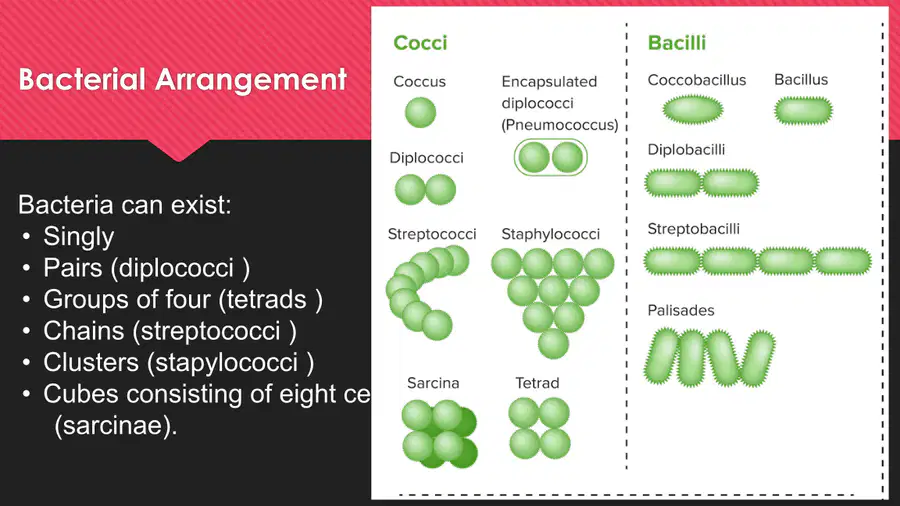
Which of the following is NOT a way bacteria can be arranged?
Singly
Pairs
Clusters
Filaments
31

32

33
34
35
36
Multiple Choice
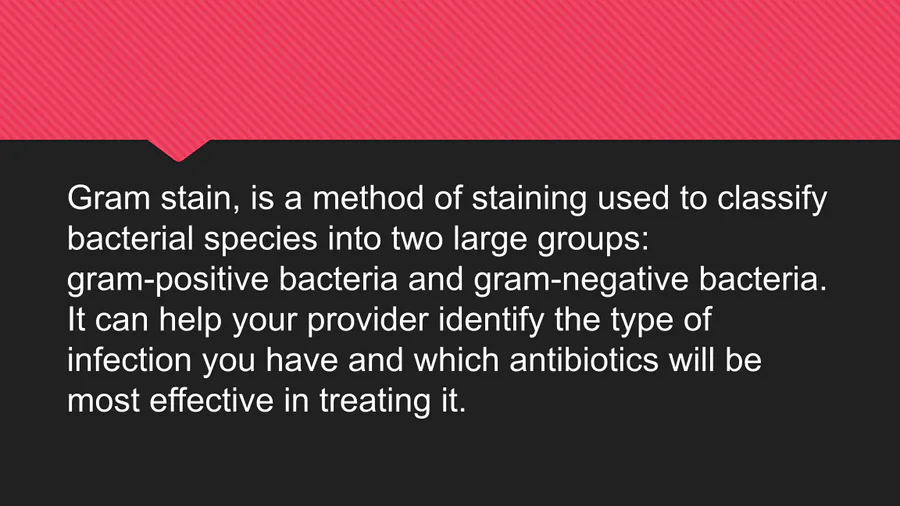
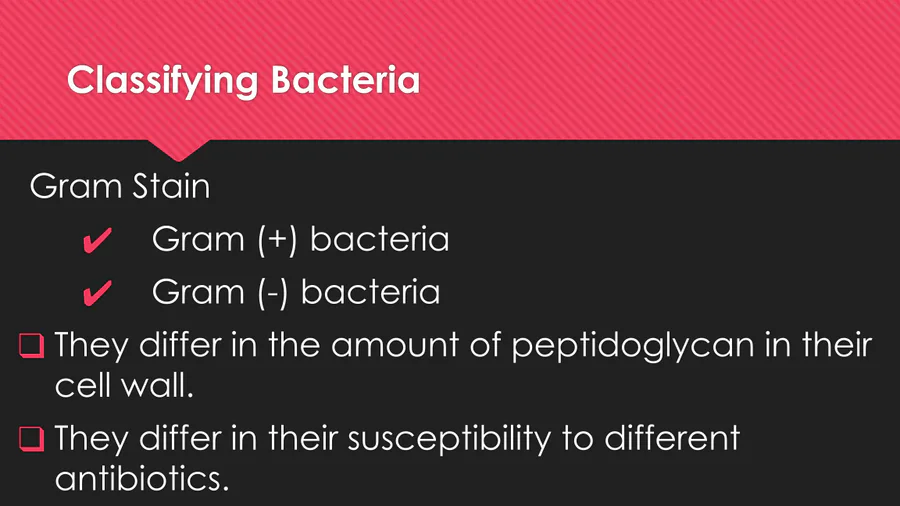
Who introduced the Gram staining technique and in what year?
Louis Pasteur in 1875
Hans Christian Gram in 1882
Robert Koch in 1890
Alexander Fleming in 1928
37
Fill in the Blanks
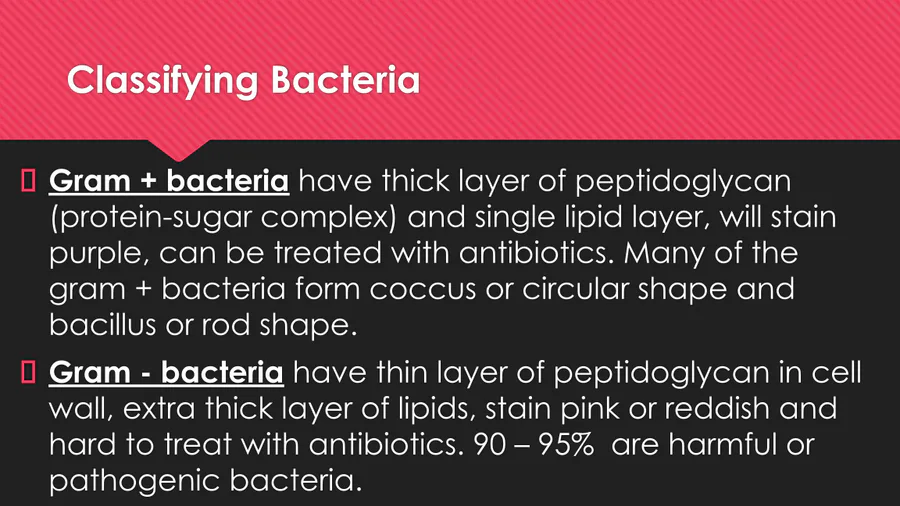
Gram-positive bacteria have a thick layer of
38
Multiple Choice
Gram-negative bacteria have thick layer of ____
peptidoglycan
lipids
proteins
lipopolysaccharide
39
40
41
42
43
Multiple Choice
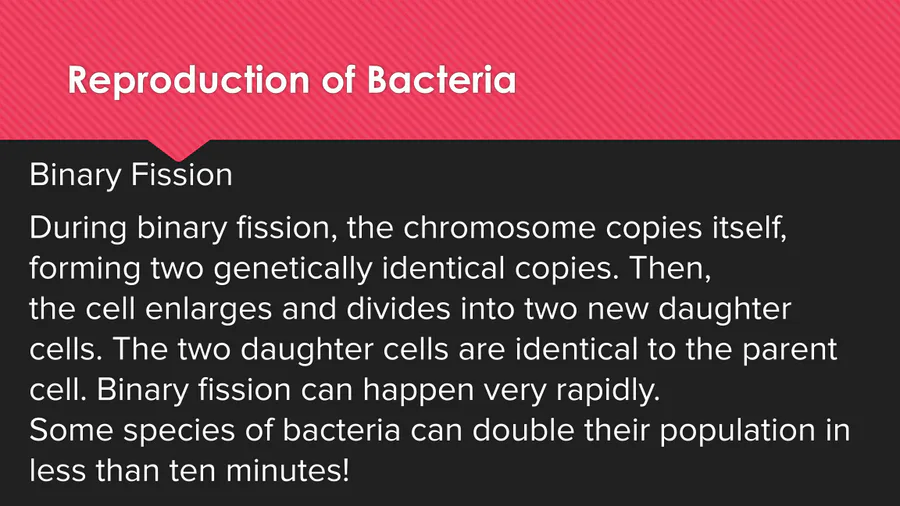
Which process allows bacteria to reproduce rapidly, resulting in two genetically identical daughter cells?
Binary fission
Conjugation
Transformation
Transduction
44
Multiple Select
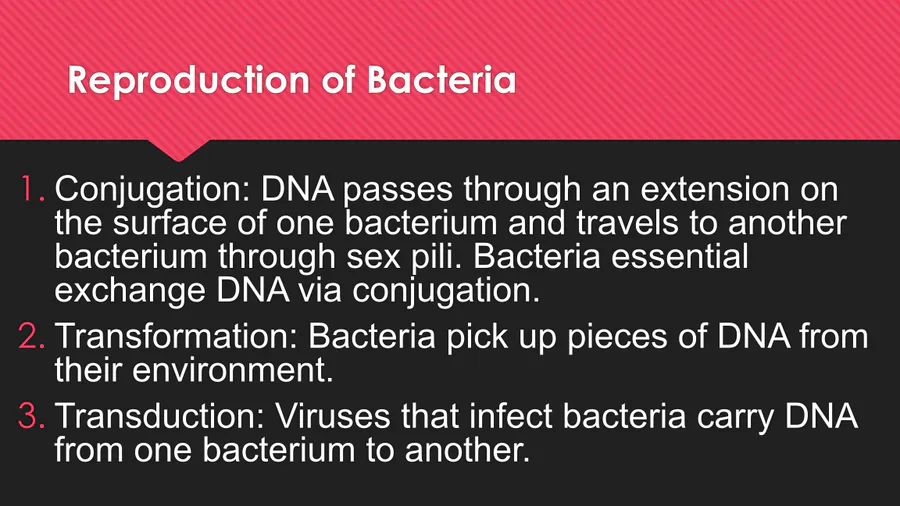
Which of the following is not a method of acquiring new DNA for bacteria?
Conjugation
Transformation
Transduction
Binary fission
45
46
Multiple Choice
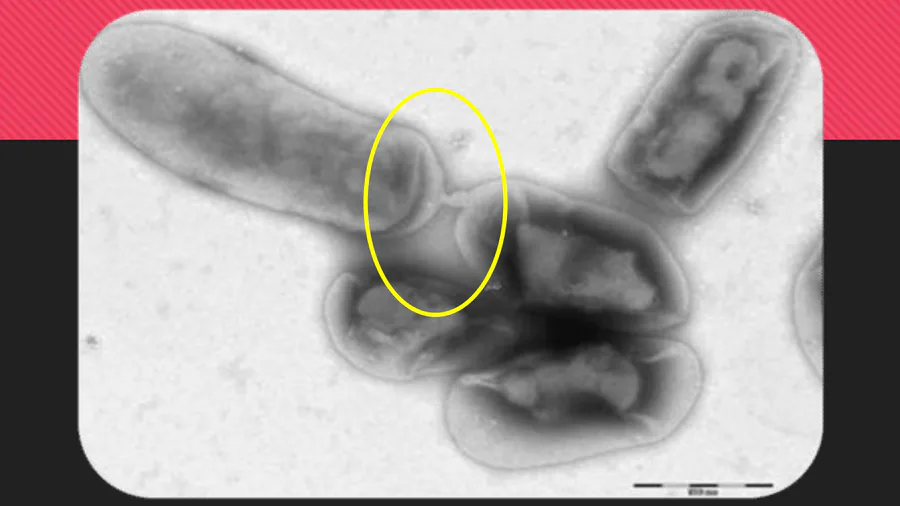
The image shows two bacteria connected by a structure. This structure is most likely involved in which process?
Conjugation
Binary fission
Transformation
Transduction
47

48
49
50
51
52
53
54
Multiple Choice
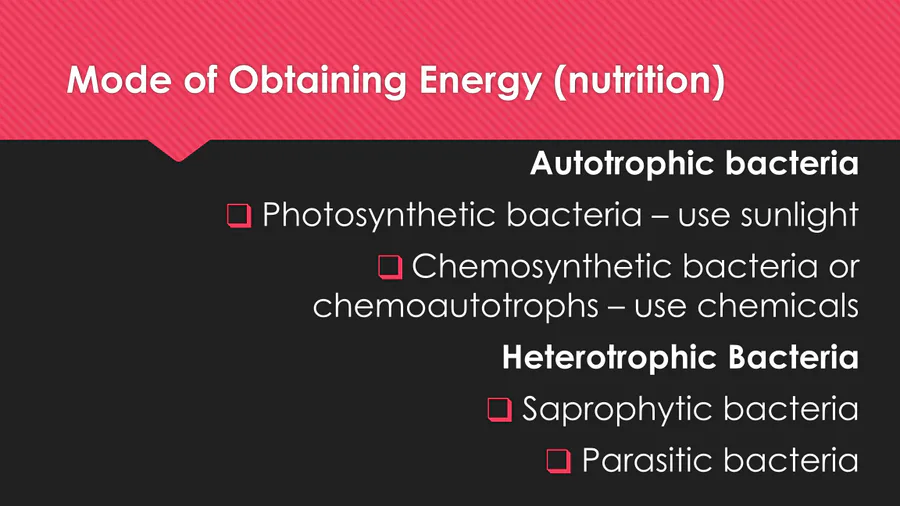
Bacteria can adapt to different living conditions. Which of the following is NOT a type of adaptation mentioned in the lesson?
Thermophilic chemosynthetic autotrophs
Photosynthetic autotrophs
Parasitic fungi
Differently shaped micro-organisms
55
Multiple Choice
Bacteria that obtain food from tissues of living organisms
photosynthetic
parasitic
saprophytic
chemosynthetic
56
Multiple Choice
Bacteria that obtain food from oxidation of certain inorganic chemicals
photosynthetic
parasitic
saprophytic
chemosynthetic
57
Multiple Choice
Bacteria that obtain food from dead organic decaying substances
photosynthetic
parasitic
saprophytic
chemosynthetic
Show answer
Auto Play
Slide 1 / 57
SLIDE
Similar Resources on Wayground

57 questions
Biology - Units 3 and 4 Review
Presentation
•
9th - 10th Grade
52 questions
Cell Membrane
Presentation
•
9th - 10th Grade
53 questions
SCIENCE 6 Nitrogen Cycle and Water cycle
Presentation
•
6th Grade
49 questions
Lesson 4: Interaction
Presentation
•
8th Grade
55 questions
Plant and animal cells
Presentation
•
8th Grade
47 questions
The Cell thoery
Presentation
•
6th - 8th Grade
60 questions
Spheres, Layers, Rocks
Presentation
•
8th Grade
Popular Resources on Wayground
10 questions
Impact of 9/11 and the War on Terror

Interactive video
•
10th - 12th Grade
21 questions
Continents and Oceans

Quiz
•
6th Grade
5 questions
9/11
Interactive video
•
9th Grade
20 questions
Parts of Speech
Quiz
•
5th Grade
16 questions
Subject & Predicate
Quiz
•
5th Grade
10 questions
Riddles Riddles fun Riddles
Quiz
•
6th - 12th Grade
21 questions
Lab Safety
Quiz
•
10th Grade
6 questions
PRIDE in the Hallways and Bathrooms
Presentation
•
12th Grade
Discover more resources for Science
20 questions
Lab Safety
Quiz
•
5th - 8th Grade
20 questions
Scientific Method and Variables
Quiz
•
8th Grade
20 questions
Scientific method and variables
Quiz
•
8th Grade
27 questions
Counting Atoms - Subscripts
Quiz
•
8th Grade
22 questions
Scientific Method and Variables
Quiz
•
8th Grade
20 questions
Claim, Evidence and Reasoning (CER)
Quiz
•
6th - 8th Grade
18 questions
Counting Atoms
Quiz
•
7th - 8th Grade
20 questions
Elements, Compounds and Mixtures
Quiz
•
8th Grade