Search Header Logo
  1. Resource Library
  2. Science
  3. Earth & Space Science
  4. Eclipses
  5. Eclipses
Eclipses

Eclipses

Assessment

Presentation

•

Science

•

8th Grade

•

Practice Problem

•

Easy

•
NGSS
MS-ESS1-1

Standards-aligned

Created by

Amy Kramer

Used 10+ times

FREE Resource

14 Slides • 12 Questions

1

Eclipses
media
media

2

media
media

3

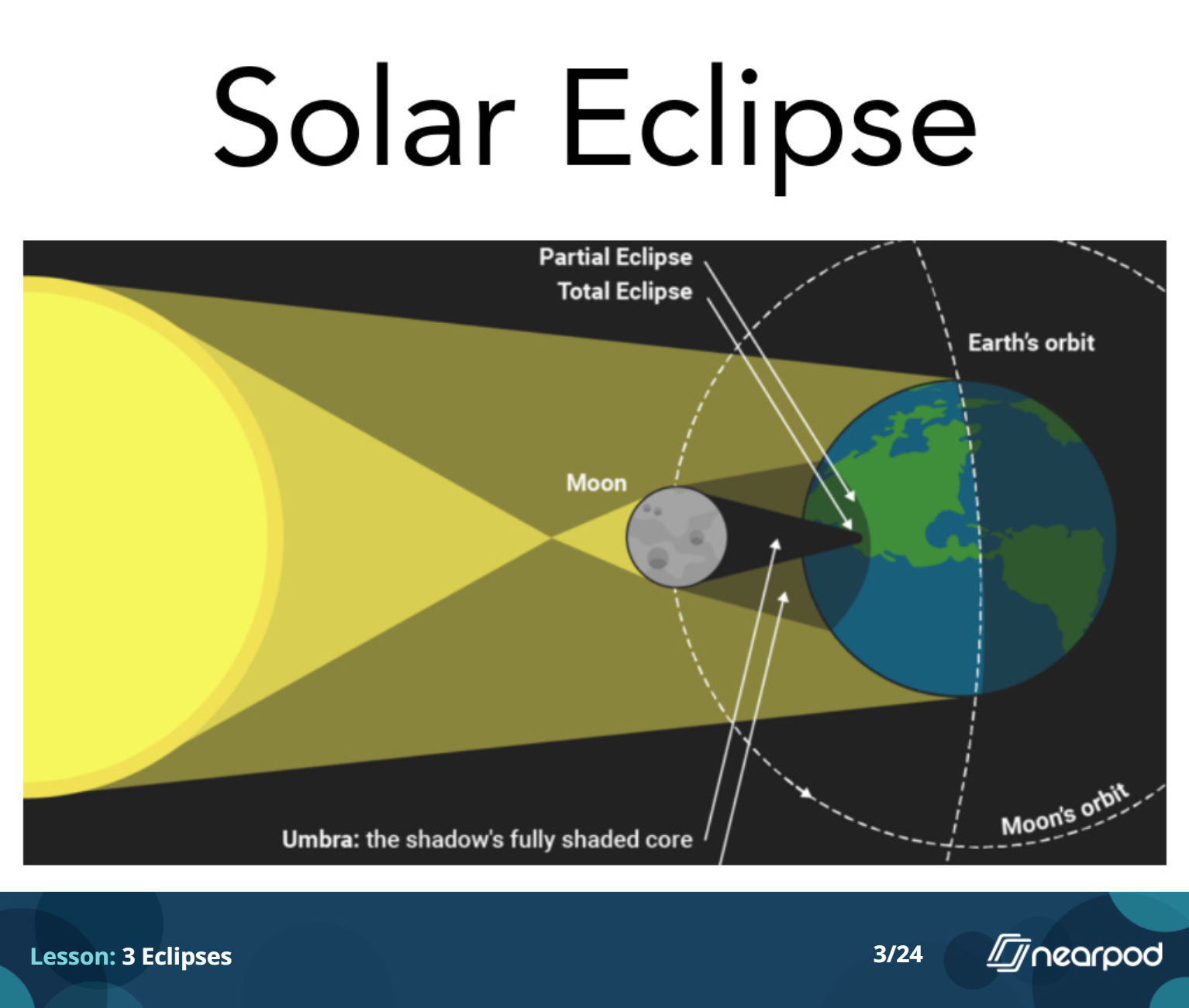
Solar Eclipse

A SOLAR ECLIPSE happens when the

 MOON casts a shadow on the EARTH.


This happens when the MOON moves BETWEEN the SUN and the EARTH


media
media

4

Solar Eclipse

A Solar Eclipse can only occur during the 

NEW Moon Phase.

The MOON is SMALLER than the EARTH so the shadow where you can see a total solar eclipse is only seen by people in a small area.

media
media

5

Multiple Choice

Question image

Why can a solar eclipse only happen during the new moon?

1

Because the moon is closest to Earth during the new moon

2

Because the moon passes directly between the sun and Earth

3

Because the sun is at its brightest during the new moon

6

MODEL the Solar Eclipse

​Shine the Flashlight on the Earth and move the moon into a position to make a shadow on the Earth:

media

7

Draw

Draw the Moon as it appears in a SOLAR ECLIPSE in the picture to the left (and on your worksheet)

8

Multiple Choice

Question image

Which of the following best explains why we don't see solar eclipses often?

1

The Moon's shadow is small

2

The Sun is too far away

3

The Moon is always in front of the Sun

9

media
media
media
When do Solar Eclipses occur?

10

Multiple Choice

Question image

Why don't eclipses happen every month, even though the Moon orbits the Earth every month.

1

They don't happen when the moon is farther away

2

The moon is on a tilted orbit

3

They only happen in winter

11

media

12

13

​Lunar Eclipse
media

14

Lunar Eclipse

A LUNAR ECLIPSE happens when the

 EARTH casts a shadow on the MOON.


This happens when the EARTH moves BETWEEN the SUN and the MOON.


media
media

15

Fill in the Blanks

media image

A lunar eclipse can occur only on the night of a

moon.

16

Lunar Eclipse

A Lunar Eclipse can only occur during the FULL Moon Phase.

A total lunar eclipse occurs when the Moon passes completely into the darkest part of Earth's shadow (called the UMBRA). A partial lunar eclipse happens when only a portion of the Moon enters the umbra, leaving the rest of the Moon visible in the Earth's fainter penumbra

media
media

17

MODEL the Lunar Eclipse

​Shine the Flashlight on the Earth and move the moon into a position to hide it in Earth's shadow:

media

18

Draw

Draw the Moon as it appears in a LUNAR ECLIPSE in the picture to the left (and on your worksheet)

19

Multiple Select

Question image

Select all the conditions that must be met for a lunar eclipse to occur.

1

The Moon must be full

2

The Sun, Earth, and Moon must be in a straight line

3

The Moon must be between the Sun and Earth

20

When do Lunar Eclipses occur?

​They happen 2 to 5 times every year with a TOTAL Lunar Eclipse happening every 18 months (1.5 years).

During a Lunar Eclipse the Moon turns red because of Earthshine.

media

21

22

Multiple Choice

Which celestial body moves between the Sun and the Moon during a lunar eclipse?

1

Earth

2

Moon

3

Sun

4

Mars

23

Multiple Choice

What is a solar eclipse?

1

When the Earth moves in between the Moon and the Sun and casts a shadow on the Moon.

2

When the Moon moves in between the Sun and the Earth and casts a shadow on the Earth.

3

When the Sun moves in between the Earth and the Moon and casts a shadow on the Moon.

24

Multiple Choice

What is a lunar eclipse?

1

Earth moves in between the Moon and the Sun and casts a shadow on the Moon.

2

Moon moves between the Sun and the Earth and casts a shadow on the Earth.

3

Sun moves between the Earth and the Moon and casts a shadow on the Moon.

25

Multiple Choice

Which of the following moon phases could you see a solar eclipse?

1

Full Moon

2

New Moon

3

First and Third Quarters

4

Waxing Crescent

26

Multiple Choice

Which of the following moon phases could you see a Lunar eclipse?

1

Full Moon

2

New Moon

3

First and Third Quarters

4

Waxing Crescent

pattern-tertiary
Eclipses
media
media

Show answer

Auto Play

Slide 1 / 26

SLIDE