

Standard 5 Review ALL - Ecology

Presentation
•
Biology
•
9th - 12th Grade
•
Medium
+20
Standards-aligned

James Franks
Used 1+ times
FREE Resource
51 Slides • 95 Questions
1
Standard 5.1, 5.4, 5.5, 5.6 - Basic Review 1
Organisms and their Environment
Ecological organization
organism, population, community, ecosystem, biome, biosphere
Coevolution and ecological relationships
herbivory, predation, competition, cooperation, mutualism, commensalism, parasitism, mimicry
Energy flow and matter
Food chains, webs, pyramids
Population Growth Patterns
Exponential and logistic growth, carrying capacity, density dependent and independent limiting factors
Interdependence
2
BIO.5.1 Illustrate levels of ecological hierarchy, including organism, population, community, ecosystem, biome, and biosphere.
BIO.5.4 Develop and use models to describe the flow of energy and amount of biomass through food chains, food webs, and food pyramids.
BIO.5.5 Evaluate symbiotic relationships (e.g., mutualism, parasitism, and commensalism) and other coevolutionary (e.g., predator-prey, cooperation, competition, and mimicry) relationships within specific environments.
BIO.5.6 Analyze and interpret population data, both density-dependent and density-independent, to define limiting factors. Use graphical representations (growth curves) to illustrate the carrying capacity within ecosystems.
3
Biotic Factors
living parts of an ecosystem
plants, animals, bacteria, mushrooms, mosquitos…
Abiotic Factors
nonliving parts of an ecosystem
rock, temperature, water, soil, energy, pH

4
INCLUDE ONLY BIOTIC FACTORS
ORGANISM
an individual living thing
Ex. one goldfish
POPULATION
a group of the same species at the same place and time
Ex. all of the goldfish in a lake
COMMUNITY
all of the different populations living in the same place at the same time
Ex. All of the goldfish, starfish, aquatic plants...in a lake


5
Drag and Drop
Frogs, fish, insects, and plants all living together in the same pond -
One frog sitting on a lily pad -
A group of frogs living in the same pond -
6
INCLUDE BOTH BIOTIC & ABIOTIC FACTORS
ECOSYSTEM
All of the living things and their nonliving environment at the same place and time
Ex. all of goldfish, starfish, aquatic plants...and their nonliving environment in a lake
BIOME
All ecosystems with similar climates
BIOSPHERE
All places on earth where life exists
Ex. all of Earth’s ecosystems


7
Drag and Drop
A group of deer living in the same forest. -
Deer, trees, birds, foxes, sunlight, soil, water, and temperature in the same forest. -
One deer walking through the forest. -
8
Herbivory +/-
animals eating plants
Autotrophs
use light energy to make their own food
Heterotrophs
must consume other organisms for food
Predation +/-
animals consuming animals
Predator
organism hunts for food
Prey
organism killed and consumed for food


9
Carnivores
animals that only eat animals
ex. lions only eat other animals
Herbivores
animals that only eat plants
ex. deer only eat plants
Omnivores
animals that only both plants and animals
ex. bears eat berries and fish

10
Drag and Drop
11
Drag and Drop
Elephants eat bark, leaves, small branches, roots, grasses, and fruit -
Lions eat zebras and wildebeests -
12
Camouflage
resembling something that blends in with your surroundings
ex. leaf bug; stick bug
Mimicry
one organism (the mimic) evolves traits to resemble another organism to gain a survival advantage
ex. harmless snake looks like venomous snake
Self-mimicry
one part of an animal resembles another part of its body
ex. eye spots on fish; head and tail on snake look alike


13
Dropdown

A squirrel's fur resembles the tree it lives in -
14
Drag and Drop

A hoverfly has the same coloration as a bee -
15
Competition +/-
one competitor must develop a competitive advantage over the other for resources
many male animals fight each other for food and/or mating opportunities
Cooperation +/+
organisms learn to help and depend on each other
e.x dolphins herd fish together so they can easily trap and eat them
ex. animals feeding their young


16
Dropdown
A lion kills an antelope for food -
17
Dropdown
Ants work together to take care of the colony -
18
MUTUALISM +/+
Both organisms benefit
Ex. Flower gets pollinated, humming bird gets food
Ex. Alligator and bird - bird gets meal, alligator gets teeth cleaned
COMMENSALISM +/0
One organism benefits, other is not affected
Ex. Sucker fish and shark - sucker fish attaches to shark and gets leftovers
Shark is not affected
Ex. Barnacles on whale
PARASITISM +/-
One organism benefits, other is harmed
Parasite lives in or on host
Ex. Fleas get a meal, the dog loses blood and is harmed


19
Multiple Choice
What term refers to a close relationship between different species where one benefits and the other is harmed?
20
Drag and Drop

Hummingbirds feed on nectar from flowers and pollinate them in the process. This relationship is called
21
Drag and Drop
False widow spiders look like deadly black widow spiders -
Chameleon coloration blends in to hide from the flies it catches to eat -
Predation
22

Nutrients (matter) are cycled in an ecosystem - used over and over
carbon, nitrogen, phosphorus, oxygen..,
Energy flows in one direction, and is not cycled
Most energy is used or lost as heat
10%
23
Multiple Choice
Nutrients
24
PRODUCERS (autotrophs)
organisms that use energy from the sun to make food (plants)
convert light energy (Sun) into chemical energy (sugar)
has the most energy available and greatest biomass
plants, cyanobacteria, algae
CONSUMERS (heterotrophs)
organisms that get energy by eating other organisms
animals; most bacteria, fungi

25
PRIMARY
CONSUMERS
Herbivores - only eat producers (plants)
cows, rabbits, and deer
TERTIARY
CONSUMERS
eat secondary consumers
Carnivores
Top Predator
Top Consumer
Has least available energy
SECONDARY CONSUMERS
eat primary consumers
Omnivores - eat plants and animals
Carnivores - only eat animals

26
Dropdown
Producer =
Primary Consumer =
Secondary Consumer =
27
Decomposers
Bacteria and Fungi that chemically break down dead and decaying matter and put nutrients back into the soil
Plants must have these nutrients to grow

28
Multiple Choice
How do decomposers help other organisms in an ecosystem?
They break down dead organisms and add nutrients back to the soil that plants use.
They use the sunlight to make their own food that other organisms eat for energy.
They help disperse seeds for plant growth.
Decomposers do not help other organisms in an ecosystem.
29
Food Chain
simple linear diagram showing the flow of energy in an ecosystem
Arrow points in the direction energy is moving
Food Web
complex diagram that shows many interweaving food chains


Sun
Producer
Primary
Consumer
Secondary
Consumer
Tertiary
Consumer
Quaternary
Consumer

30
Hotspot
Click the food chain that has the correct arrows.
31

32

Producer
Sun
Primary
Consumer
Quaternary
Consumer
Tertiary
Consumer
Secondary
Consumer
33


A Trophic Level is each step in a food chain or food web
Indicates how many times energy is transferred or how much biomass is available


Level 0
Sun
Main energy source for life
Light Energy
Level 1
Producers
Most available energy and biomass
Level 2
Primary Consumers
Level 3
Secondary Consumers
Level 4
Tertiary Consumers
Least available energy and biomass
34
Labeling
Label the trophic levels.
2
1
4
0
5
3
35

Trophic Level 1 - Bottom
Always producers
Most available energy and biomass
Trophic Level 4/5 - Top
Always predator
Least available energy and biomass
Energy and Biomass
decrease as you move to next level
only 10% is transferred to next level
the rest is used or lost
36
Dropdown
The Apex Predator always found at the
37
Dropdown
The apex predator has the
38
Dropdown

39

40

Producers - 50,000J
Primary Consumers - 5,000 J
Secondary Consumers - 500 J
Tertiary Consumers - 50 J
41
Labeling
Label the transfer of energy correctly on the energy pyramid.
5 J
50 J
500 J
5,000 J
50,000 J
42
Increasing Population Size
Birth Rate (natality)
organisms being born
Immigration
organisms moving into a population
Decreasing Population Size
Death Rate (mortality)
organisms dying
Emigration
organisms moving out of a population
LIMITING FACTORS
Any resource or environmental condition that slows the growth of a population
2 Types:
Density Dependent
Density Independent
43
Multiple Choice
Which statement best describes the relationship between birth rate and death rate in a growing population?
The birth rate is equal to the death rate, so the population stays the same.
The birth rate is less than the death rate, so the population decreases.
The birth rate is greater than the death rate, so the population increases.
The birth rate and death rate have no effect on population size.
44
Multiple Choice
How do immigration and emigration affect the size of a population?
Immigration increases population size, while emigration decreases it.
Immigration decreases population size, while emigration increases it.
Immigration and emigration both decrease population size.
Immigration and emigration have no effect on population size.
45
Exponential Growth
grows without limit
new population that initially has
unlimited resources
few or no predators
very little competition for resources
J-shaped curve
Logistic Growth
natural growth
grows quickly at first then levels off
slowed by limiting factors
S-shaped curve
Has a Carrying capacity
number of organisms an ecosystem can support


46
Labeling
Label the growth curve.
slow growth
fast growth
carrying capacity
47
Labeling
Label the growth curve.
carrying capacity
fast growth
slow growth
48
DENSITY INDEPENDENT
Limiting factors that affect a population regardless of its size or density. All species equally affected
temperature - abiotic
unusual weather - abiotic
flood, hurricane, tornado, drought
oxygen levels - abiotic
sunlight - abiotic
natural disasters - abiotic
human activities - anthropogenic
habitat destruction; pollution
deforestation
overhunting
DENSITY DEPENDENT
Limiting factors that increase in effect as a population grows larger or denser.
competition - biotic
overcrowding - biotic
predation - biotic
parasitism - biotic
disease - biotic
bacteria/viral infection
food supply - biotic
water availability - abiotic
waste accumulation - abiotic
49
Multiple Choice
Which of the following is an example of a density-independent limiting factor?
Competition for food
A contagious disease
A wildfire
Predation by wolves
50
Multiple Choice
Which graph represent the change in black bear population if a drought reduces the number of blueberry bushes in Pickens county?
51
The number of organisms an ecosystem can support
Population growth is limited by limiting factors
resources, predation, weather, disease...

Slow Growth
Slow Growth
Fast Growth
52
Multiple Choice
What happens to a population when it reaches the carrying capacity of its environment?
The population continues to grow without limits.
The population crashes and becomes extinct.
The birth rate becomes higher than the death rate.
The population levels off as resources become limited.
53
Multiple Choice

Based on the graph, what does the leveling off of the deer population around 500 most likely represent?
The number of predators in the area
A decrease in the birth rate only
The forest’s carrying capacity for deer
The start of an extinction event
54
Multiple Choice

A population of raccoons in a Mississippi wetland is growing rapidly.
At first, the population increases exponentially, but over time the growth slows and levels off.
What most likely caused the change from exponential to logistic growth?
A sudden increase in birth rate
A decrease in predator populations
The presence of limiting factors like food and space
The migration of raccoons from other areas
55
Multiple Choice

A lake in Mississippi is stocked with a new species of fish.
Over the first few years, the fish population grows rapidly.
After a while, the growth slows and the population levels off.
What most likely explains this shift from exponential to logistic growth?
The fish ran out of genetic variation.
Predators stopped hunting the fish.
Resources like oxygen and food became limited as the population grew.
The fish evolved to stop growing after a certain number of years.
56
Producers have the most effect on all organisms in an ecosystem

A decrease producers will affect ALL organisms in a food web
A decrease in sunlight or rainfall will decrease the number of producers
57
If a primary consumer is removed from a food chain, the number of producers will increase.
Less Grasshoppers, Mice, or Rabbits > more Grass
If a secondary consumer is removed from a food chain, the number of producers will decrease.
Less Snakes and Lizards means more Grasshoppers, Mice, or Rabbits > less Grass
58
If a secondary consumer is removed from a food chain, the number of primary consumers will increase.
Less Snakes and Lizards > more Grasshoppers and Mice
If a secondary consumer is removed from a food chain, the number of tertiary consumers will decrease.
Less Snakes and Lizards > less Hawks
59
Multiple Choice

What is the most likely effect of removing a top predator, like a bobcat, from a Mississippi forest ecosystem?
Prey populations will decrease, and plant life will thrive.
Prey populations will increase, leading to overgrazing and less plant life.
Other predators will stop hunting to avoid competition.
The ecosystem will remain stable and unaffected.
60

As the prey population increases the predator population increases (but lags behind).
When the prey population exceeds carrying capacity, the prey population decreases.
Since the predators primarily depend on the prey as their main food source, their population decreases as well (but lags)
More prey survive due to more food and less predators
More predators are born and survive due to more prey available...

Predator-Prey Cycle (boom-bust cycle)
61
Multiple Choice
What usually happens to a predator population when the prey population decreases?
The predator population increases because there is more competition.
The predator population decreases due to a lack of food.
The predator population stays the same regardless of prey numbers.
The predator population becomes more genetically diverse.
62
Standard 5.2, 5.3, 5.7 - Basic Review 2
Changes in the Environment
Biogeochemical cycles
water, carbon, nitrogen, phosphorus cycles, bacteria
Greenhouse Effect
Greenhouse gases, climate change
Succession
Primary and secondary succession, pioneer species, climax community
63
BIO.5.2 Analyze models of the cycling of matter (e.g., carbon, nitrogen, phosphorus, and water) between abiotic and biotic factors in an ecosystem and evaluate the ability of these cycles to maintain the health and sustainability of the ecosystem.
BIO.5.3 Analyze and interpret quantitative data to construct an explanation for the effects of greenhouse gases on the carbon dioxide cycle and global climate.
BIO.5.7 Investigate and evaluate factors involved in primary and secondary ecological succession using local, real world examples.
64
Matter Cycles
Matter (not energy) is recycled in ecosystems between abiotic (nonliving) and biotic (living) parts of the environment.
65
Water Cycle
Abiotic to Biotic: Plants take in water from soil; animals drink water
Biotic to Abiotic: Transpiration, excretion, and respiration release water vapor
Water moves by evaporation, condensation, precipitation, runoff, and infiltration

Water INTO Living Things
Root Absorption - water is taken in by plants - abiotic > biotic
Drinking - animals take in water
Water OUT of Living Things
Transpiration - water vapor is released from the leaves of plants - biotic > abiotic
Exhalation, Perspiration, Urination - water is released from animals - biotic > abiotic
66
Multiple Choice

Analyze the diagram.
Based on the water cycle, which component is the direct result of both abiotic and biotic processes?
Evaporation from lakes
Condensation forming clouds
Transpiration from plant leaves
Precipitation as rain or snow
67
Multiple Choice

Analyze the diagram.
What is the role of transpiration in the water cycle?
Transporting water underground to aquifers
Releasing water vapor into the atmosphere from plant leaves
Causing clouds to form from rising warm air
Producing precipitation that returns water to the land
68
Nitrogen Cycle
Nitrogen OUT of the Atmosphere
Nitrogen Fixation - Nitrogen Fixing Bacteria in soil or root nodules convert nitrogen gas → ammonia; Abiotic → Biotic
Nitrification - Nitrifying bacteria convert ammonia → nitrites → nitrates (NO₃⁻) which plants can use
Nitrogen INTO Living Things
Assimilation - Plants absorb nitrates from soil to build proteins and DNA - Abiotic > Biotic
Consumption - Animals eat plants, gaining nitrogen - Biotic > Biotic
Nitrogen OUT of Living Things
Decomposition - Decomposers break down dead organisms and waste → release ammonia into soil - Biotic → Abiotic
Nitrogen INTO the Atmosphere
Denitrification - Denitrifying bacteria convert nitrates → Nitrogen gas, returning it to atmosphere - Abiotic → Biotic

Bacteria
Bacteria
Bacteria
Bacteria
Bacteria
69
Multiple Choice
Which of the following is not a role of bacteria in the nitrogen cycle?
Converting atmospheric nitrogen into a usable form for plants
Breaking down dead organisms and releasing ammonium into the soil
Transforming nitrates back into nitrogen gas
Absorbing carbon dioxide during photosynthesis
70
Multiple Choice

71
Multiple Choice

Analyze the diagram.
Antibiotics in soil can kill bacteria involved in key nitrogen cycle processes.
Which outcome is most likely if nitrogen-fixing bacteria are reduced?
Decreased nitrogen fixation, reducing the amount of usable nitrogen in the soil
Increased nitrogen gas returning to the atmosphere through denitrification
More nitrogen compounds in the soil due to reduced reliance on nitrogen-fixing bacteria
Higher nitrogen fixation, causing excess nitrogen to be released into the atmosphere
72
Multiple Choice
Atmospheric nitrogen has to be combined with other elements, or fixed, in order to be used by plants.
Lightning is one way that nitrogen is fixed. When lightning occurs, the extreme heat breaks the bonds in nitrogen molecules, allowing nitrogen to combine with oxygen and form nitrogen oxides.
In what way is most of the nitrogen fixed by lightning made available for use by plants?
It is moved by the wind toward dry areas.
It is incorporated into the exoskeletons of flying insects that eat plants.
It is inhaled and exhaled by birds roosting in trees during rainstorms.
It is carried by rain to the soil.
73
Multiple Choice

Analyze the diagram.
Which component is a direct component of abiotic and biotic activities in this cycle?
nitrates
nitrites
ammonium
atmospheric nitrogen
74
Phosphorus Cycle
Phosphorus OUT of Abiotic Sources
Weathering - Rain and wind break down rocks → release phosphate (PO₄³⁻) into soil and water
Abiotic → Abiotic
Phosphorus INTO Living Things
Absorption / Assimilation - Plants absorb phosphate from soil through roots - Abiotic → Biotic
Consumption - Animals eat plants → phosphorus moves up the food chain - Biotic → Biotic
Animals drink water with dissolved phosphate in it
Phosphorus OUT of Living Things
Decomposition - Decomposers break down dead plants/animals → return phosphorus to soil or sediments - Biotic → Abiotic
Phosphorus INTO Abiotic Sources
Sedimentation - In water, phosphate settles and forms new rock layers over time

75
Multiple Choice

Analyze the diagram.
What is the role of weathering of rocks in the phosphorus cycle?
It allows phosphorus to cycle between the atmosphere and organisms
It transforms phosphorus into nitrogen for plant uptake
It releases phosphate into the soil where it becomes available to plants
It stores phosphate in the form of fossil fuels for long-term energy use
76
Multiple Choice

Phosphorus is an essential nutrient for living organisms, often absorbed by plants from the soil in the form of phosphate. Some soil bacteria help break down organic material to release phosphorus into forms that plants can use.
How would increased use of antifungal or antibacterial chemicals in agriculture most likely affect the phosphorus cycle?
By decreasing the breakdown of organic material, leading to lower phosphate availability for plants
By speeding up rock weathering and increasing phosphate levels in groundwater
By eliminating the need for decomposers in releasing phosphorus from rocks
By causing phosphorus to cycle more rapidly between the biosphere and the geosphere
77
Multiple Choice

Analyze the diagram.
Based on the diagram, which component is a direct result of abiotic and biotic interactions in the phosphorus cycle?
Phosphate in animal tissues
Phosphate released by weathered rocks
Phosphate in decomposers
Phosphate absorbed by plant roots
78

Eutrophication
Overuse of fertilizer (nitrogen / phosphate) or animal waste dissolves in rainwater and runoff occurs into ponds and lakes
This leads to rapid algae growth (algal bloom) and depletion of oxygen in pond killing aquatic life

79
Drag and Drop
80

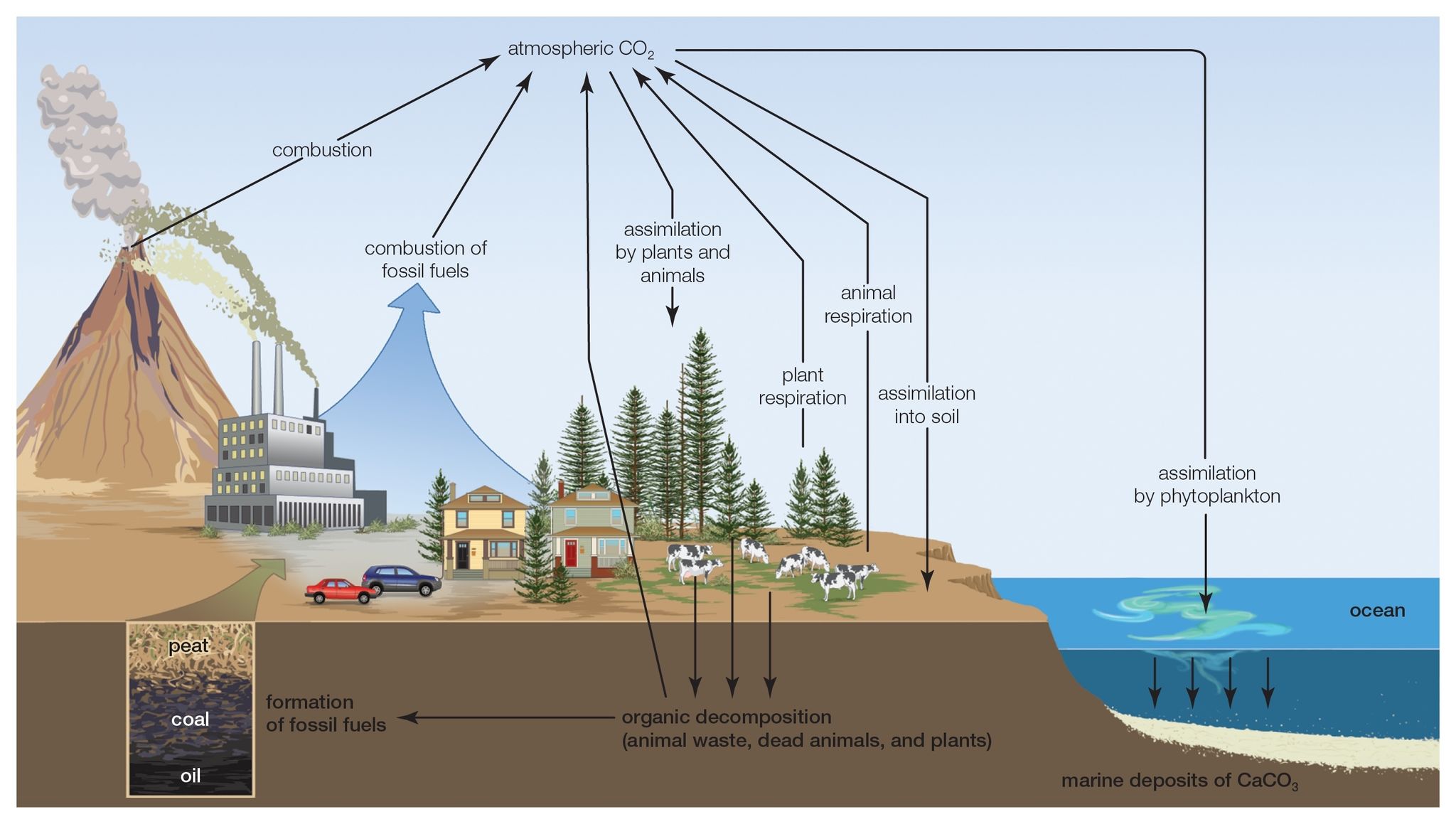
Carbon Cycle
Carbon OUT of the Atmosphere
Photosynthesis - plants convert CO₂ in the air into glucose - biotic > abiotic
Oceans absorb CO₂ from the air
Carbon INTO the Atmosphere
Respiration - all organisms convert glucose into CO₂ in the air - biotic > abiotic
Burning Fossil Fuels adds more CO₂ to the air
Decomposition adds more CO₂ to the air - biotic > abiotic
Deforestation reduces the number of trees that can absorb CO₂
Consumption - animals eating moves carbon through the food web - biotic > biotic
81
Multiple Choice

Analyze the diagram.
What is the role of photosynthetic organisms in the carbon cycle?
Breaking down carbon compounds and releasing methane into the atmosphere
Converting atmospheric carbon dioxide into organic molecules
Storing carbon in inorganic rock formations
Releasing carbon dioxide by feeding on dead organisms
82
Labeling
Label the diagram with the correct process that is occurring in the carbon cycle
Photosynthesis
Combustion
Fossil Fuels
Cellular Respiration
83
Multiple Choice
84
Multiple Choice
Analyze the diagram.
Plants play a key role in the carbon cycle by removing carbon dioxide from the atmosphere through photosynthesis and storing carbon in their tissues.
How would a large-scale reduction in plant populations most likely affect the carbon cycle?
By increasing atmospheric carbon dioxide levels due to decreased photosynthesis
By reducing the amount of carbon stored in fossil fuels underground
By increasing the number of decomposers that remove carbon from the atmosphere
By causing an immediate increase in the amount of carbon fixed by animals
85
Multiple Choice
Analyze the diagram.
Based on the carbon cycle, which component is a direct result of both biotic and abiotic processes in the environment?
Carbon dioxide in the atmosphere
Glucose in plant tissues
Limestone (calcium carbonate) in sediment
Fossil fuel formation underground
86
Greenhouse gases are gases that trap heat in the Earth's atmosphere
Carbon dioxide (CO2 - main one), methane, water vapor
Greenhouse Effect is the warming of the Earth caused by greenhouse gases.
Necessary for life to exist on Earth!

87
Evidence - Carbon Dioxide measurements taken over time compared to the Earth's temperature
As carbon dioxide levels increase, the temperature of the Earth increases.

Excess greenhouse gases cause climate change
Increasing Carbon Dioxide in the Atmosphere Increases Global Temperatures
88
Multiple Choice
Which greenhouse gas is most commonly associated with climate change discussions due to its significant role in trapping heat in Earth’s atmosphere?
89
Multiple Choice
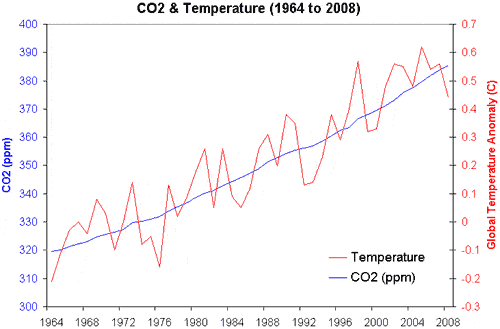
The graph below shows CO2 emissions and temperatures from 1909 to 1949. What conclusion is best supported by the graph?
90
Increasing the Greenhouse Effect
Increases Earth's temperature
Combustion - Burning Fossil Fuels - MAIN CAUSE
Deforestation - cutting down forests - less photosynthesis
Wildfires
Warmer Oceans
Decomposition
Decreasing the Greenhouse Effect
Decreases the Earth's temperature
Burn less fossil fuels
Use renewable energy sources like solar, wind, hydroelectric
Planting Trees - more photosynthesis
Cooler Oceans
91
Multiple Choice
The main human activity that releases greenhouse gases is...
92
Multiple Choice

93
Multiple Choice
Certain gases in the atmosphere – water vapor, carbon dioxide, methane, and nitrous oxide – help maintain the Earth’s temperatures and climate.
What are these gases called?
ozone gases
solar gases
greenhouse gases
stomach gases
94
Multiple Choice
Which of the following is contributing to an INCREASE in carbon dioxide in the atmosphere?
deforestation
photosynthesis
oceans
all of the above
the loss of animal species
95
Pioneer Species first living thing in an ecosystem - small, fast growing, many seeds
lichens, mosses, grasses
Climax Community is the final mature community
hardwood forest of oaks, maple...

Ecological Succession is a series of predictable changes in an ecosystem
How life begins or returns to an area
96

Primary Succession
Begins after soil has been removed - on bare rock
Lava flow, glacier retreating, new land formed
Secondary Succession
Begins after life has been removed - soil is still there
Wildfire, flood, abandoned land


97

Primary Succession begins on bare rock
After lava flow, glacier retreating, new land formed
Pioneer species is mosses or lichen that break down rock creating layer of soil
Next = grasses, shrubs, fast-growing trees
Climax Community is hardwood trees
98
Multiple Select
After which events can primary succession occur? (2)
Volcanic eruption
Forest fire
Flood
A glacier retreating
A farmer clearing land
99
Reorder
Place primary succession in order
Bare rock
Lichens
Grasses
Shrubs
Trees
100
Secondary Succession begins after life has been removed but soil is still present
Wildfire, flood, abandoned land, cleared land
Pioneer species is grasses or mosses
Next = shrubs, fast-growing trees
Climax Community is hardwood forest

101
Multiple Select
After which events can secondary succession occur? (3)
Forest fire
Volcanic eruption
A glacier retreating
Flood
Clearing land to plant
102
Multiple Choice
103
Multiple Choice
Why do grasses appear before shrubs in ecological succession?
loosen the dirt for new trees to take roots?
provide food for animals returning to the area
require plenty of sunlight to make their own food
can grow even in areas with shallow soil
104
Grasses appear before shrubs in ecological succession because they can grow even in areas with shallow soil. This allows them to establish themselves and create a suitable environment for other plants to grow. They do not require plenty of sunlight to make their own food, unlike other options. Additionally, they do not loosen the dirt for new trees to take roots or provide food for animals returning to the area. The ability of grasses to thrive in challenging soil conditions makes them the initial pioneers in ecological succession.
105
Reorder
Place Secondary Succession in Order
Soil
Grasses
Shrubs
Fast-growing Trees
Hardwood Forest
106
Categorize
Barrier island formation in New Jersey
Landslide along a coast in California
Advancing of glaciers across Minnesota
Fire that released lodgepole pine seed in Colorado
Straight-line wind damage uprooting hardwood trees in Mississippi
Volcanic eruption and extensive lava flow in Hawaii
Match the events to the kind of succession that each could lead to.
107
Pond Succession
Begins with a depression in the earth
Pioneer species - Phytoplankton, blue-green algae bacteria are producers
Zooplankton feed on producers
Sediment gradually fills in the pond
Ponds are never climax communities
ORDER: Lake→Marsh→Grassland→Shrubs→Forest
Pond→Meadow→Shrubs→Forest

108
Multiple Choice
What is the climax community of a pond ecosystem?
the pond is the climax community
a meadow
a hardwood forest
109
Reorder
Pland pond succession in order - start with POND
Pond
Grasses
Shrubs
Small Trees
Forest
110
Multiple Choice
Which of the following is an example of secondary succession?
Regrowth of vegetation after a forest fire
Recovery of a coral reef after a bleaching event
Formation of a new island after a volcanic eruption
Replanting of crops after a harvest
111
Secondary succession refers to the process of regrowth of vegetation after a forest fire. It is a natural phenomenon where the ecosystem gradually recovers and new plant life emerges. This type of succession occurs when the soil is still intact and seeds or roots of plants are present. Secondary succession is different from primary succession, which occurs in areas where there is no existing soil. In secondary succession, the vegetation gradually reestablishes itself, leading to the restoration of the ecosystem.
112
PRACTICE
Questions
113
Multiple Choice
An example of typical pioneer species, that is one that appears in the earliest stages of ecological succession is:
Oak Trees
Spiders
Weeds
Small Conifer Trees
114
In the earliest stages of ecological succession, pioneer species like weeds appear. These plants are the first to colonize disturbed or barren areas. Weeds are known for their ability to quickly establish and reproduce, making them well-suited for these early stages. They outcompete other species due to their rapid growth and adaptability. Weeds play a crucial role in preparing the environment for the growth of other plant species. Therefore, weeds are considered typical pioneer species in ecological succession.
115
Multiple Choice
Breaking News! A new island has formed off of Hawaii! What must occur for it to become an ecosystem?
Secondary Succession
Aquatic succession
Primary Succession
Ferns must grow
116
To form an ecosystem, the new island off of Hawaii must undergo primary succession. This process involves the colonization of barren land by pioneer species, such as lichens and mosses, which gradually break down rocks and create soil. Over time, more complex plants like ferns and trees can establish themselves, attracting animals and forming a diverse ecosystem. Primary succession is different from secondary succession, which occurs on previously inhabited land. Aquatic succession and the growth of ferns are not the primary factors for the formation of an ecosystem on the new island.
117
Multiple Choice
Which would result in primary succession?
volcano destroying habitat leaving only soil and ash
Tornado destroying a crop leaving very little soil
Glacier retreating exposing bare rock
limiting factors
118
Primary succession occurs when a glacier retreats, exposing bare rock. This process allows pioneer species to colonize the area and gradually form soil. Unlike other options, such as a volcano destroying habitat or a tornado destroying a crop, the glacier retreating provides a starting point for new ecological communities. The answer to the question 'Which would result in primary succession?' is the option 'Glacier retreating exposing bare rock'.
119
Multiple Choice
Which of the following best describes the role of lichens in primary succession?
They provide food for herbivores
They break down rock to form soil
They are the final species to establish in a climax community
They compete with grasses for sunlight
120
Multiple Choice
In ecological succession, what role do decomposers play?
They are the first organisms to colonize a barren environment.
They break down dead organic matter, returning nutrients to the soil.
They compete with pioneer species for resources.
They prevent the establishment of new species.
121
Multiple Choice

6. Which sequence best represents the stages of succession that would most likely occur?
bare rock → forest → moss → lichens
grassland → forest → marsh → lake
lake → marsh → grassland → shrubs → forest
pine forest → grassland → shrubs → lichens
122
Multiple Choice
In a Mississippi ecosystem, which of the following best describes the climax community that will eventually form after a long period of stability?
A grassland filled with wildflowers and weeds
A dense forest dominated by hardwood trees like oak and maple
A fast-growing pine forest with a thick underbrush of shrubs
A wetland area populated by cattails and sedges
123
Multiple Choice
124
Multiple Choice
A severe wildfire burns a large section of Mississippi's De Soto National Forest. The fire burns the trees and plants, but the soil remains intact. Which statement best describes the ecological succession that will follow?
Primary succession will occur, starting with lichens colonizing the bare ground.
Secondary succession will occur, starting with grasses and weeds that can grow in the existing soil.
Primary succession will occur, as all the original organisms were removed by the fire.
Secondary succession will occur, starting with the immediate regrowth of the climax community of oak trees.
125
Multiple Choice
In the early 1900s, hunters in a specific region heavily targeted the passenger pigeon population. As the pigeons migrated in massive, dense flocks, they were easy targets for hunters, leading to a rapid decline in their numbers.
How is this limiting factor classified?
Density-independent, because humans are an abiotic factor.
Density-independent, because the hunting occurred regardless of the bird population size.
Density-dependent, because the high density of the bird flocks made it easier for hunters to find and kill them.
Density-dependent, because the birds were competing with the hunters for food.
126
Drag and Drop
127
Multiple Choice

The graph above shows the growth of a population of bacteria over time. Which statement best explains why the population growth levels off after day 25?
The rate of immigration began to exceed the rate of emigration.
The population reached the carrying capacity of its environment due to limited resources.
The population shifted from logistic growth to exponential growth.
A density-independent factor, such as a temperature drop, destroyed the population.
128
Multiple Choice
Which situation describes a density-dependent limiting factor for a deer population?
A major hurricane destroys the trees and shrubs in the forest.
A long drought lowers water levels in ponds across the region.
A contagious disease spreads quickly in a crowded deer herd.
A volcanic eruption covers the area with ash.
129
Multiple Choice
A lake has experienced repeated fish kills during the summer. Tests show high levels of nitrates and phosphates, warm water temperatures, and very low dissolved oxygen near the bottom. Which combination of processes best explains these conditions?
Weathering and rock formation
Nitrogen fixation and nitrification
Algal blooms followed by decomposition and oxygen use by bacteria
Denitrification and nitrogen gas release into the atmosphere
130
Multiple Choice

The bar graph below shows the average phosphate concentration in a river before and after a city bans phosphate-containing detergents.
Which conclusion is best supported by these data?
The ban had no effect on phosphorus levels in the river.
The ban reduced phosphorus entering the river over time.
The ban increased fertilizer use in nearby farms.
The ban caused nitrogen levels in the river to increase.
131
Multiple Choice
A student claims: “Without bacteria, the nitrogen cycle would stop, but the phosphorus cycle could still continue.” Which evaluation of this claim is most accurate?
The claim is correct because nitrogen processes do not involve decomposers.
The claim is correct because phosphorus is only stored in the atmosphere.
The claim is partly correct because bacteria are essential for several nitrogen steps, but decomposers also play an important role in the phosphorus cycle.
The claim is incorrect because bacteria are not involved in any biogeochemical cycles.
132
Multiple Choice
As the oceans absorb more and more CO2 from the atmosphere, they become more acidic. Which of the following is a direct consequence of this on ecosystem health?
It causes sea levels to drop.
It damages and bleaches coral reefs, reducing biodiversity.
It causes an increase in polar ice.
It makes fish grow larger and stronger.
133
Multiple Choice
Which pair lists one biotic and one abiotic process that add CO₂ to the atmosphere?
Cellular respiration (biotic) and combustion (abiotic)
Photosynthesis (biotic) and volcanic activity (abiotic)
Decomposition (biotic) and ocean absorption (abiotic)
Transpiration (biotic) and evaporation (abiotic)
134
Match
Match the following terms:
Animals eating plants
Animals hunting and eating other animals
Both organisms benefit
One organism benefits, other is unaffected
One organism benefits, other is harmed
herbivory
predation
mutualism
commensalism
parasitism
herbivory
predation
mutualism
commensalism
parasitism
135
Dropdown
The apex predator has the
136
Multiple Choice
If the producers in an ecosystem have 25,000 kJ of energy, approximately how much energy is available to the secondary consumers?
25,000 kJ
2,500 kJ
250 kJ
25 kJ
137
Match
Match the organism to their trophic level:
producer
primary consumer
secondary consumer
tertiary consumer
1
2
3
4
1
2
3
4
138
Multiple Choice
Creosote bushes release toxins into the soil that prevent other plants, including their own seedlings, from growing nearby. Which statement best explains the evolutionary advantage of this behavior?
It increases the number of pollinators attracted to the area.
It reduces competition for water and nutrients in a dry environment.
It provides nutrients to the soil for future generations.
It creates a symbiotic relationship with soil bacteria.
139
Multiple Choice
Global atmospheric carbon dioxide (CO2) levels have increased significantly over the last 100 years. Which statement best explains this trend based on the carbon cycle?
CO2 is being removed from the atmosphere faster than it is being released.
CO2 is being released into the atmosphere faster than it is being removed.
Photosynthesis rates have increased, causing an excess of CO2
Cellular respiration rates in animals have decreased, trapping CO2.
140
Drag and Drop
141
Multiple Choice

In a marine ecosystem, an inverted biomass pyramid is observed where the mass of zooplankton (primary consumers) is larger than the mass of phytoplankton (producers) at any single moment. However, the energy pyramid is always upright. Why is the energy pyramid never inverted?
Energy is recycled, but biomass is not.
Consumers continually generate new energy.
Energy is lost as heat at each trophic level and cannot be created.
Biomass increases as organisms get larger up the food chain.
142
Multiple Choice
Why is a climax community, such as a hardwood forest, considered more stable than a pioneer community, such as a field of grasses?
It has fewer biological interactions.
It has greater biodiversity and complex food webs.
It requires less energy from the sun.
It is not affected by abiotic factors like rain.
143
Drag and Drop
144
Multiple Choice
In the water cycle, water moves between the atmosphere and the surface of Earth. Which process represents a direct interaction between a biotic factor (living) and an abiotic factor (nonliving)?
Precipitation falling from clouds to the ground.
Water evaporating from the surface of a lake.
Transpiration releasing water vapor from plant leaves.
Water infiltrating the soil to form groundwater.
145
Multiple Choice
Kudzu is a fast-growing vine introduced to Mississippi that climbs over trees and shrubs, blocking them from sunlight. Why is kudzu considered a significant threat to local biodiversity?
It increases the food supply for native herbivores.
It forms a mutualistic relationship with native trees.
It outcompetes native plants for light, leading to the death of native species.
It acts as a pioneer species on bare rock.
146
Multiple Choice
While nitrogen-fixing bacteria are the primary way atmospheric nitrogen (N2) is converted into a usable form for plants, which abiotic natural phenomenon also provides enough energy to break N2 bonds and fix nitrogen?
Heavy rainfall
Lightning strikes
Volcanic eruptions
Erosion of rocks
Standard 5.1, 5.4, 5.5, 5.6 - Basic Review 1
Organisms and their Environment
Ecological organization
organism, population, community, ecosystem, biome, biosphere
Coevolution and ecological relationships
herbivory, predation, competition, cooperation, mutualism, commensalism, parasitism, mimicry
Energy flow and matter
Food chains, webs, pyramids
Population Growth Patterns
Exponential and logistic growth, carrying capacity, density dependent and independent limiting factors
Interdependence
Show answer
Auto Play
Slide 1 / 146
SLIDE
Similar Resources on Wayground

136 questions
CHEMISTRY REVIEW
Presentation
•
9th - 12th Grade
136 questions
Countable and Uncountable Nouns
Presentation
•
KG - University
137 questions
Review UNIT 4B: MOVEMENT & GAS EXCHANGE
Presentation
•
11th Grade
145 questions
Energy Conservation, Transfer, and Transformation
Presentation
•
8th - 12th Grade
140 questions
Unit 7 Review AP Bio
Presentation
•
9th - 12th Grade
141 questions
quarter review
Presentation
•
KG - University
137 questions
Livestock Judging
Presentation
•
12th Grade
Popular Resources on Wayground
10 questions
Safety Day 2026 – Student Review

Quiz
•
9th Grade
21 questions
Continents and Oceans
Quiz
•
6th Grade
20 questions
Parts of Speech
Quiz
•
5th Grade
16 questions
Subject & Predicate
Quiz
•
5th Grade
25 questions
Multiplication Facts
Quiz
•
5th Grade
12 questions
Map Skills
Quiz
•
3rd Grade
22 questions
Continents and Oceans
Quiz
•
5th Grade
15 questions
Rounding Decimals
Quiz
•
5th Grade
Discover more resources for Biology
20 questions
Cell organelles and functions
Quiz
•
10th Grade
20 questions
Cell Transport
Quiz
•
9th - 12th Grade
25 questions
photosynthesis and cellular respiration
Quiz
•
9th Grade
20 questions
Cell Cycle
Quiz
•
9th Grade
8 questions
DNA vs. RNA
Presentation
•
9th - 12th Grade
14 questions
Ecological Succession: Primary and Secondary
Quiz
•
9th Grade
20 questions
Macromolecules
Quiz
•
10th Grade
20 questions
Characteristics of Life
Quiz
•
9th - 10th Grade