Search Header Logo
  1. Resource Library
  2. Science
  3. Chemistry
  4. Nuclear Chemistry
  5. Nuclear Chemistry Introduction
Nuclear Chemistry Introduction

Nuclear Chemistry Introduction

Assessment

Presentation

Science

9th Grade

Practice Problem

Easy

NGSS
HS-PS1-8, MS-LS1-8, MS-PS2-3

+2

Standards-aligned

Created by

Jan Davis

Used 1+ times

FREE Resource

19 Slides • 21 Questions

1

media

2

Open Ended

Think about yesterday’s lesson. What is something you remember?


3

media

4

Open Ended

Describe a situation where knowledge of nuclear chemistry could help keep people safe.

5

Multiple Choice

Why is it important to understand radioactivity in today's world?

1

Because it helps us understand the dangers and benefits of nuclear energy

2

Because it is only used in nuclear weapons

3

Because it is not relevant to our daily lives

4

Because it is a topic only for scientists

6

media

7

media

8

media

9

media

10

Open Ended

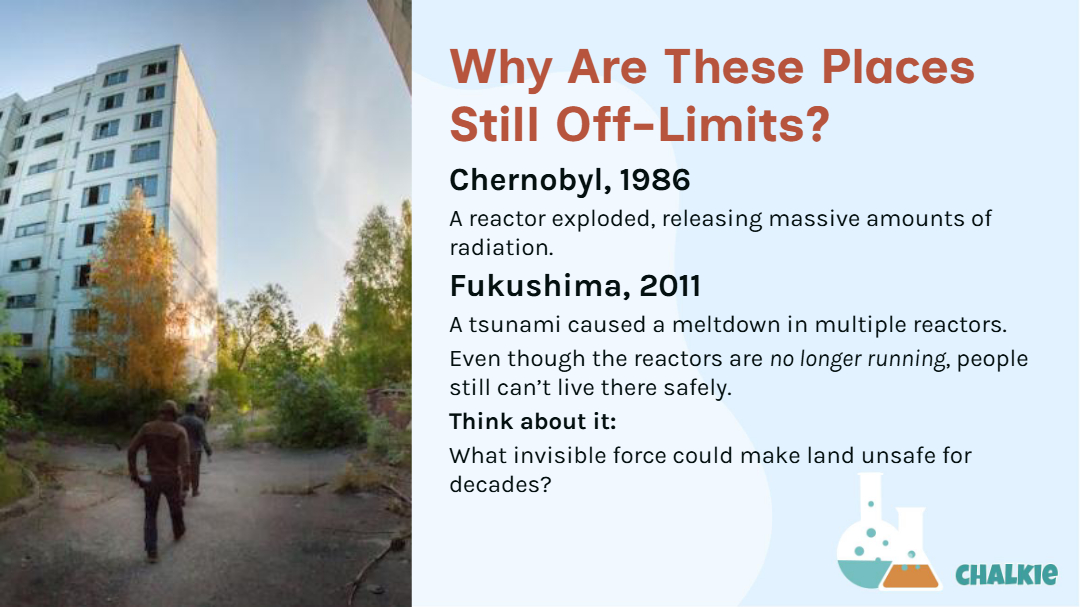
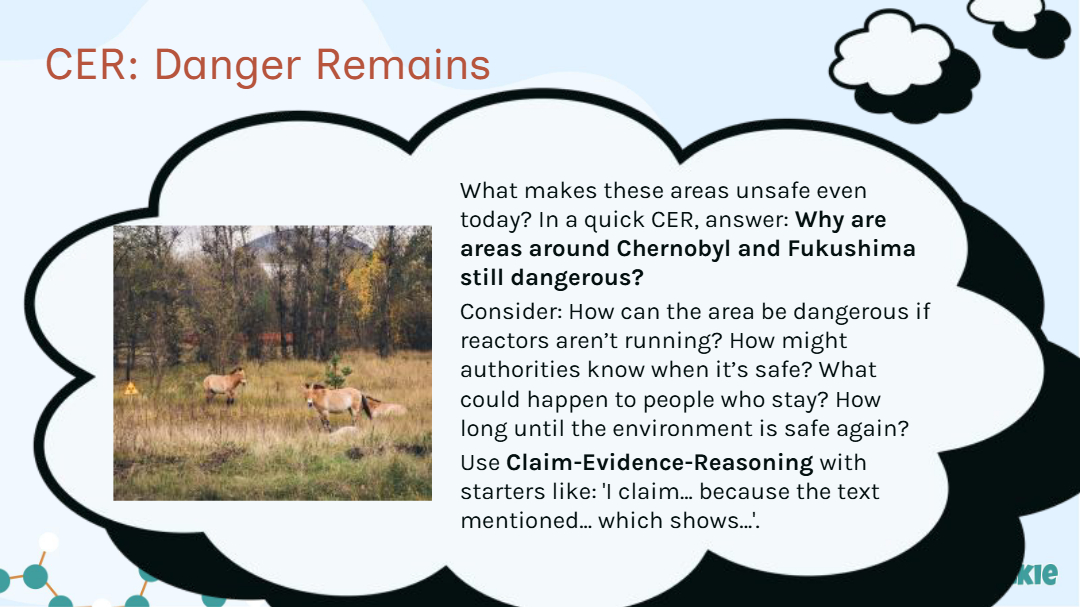
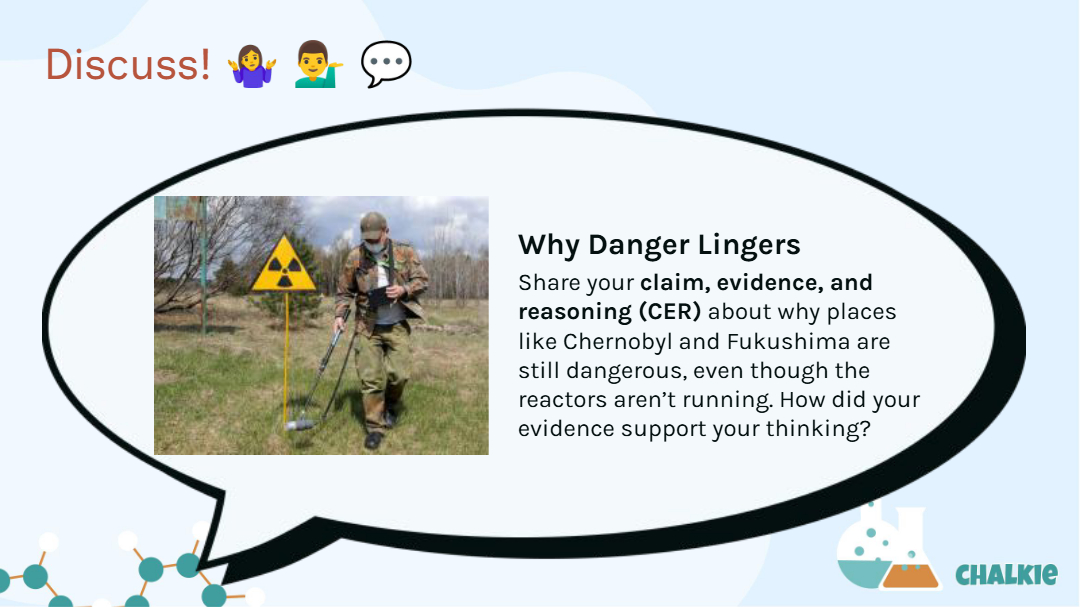
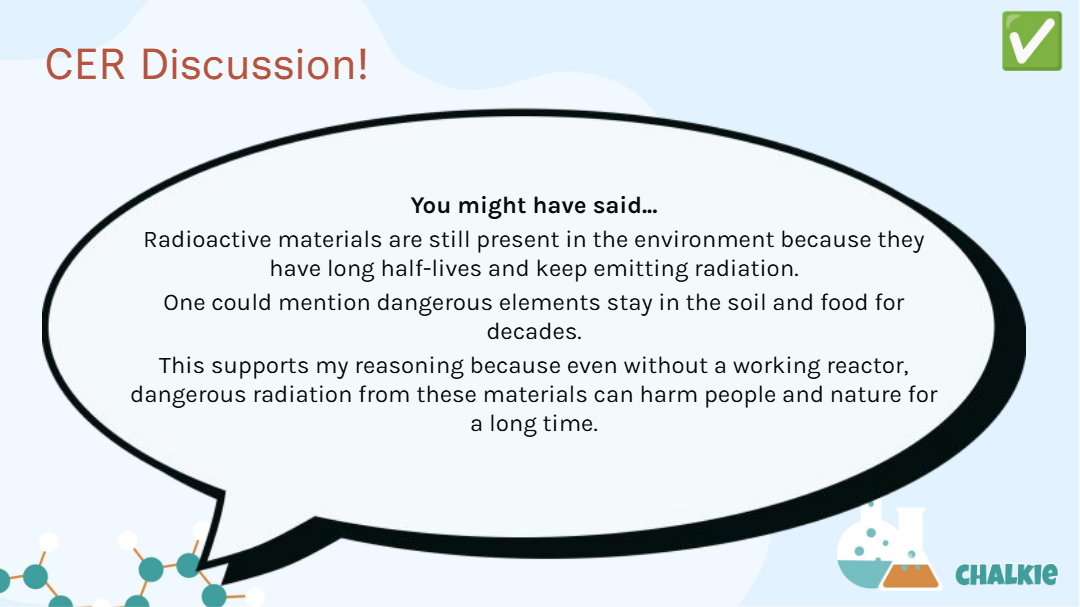
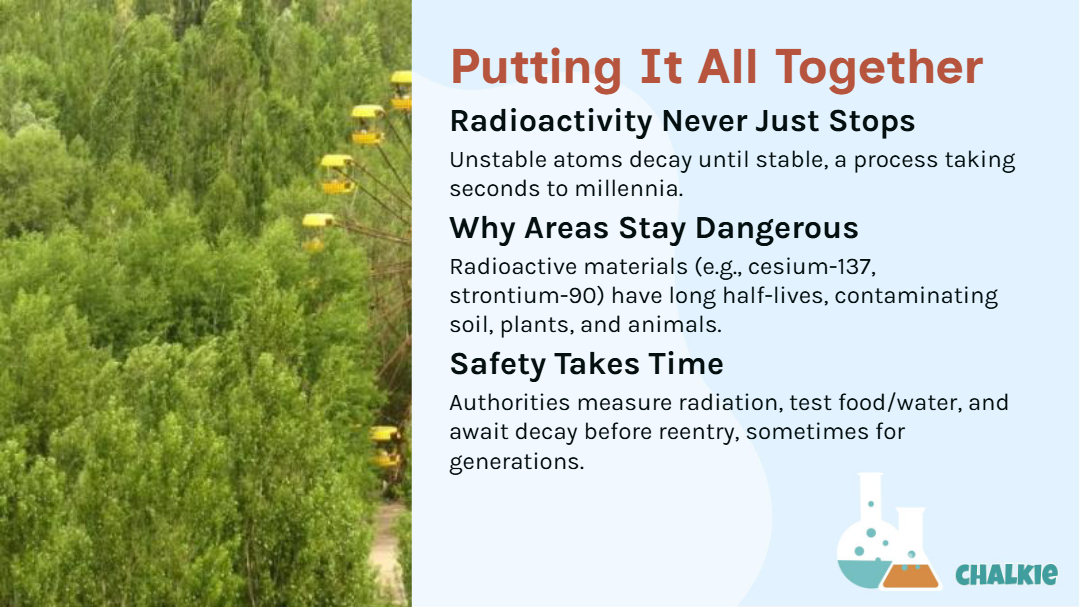
Explain why areas around Chernobyl and Fukushima are still dangerous, even though the reactors are no longer running.

11

media

12

Fill in the Blank

Type answer...

13

Multiple Select

Which of the following are reasons why radioactive materials remain dangerous in the environment for a long time?

1

They have long half-lives

2

They emit radiation for decades

3

They can stay in soil and food

4

They are easily removed by rain

14

media

15

Multiple Choice

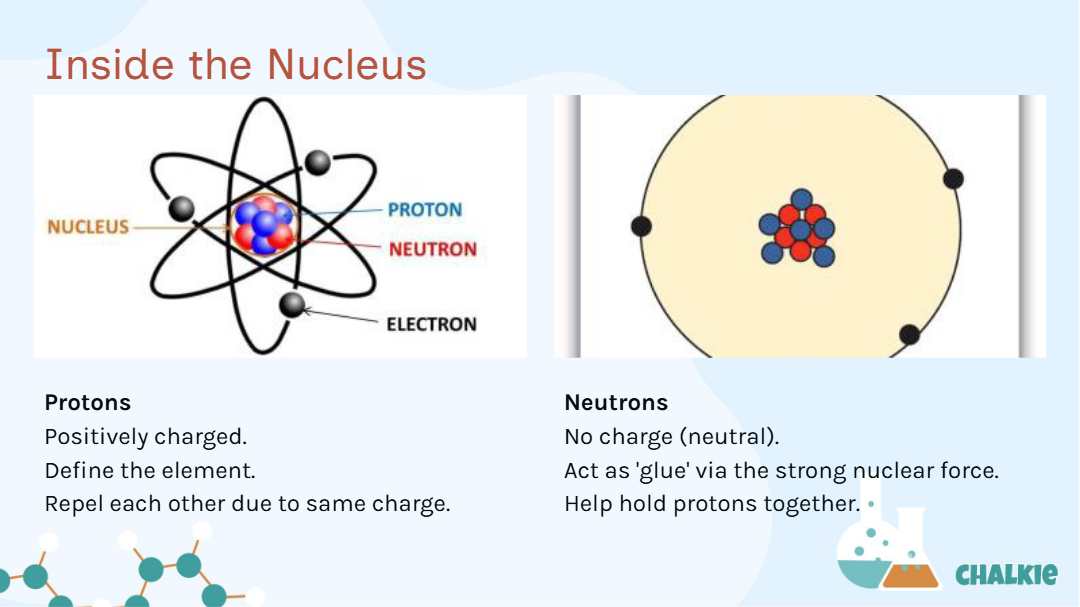
Which subatomic particle is responsible for defining the element and repelling each other due to their charge?

1

Proton

2

Neutron

3

Electron

4

Photon

16

media

17

Multiple Choice

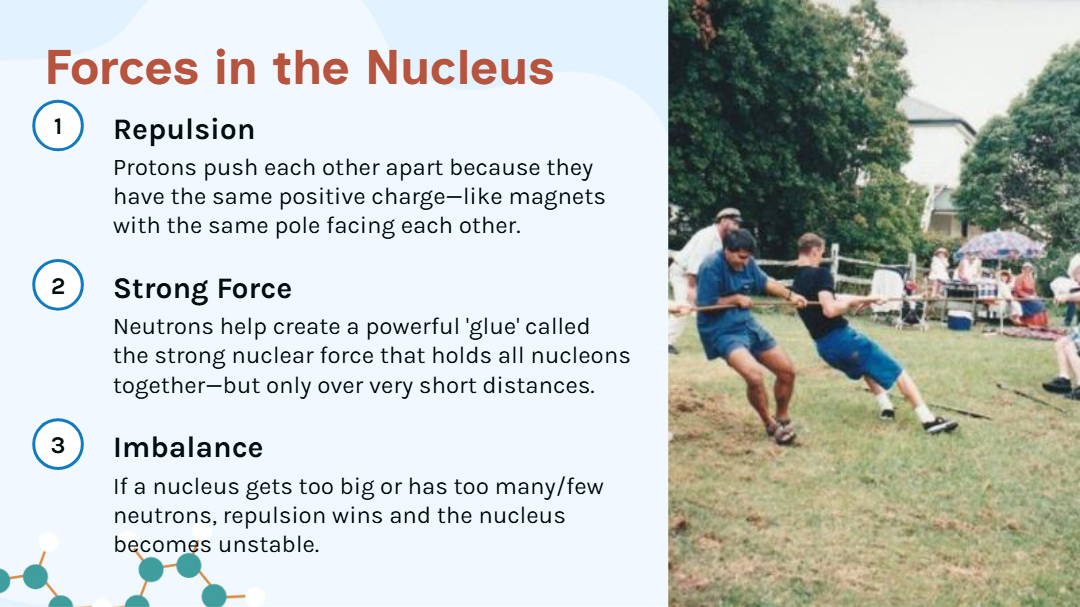
If a nucleus has too many or too few neutrons, what happens to its stability?

1

It becomes unstable

2

It becomes more stable

3

It gains energy

4

It loses all protons

18

Open Ended

Explain how neutrons contribute to the stability of the nucleus.

19

media

20

media

21

media

22

Open Ended

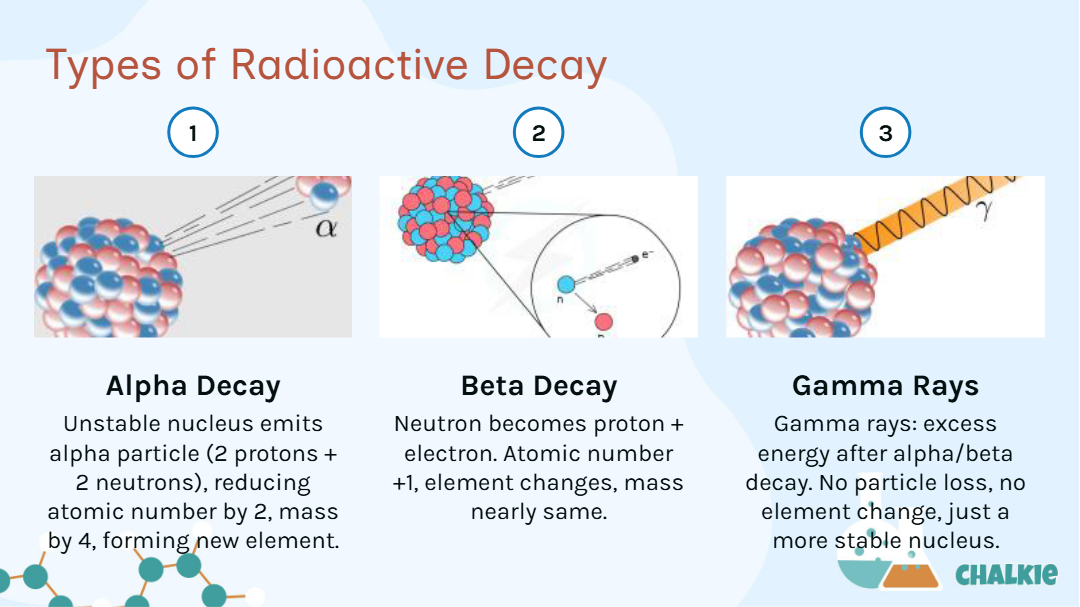
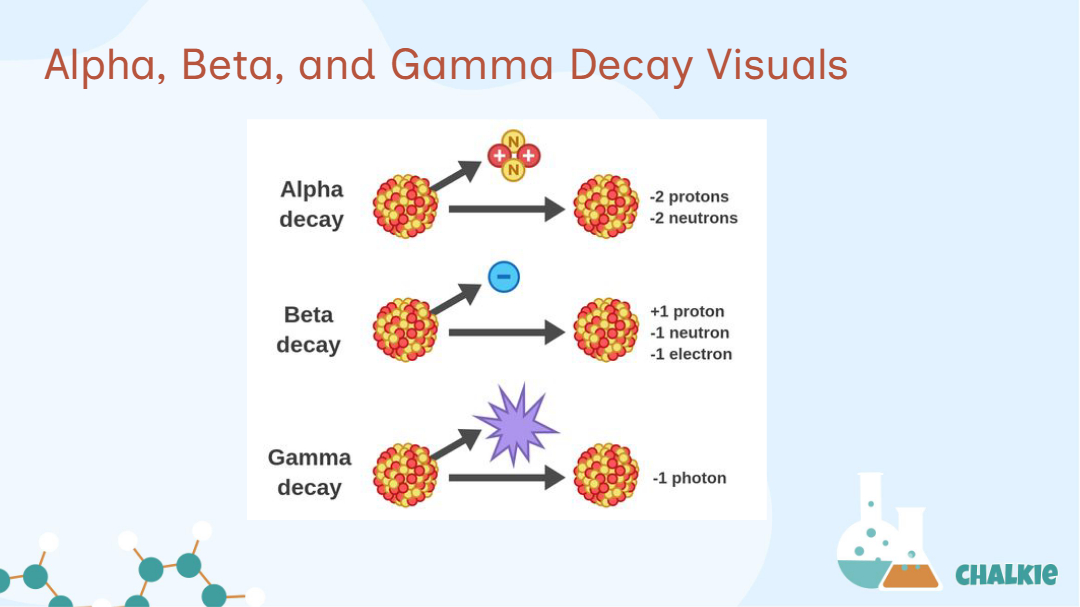
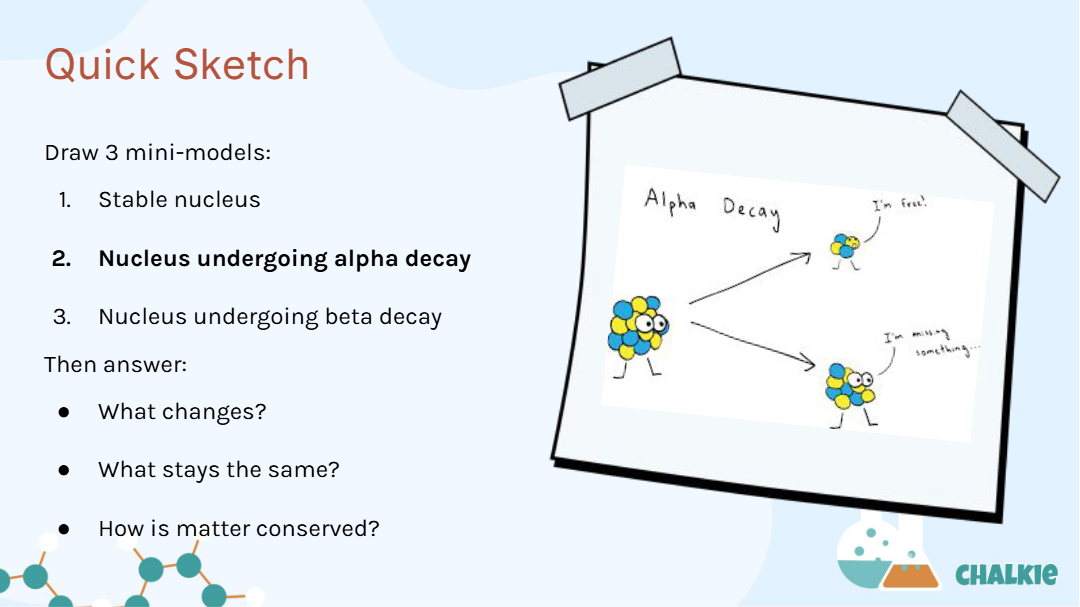
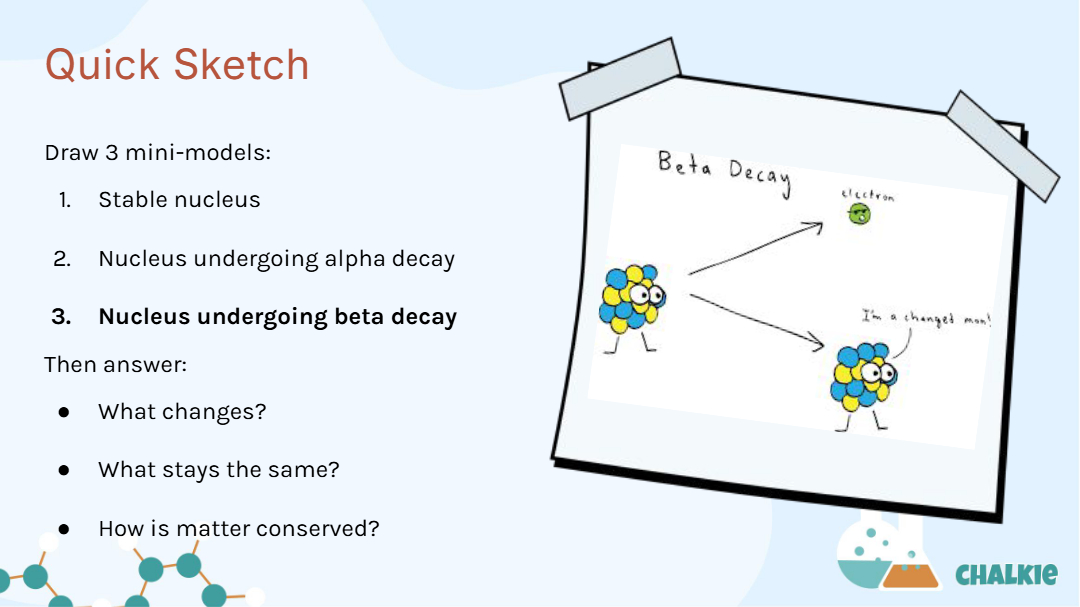
Compare and contrast alpha, beta, and gamma decay in terms of changes to atomic number, mass number, and particle emission.

23

Multiple Choice

Which of the following statements about gamma decay is correct?

1

No particle is lost, only energy is emitted

2

Atomic number decreases by 2

3

A neutron turns into a proton

4

Mass number decreases by 4

24

Fill in the Blank

25

Multiple Select

Which of the following are emitted during radioactive decay to help a nucleus become more stable?

1

Alpha particles

2

Beta particles

3

Gamma energy

4

Neutrons

26

Multiple Choice

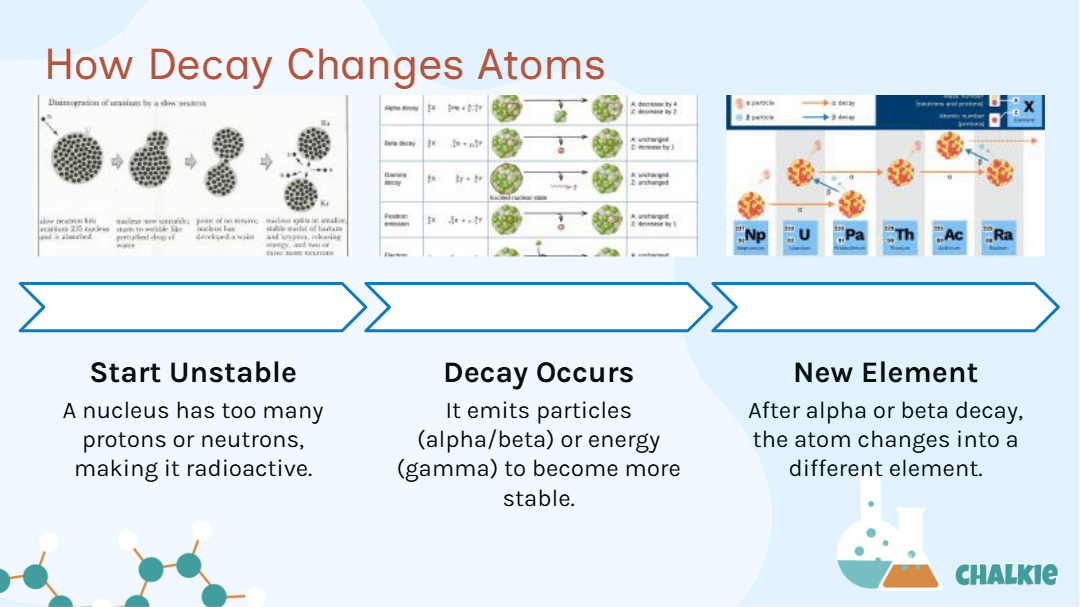
What happens to an atom after it undergoes alpha or beta decay?

1

It becomes a different element.

2

It disappears completely.

3

It becomes a stable isotope of the same element.

4

It splits into three smaller atoms.

27

media

28

Multiple Choice

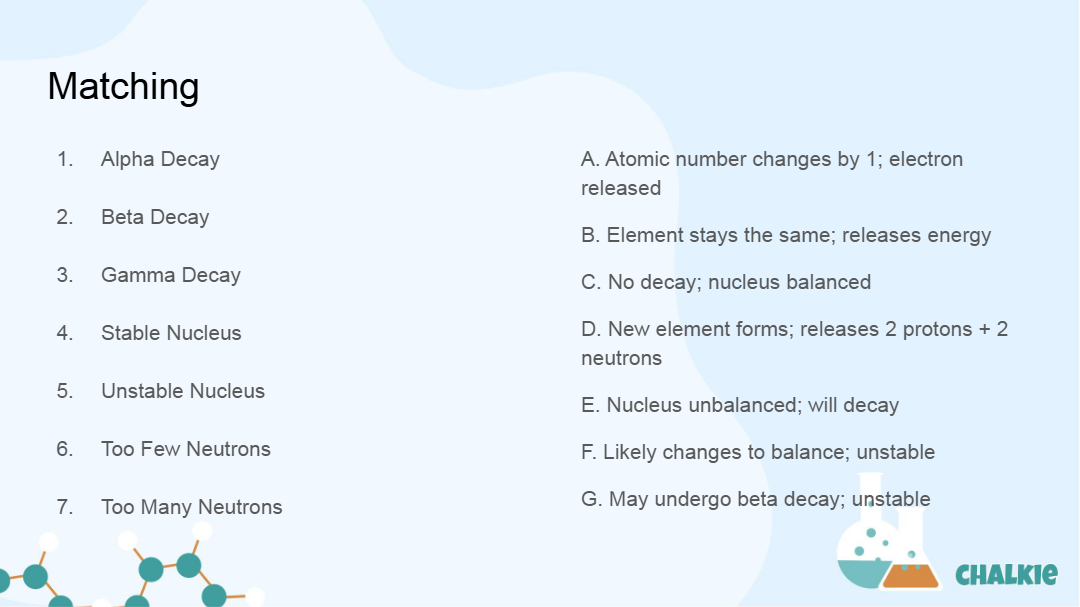
Which statement best describes a stable nucleus?

1

No decay; nucleus balanced

2

Nucleus unbalanced; will decay

3

Releases 2 protons and 2 neutrons

4

May undergo beta decay; unstable

29

Open Ended

Explain how the stability of a nucleus is affected by having too many or too few neutrons.

30

Fill in the Blank

31

media

32

media

33

media

34

media

35

Open Ended

How is matter conserved?

36

media

37

media

38

Fill in the Blank

39

Multiple Choice

Which of the following is considered an 'off-limits' or unsafe area due to potential dangers?

1

A public park

2

A nuclear accident zone

3

A shopping mall

4

A school playground

40

Open Ended

What is one question you still have about nuclear chemistry or radioactivity after today's lesson?

media

Show answer

Auto Play

Slide 1 / 40

SLIDE