

The Judicial Branch

Presentation
•
Social Studies
•
9th - 12th Grade
•
Practice Problem
•
Easy

Patrick Newell
Used 1+ times
FREE Resource
19 Slides • 15 Questions
1

2

3

4

5

6
Multiple Choice
The difference between an appellate court and a district court is that an appellate court
conducts trials by jury
has original jurisdiction
reviews previous court decisions
hears civil cases but not criminal cases
7

8
Multiple Choice

Which of the following describes the origin of the United States court system presented in the diagram?
Article II of the Constitution established the three-tiered court system and the jurisdiction of each court in each tier.
McCulloch v. Maryland (1819) allowed the Supreme Court to establish other federal courts.
Article III of the Constitution established a Supreme Court, while other federal courts were established by Congress.
Marbury v. Madison (1803) allowed Congress to create other federal courts.
9
Multiple Choice
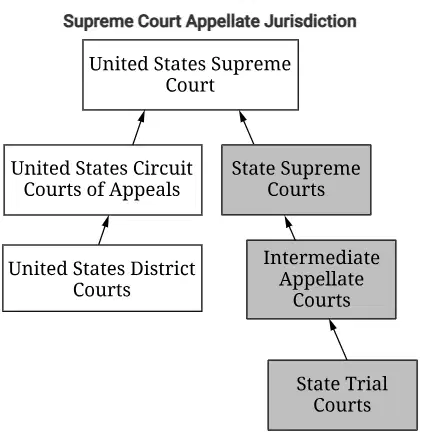
Which of the following statements best explains the diagram?
The United States District Court is the starting place for all cases going to the United States Supreme Court.
State supreme courts have the final say in all cases arising in the states.
Cases arising at both the state and federal level may be appealed to the United States Supreme Court.
The number of federal courts is greater than the number of state courts.
10

11

12

13

14

15

16

17
18
Multiple Choice
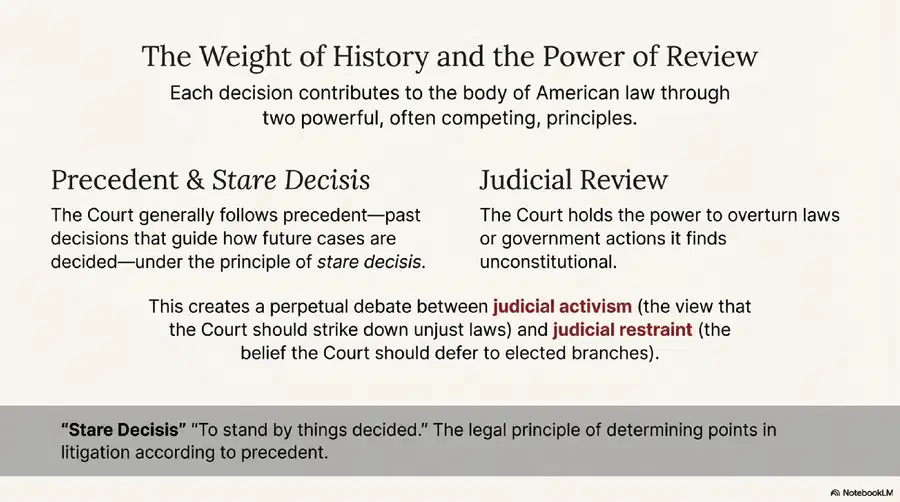
Which of the following best explains the principle of stare decisis?
It requires that at least four Supreme Court justices agree to hear a case.
It encourages presidents to take judicial experience into account when nominating judges.
It encourages judges to follow precedent when deciding cases.
It reinforces the philosophy of judicial activism.
19
Multiple Choice
Which of the following scenarios best illustrates the concept of a case being decided based on precedent?
The Supreme Court bases its decision in a case involving the commerce clause on one of its earlier decisions involving the commerce clause.
The Supreme Court overturns a lower court decision in a case dealing with voter identification laws.
A state passes a law which contradicts federal law, causing the Supreme Court to rule in favor of the federal government.
The chief justice of the Supreme Court disagrees with the majority of the other justices and decides to declare a law passed by Congress as unconstitutional.
20
Multiple Choice
Which of the following scenarios exemplifies the principle of stare decisis?
A Senator raises opposition to a proposed bill by speaking on the floor of the Senate for eight hours.
A majority opinion of the United States Supreme Court dealing with school segregation states that the decision follows the precedent established in Brown v. Board of Education of Topeka (1954).
A president orders the National Aeronautics and Space Administration (NASA) to begin an initiative to send manned spacecraft to Mars.
Four members of the United States Supreme Court agree to hear an appeal on a death penalty case from a state supreme court.
21

22
Multiple Choice
During a television interview on July 1, 2018, Senator Lindsey Graham stated that "one of the concepts that really means a lot in America is stare decisis. That means you don't overturn precedent unless there's a good reason." About which ongoing debate was Senator Graham sharing his position?
State jurisdiction versus federal jurisdiction
Judicial activism versus judicial restraint
Executive orders versus executive agreements
Reserved powers versus delegated powers
23
Multiple Choice
Which of the following best defines the term “judicial activism”?
The demands on judges to hear large numbers of cases
The tendency of judges to interpret the Constitution according to their own views
The unwillingness of judges to remove themselves from cases in which they have a personal interest
The efforts of judges to lobby Congress for funds
24
Multiple Choice
The idea that judges ought to freely strike down laws that are inconsistent with their understanding of the Constitution is known as
original intent
judicial restraint
judicial activism
stare decisis
25

26

27
Multiple Choice
In 1998, Goodyear employee Lilly Ledbetter filed suit against her employer for pay discrimination based on her gender. Though Ledbetter was initially successful, Goodyear appealed the decision and the case went to the Supreme Court. In Ledbetter v. Goodyear Tire and Rubber Co. (2007), the Supreme Court ruled that the Civil Rights Act of 1964 requires that sex discrimination complaints must be made within 180 days “after the alleged unlawful employment practice occurred,” which Ledbetter had failed to do. Which of the following actions could be taken to reverse the impact of the decision?
Ledbetter could renew her appeal by seeking additional Supreme Court review.
The president could sign an executive order to alter the Civil Rights Act.
Ledbetter could pursue her case using the same arguments in state courts.
Congress could enact legislation to amend Title VII of the Civil Rights Act.
28
Multiple Choice
The majority party in the Senate is concerned that the Supreme Court has made a number of ideologically dangerous and controversial rulings. Which of the following actions could be taken by the Senate to limit the Supreme Court’s power?
Replace the chief justice of the Supreme Court with someone with whom they agree with ideologically
Pass legislation already passed by the House that would limit the impact of the Supreme Court’s recent rulings
Ratify a constitutional amendment limiting the Supreme Court’s power
Enforce term limits for justices on the Supreme Court
29
Multiple Choice
The Supreme Court issued a ruling that was unpopular with a majority of Americans. The president and Congress might be able to lessen the impact of the decision by
reducing the pay of the justices to pressure them to reverse their decision
overruling the Supreme Court’s decision by a two-thirds vote in Congress
impeaching the justices in the majority
refusing to actively enforce the decision
30

31
Multiple Choice
On September 23, 1957, President Dwight Eisenhower signed a proclamation mandating the use of Arkansas National Guard members and federal armed forces to enforce the United States Supreme Court’s decision in Brown v. Board of Education (1954) in Little Rock, Arkansas. Which limitation on judicial power is demonstrated in this scenario?
Constitutional amendments can modify the impact of the Supreme Court’s decisions.
Congressional legislation can impact the scope of the Supreme Court’s jurisdiction.
Judicial appointments can influence the decisions made by the Supreme Court.
State and local government can refuse to enforce Supreme Court decisions.
32

33
Multiple Choice
In the case Brown v. Board of Education of Topeka (1954), the Supreme Court ruled that school segregation was unconstitutional. Following the ruling, schools were ordered to desegregate, but at a high school in Little Rock, Arkansas, the governor ordered the state's National Guard to prevent African American students from entering the school. Only when President Eisenhower placed the National Guard under federal control and ordered troops to protect the students were they permitted to enter. This scenario illustrates which of the following?
Legalized segregation is sometimes allowed as an exception to the protections of the Fourteenth Amendment.
Controversial decisions by the court are often challenged and action is sometimes required to ensure enforcement by other branches of government.
The executive branch has to decide whether to uphold a court decision or veto it and President Eisenhower's federalizing troops in Arkansas signaled his response.
States have the authority under the Tenth Amendment to ignore federal court decisions.
34
Multiple Choice
On June 27, 1989, President George H.W. Bush called for the Flag Desecration Amendment, which would prohibit desecration of the American flag. Bush’s comments were in response to the United States Supreme Court’s 5—4 decision in Texas v. Johnson, which held that a state law banning desecration of the flag was in violation of the First Amendment. Which of the following explains why the president asked for a constitutional amendment to be passed?
A constitutional amendment would provide guidance to the Supreme Court in its efforts to engage in judicial activism.
A constitutional amendment would force the Supreme Court to accept the constitutionality of the anti-flag burning laws in subsequent cases.
A constitutional amendment would be needed in order for the Supreme Court to rule on flag desecration cases.
A constitutional amendment would permit the Supreme Court to exercise judicial review of state laws on constitutional issues.
Show answer
Auto Play
Slide 1 / 34
SLIDE
Similar Resources on Wayground

28 questions
The Byzantine Empire
Presentation
•
9th - 12th Grade
27 questions
Writing a Resume
Presentation
•
9th - 12th Grade
27 questions
Kitchen Equipment Review
Presentation
•
9th - 12th Grade
28 questions
Evidence of Evolution
Presentation
•
9th - 12th Grade
26 questions
History of Russia II
Presentation
•
9th - 12th Grade
26 questions
Introduction to Matter
Presentation
•
9th - 12th Grade
29 questions
Persian War
Presentation
•
9th - 12th Grade
27 questions
Unit 2: Gilded Age Review
Presentation
•
9th - 12th Grade
Popular Resources on Wayground
10 questions
How much do you know about our Portrait of an Eagle?

Quiz
•
10th Grade
10 questions
Fast Food Slogans
Quiz
•
6th - 8th Grade
21 questions
Continents and Oceans
Quiz
•
6th Grade
20 questions
Parts of Speech
Quiz
•
5th Grade
16 questions
Subject & Predicate
Quiz
•
5th Grade
25 questions
Multiplication Facts
Quiz
•
5th Grade
12 questions
Map Skills
Quiz
•
3rd Grade
22 questions
Continents and Oceans
Quiz
•
5th Grade
Discover more resources for Social Studies
10 questions
Exploring the Age of Exploration: Key Events and Figures

Interactive video
•
6th - 10th Grade
17 questions
1.3 Review
Presentation
•
11th Grade
10 questions
Exploring the 13 Colonies Regions
Interactive video
•
6th - 10th Grade
8 questions
Smith Unit 5 Quick Check #1 Big Business, Monopolies &Technology
Quiz
•
11th Grade
46 questions
Unit 1 Test REVIEW Ancient Greece and Rome
Quiz
•
9th - 12th Grade
10 questions
Exploring Ancient Mesopotamia Through Song
Interactive video
•
6th - 10th Grade
27 questions
Supply & Demand Test Review
Quiz
•
12th Grade
36 questions
Unit 5 Key Terms
Quiz
•
11th Grade - University