MJ3/HON Atoms
Presentation
•
Science
•
8th Grade
•
Practice Problem
•
Easy
Standards-aligned
Amy Kramer
Used 11+ times
FREE Resource
12 Slides • 25 Questions
1
2
3
Multiple Choice
Which of the following best describes a subatomic particle?
A particle smaller than an atom and makes up the atom
A molecule that forms when atoms bond together
A type of energy released by atoms when they bond
A visible part of matter made of atoms
4
5
Multiple Choice
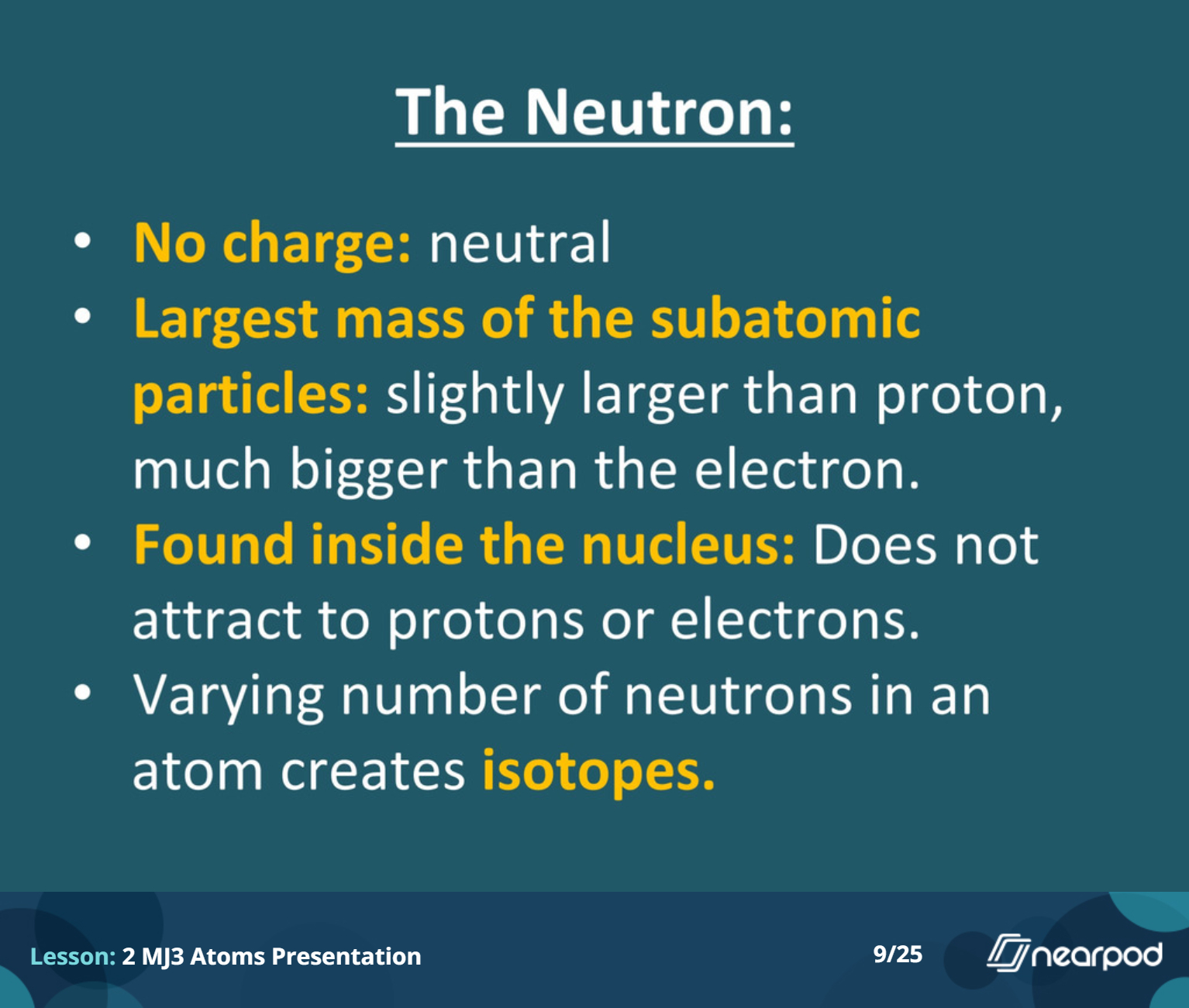
Which subatomic particle has no charge and is found in the nucleus of an atom?
Proton
Neutron
Electron
6
Multiple Choice
Which subatomic particle is positively charged and is found in the nucleus of an atom?
Proton
Neutron
Electron
7
Multiple Choice
Which subatomic particle is negatively charged and found outside the nucleus of an atom?
Proton
Neutron
Electron
8
Draw
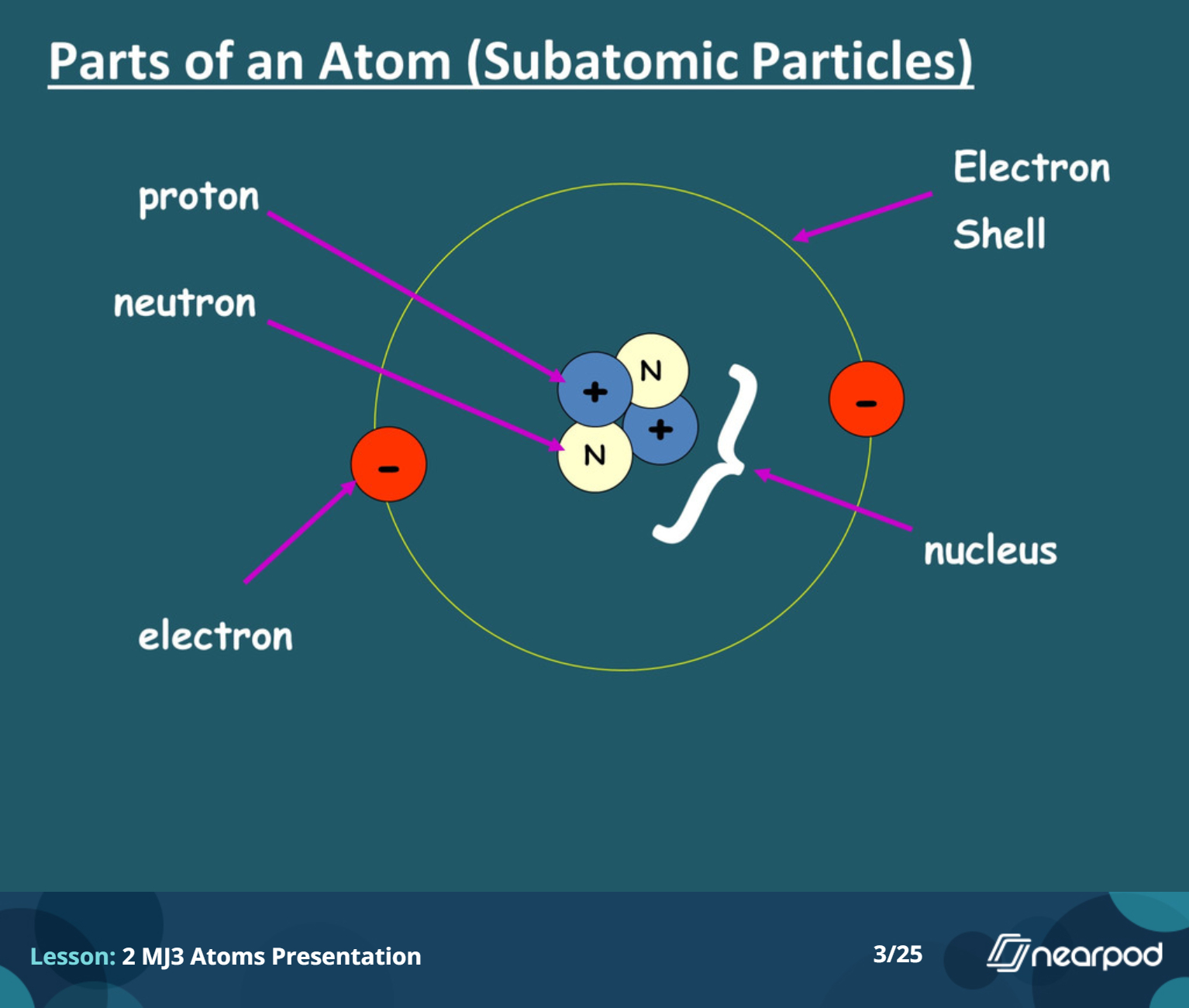
Draw an atom with 2 protons, 2 neutrons, and 2 electrons:
9
10
Open Ended
What are three things that are made of atoms?
11
12
Multiple Choice
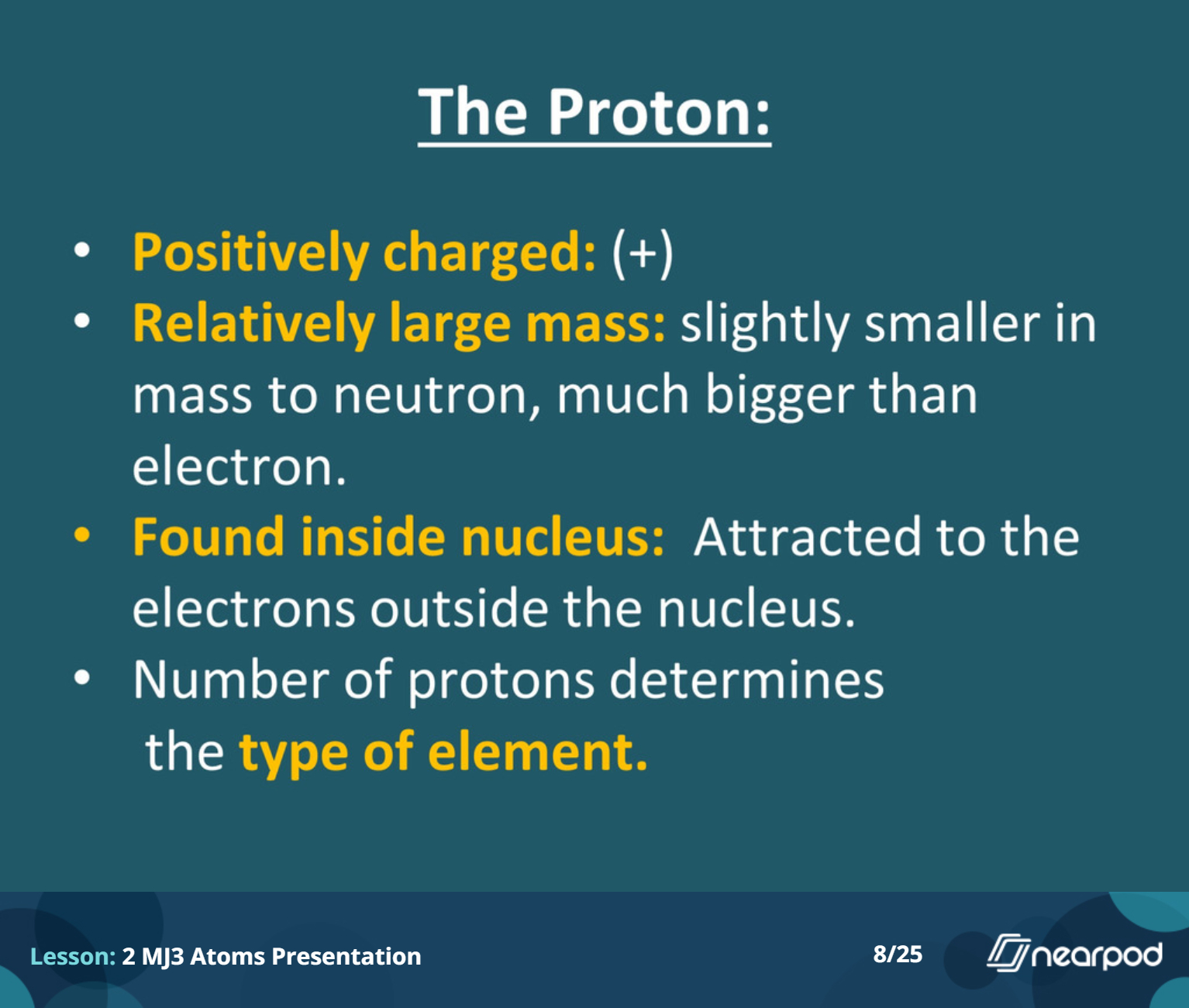
Which of the following statements about protons is correct?
Protons are negatively charged and found outside the nucleus.
Protons have a relatively large mass and are found inside the nucleus.
Protons have no charge and are found in the electron shell.
Protons are smaller than electrons and found outside the nucleus.
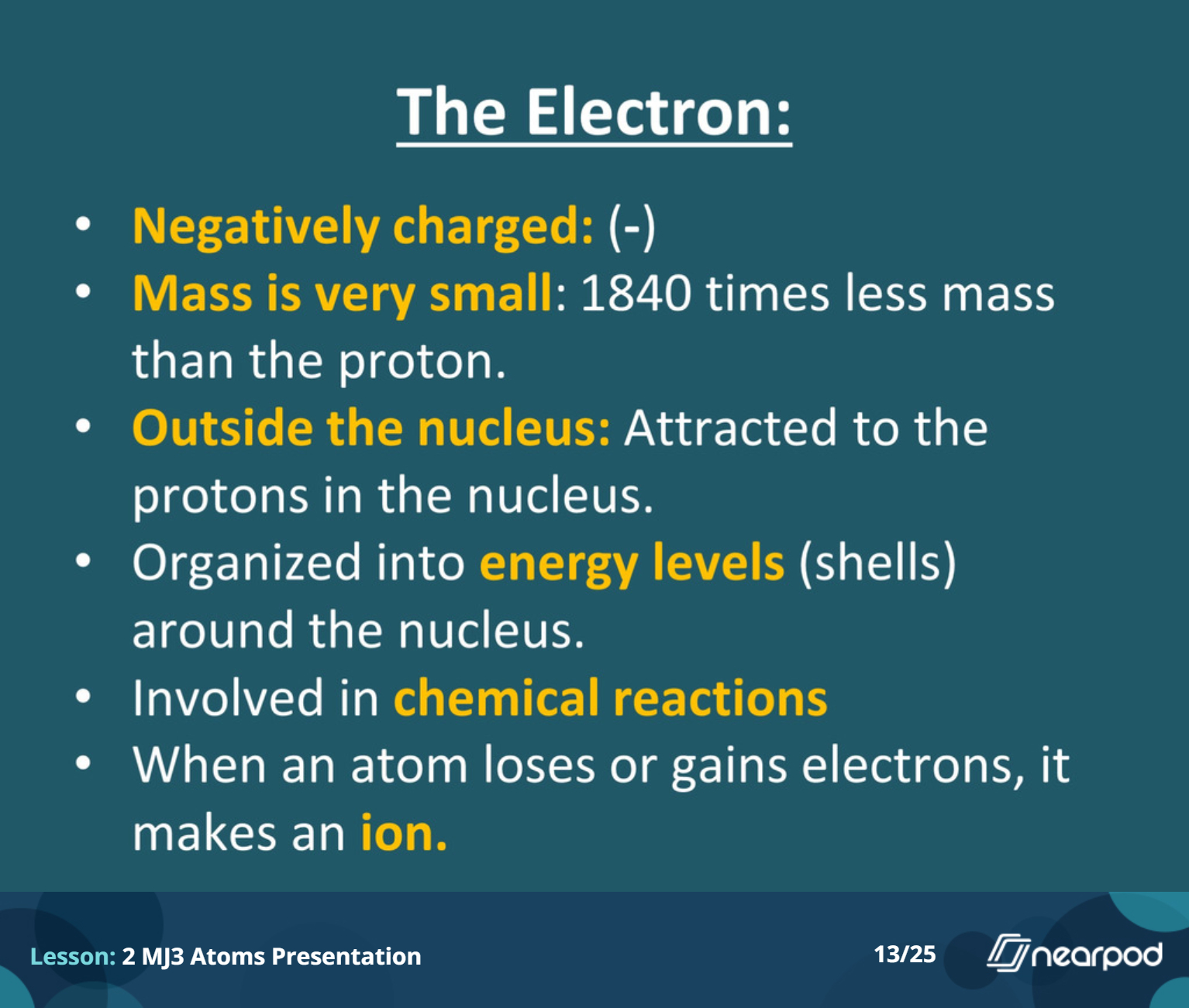
13
14
Multiple Choice
Which subatomic particle is the largest?
Proton
Electron
Neutron
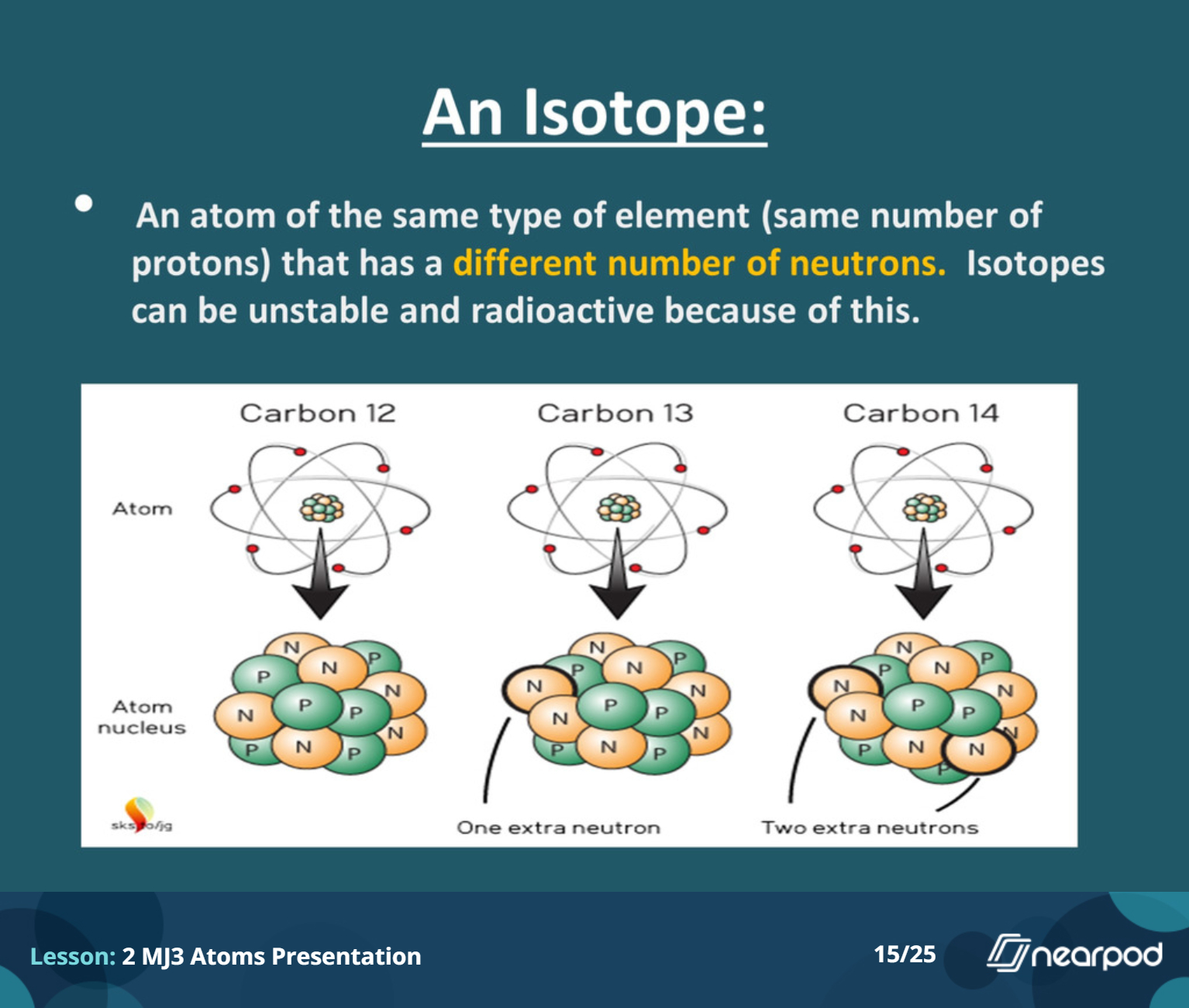
Isotope
15
Multiple Choice
Changing the number of neutrons in an atom makes ...
a proton
an electron
a nucleus
an isotope
16
17
Multiple Select
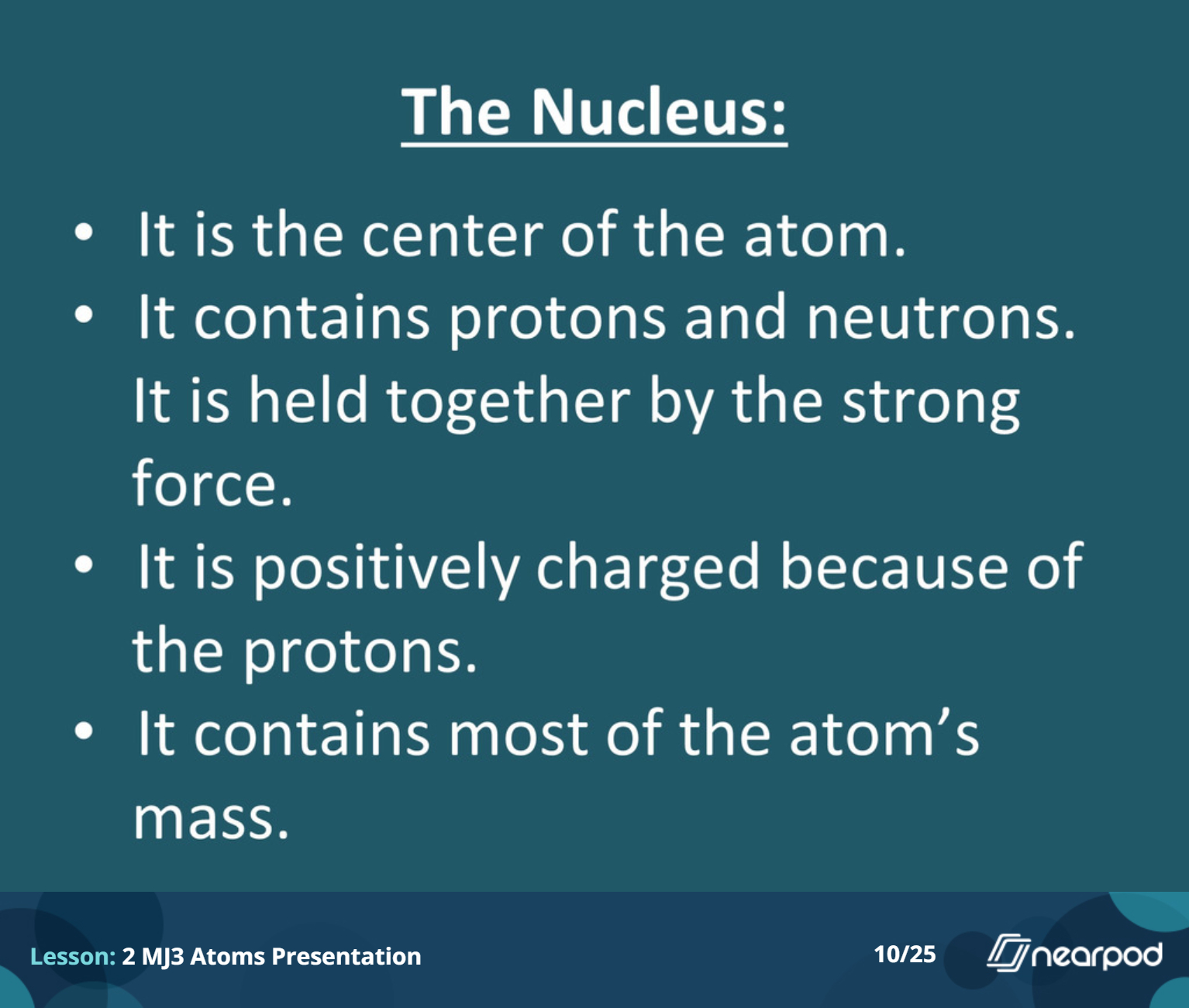
Which of the following statements about the nucleus are correct?
It contains protons and neutrons.
It is negatively charged.
It contains most of the atom's mass.
It is located outside the atom.
18
19
Multiple Choice
Which subatomic particle is the smallest?
Proton
Electron
Neutron
Ion
20
Multiple Choice
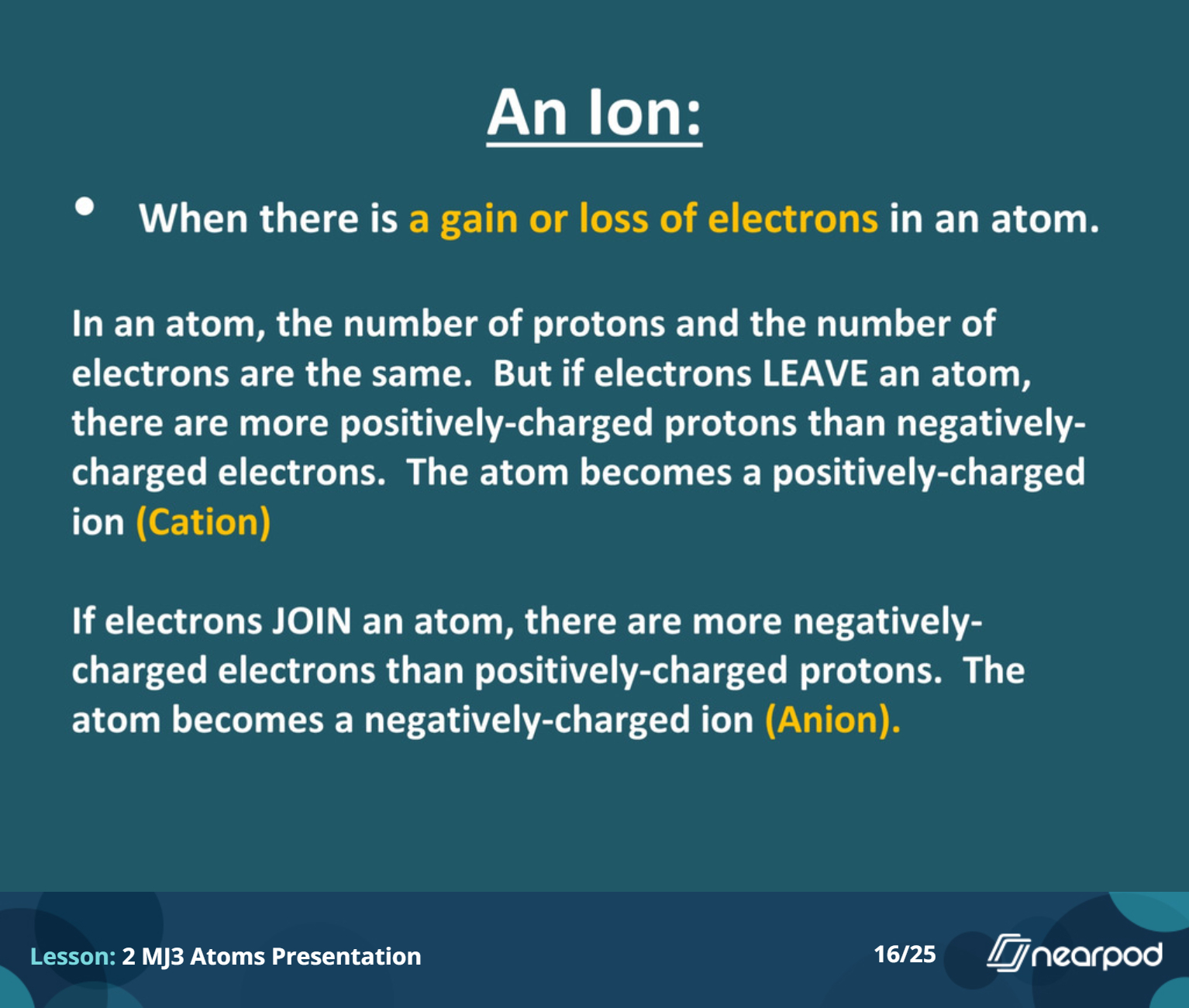
Changing the number of electrons in an atom makes ...
a proton
a neutron
an ion
an isotope
21
22
Fill in the Blanks
An atom of the same element with a different number of
23
24
25
Multiple Choice
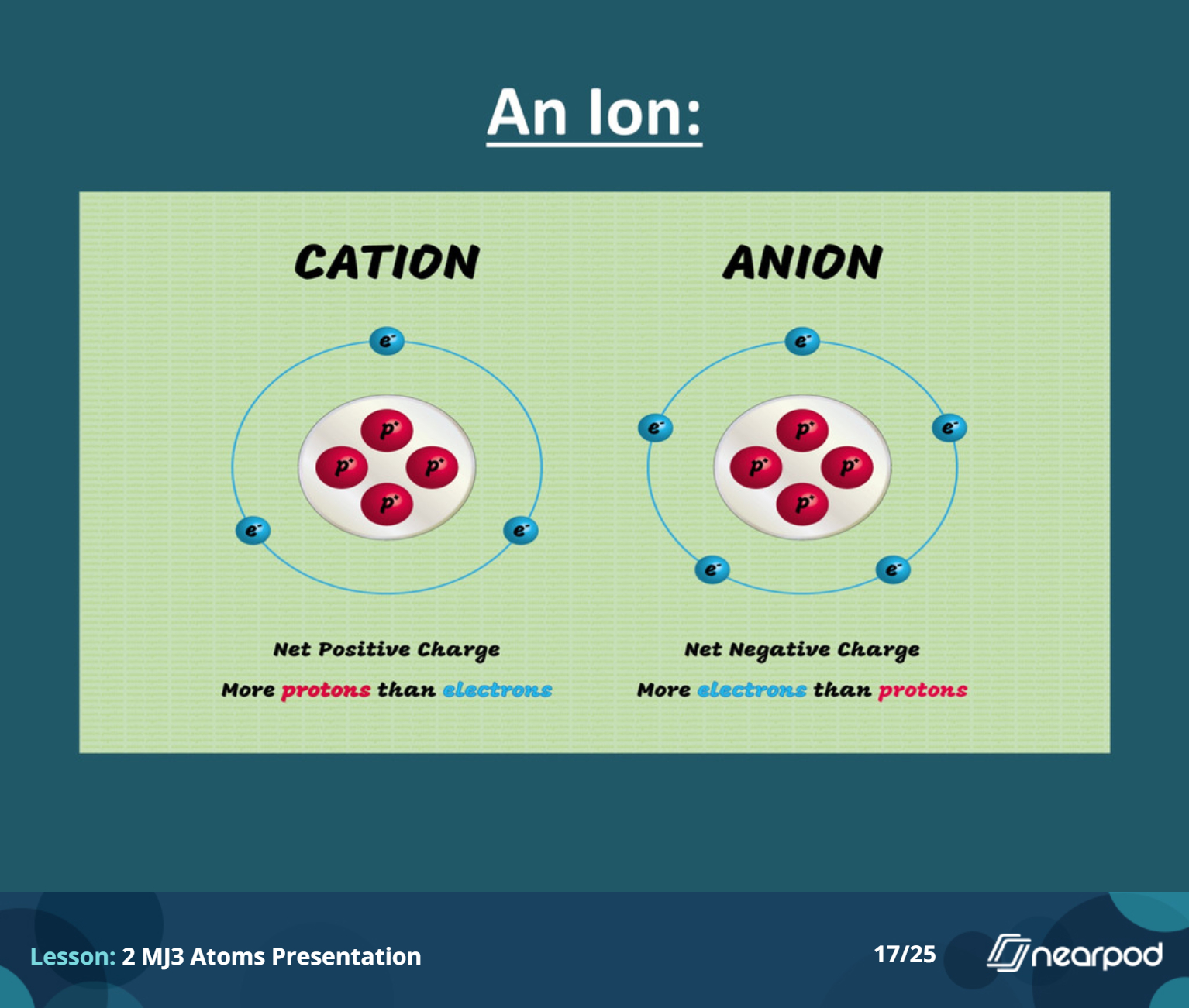
What happens to the charge of an atom if it loses electrons?
It becomes positively charged.
It becomes negatively charged.
It remains neutral.
It becomes an isotope.
26
Multiple Choice
What happens to the charge of an atom if it gains electrons?
It becomes positively charged.
It becomes negatively charged.
It remains neutral.
It becomes an isotope.
27
28
Match
Match the subatomic particles with their description:
Negatively Charged
Positively Charged
Neutral (No Charge)
Electron
Proton
Neutron
Electron
Proton
Neutron
29
Match
Match the subatomic particles with their description:
Smallest particle outside the nucleus
Second-Biggest particle inside the nucleus
Biggest particle inside the nucleus
Electron
Proton
Neutron
Electron
Proton
Neutron
30
Match
Match the subatomic particles with their description:
Involved in chemical reactions
Determines the element's name
Changes result in isotopes
Electron
Proton
Neutron
Electron
Proton
Neutron
31
Multiple Choice
Which subatomic particles are found inside the nucleus of an atom?
protons only
protons and electrons
protons and neutrons
32
Multiple Choice
Which subatomic particle has a positive charge?
proton
neutron
electron
33
Multiple Choice
Which subatomic particle has a negative charge?
proton
neutron
electron
34
Multiple Choice
Which subatomic particle has no (neutral) charge?
proton
neutron
electron
35
Multiple Choice
If an atom has a different number of neutrons, then it is an...
isotope
ion
atom
36
Multiple Choice
If an atom has a different number of electrons, then it is an...
isotope
ion
atom
37
Fill in the Blanks
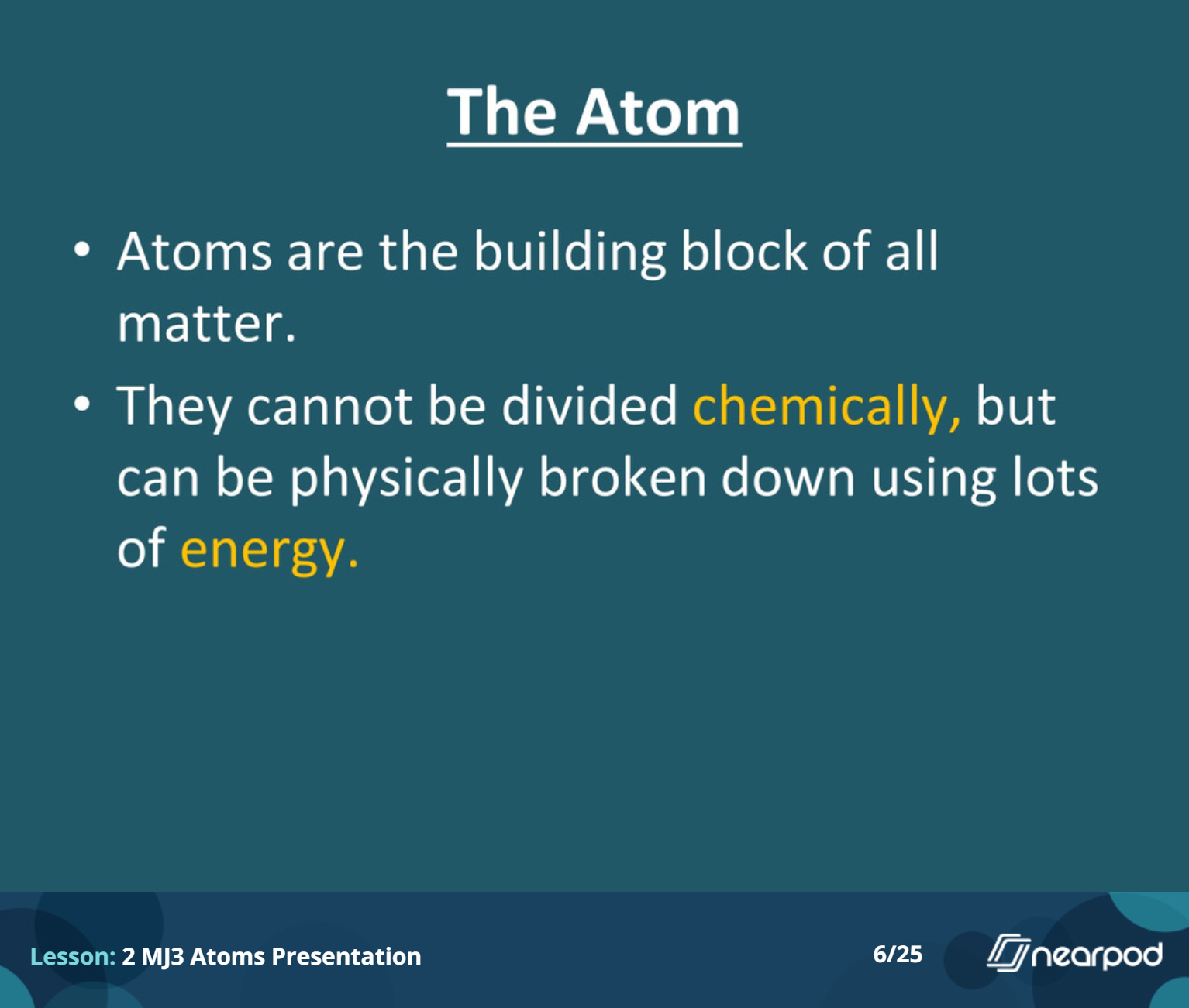
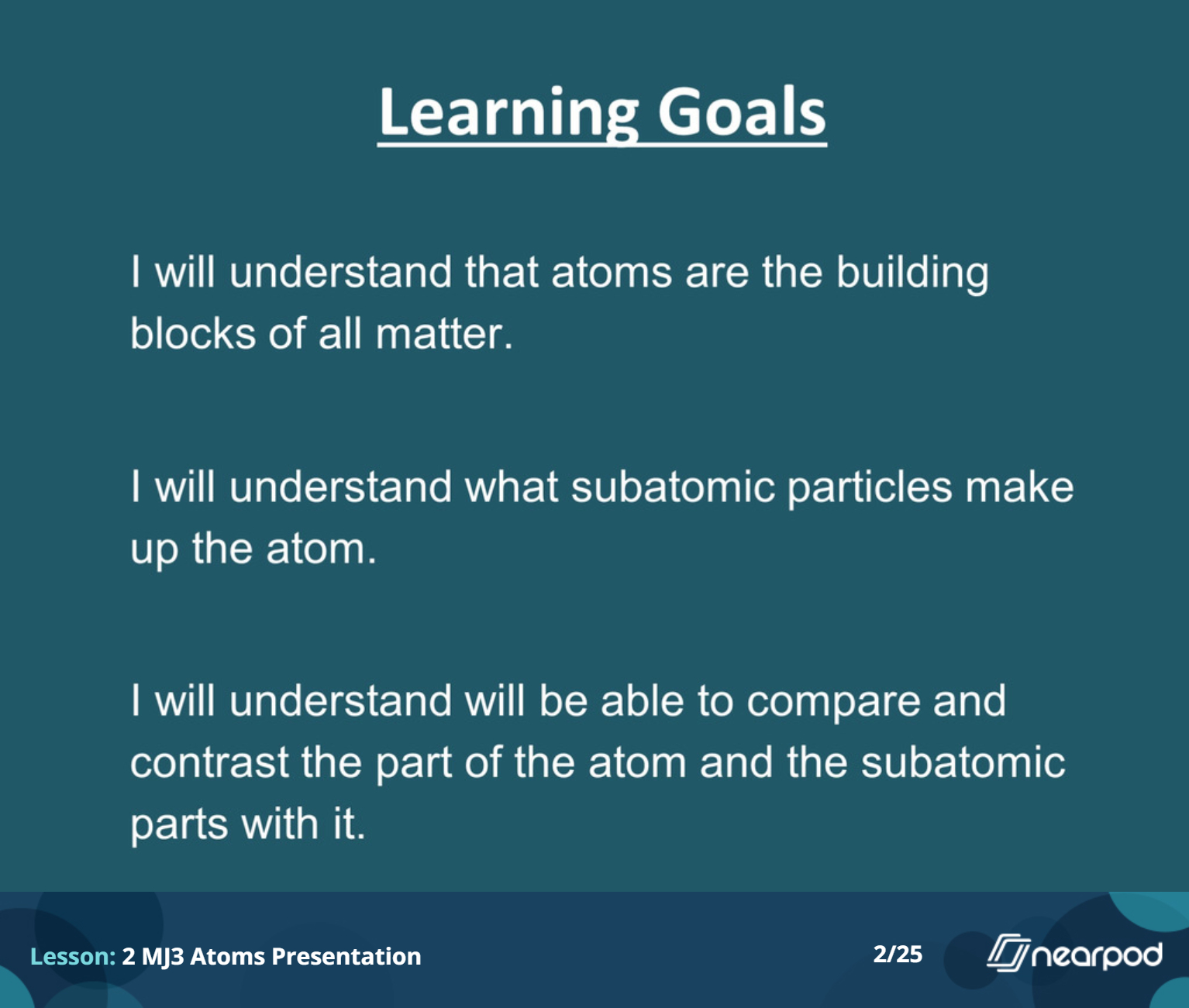
Atoms are the building blocks of all
Show answer
Auto Play
Slide 1 / 37
SLIDE

Similar Resources on Wayground
29 questions
Cell Organelles 7.12D
Presentation
•
7th Grade
33 questions
Atoms and the periodic table
Presentation
•
8th Grade
33 questions
Chemical Bonding
Presentation
•
8th Grade
31 questions
Solutions: Elements, Compounds, and Mixtures
Presentation
•
8th - 9th Grade
26 questions
STAAR 8TH SCIENCE REVIEW
Presentation
•
8th Grade
31 questions
CDB review questions
Presentation
•
8th Grade
30 questions
Unit 1: Nature of Matter-Lesson 1 Vocabulary Review
Presentation
•
8th Grade
31 questions
Cells and organelles lesson and quiz
Presentation
•
8th Grade
Popular Resources on Wayground
10 questions
How much do you know about our Portrait of an Eagle?
Quiz
•
10th Grade
10 questions
Fast Food Slogans
Quiz
•
6th - 8th Grade
21 questions
Continents and Oceans
Quiz
•
6th Grade
20 questions
Parts of Speech
Quiz
•
5th Grade
16 questions
Subject & Predicate
Quiz
•
5th Grade
25 questions
Multiplication Facts
Quiz
•
5th Grade
12 questions
Map Skills
Quiz
•
3rd Grade
22 questions
Continents and Oceans
Quiz
•
5th Grade
Discover more resources for Science
20 questions
Scientific Method and Variables
Quiz
•
8th Grade
20 questions
Scientific method and variables
Quiz
•
8th Grade
27 questions
Counting Atoms - Subscripts
Quiz
•
8th Grade
20 questions
Claim, Evidence and Reasoning (CER)
Quiz
•
6th - 8th Grade
18 questions
Counting Atoms
Quiz
•
7th - 8th Grade
20 questions
Elements, Compounds and Mixtures
Quiz
•
8th Grade
10 questions
Exploring Chemical and Physical Changes
Interactive video
•
6th - 10th Grade
10 questions
Decoding the Periodic Table of Elements
Interactive video
•
6th - 10th Grade