

Photosynthesis and ATP

Presentation
•
Science
•
9th - 12th Grade
•
Practice Problem
•
Medium
+1
Standards-aligned

Barbara White
Used 20+ times
FREE Resource
14 Slides • 11 Questions
1

Photosynthesis and ATP
High School
2
Learning Objectives
Describe the roles of ATP and ADP in storing and releasing cellular energy.
Explain the overall process of photosynthesis, including its reactants and products.
Detail the two major stages of photosynthesis: light-dependent and light-independent reactions.
Identify key structures in the chloroplast and explain the function of chlorophyll.


3
Key Vocabulary
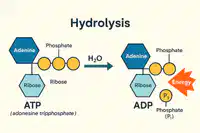
ATP
Adenosine triphosphate is an energy-carrying molecule used by cells to power metabolic and cellular processes.

Photosynthesis
The process where plants use sunlight, water, and carbon dioxide to create their own food.

Chloroplast
An organelle in plant cells where the entire process of photosynthesis takes place.

Chlorophyll
The green pigment in chloroplasts that absorbs light energy from the sun for photosynthesis.

Thylakoid
A sac-like membrane inside chloroplasts where the light-dependent reactions of photosynthesis occur.

Stroma
The fluid-filled space in a chloroplast that surrounds thylakoids and where the Calvin Cycle occurs.
4
ATP: The Cell's Energy Currency
ATP (High Energy)
Adenosine Triphosphate (ATP) is a key molecule that stores energy for cellular activities.
It is a high-energy molecule that features a total of three phosphate groups.
Energy is released for the cell’s use when the bond to the third phosphate group breaks.

ADP (Low Energy)

Adenosine Diphosphate (ADP) is what remains after ATP releases its stored energy.
This lower-energy molecule has only two phosphate groups instead of three.
Energy can be used to add a phosphate group back to ADP, reforming it into ATP.
5
Multiple Choice
How does the ATP-ADP cycle work to store and release energy for the cell?
Energy is stored when a phosphate group is added to ADP to form ATP, and released when a phosphate is removed.
Energy is only stored in ATP and cannot be released.
Energy is stored when a phosphate group is removed from ATP, and released when one is added to ADP.
Energy is released by adding a phosphate group to ATP.
6
What is Photosynthesis?

7
Solved Example 1
A plant produces 2 moles of glucose (C6H12O6) through photosynthesis. How many moles of oxygen (O2) are released? The balanced equation is 6CO2 + 6H2O → C6H12O6 + 6O2.
Step 1: Analyze and Sketch the Problem
Goal: Find the moles of oxygen (O2) produced.
Knowns: Moles of glucose (C6H12O6) = 2 mol.
Unknown: Moles of oxygen (O2).
Formula: The molar ratio between C6H12O6 and O2 is 1:6.
8
Solved Example 1
A plant produces 2 moles of glucose (C6H12O6) through photosynthesis. How many moles of oxygen (O2) are released? The balanced equation is 6CO2 + 6H2O → C6H12O6 + 6O2.
Step 2: Solve for the Unknown
9
Solved Example 1
A plant produces 2 moles of glucose (C6H12O6) through photosynthesis. How many moles of oxygen (O2) are released? The balanced equation is 6CO2 + 6H2O → C6H12O6 + 6O2.
Step 3: Evaluate the Answer
10
Multiple Choice
According to the chemical equation for photosynthesis, what are the primary reactants and products?
Reactants: Water, Carbon Dioxide, and Sunlight; Products: Oxygen and Glucose.
Reactants: ATP and NADPH; Products: Oxygen and Glucose.
Reactants: Oxygen and Glucose; Products: Water, Carbon Dioxide, and Sunlight.
Reactants: Water and Oxygen; Products: Glucose and Carbon Dioxide.
11
Capturing Light Energy
Photosynthesis occurs inside cell organelles known as chloroplasts.
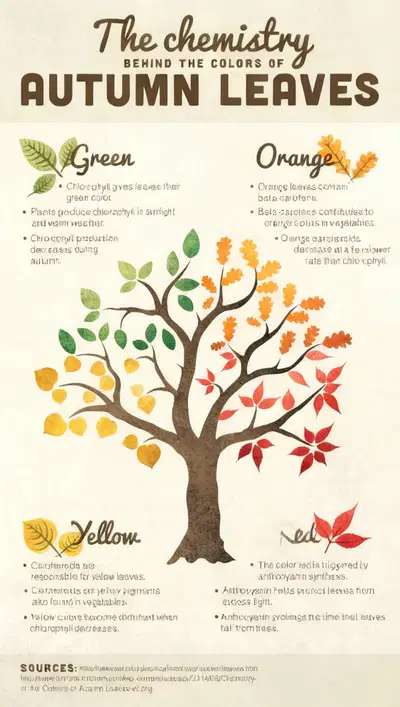
Chlorophyll, the main pigment, absorbs light and gives plants their green color.
When chlorophyll absorbs light, it creates a supply of high-energy electrons.
In the fall, other pigments become visible as chlorophyll starts to break down.

12
Multiple Choice
What is the primary role of chlorophyll in photosynthesis?
To take in carbon dioxide from the atmosphere.
To store glucose after it has been produced.
To give leaves their fall colors by breaking down.
To absorb light energy and transfer it to high-energy electrons.
13
The Machinery of Photosynthesis
A chloroplast is enclosed by an outer and inner membrane, containing several structures.
Thylakoids, stacked into grana, are where the light-dependent reactions happen.
The stroma is the fluid-filled space where the light-independent reactions occur.
Stomata are leaf openings that let carbon dioxide (CO2) enter the plant.


14
Multiple Choice
Where do the light-dependent reactions and the light-independent reactions (Calvin cycle) take place, respectively?
Stomata and Granum
Stroma and Thylakoids
Thylakoids and Stroma
Outer membrane and Inner membrane
15
Phase 1: Light-Dependent Reactions
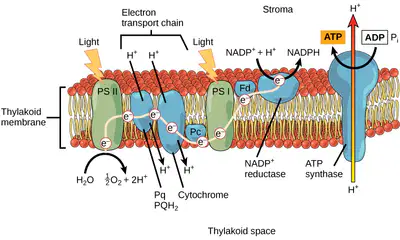
This phase occurs in the thylakoids, using water and sunlight as reactants.
Light energy splits water (H2O), releasing oxygen and providing electrons to Photosystem II.
Hydrogen ions (H+) create a gradient that powers the production of ATP.
NADP+ accepts electrons to make NADPH; both are energy carriers for the next phase.
16
Multiple Choice
What are the main products of the light-dependent reactions that are used to power the next phase of photosynthesis?
Water and Sunlight
ATP and NADPH
Carbon Dioxide and Water
Oxygen and Glucose
17
Phase 2: Light-Independent Reactions (Calvin Cycle)
The Calvin Cycle occurs in the stroma and does not need direct light.
Energy from ATP and NADPH produced in the light-dependent phase is used.
The cycle’s main reactant is carbon dioxide (CO2) from the atmosphere.
The final product is glucose, a sugar used for plant energy and growth.


18
Multiple Choice
What are the essential inputs required for the Calvin Cycle to produce glucose?
Carbon Dioxide, ATP, and NADPH
Water, Sunlight, and Oxygen
Oxygen and ATP
Sunlight and Carbon Dioxide
19
Common Misconceptions about Photosynthesis
Misconception | Correction |
|---|---|
Photosynthesis is the plant's 'breathing'. | Plants 'breathe' through respiration. Photosynthesis is for making food. |
Light-independent reactions only happen at night. | They occur during the day, using products from light-dependent reactions. |
All parts of a plant can photosynthesize. | Photosynthesis mainly occurs in leaves and stems, not in the roots. |
Plants get their food from the soil. | Plants create their own food (glucose) through photosynthesis, not from soil. |
20
Multiple Choice
Why is the splitting of water essential for the light-dependent reactions to continue?
It provides the carbon atoms needed to build glucose.
It replaces the high-energy electrons that are passed to the electron transport chain.
It creates the NADPH needed for the Calvin Cycle.
It releases oxygen, which powers ATP synthase.
21
Multiple Choice
What is the direct relationship between the light-dependent and light-independent reactions?
The light-dependent reactions produce glucose, which the light-independent reactions break down.
The light-independent reactions produce oxygen, which is used by the light-dependent reactions.
There is no relationship; they are separate processes that occur at different times.
The light-dependent reactions produce ATP and NADPH, which power the light-independent reactions to make sugar.
22
Multiple Choice
A scientist discovers a plant with a mutation that causes its stomata to be closed all the time. How would this most likely impact the Calvin Cycle?
The cycle would produce oxygen instead of sugars.
The cycle would accelerate because more water is conserved.
The cycle would halt because it cannot take in the CO2 needed to produce sugars.
The cycle would not be affected because it is dependent on light, not CO2.
23
Multiple Choice
Imagine a plant is exposed to light that only contains green wavelengths. What would be the predicted outcome for photosynthesis and why?
Photosynthesis would produce a different type of sugar.
Photosynthesis rates would be very high because plants are green.
Photosynthesis would stop completely, but the plant would survive on stored energy.
Photosynthesis rates would be very low because chlorophyll primarily reflects green light, rather than absorbing it.
24
Summary
25
Poll
On a scale of 1-4, how confident are you with the key concepts of photosynthesis and ATP covered today?
1
2
3
4
Photosynthesis and ATP
High School
Show answer
Auto Play
Slide 1 / 25
SLIDE
Similar Resources on Wayground

19 questions
Periodic Trends Lesson
Presentation
•
10th - 12th Grade
22 questions
Accuracy v. Precision, Sig Figs, and Scientific Notation
Presentation
•
9th - 12th Grade
21 questions
Introduction to the Integumentary System
Presentation
•
9th - 12th Grade
17 questions
Atmosphere and Climate Change
Presentation
•
9th - 12th Grade
20 questions
Photosynthesis
Presentation
•
9th - 11th Grade
20 questions
Periodic Trends
Presentation
•
10th - 12th Grade
19 questions
history of atom
Presentation
•
10th - 12th Grade
Popular Resources on Wayground
6 questions
PRIDE Always and Everywhere
Presentation
•
12th Grade
20 questions
Lab Safety Quiz

Quiz
•
6th Grade
26 questions
KOR Review Kahoot Questions
Quiz
•
8th Grade
21 questions
Continents and Oceans
Quiz
•
6th Grade
12 questions
Unit Zero lesson 2 cafeteria
Presentation
•
9th - 12th Grade
20 questions
Parts of Speech
Quiz
•
5th Grade
10 questions
Riddles Riddles fun Riddles
Quiz
•
6th - 12th Grade
16 questions
Subject & Predicate
Quiz
•
5th Grade
Discover more resources for Science
10 questions
Scientific Method (The scientific method)

Interactive video
•
9th Grade
10 questions
Exploring Chemical and Physical Changes
Interactive video
•
6th - 10th Grade
10 questions
Exploring the States of Matter
Interactive video
•
6th - 10th Grade
20 questions
Atomic Structure
Quiz
•
9th Grade
30 questions
Atomic Structure and Periodic Table Review
Quiz
•
10th Grade
9 questions
Exploring the Steps of the Scientific Method
Interactive video
•
6th - 10th Grade
16 questions
Identify Key Characteristics of Living Organisms
Quiz
•
9th - 12th Grade
20 questions
Photosynthesis
Quiz
•
9th Grade