

Work, Power, and Energy

Presentation
•
Science
•
9th - 12th Grade
•
Medium
+2
Standards-aligned

Barbara White
Used 40+ times
FREE Resource
27 Slides • 12 Questions
1

Work, Power, and Energy
High School
2
Learning Objectives
Describe the relationship between work and energy.
Explain that power is the rate at which work is done.
Identify different forms of energy and their transformations.
Recognize the purpose of simple machines and the concept of efficiency.


3
Key Vocabulary

Work
The transfer of energy that results in an object's movement due to an applied force.

Energy
The ability to do work or cause a change in a system or an object.
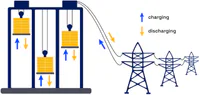
Power
The rate at which work is done or the amount of energy transferred per unit time.
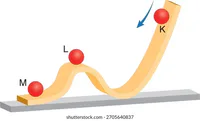
Kinetic Energy
The energy an object possesses due to its motion, dependent on its mass and speed.
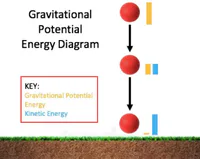
Potential Energy
Stored energy an object has due to its position or state, such as gravitational potential energy.
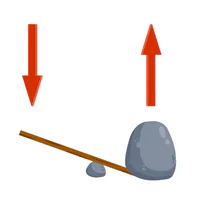
Machines
Devices that help us do work by changing the force applied or the direction of the force.
4
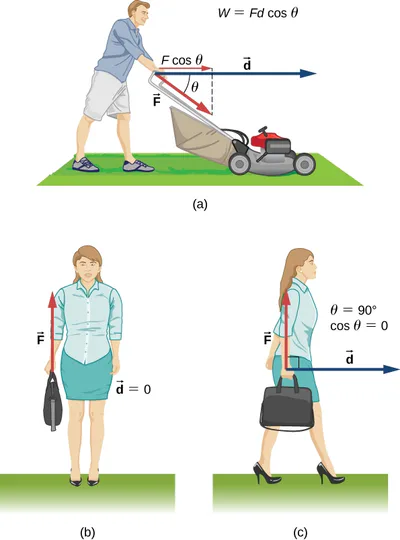
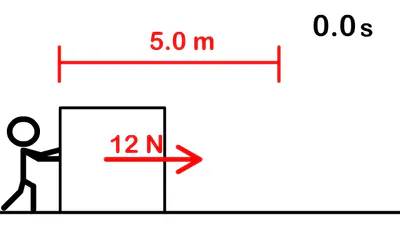
What is Scientific Work?
5
Solved Example 1
A person pushes a box with a force of 50 Newtons over a distance of 10 meters. How much work is done on the box?
Step 1: Analyze and Sketch the Problem
6
Solved Example 1
A person pushes a box with a force of 50 Newtons over a distance of 10 meters. How much work is done on the box?
Step 2: Solve for the Unknown
Substitute the known values into the work formula: W = 50 N × 10 m.
Calculate the result: W = 500 J.
7
Solved Example 1
A person pushes a box with a force of 50 Newtons over a distance of 10 meters. How much work is done on the box?
Step 3: Evaluate the Answer
The unit for work is the Joule (J), which is correct.
The calculation correctly multiplies force by distance. The answer is positive, indicating work was done on the object, which is consistent with the problem.
8
Multiple Choice
Under which of these conditions is scientific work being done?
Pushing against a car that will not move.
Thinking hard to solve a math problem.
Holding a heavy box in your arms.
Lifting a backpack from the floor to the table.
9
Energy: The Ability to Do Work
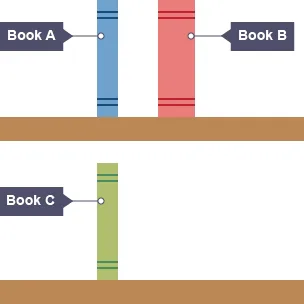
Potential Energy (PE)
Potential energy is the stored energy of an object based on its position or state.
A book held above the ground is an example of gravitational potential energy.
The SI unit for energy is the Joule (J), the same as for work.
Kinetic Energy (KE)
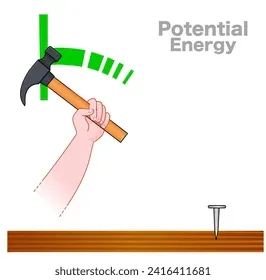
Kinetic energy is the energy an object possesses due to its motion.
Any object that is moving, like a falling book, has kinetic energy.
The amount of kinetic energy depends on the object's mass and velocity.
10
Solved Example 2
What is the gravitational potential energy of a 2 kg book that has been lifted to a shelf 1.5 meters high? (Use g = 9.8 m/s2)
Step 1: Analyze and Sketch the Problem
11
Solved Example 2
What is the gravitational potential energy of a 2 kg book that has been lifted to a shelf 1.5 meters high? (Use g = 9.8 m/s2)
Step 2: Solve for the Unknown
12
Solved Example 2
What is the gravitational potential energy of a 2 kg book that has been lifted to a shelf 1.5 meters high? (Use g = 9.8 m/s2)
Step 3: Evaluate the Answer
The calculation results in Joules, the correct SI unit for energy.
The answer is positive, which makes sense as the book gained potential energy by being lifted. The magnitude is reasonable for the given mass and height.
13
Multiple Choice
What are the two main classifications of energy?
Stored and Moving
Force and Motion
Joules and Watts
Potential and Kinetic
14
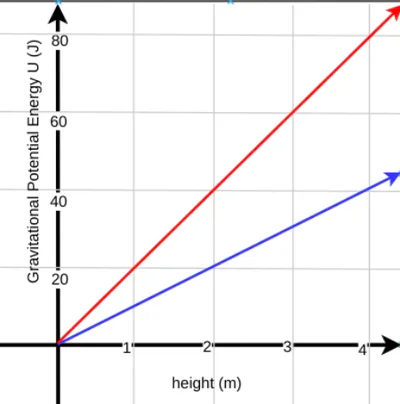
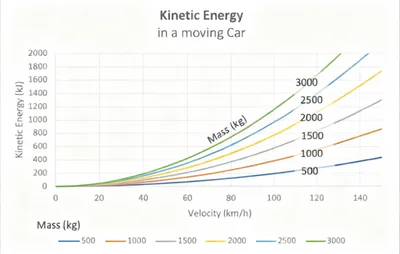
Calculating Potential and Kinetic Energy
Gravitational Potential
Kinetic Energy
15
Multiple Choice
Which of the following would cause the largest increase in an object's kinetic energy?
Doubling the object's speed.
Doubling the object's mass.
Halving the object's mass.
Halving the object's speed.
16
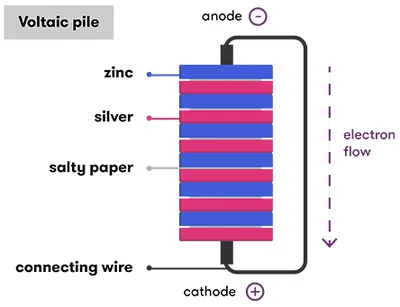
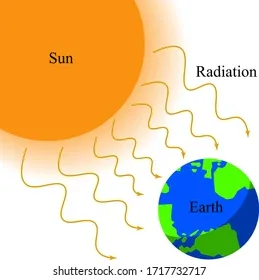
Different Forms of Energy
17
Multiple Choice
Energy stored in the food you eat is an example of which form of energy?
Nuclear Energy
Thermal Energy
Mechanical Energy
Chemical Energy
18
Energy Transformations and Conservation
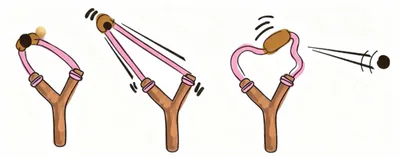
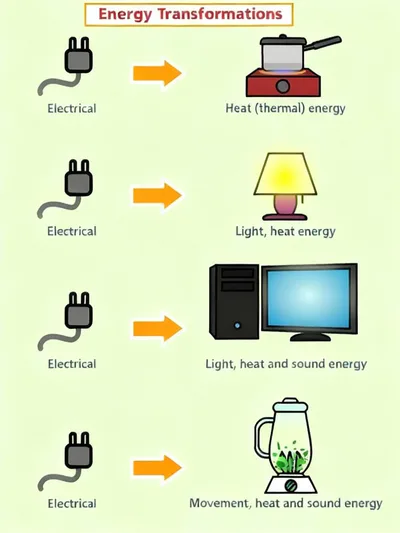
Energy is never created or destroyed, it only changes from one form to another.
For example, a television transforms electrical energy into light and sound energy.
A stretched rubber band’s potential energy becomes kinetic energy when it is released.
The First Law of Thermodynamics reinforces the idea of energy conservation.
19
Solved Example 5
A 5 kg object is held at 10 meters high. What is its potential energy at the top and its speed just before hitting the ground, assuming no air resistance?
Step 1: Analyze and Sketch the Problem
20
Solved Example 5
A 5 kg object is held at 10 meters high. What is its potential energy at the top and its speed just before hitting the ground, assuming no air resistance?
Step 2: Solve for the Unknown
21
Solved Example 5
A 5 kg object is held at 10 meters high. What is its potential energy at the top and its speed just before hitting the ground, assuming no air resistance?
Step 3: Evaluate the Answer
22
Multiple Choice
According to the Law of Conservation of Energy, what happens to energy in any transformation?
New energy is created to make the transformation possible.
Energy is lost as heat and cannot be accounted for.
Some energy is destroyed in the process.
Energy is converted from one form to another, but the total amount remains constant.
23
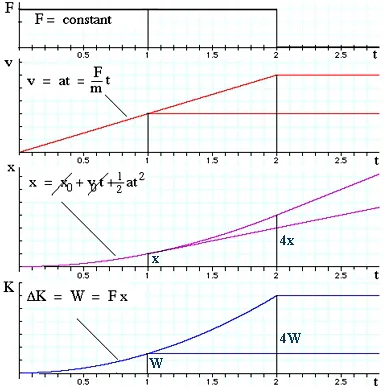
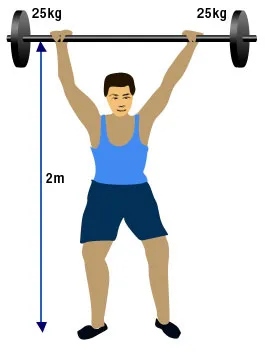
What is Power?
24
Solved Example 6
A powerful motor completes 5,000 Joules of work in 20 seconds. Calculate the power generated by the motor in Watts.
Step 1: Analyze and Sketch the Problem
25
Solved Example 6
A powerful motor completes 5,000 Joules of work in 20 seconds. Calculate the power generated by the motor in Watts.
Step 2: Solve for the Unknown
26
Solved Example 6
A powerful motor completes 5,000 Joules of work in 20 seconds. Calculate the power generated by the motor in Watts.
Step 3: Evaluate the Answer
27
Multiple Choice
How is power defined in physics?
The ability to cause change.
The rate at which work is done.
The strength of a force.
The total amount of work done.
28
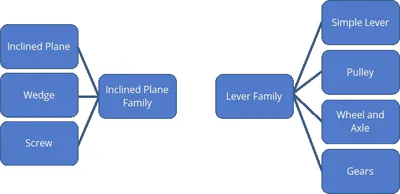
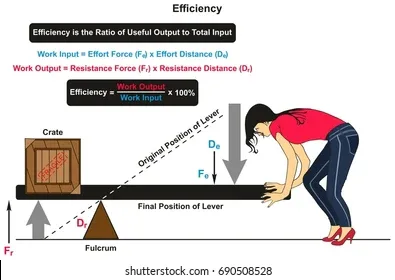
Machines and Efficiency
29
Solved Example 7
A mover does 1500 J of work to push a box up a ramp. The work done on the box to raise it is 1200 J. What is the efficiency of the ramp?
Step 1: Analyze and Sketch the Problem
Goal: Calculate the efficiency of the ramp.
Knowns: Total Work Input = 1500 J; Useful Work Output = 1200 J.
Unknown: Efficiency (Eff) = ?
Formula: Efficiency is the ratio of useful work output to total work input, often expressed as a percentage.
30
Solved Example 7
A mover does 1500 J of work to push a box up a ramp. The work done on the box to raise it is 1200 J. What is the efficiency of the ramp?
Step 2: Solve for the Unknown
31
Solved Example 7
A mover does 1500 J of work to push a box up a ramp. The work done on the box to raise it is 1200 J. What is the efficiency of the ramp?
Step 3: Evaluate the Answer
32
Multiple Choice
Why can a machine never be 100% efficient?
Because machines cannot produce more energy than is put in.
Because machines are designed to do only one type of work.
Because some work is always converted into non-useful forms like heat due to friction.
Because the force applied is always greater than the output force.
33
Common Misconceptions about Work, Energy, and Power
Misconception | Correction |
|---|---|
Any effort or exertion is considered work. | Work is done only when a force causes movement. |
Energy can be "used up" or destroyed. | Energy is conserved; it only changes from one form to another. |
Power and strength are the same thing. | Power is the rate at which work is done. |
Machines are able to create energy. | Machines only transfer energy; they cannot create it. |
34
Multiple Choice
A student lifts a 2 kg box from the floor to a shelf 1.5 meters high in 2 seconds. How would the power exerted change if they lifted the same box to the same shelf in 1 second?
The power would be doubled.
The power would be quartered.
The power would remain the same.
The power would be halved.
35
Multiple Choice
A roller coaster car is at the top of its first and highest hill. Which statement best describes the relationship between its potential and kinetic energy at this point?
Its potential energy is at its maximum, and its kinetic energy is near zero.
It has no potential or kinetic energy.
Its potential and kinetic energy are equal.
Its kinetic energy is at its maximum, and its potential energy is at its minimum.
36
Multiple Choice
A car's engine converts the chemical energy in gasoline into thermal and mechanical energy to move the car. Analyze this process in the context of the Law of Conservation of Energy and efficiency.
The total energy is conserved, but not all of it becomes useful mechanical energy; much is lost as heat.
The car creates new mechanical energy to overcome friction.
The process is 100% efficient as all chemical energy becomes motion.
Energy is lost, violating the Law of Conservation of Energy.
37
Multiple Choice
Imagine two cranes lifting identical steel beams to the same height. Crane A lifts the beam in 10 seconds, while Crane B lifts it in 20 seconds. What can you conclude about the work done and power exerted by each crane?
Crane B does more work but exerts less power.
Crane A does more work and exerts more power.
Both cranes do the same work, and they exert the same amount of power.
Both cranes do the same work, but Crane A exerts more power.
38
Summary
39
Poll
On a scale of 1-4, how confident are you about the concepts of work, power, and energy?
1
2
3
4
Work, Power, and Energy
High School
Show answer
Auto Play
Slide 1 / 39
SLIDE
Similar Resources on Wayground

30 questions
Eukaryotic Cell Structure
Presentation
•
9th - 12th Grade
38 questions
Newton's Third law
Presentation
•
9th - 12th Grade
30 questions
Evidence of Evolution
Presentation
•
9th - 12th Grade
35 questions
Acids and Bases Review Lesson
Presentation
•
9th - 12th Grade
33 questions
Energy & Energy Transformations
Presentation
•
9th - 12th Grade
34 questions
Skeletal System (Part 1)
Presentation
•
9th - 12th Grade
33 questions
Population Ecology Review
Presentation
•
9th - 12th Grade
36 questions
Plant Hormones and Responses (Tropisms)
Presentation
•
9th - 12th Grade
Popular Resources on Wayground
10 questions
Impact of 9/11 and the War on Terror

Interactive video
•
10th - 12th Grade
21 questions
Continents and Oceans

Quiz
•
6th Grade
5 questions
9/11
Interactive video
•
9th Grade
20 questions
Parts of Speech
Quiz
•
5th Grade
16 questions
Subject & Predicate
Quiz
•
5th Grade
10 questions
Riddles Riddles fun Riddles
Quiz
•
6th - 12th Grade
21 questions
Lab Safety
Quiz
•
10th Grade
6 questions
PRIDE in the Hallways and Bathrooms
Presentation
•
12th Grade
Discover more resources for Science
10 questions
Exploring Chemical and Physical Changes
Interactive video
•
6th - 10th Grade
20 questions
Atomic Structure
Quiz
•
9th Grade
30 questions
Atomic Structure and Periodic Table Review
Quiz
•
10th Grade
21 questions
Cell Organelles
Quiz
•
9th Grade
20 questions
Observation vs. Inference
Quiz
•
7th - 9th Grade
20 questions
ELEMENTS, COMPOUNDS, AND MIXTURES
Quiz
•
9th Grade
10 questions
Physical and Chemical Changes
Quiz
•
5th - 10th Grade
43 questions
1st SW Vocab Biology
Quiz
•
9th Grade