Search Header Logo
U1 L4 Assignment

U1 L4 Assignment

Assessment

Presentation

Social Studies

9th - 12th Grade

Hard

Created by

DALLAS GILLELAND

FREE Resource

2 Slides • 5 Questions

1

​Unit 1, Lecture 4 Assignment

By DALLAS GILLELAND

2

Lesson Objective

Students will explain how the public sphere and new forms of communication during the Enlightenment allowed ideas to spread beyond traditional authority and challenge political and religious power.

3

Multiple Choice

The "Public Sphere" refers to what during the enlightenment period?

1
A forum for government announcements.
2
A place for private gatherings.
3
A venue for artistic performances.
4
A space for public discussion and debate.

4

Open Ended

Question image

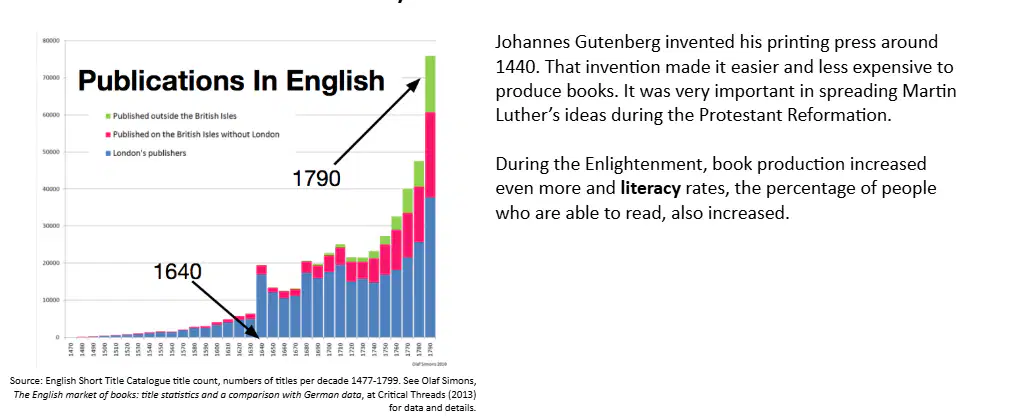
How might increased book production and literacy have contributed to the start of the Enlightenment?

Hint: Consider how being able to read books for yourself—instead of relying on churches or rulers—might change the way people think about authority and truth.

5

Open Ended
Question image

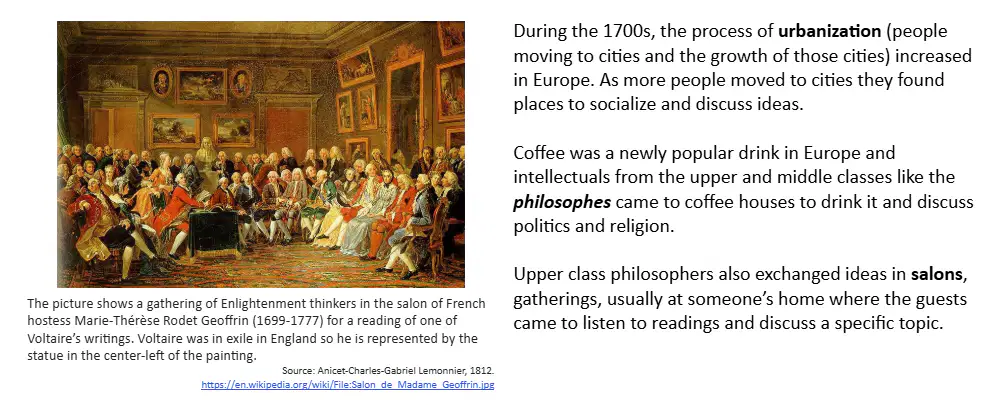
How might urbanization, salons, and coffeehouse have contributed to the start of the Enlightenment?

Hint: Consider how cities, salons, and coffeehouses created spaces where people could talk, debate, and hear new ideas more often than before.

6

Open Ended

During the Enlightenment, thinkers across Europe formed an informal communication network known as the Republic of Letters. Philosophers, scientists, and writers exchanged letters, essays, and research with one another across national borders.

This network was not controlled by any government or church. Instead, it relied on personal connections and shared curiosity. Thinkers debated ideas, challenged each other’s conclusions, and built on one another’s work even when they lived in different countries.

Because communication crossed borders, rulers found it harder to control the spread of ideas. An idea banned in one country might still circulate through private letters or be published elsewhere. As a result, knowledge became more international and less dependent on government approval.

The Republic of Letters helped weaken traditional authority by allowing people to share ideas freely, compare viewpoints, and question established beliefs. It supported the Enlightenment belief that reason and knowledge should be shared openly rather than controlled by powerful institutions.

In what ways did the Republic of Letters function like the modern-day internet when it came to sharing ideas and limiting government control over information?

Hint: Think about how ideas spread quickly across long distances when people can communicate directly with one another, and how that makes it harder for governments to control information.

7

Open Ended

Why did the spread of ideas through the public sphere make political change more likely, even before any revolutions began? Think about why "Enlightened Despots refused to give people power and wanted to keep all the control.

Hint: Ask yourself: How could talking, reading, and debating ideas make people more willing to challenge leaders later on?

​Unit 1, Lecture 4 Assignment

By DALLAS GILLELAND

Show answer

Auto Play

Slide 1 / 7

SLIDE