Search Header Logo
  1. Resource Library
  2. Science
  3. Biology
  4. ...
  5. Evidence Of Evolution Day 1
Evidence of Evolution Day 1

Evidence of Evolution Day 1

Assessment

Presentation

Science

9th Grade

Medium

NGSS
MS-LS4-2, HS-LS4-1, MS-LS1-1

+4

Standards-aligned

Created by

A T

Used 2+ times

FREE Resource

11 Slides • 29 Questions

1

​Evidence of Evolution

By A T

​Day 1 Student Notes

media

2

media
media

​II. Anatomical Structures

NOTES

3

Multiple Choice

What is the definition of analogous structures?

1

Structures that have similar functions but different evolutionary origins.

2

Structures that have different functions but similar evolutionary origins.

3

Structures that have similar functions and similar evolutionary origins.

4

Structures that have similar functions but different functions.

4

media

5

Multiple Choice

Question image

Use the previous slide to answer the question.

  Notice the similarities of a shark and dolphin.  If these similarities developed by  common life experiences and not by common ancestry, which of the following vocabulary words would best describe them?

1

Vestigial Organ

2

   Embryological Similarities

3

Homologous Structures

4

Analogous Structures

6

Multiple Choice

Provide an example of analogous structures.

1

Bat wings and fish fins.

2

Bird wings and butterfly wings

3

Human arms and dog legs.

4

Spider legs and crab legs.

7

media

​II. Anatomical Structures

media

NOTES

8

media

9

Multiple Select

Question image

According to the previous slide, which of the following are functions used by the pentadactyl limb?

Choose all that apply.

1

Swimming

2

Digging

3

Grasping

4

Climbing

10

Multiple Choice

Question image

The forelimbs of humans and dogs are shown in the picture. This is an example of...

1

analogous structures, which are evidence of common ancestry

2

homologous structures, which are evidence of common ancestry

3

analogous structures, which are not evidence of common ancestry

4

homologous structures, which are not evidence of common ancestry

11

Multiple Choice

Question image

Some organisms that share a common ancestor have features that have different functions, but similar structures.  These are known as -

1
vestigial structures
2
analogous structures
3
homologous structures
4
fossil structures

12

Multiple Choice

Humans, birds, whales, and lizards all have similar arm bones. What is the reason for this?
1
The function of these bones is the same in all animals
2
They live in similar environments
3
They have a common ancestor
4
All organisms resemble humans

13

Multiple Choice

Question image

The limbs of several organisms are shown in the illustrations below. Scientists sometimes compare the limbs of these organisms to look for evidence of common ancestry. These limbs provide evidence of common ancestry because they -

1

have the same basic structure

2

perform the same function

3

are the same size

4

are parts of mammals

14

media

​II. Anatomical Structures

media
media

Limb buds in snakes

media
media

NOTES

15

media

16

Multiple Choice

Which of the following best describes vestigial structures?

1

Structures that are fully functional and essential for survival.

2

Structures that have lost all or most of their original function in the course of evolution.

3

Structures that have evolved to perform a new function.

4

Structures that are found only in embryonic stages.

17

Multiple Choice

Question image

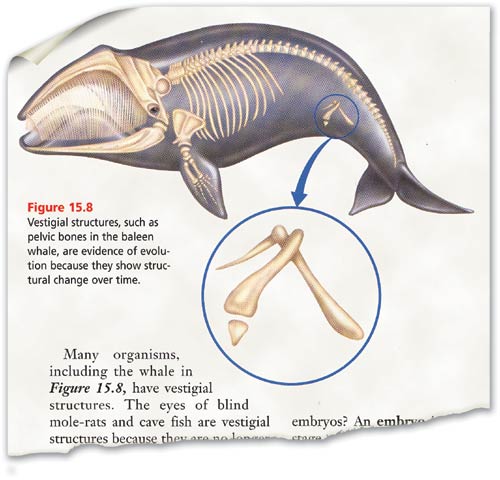
Whales have pelvic bones. What type of structure does this best represent?

1

Homologous structure

2

Analogous structure

3

Vestigial structure

4

None of the above

18

Multiple Choice

Question image
Which of the following is an example of a vestigial structure?
1
the wings of a red-tailed hawk
2
the hind limbs of a house cat
3
the fins of sharks
4
the tailbone of a human

19

media
media

​Activity 3:
Coloring Homologous Structures

NOTES

20

​1. The bones in a human arm, bird wing, and bat wing are considered ____________________ structures.

2. Since they have
homologous structures, what does this tell us about their ancestors?
A. All 3 have a common ancestor
B. Only the bird and bat have a common ancestor.
C. Only the human and bat have a common ancestor.

​Activity 3: Answer on your paper

21

Multiple Choice

2. Since they have homologous structures, what does this tell us about their ancestors?
A. All 3 have a common ancestor
B. Only the bird and bat have a common ancestor.
C. Only the human and bat have a common ancestor.

1

A

2

B

3

C

22

media

NOTES

23

Multiple Choice

Question image

Fossils of the Durodon, an aquatic mammal that lived over 40 million years ago, provide scientists with evidence for the ancestry of the modern whale. These fossils contained vestigial, or small, underdeveloped hind limbs. This feature helps scientists conclude that the Durodon probably:

1

Was a mix of many

different types of animals.

2

Descended from animals that could walk on land.

3

Was the apex predator

of the ancient aquatic food chain.

4

Needed strong back limbs to propel them through the water.

24

Multiple Choice

Biogeography is the study of the location of organisms around the world. Which of the following best explains how biogeography can provide evidence for evolution?

1

It shows that organisms have structures that serve no purpose but that resemble structural roles in related organisms.

2

It shows that there are similarities and differences among the DNA of different species.

3

It shows that organisms have changed gradually over millions of years.

4

It shows that some organisms that are unrelated have developed similar adaptations to similar environment.

25

media

26

Multiple Choice

Question image

What is the endosymbiotic theory?

1

A theory that explains the origin of eukaryotic cells from prokaryotic organisms.

2

A theory that describes the process of photosynthesis in plants.

3

A theory that explains the formation of the ozone layer.

4

A theory that describes the evolution of multicellular organisms.

27

Multiple Choice

Question image

Which organelles are believed to have originated through endosymbiosis?

1

Ribosomes and lysosomes

2

Mitochondria and chloroplasts

3

Golgi apparatus and endoplasmic reticulum

4

Nucleus and nucleolus

28

Multiple Choice

What evidence supports the endosymbiotic theory regarding mitochondria and chloroplasts?

1

They have their own DNA, which is similar to bacterial DNA.

2

They are surrounded by a single membrane.

3

They can survive independently outside the cell.

4

They are involved in protein synthesis.

29

Multiple Choice

Question image

What is a key difference between prokaryotic and eukaryotic cells that supports the endosymbiotic theory?

1

Eukaryotic cells have a nucleus, while prokaryotic cells do not.

2

Prokaryotic cells have mitochondria, while eukaryotic cells do not.

3

Eukaryotic cells lack any membrane-bound organelles.

4

Prokaryotic cells have chloroplasts, while eukaryotic cells do not.

30

Multiple Choice

Question image

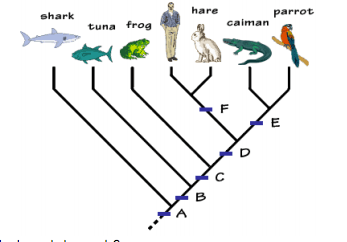
On the cladogram, which organism is the closest relative of the parrot?

1

Frog

2

Hare

3

Caiman

4

Parrot

31

Multiple Choice

Question image

What is the common ancestor of Letters C and E?

1

1

2

2

3

3

4

4

32

Multiple Choice

Question image

Who is most closely related to Taxidea taxus?

1

Lutra lutra

2

Panthera pardus

3

Canis latrans

4

Canis lupus

33

Multiple Choice

Question image

Which group of animals on this tree are most closely related to birds?

1

Saurischian dinosaurs

2

Ornithischian dinosaurs

3

Crocodiles

4

None of these are related to birds

34

Multiple Choice

Question image

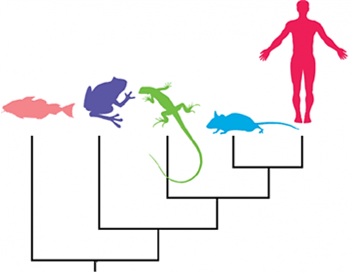
According to this phylogenetic tree, which creature is the least related out of all pictured?

1

Fish

2

Frog

3

Salamander

4

Human

35

Multiple Choice

Question image

The cladogram shown is a model used by scientists to represent the order in which they hypothesize organisms descended from a common ancestor based on the appearance of derived characteristics.

Which of the following traits do the salamander and the lizard share?

1

Jaws only

2

Jaws and Lungs

3

Claws or nails

4

Jaws, Lungs, and Claws or nails

36

Multiple Choice

Question image

Which trait (adaptation) was developed most recently?

1

tetrapod limbs

2

feathers

3

amnion

4

They developed at the same time

37

Multiple Choice

Why are advantageous traits more likely to be passed onto offspring?
1
Because they are more likely to survive and reproduce.
2
Because they come from dominant alleles.
3
Because they come from recessive alleles.
4
Because the trait is an acquired phenotype.

38

Multiple Choice

Question image

Which trait should go where A is on the cladogram?

1

eyes

2

feet

3

lips

4

hat

39

Multiple Choice

Question image

Which organism goes in the B position?

1
2
3
4

40

Multiple Choice

Which of the following statements is true?

1

Prokaryotic cells are always multicellular, eukaryotic cells can be unicellular or multicellular

2

Eukaryotic cells include fungi, protists, plants, and animals; prokaryotic cells include bacteria

3

Paramecium, a unicellular organism, is prokaryotic

4

Since it is made of many cells, a bacterial colony is a multicellular organism

​Evidence of Evolution

By A T

​Day 1 Student Notes

media

Show answer

Auto Play

Slide 1 / 40

SLIDE