Life Science Check In Science
Presentation
•
Science
•
6th - 8th Grade
•
Easy
+24
Standards-aligned
Angalel Dixon
Used 1+ times
FREE Resource
25 Slides • 77 Questions
1
2
3
4
5
Multiple Choice
What is a principal that states that geologic processes that occurred in the past can be explained by current geologic processes.
Catastrophism
Unconformity
Uniformitarianism
Angular Unconformity
6
Multiple Choice
True or false: The tectonic plates will never stop moving
True
False
7
Multiple Choice
8
Multiple Choice
Identify this type of plate movement
Divergent Boundary
Convergent Boundary
Transform Boundary
None
9
Multiple Choice
Identify this type of plate movement
Divergent Boundary
Convergent Boundary
Transform Boundary
None
10
Multiple Choice
Around 200 – 250 million years ago ______ started to break into separate plates.
Oceans
China
Pangea
None
11
Multiple Choice
Identify this type of plate movement
Divergent Boundary
Convergent Boundary
Transform Boundary
None
12
Multiple Choice
The movement of the tectonic plates is caused by
the rotation of the Earth.
convection currents in the Mantle
the gravity of the iron-nickel core.
the Moho discontinuity.
13
Multiple Choice
14
Evidence of Change
Law of superposition- In an undisturbed sequence of sedimentary rock layers, each layer or fossil is younger than the one below it and older than the one above it.
15
16
17
Multiple Choice
Which of the following orders the rock layers accurately from oldest to youngest?
1, 2, 3, 4, 5
5, 4, 3, 2, 1
2, 3, 4, 5, 1
1, 2, 3, 5, 4
18
Multiple Choice
What evidence was used to support Continental Drift?
Continents fitting together like a puzzle
Fossils of Ferns on Antarctica
Similar mountain ranges on different continents
All of the above
19
Multiple Choice
What type of plate boundary is the Mid-Ocean Ridge?
Divergent
Convergent
Transform
20
Multiple Choice
If you took rock samples from the Mid-Atlantic Ridge, the youngest rock would be
located where the plates collide
located at the place where rocks are furthest from the rift valley
Located at the center of the ridge (rift valley), where oceanic crust is formed
none of the above; all the rocks would be the same age
21
Multiple Choice
22
Multiple Choice
Fossils of animals without wings or swimming speeds can be found in South America and Africa. This supports that those continents used to be together because...
The animals had to be able to walk from place to place
The animals used to have wings but don't anymore
The fossils moved to the area AFTER the continents moved
This doesn't support continental drift
23
24
25
Multiple Choice
26
Multiple Choice
Any change in the sequence of DNA is a
recombination
mutation
chromatin
independent assortment
27
Multiple Choice
Genetic _________________ allow some organisms to be better adapted to the environment.
variations
domination
repeats
weakness
28
Multiple Choice
29
Multiple Choice
How do you "win" at natural selection?
survive
go extinct
survive & reproduce
30
Multiple Choice
31
Multiple Choice
32
Multiple Choice
33
Multiple Choice
Individuals that are better able to cope with the challenges of their environment tend to
Increase in population over time.
Decrease in population over time.
Leave fewer offspring than those less suited to the environment.
Both (a) and (c)
34
35
36
Multiple Choice
37
Multiple Choice
38
Multiple Choice
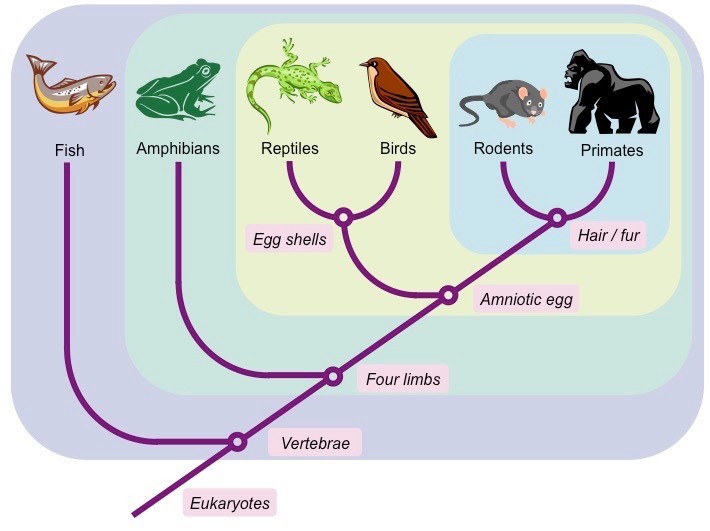
What characteristic distinguishes amphibians from birds and reptiles?
Amniotic egg
Egg shells
Vertebrae
Hair/fur
39
40
Multiple Choice
Fossils provide evidence of organisms that lived in the past.
true
false
41
Multiple Choice
Provides evidence about the existence of species, the order in which they have existed through time, and how they have changed over time.
extinction
fossil record
DNA
42
Multiple Choice
Fossils that help fill in the gaps between two groups of organisms.
transitional fossils
fossil record
amber fossils
cast fossils
43
44
Multiple Choice
45
Multiple Choice
46
Multiple Choice
47
Multiple Choice
48
Multiple Choice
49
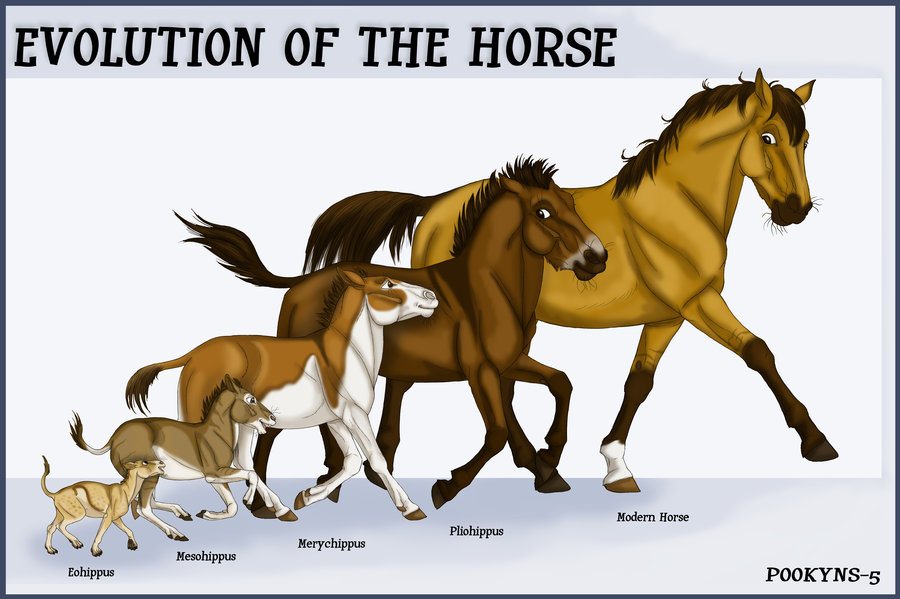
Multiple Choice
50
Multiple Choice
51
Multiple Choice
52
Multiple Choice
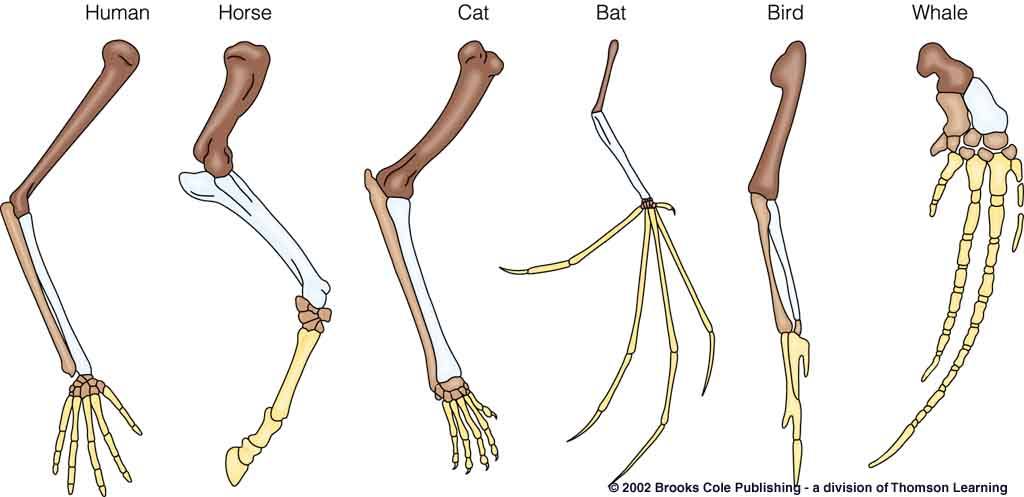
structures that have lost their original function through evolution
homologous structure
analogous structure
comparative anatomy
vestigial structure
53
54
Multiple Choice
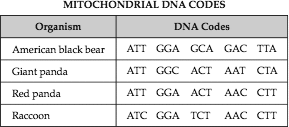
What conclusions can be made based on this table shown?
the American black bear and the giant panda are most closely related
the giant panda and the red panda are most closely related
the red panda and the racoon are the most closely related
the giant panda and the racoon are most closely related
55
Multiple Choice
56
Multiple Choice
57
58
Multiple Choice
In the cartoon below, Canus nipponicus refers to a proposed scientific name for an imaginary organism. This proposed scientific name indicates the
kingdom and phylum
phylum and genus
genus and species
kingdom and species
59
Multiple Choice
What kingdom contains multicellular organisms that use photosynthesis to meet their energy demands?
Plants
Animals
Fungi
Protista
60
Multiple Choice
What is the name of the kingdom that contains multicellular organisms that use cellular respiration to maintain their energy demands of their cells?
Protista
Animals
Archeabacteria
Plants
61
Multiple Choice
What is the most broad way life could be grouped according to the classification system?
Kingdom
Domain
Class
Family
62
Multiple Choice
63
64
65
Multiple Choice

All living things or organisms in an ecosystem are
None
biotic factors
abiotic factors
66
Multiple Choice
What is the definition of Abiotic Factors
physical or nonliving factors with which an organism might interact
living organisms with which an organism might
interact
67
Multiple Choice
Which of the following is NOT a biotic factor?
Coyote
air
elephant
68
Multiple Choice
Is a rain an abiotic or biotic factor?
abiotic
biotic
69
Multiple Choice
Is sunlight a biotic or abiotic factor?
Biotic
Abiotic
70
71
Multiple Choice
What is the correct order (smallest to largest) of the levels of organization?
Biome, Ecosystem, Community, Population, Organism
Organism, Community, Ecosystem, Population, Biome
Organism, Population, Community, Ecosystem, Biome
Community, Organism, Population, Biome, Ecosystem
72
Multiple Choice
Tundra, Desert, Forest, Wetlands, Oceans.... are all examples of what level of organization?
Community
Biome
Population
Ecosystem
73
Multiple Choice
A group of living organisms consisting of similar individuals
People
Ecosystem
Community
Species
74
Multiple Choice
75
76
Multiple Choice
If the amount of food resources increases, the population of an animal would
increase
decrease
stay the same
go extinct
77
Multiple Choice
The largest amount that an environment can support
limiting factor
carrying capacity
ecosystem
population
78
Multiple Choice
environmental factors that cause a population to stop growing or decrease in size
carrying capacity
limiting factor
ecosystem
community
79
Multiple Choice
Which of these is an example of a limiting factor
food
predators
weather conditions
disease
all of the above
80
Multiple Choice
If a disease that destroyed oak trees came through an ecosystem, what would happen to the acorn eating squirrel population?
nothing - it would stay the same
the squirrel population would increase
the squirrel population would decrease
none of the above
81
Multiple Choice
According to the graph, what is the maximum number of deer that this ecosystem can support?
100
90
80
70
82
Categorize
food
shelter
disease
rainfall
temperature
pollution
The carrying capacity of a region is affected by both density-dependent and density independent factors. Organize these options into the right categories
83
84
Multiple Choice
Which is a synonym for an autotroph?
heterotroph
consumer
producer
85
Multiple Select
Which of the following organism above are considered "Heterotrophic"?
Deer
Fern Plant
Apple Tree
Owl
Skunk
86
Multiple Select
Which of the following organism above are considered "Autotrophic"?
Lemongrass
Fox
Apple Tree
Rose Plant
Sunlight
87
Multiple Choice
88
89
Multiple Choice
90
Multiple Choice
91
Multiple Choice
Lions typical fight to death for territory, mates, and food sources. Lions are most likely fighting due to:
Commensalism
Mutualism
Competition
Parasitism
92
93
94
95
96
Multiple Choice
In this food pyramid, which level has the least amount of energy?
Producers
Primary Consumers
Secondary Consumers
Top Predators
97
Multiple Choice
In this food web, the mouse would be a _________.
Producer
Primary Consumer
Secondary Consumer
Tertiary Consumer
98
Multiple Choice
In this food web, the dragonfly would be a _________.
Producer
Primary Consumer
Secondary Consumer
Tertiary Consumer
99
Multiple Choice
In this food web, the berries would be a _________.
Producer
Primary Consumer
Secondary Consumer
Tertiary Consumer
100
Multiple Choice
101
Multiple Choice
102
Poll
How confident do you feel about this topic now?
Show answer
Auto Play
Slide 1 / 102
SLIDE

Similar Resources on Wayground
95 questions
6th Geography Lessons
Presentation
•
6th Grade
94 questions
New World 1 Review 2
Presentation
•
6th - 9th Grade
95 questions
EMW Whis/Dan
Presentation
•
8th Grade
99 questions
Map Science Review
Presentation
•
8th Grade
95 questions
L2 Cell Structure and Function
Presentation
•
6th Grade
97 questions
1.2 Atomic Structure
Presentation
•
6th - 8th Grade
95 questions
Untitled Presentation
Presentation
•
6th - 8th Grade
95 questions
Lesson 2: Atmospheric and Oceanic Circulation
Presentation
•
6th Grade
Popular Resources on Wayground
10 questions
5.P.1.3 Distance/Time Graphs
Quiz
•
5th Grade
10 questions
Fire Drill
Quiz
•
2nd - 5th Grade
20 questions
Equivalent Fractions
Quiz
•
3rd Grade
22 questions
School Wide Vocab Group 1 Master
Quiz
•
6th - 8th Grade
20 questions
Main Idea and Details
Quiz
•
5th Grade
20 questions
Context Clues
Quiz
•
6th Grade
20 questions
Inferences
Quiz
•
4th Grade
12 questions
What makes Nebraska's government unique?
Quiz
•
4th - 5th Grade
Discover more resources for Science
8 questions
Amoeba Sister Asexual vs Sexual Reproduction
Interactive video
•
8th Grade
19 questions
Introduction to Properties of Waves
Presentation
•
6th - 8th Grade
16 questions
Interactions within Ecosystems
Presentation
•
6th - 8th Grade
10 questions
Exploring the Layers of the Earth
Interactive video
•
6th - 10th Grade
16 questions
Photosynthesis and Cellular Respiration Review
Quiz
•
7th Grade
20 questions
Abiotic & Biotic Factors
Quiz
•
7th Grade
15 questions
Punnett Squares
Quiz
•
6th Grade
10 questions
Exploring the Evolution of Cell Theory
Interactive video
•
7th Grade