
Newton's 3 Laws of Motion
Authored by Carlton Johnson
Physics
6th - 8th Grade
NGSS covered
Used 95+ times


AI Actions
Add similar questions
Adjust reading levels
Convert to real-world scenario
Translate activity
More...
Content View
Student View
10 questions
Show all answers
1.
MULTIPLE CHOICE QUESTION
30 sec • 1 pt
F=ma
Newton's
1st
Law of Motion
Newton's
2nd
Law of Motion
Newton's
3rd
Law of Motion
Tags
NGSS.MS-PS2-2
2.
MULTIPLE CHOICE QUESTION
30 sec • 1 pt
For every action, there is an equal and opposite reaction.
1st
Law of Motion
2nd
Law of Motion
3rd
Law of Motion
Tags
NGSS.MS-PS2-1
3.
MULTIPLE CHOICE QUESTION
30 sec • 1 pt
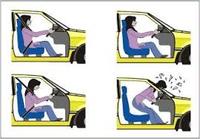
An automobile you are riding in suddenly stops, but you continue to go forward.
Newton's
1st
Law of Motion
Newton's
2nd
Law of Motion
Newton's
3rd
Law of Motion
Tags
NGSS.MS-PS2-2
4.
MULTIPLE CHOICE QUESTION
30 sec • 1 pt

The harder you hit a baseball, the faster it accelerates.
Newton's
1st
Law of Motion
Newton's
2nd
Law of Motion
Newton's
3rd
Law of Motion
Tags
NGSS.MS-PS2-2
NGSS.MS-PS2-1
5.
MULTIPLE CHOICE QUESTION
1 min • 1 pt
If a 10 kilogram object accelerates suddenly at 15 m/s2, how much force was applied to the object?
Tags
NGSS.MS-PS2-2
6.
MULTIPLE CHOICE QUESTION
30 sec • 1 pt
What is the difference between the velocity and the speed of an object?
Velocity is the change in distance over time, while speed is the change in velocity over time.
Velocity has a direction associated with it, while speed has no specific direction.
Velocity has no direction associated with it, while speed has a specific direction.
Velocity is the change in speed over time, while speed is the change in velocity over time.
7.
MULTIPLE CHOICE QUESTION
30 sec • 12 pts
Why do you lean towards the left when a car turns right
Access all questions and much more by creating a free account
Create resources
Host any resource
Get auto-graded reports

Continue with Google

Continue with Email

Continue with Microsoft
or continue with

%20(1).png)
Apple

Others
Already have an account?


