
BioPhysics B (2025) Plants Review
Authored by Nicholas Bihler
Biology, Physics
9th Grade
NGSS covered
Used 10+ times


AI Actions
Add similar questions
Adjust reading levels
Convert to real-world scenario
Translate activity
More...
Content View
Student View
40 questions
Show all answers
1.
MULTIPLE CHOICE QUESTION
1 min • 1 pt
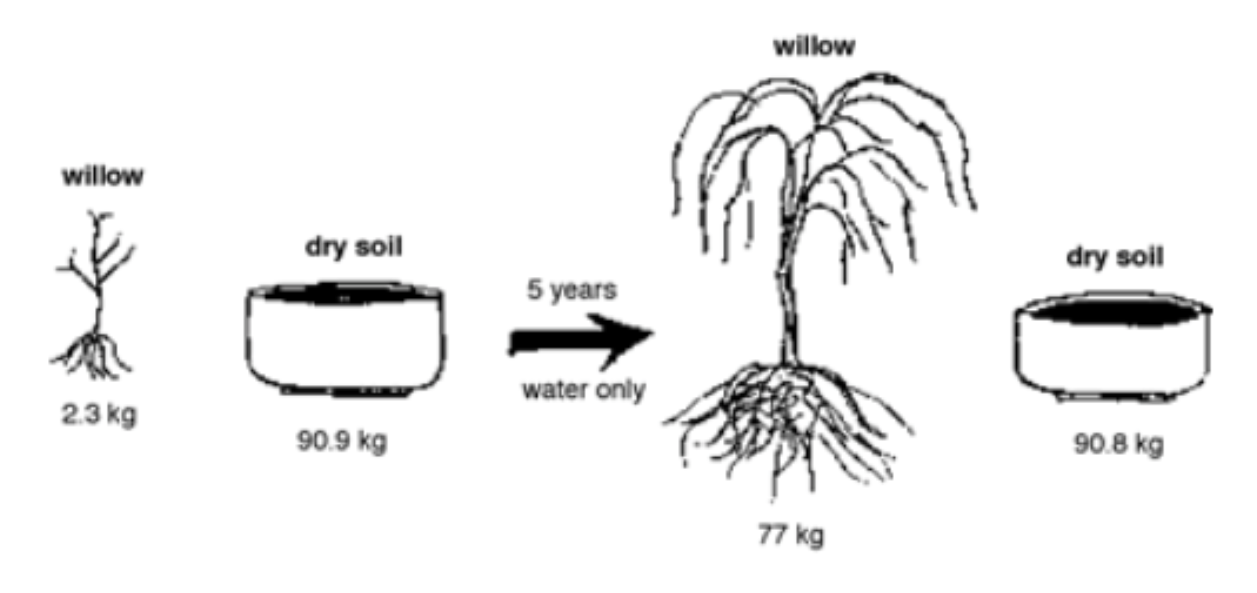
In 1634, Jan Baptist van Helmont did an experiment to try to understand where the mass of a tree comes from. He weighed a small willow tree and some dry soil. He then planted the tree and watered it each week. After 5 years he removed the tree from the pot and weighed it. He also dried the soil in the pot and weighed it. He found that the tree had gained almost 75 kg, but the soil had only lost 0.1 kg. Van Helmont concluded that the 75 kg of wood, bark and root was made out of water.
What should Van Helmont do to further test his idea that the molecules to make wood, bark, and roots come mostly from water?
Cut the tree open to see if there is water inside.
Plant another tree, but don't water it for 5 years.
Remove the water from the tree and weigh only its dry mass.
Plant many trees and give each different amounts of water.
Tags
NGSS.MS-LS1-5
2.
MULTIPLE CHOICE QUESTION
1 min • 1 pt
In 1634, Jan Baptist van Helmont did an experiment to try to understand where the mass of a tree comes from. He weighed a small willow tree and some dry soil. He then planted the tree and watered it each week. After 5 years he removed the tree from the pot and weighed it. He also dried the soil in the pot and weighed it. He found that the tree had gained almost 75 kg, but the soil had only lost 0.1 kg. Van Helmont concluded that the 75 kg of wood, bark and root was made out of water.
Van Helmont found that the tree gained about 75 kg total (dry mass would be about half that amount). Was his conclusion that "the 75 kg of wood, bark and roots was made out of water" correct?
Yes. Most of the mass of a plant comes from water.
No. Water does not add any mass to a plant.
No. Most of the mass of a plant comes from the soil.
He was partly correct. Some atoms from water get made into food for the plant.
Tags
NGSS.MS-LS1-6
NGSS.MS-LS1-5
3.
MULTIPLE CHOICE QUESTION
1 min • 1 pt
In 1634, Jan Baptist van Helmont did an experiment to try to understand where the mass of a tree comes from. He weighed a small willow tree and some dry soil. He then planted the tree and watered it each week. After 5 years he removed the tree from the pot and weighed it. He also dried the soil in the pot and weighed it. He found that the tree had gained almost 75 kg, but the soil had only lost 0.1 kg. Van Helmont concluded that the 75 kg of wood, bark and root was made out of water.
Before Van Helmont's experiment, most people thought that the mass of a plant comes from the soil. Does his experiment support that conclusion?
Yes, because the soil lost mass and the tree gained mass.
No, because the tree gained a lot more mass than the soil lost.
His experiment does not allow for any conclusions about soil.
Tags
NGSS.MS-LS1-5
4.
MULTIPLE CHOICE QUESTION
1 min • 1 pt
In 1634, Jan Baptist van Helmont did an experiment to try to understand where the mass of a tree comes from. He weighed a small willow tree and some dry soil. He then planted the tree and watered it each week. After 5 years he removed the tree from the pot and weighed it. He also dried the soil in the pot and weighed it. He found that the tree had gained almost 75 kg, but the soil had only lost 0.1 kg. Van Helmont concluded that the 75 kg of wood, bark and root was made out of water.
Van Helmont performed his experiment before the process of photosynthesis was explained. Which of the following are reactants of photosynthesis that were NOT measured by his experiment?
The mass that comes from sunlight.
The mass that comes from molecules in the air.
The mass that comes from nutrients in the soil.
The mass that comes from new atoms produced by the plant.
Tags
NGSS.MS-LS1-6
5.
MULTIPLE CHOICE QUESTION
1 min • 1 pt

How does a radish plant get carbon atoms to make fat?
Air
Water
Soil
Sunlight
Tags
NGSS.MS-LS1-6
NGSS.MS-LS1-7
6.
MULTIPLE CHOICE QUESTION
1 min • 1 pt
How does a radish plant get hydrogen atoms to make fat?
Air
Water
Soil
Sunlight
Tags
NGSS.MS-LS1-6
7.
MULTIPLE CHOICE QUESTION
1 min • 1 pt

When plants do photosynthesis, they produce as gas that is released into the air. A group of students wondered whether temperature affects the rate of photosynthesis. To answer their question, the students put a plant in five different temperatures and measured how much gas was produced by the plant when it was under a grow light for an hour. They measured the amount of gas that was produced in milliliters per hour (mL/hr). The results are shown on the points in the graph below. The students also drew a line of best fit to connect the points.
What gas was produced or given off during photosynthesis that was measured by in the experiment?
Carbon Dioxide
Water Vapor
Ethanol
Oxygen
Tags
NGSS.MS-LS1-6

Access all questions and much more by creating a free account
Create resources
Host any resource
Get auto-graded reports

Continue with Google

Continue with Email

Continue with Classlink

Continue with Clever
or continue with

Microsoft
%20(1).png)
Apple

Others
Already have an account?

